Quiz 4 Sense of Hearing
 Call Kai
 Learn
Learn Practice Test
 Spaced Repetition
 Match
Match Flashcards
 Knowt Play
1/25

There's no tags or description
Looks like no tags are added yet.
Name | Mastery | Learn | Test | Matching | Spaced | Call with Kai |
|---|
No analytics yet
Send a link to your students to track their progress
26 Terms
What is the most common difficulty among people who have hearing loss?
Hearing in noise.
Common for a person with hearing loss to listen comfortably in quiet conditions.
Noise has disproportionate impact when the listener has sensorineural hearing loss.
What is the cocktail party effect?
Ability to focus your attention on a single sound source.
Based on:
Spatial location
voice pitch
intensity (louder or softer)
Signal-to-noise ratio
the ratio of signal intensity to noise intensity
the severity of background noise is expressed as this.
Positive SNR
means the intensity of the signal is greater than the intensity of the noise.
signal 70 dB—> Noise 65 dB= SNR is +5dB
0 dB SNR
means the intensity of the signal is the same as the intensity of the noise
Signal 65 dB—> noise 65 dB= SNR is 0 dB
Negative SNR
means the intensity of the signal is less than the intensity of the noise
Signal 65dB—> noise 70 dB= SNR is -5 dB
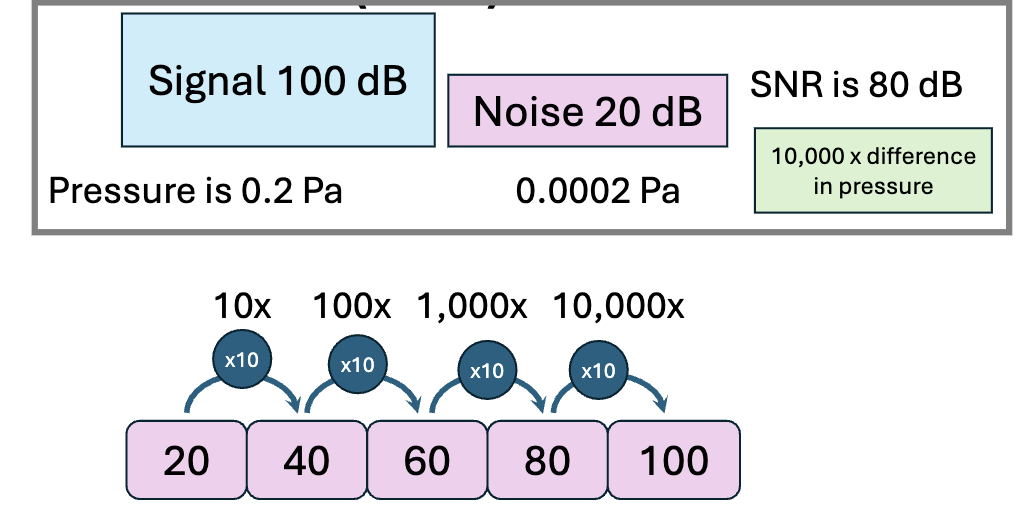
How to calculate the SNR
What appears to be a simple difference between decibel levels is actually a ratio because decibels are multiplied.
Why does sensorineural hearing loss make speech difficult to seperate from noise?
NOT merely because of reduced audibility: if it were then we’d observe difficulty in noise among people who have conductive hearing loss.
It’s mainly because of the distortion of sound resulting from damaged OHC—> this should make sense because OHCs sharpen our frequency differences.
White noise
equal energy at all frequencies.
Never used as a masker for real experiments and evaulations
Pink noise
equal energy at all octaves/more energy at low frequencies
Commonly used for real evaluations or experiments
Because it nicely reflects the natural distribution of sound energy encountered in the world.
Speech-shaped noise
long-term spectrum is the same as speech
averages the spectrum of a long stretch of speech and filters noise to have that same spectrum.
But unlike speech, it is steady in loudness (no modulations), no intelligible words (no information), and is not harmonic (no pitch)
What noise should you use to make sense of noise when it is used to represent a long chunk of speech?
speech-shaped noise
What kind of intensity does speech tend to have in a long-term sense?
Greater intensity in the low-frequency region (below 1500 Hz) which slopes down to reduced intensity in the higher frequencies.
What phonetic features are affected by noise?
Voicing: still perceivable at nearly 100% accuracy even when there is background noise.
Manner of articulation: t-s, d-z, p-f, sh-ch,= mostly still perceptible when there is background noise. Some mistakes.
Place of articulation: t-k, d-b, s-f, n-m,= most often misperceived when there is background noise. So many mistakes
Single talker
harmonic (it has pitch contour), it could contain energy that will overlap with the target speech, in terms of frequencies and modulations.
What is easier to hear a single talker with what kind of vocal tracts?
High F0= smaller vocal tract
Low F0= larger vocal tract
Why would you want speech shaped noise?
when you want a background noise that mimics the dynamic modulations of speech, offering the opportunity to glimpse the target speech.
But you don’t want to introduce complicated confusions by accidentally introducing real words.
Multi talker babble
similar to competing talker but key differences are:
not intelligible (less potential for intrusive confusing information)
Modulations (fluctuating soft/loud moments) are weaker, because the moments of silence for one talker are filled in with vocal parts from a different talker.
energetic masking
physical interference of the masker on the signal
when both sounds contain energy in the same frequencies at the same time and portions of the speech signal are rendered inaudible at the periphery
overlap in the ear
informational masking
confusions (uncertainty) b/w signal and masker
when the signal and masker are both audible but the listener is unable to disentangle the elements of the target signal from a distracter based on similarities or attentional patterns.
Confusion in the brain
Does turning up the volume up for conductive hearing loss an easy way to manage audibility?
yes
when something is obstructing the path of the sound but the cochlea (OHCs, nerves) are healthy
they provide straight amplification and difficulty is relieved.
Sensorineural hearing loss has loss at what regions?
loss is usually high frequencies
Want to amplify the higher frequencies not the lower ones but because the lower ones are also getting loud it is masking the higher frequencies. (this is a typical hearing aid design)
What is a typical challenge with amplifying high frequencies in hearing aids?
FEEDBACK Cancelation: hearing aids have special ways to detect their own output in an attempt to cancel feedback before it loops back into the microphone
Like when you cup your hand.
Hearing aids must provide more intensity boost to sounds that are soft but less to ones that already loud.
Damaged OHCs means poor frequency tuning
means expanding the range of the cochlea that is activated.
this causes lack of clarity in the sound (even if it is amplified)
Also happens when sound intensity is increased (leading to an increase in perceived loudness)
meaning loud sounds can sound very loud to a person with sensorineural hearing loss (loudness recruitment)
Speech-shaped noise has more energy in the:
low frequencies
This type of hearing loss usually results in difficulty hearing speech in noise
Sensorineural