BIOL113 L27
 View linked note
 Call Kai
 Learn
Learn Practice Test
 Spaced Repetition
 Match
Match Flashcards
 Knowt Play
1/42

There's no tags or description
Looks like no tags are added yet.
Name | Mastery | Learn | Test | Matching | Spaced | Call with Kai | Chat |
|---|
No analytics yet
Send a link to your students to track their progress
43 Terms
What is the defining characteristic of annelids?
Segmented bodies externally and internally.
How many species of annelids are there?
About 15,000 species.
What is the length range of annelids?
From less than 1 mm to 3 m.
What is the function of the coelom in annelids?
Forms a hydroskeleton for movement.
What is the term for the repetition of body parts in each segment of annelids?
Metamerism.
What are the two antagonistic muscle layers in annelids?
Circular and Longitudinal.
What is the purpose of the attachment of muscles to setae in annelids?
To aid in movement
What is the name of the three classes into which the phylum Annelida is traditionally divided?
Oligochaeta, Polychaeta, and Hirudinea.
Where do most annelids, including earthworms, burrow?
In sand and silt
How is the coelom of the earthworm partitioned?
By septa, but the digestive tract, longitudinal blood vessels, and nerve cords penetrate the septa and run the animal’s length.
What functions as a hydrostatic skeletal unit in the earthworm?
Each isolated coelomic space.
What happens when the longitudinal muscles of the earthworm are fully contracted?
Its circulars are fully stretched.
How does burrowing in the earthworm occur?
Muscles thrust the head into the soil and the bulge just behind the head creates the burrow.
What anchors the earthworm so that other parts of the body can extend during burrowing?
Setae
What are the components of the earthworm's digestive system?
Pharynx, esophagus, crop, gizzard, and intestine.
What are the components of the earthworm's nervous system involved in the coordination of locomotion?
Short nerve fibres in ventral nerve cord, stretch receptors in longitudinal muscle, and giant nerve fibres.
What type of circulatory system do annelid worms have?
Closed circulatory system.
What acts as muscular pumps to distribute blood in annelid worms?
The dorsal vessel and five pairs of esophageal vessels.
What removes wastes from the blood and coelomic fluid in annelid worms?
A pair of excretory tubes called metanephridia.
How do earthworms reproduce?;
They are cross-fertilizing hermaphrodites and exchange sperm before separating.
what are hermaphrodites?
organisms that possess both male and female reproductive organs, allowing them to produce both eggs and sperm.
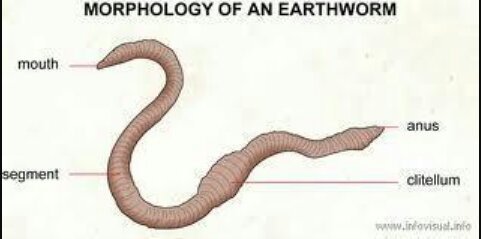
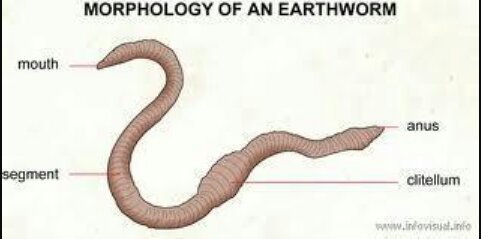
What is the special organ in earthworms that secretes a mucous cocoon?
The clitellum.
How do some earthworms reproduce asexually?
By fragmentation followed by regeneration.
What is the class of annelid worms that have paddlelike or ridgelike parapodia?
Polychaeta.
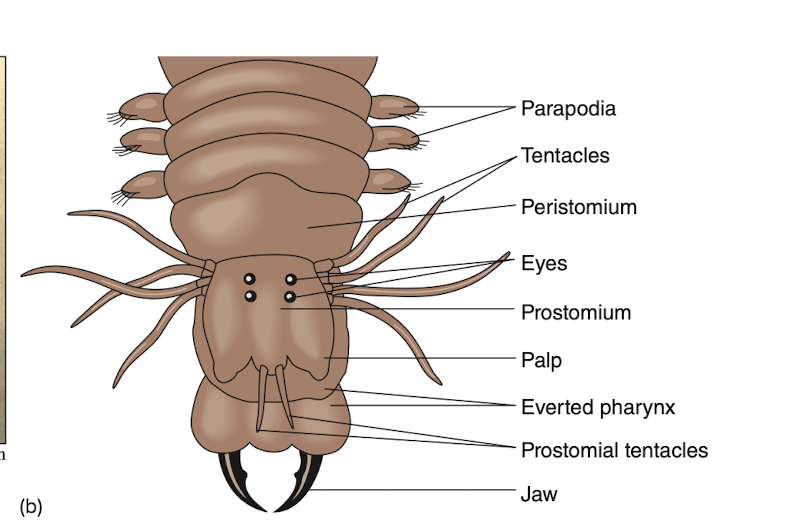
What function do the parapodia serve in polychaetes?
They function in locomotion and in many polychaetes, the rich blood vessels in the parapodia function as gills.
Where do most polychaetes live?
Most polychaetes are marine, crawling on or burrowing in the seafloor, drifting and swimming in the plankton, or living in tubes made of mucus, sand, and broken shells.
What are the feeding habits of polychaetes?
They include carnivores, scavengers, and planktivores, with some like fanworms trapping plankton on feathery tentacles.
What are the antagonists of the left-hand longitudinal muscles in each segment?
The right-hand longitudinal muscles.
What happens when the longitudinal muscles of one side are fully contracted in a segment?
The longitudinal muscles of the other side are completely stretched and the parapodium is at maximum protrusion.
In rapid crawling, what is the usual interval between segments in the same phase of contraction?
Usually from eleven to fifteen segments in length.
What is the interval between segments in slow walking?
Between six and eight segments long.
Where do the majority of leeches inhabit?
Fresh water.
What is the size range of leeches?
From about 1 to 30 cm.
What do many leeches feed on?
Other invertebrates.
How do some blood-sucking leeches feed on other animals?
By attaching temporarily and using bladelike jaws to slit the host’s skin or by secreting enzymes that digest a hole through the skin.
What does the leech secrete into the wound while feeding?
Hirudin, an anticoagulant.
What were leeches frequently used for by physicians until this century?
Bloodletting.
For what purposes are leeches still used in modern times?
Treating bruised tissues and stimulating the circulation of blood to fingers or toes that have been sewn back after accidents.
How do leeches attach and move using looping movement?
Attaches by posterior sucker, extends body, attaches anterior sucker, repositions posterior sucker, contracts and shortens body pulling towards anterior sucker.
What is the evolutionary significance of the coelom?
it provides a hydrostatic skeleton that allows new and diverse modes of locomotion, body space for storage and organ development, and cushions internal structures.
What does segmentation allow in Annelida?
A high degree of specialization of body regions, with groups of segments modified for different functions.
What are the characteristics of leeches in terms of segmentation and setae?
Leeches have no obvious segmentation and no setae.
What type of muscles are well developed in Polychaeta?
Longitudinal muscles and parapodia.