Bio Midterm 3 (gene regulation + virus)
 Call Kai
 Learn
Learn Practice Test
 Spaced Repetition
 Match
Match Flashcards
 Knowt Play
1/44

There's no tags or description
Looks like no tags are added yet.
Name | Mastery | Learn | Test | Matching | Spaced | Call with Kai |
|---|
No analytics yet
Send a link to your students to track their progress
45 Terms
operon
a cluster of genes organized into a single transcription unit and its associated regulatory sequences
Regulatory sequences
DNA sequences to which specific proteins bind to control the transcription of the gene or genes.
regulatory protein
a DNA-binding protein that binds to a regulatory sequence and affects the expression of an associated gene or genes
Allosteric inhibitors
Molecules that bind to a protein at a site other than the active site (allosteric site)
Cause a shape change that reduces or shuts down activity
Allosteric activators
Bind at an allosteric site
Cause a shape change that increases activity
Polyribosomes
Multiple ribosomes translating a single mRNA at the same time
Allows bacteria to make proteins very quickly
transcription and translation can occur basically simultaneously
what makes the nucleosomes bind DNA less tightly
Acetylation
Epigenetics
the study of how gene expression is changed by chemical modifications to chromatin that DO NOT IMPACT gene sequence
DNA methylation
Methyl groups can be reversibly added to cytosine bases. These turn gene expression off They can be removed to turn expression back on
Genomic imprinting
an epigenetic phenomenon is which the expression of a particular allele for a gene depends on the parent its inherited from. if an allele you got from mom was methylated and thus silenced in mom, that same allele is likely methylated and still silenced in you to this day.
for Tryptophan (trp) operon, Each segment (gene) of mRNA encodes for
an enzyme that catalyzes the reaction to make Tryptophan
Repressible operon
something that is usually ‘on’ and can get turned ‘off’ (aka trp operon)
Inducible operon
something that is usually ‘off’ and get activated ‘on’ (aka lac operon)
Negative regulation
keeping or turning a gene “off”
Positive regulation
turning a gene “on”
repressor
turns off operons, to stop enzyme production
inducer
turns "on" specific operons, allowing cells to produce enzymes needed for metabolic pathway
Regulation at the DNA structural level
How tightly bound DNA is around nucleosomes
DNA methylation (in promoter area)
Transcription factors (specifically its role in gene regulation)
These proteins participate in weak interactions (non-covalent interactions) with DNA; This is what “tells” a transcription factor what DNA sequence to bind to; some activate (meaning tells RNA poly to come) while some silence gene expressionn (blocks RNA poly)
combinatorial TF-based regulation
different combinations of TFs bind to and regulate the promoters of different genes
Hormone cascades
The idea is that one hormone signal can coordinate many genes at once by activating shared TFs;
A single hormone signal can activate one or more transcription factors, and those TFs can simultaneously switch on a whole set of related genes—thanks to shared DNA binding sites and combinatorial control.
Long noncoding RNA (lncRNA)
RNA greater than 200 bases in length, They can act like transcription factors They can bind to mRNA’s themselves and prevent or promote translation; does X chromosome inactivation (Barr bodies)
Xist
the name of the lncRNA that silences an X chromosome in female placental mammals. It functions by completely coating the chromosome and epigenetically silencing them
UTR
untranslated region This sequence does not get translated by the ribosome
Regulation at the translation level
3’ UTR and polyA tail largely influence mRNA half-life
Sequences in the 5’ UTR and 3’ UTR, and length of polyA tail influence how well the small ribosomal subunit, and therefore how quickly translation initiates
RNA interference (RNAi)
Rate of protein degradation
RNA interference (RNAi)
ncRNAs called miRNA or siRNA. (These are shorter than lncRNA)
miRNA
molecules are transcribed from an organism’s genome; usually does not perfectly base pair with target mRNA transcripts —> represses translation
blocks translation
siRNA
molecules are made in a lab or came from viruses; usually perfectly base pairs with target mRNA transcripts• Generally this results in them being cleaved then degraded
it destroys the mrna message completely.
Rate of protein degradation
When a cell wants to get rid of a protein, it covalently attaches a ubiquitin tag. Ubiquitin Ubiquitin tags recruit proteasomes, which break down the tagged protein
Regulation at the transcription level
transcription factors on promoter activate/silence gene expression
combinations of general transcription factor (TF)
Hormone cascades
Long noncoding RNA
Rhinovirus
Cold
Influenza
flu
Herpes
mono
virus
a small biological particle that can infect the cells of a living organism; NOT alive at the cellular level, but they share certain characteristics with living organisms.
virion
viral particle
Capsid
The protective layer of protein that surrounds the nucleic acid core of a virus in free form; also known as a coat.
Polyhedron
Coat proteins that form triangular units that fit together like the parts of a geodesic sphere.
Helix
Protein subunits of the coat that assemble in a rodlike spiral around the genome
Envelopes
A surface membrane derived from its host cell
Tail
The structure attached to one side of the polyhedral head
Virulent bacteriophages
kill their host cells during each cycle of infection (lytic cycle)
T-even bacteriophages T2, T4, and T6
virulent, complex viruses that infect E. coli
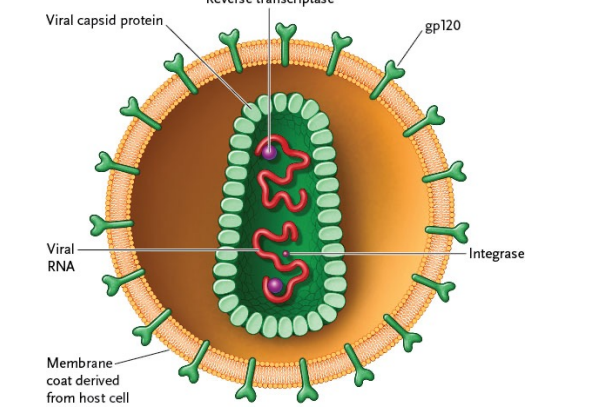
retrovirus
an enveloped virus with an RNA genome that replicates via a DNA intermediate
latent phase
he virus remains in the cell in an inactive form – the viral nucleic acid is present in the cytoplasm or nuclear DNA, but no complete viral particles or viral release can be detected.
At times, particularly during periods of metabolic stress, the virus may become active – viral DNA is replicated in quantity, capsid proteins are made, and completed viral particles are released from the cell.
Properties of HIV
HIV infects particular cells of the immune system.
Mild initial symptoms disappear as antibodies appear in the body and the number of viral particles drops.
Although an infected person may appear healthy for years, HIV spreads steadily to other immune system cells.
Ultimately, the body’s immune response is destroyed, making the HIV-infected person susceptible to other infections.