bio2 exam 4
 Call Kai
 Learn
Learn Practice Test
 Spaced Repetition
 Match
Match Flashcards
 Knowt Play
1/101

There's no tags or description
Looks like no tags are added yet.
Name | Mastery | Learn | Test | Matching | Spaced | Call with Kai | Chat |
|---|
No analytics yet
Send a link to your students to track their progress
102 Terms
human microbiome
the collection of microbes found in or on the human body
human virome
entire population of viruses present in and on human body
probiotic
live microbes applied to or ingested into the body, intended to exert a beneficial effect
prebiotic
a substance that passes undigested into the colon and stimulates the growth and/or activity of certain types of bacteria
Phage therapy
treatment of bacterial diseases using bacteriophages specific to a particular bacterium
resident microbiota
species of microbes that are always present on or in another organism in a specific area
transient microbiota
the microorganisms that are present temporarily in an area that do not permanently colonize
Sterile body parts examples
Blood, kidneys, liver, muscles, bone, brain, spinal cord, lower respiratory tract
Bacteriophages outnumber bacteria:
10:1
What role do bacteriophages play in microbial populations?
Regulate them by killing over growth, gene transfer
Advantage of Phage therapy
Alternative to using antibiotics to kill only specific bacteria without harming residents
Vaginal birth obtain initial microbes from
the vaginal canal
C-section birth obtain initial microbes from
gut/skin bacteria, environment
Advantage of vaginal birth
baby has more diverse microbiome
Disadvantage of c-section birth
baby tends to be overweight (fermentation)
Bifidobacterium
Found in GI tract of breast-fed infants; uses oligopolysaccharides for food
Benefit of bifidobacterium
Increased immunity, helps digest breast milk
In the twin mice study, what was transferred to germ-free mice?
Feces/gut microbiota of the lean and obese twins
What happened to the mice receiving microbes from obese twins?
increased number of firmicutes and methanogens made them grow obese as well
What happened to the mice receiving microbes from lean twins?
increased number of bacteriodetes, remained lean
Gut-brain axis
The affects of neurotransmitters, especially serotonin, based on gut microbiota health
Dietary fiber
nondigestible carbohydrates that feed gut microbiota
Short chain fatty acids
acetate, propionate, butyrate; result from gut bacteria
benefits of short chain fatty acids
reduces inflammation, helps colon, improves metabolism and immune health
infection
entry, attachment, and colonization of a specific body part by a specific bacteria
pathogen
nonresident microbe that if allowed to colonize causes disease
Opportunistic pathogen
takes advantage of a weakened host (eg immunocompromised patients)
exogenous infection
infection originating outside the body
endogenous infection
infection originating from inside the body (normal flora)
Focal infection
infection that began as a local infection but spreads to another part
Order of infection
Entry, Attachment, Colonization, Invasion/Immune evasion, Damage, Transmission
Examples of attachment
Fimbrae, Flagella, Adhesion Proteins, Capsules
Examples of entry
Oral, ocular, skin abrasion, pores, urogenital tact, respiratory
Examples of colonization
Forming biofilm
Quorum
Population threshold that when met signal rapid genetic change across the population
Quorum sensing
The ability of bacteria to sense the number of bacteria, share information, and adjust their gene expression
Examples of immune evasion
Viruses that envelop themselves in host cell membranes
Examples of damage
Release of toxins, enzymes that damage the host
virulence
Degree of damage or risk of life of an organism
virulence factor
any characteristic or structure of the microbe contributes to its ability to establish itself in the host and cause damage
Examples of virulence factors
Adhesion factors, exoenzymes, toxins, and immune evasion
The portal of entry of Streptococcus pneumoniae
upper/lower respiratory tract
Attachment mechanism of Streptococcus pneumoniae
Sticky capsule, fimbrae
Virulence factors of Streptococcus pneumoniae
- IgA Protease
- Penicillin Resistant
- Anti-phagocytic capsule
Portal of entry of salmonella typhi
fecal-oral route
Attachment mechanism of salmonella typhi
Fimbrae, flagella
Virulence factors of salmonella typhi
Capsule, Type 3 secretion
Infectious dose
minimum number of microbes required for infection to proceed
Lethal dose
minimum number of microbes required to kill host
Endotoxin
A toxic, heat stable component of the outer membrane of certain gram-negative bacteria that is released only when the bacteria die.
Exotoxin
a toxin released by a living, Gram-negative or positive, bacterial cell into its surroundings when it reachs quorum.
Botulinum toxin
Toxin produced by the bacterium Clostridium botulinum that produces tetanus.
tetanospasmin toxin
Toxin produced by the bacterium Clostridium tetani that produces tetanus.
Physiological effects of botulinum toxin
Flaccid paralysis, muscle weakness, drooping. Can reach vital organs like the lungs and disable them
Physiological effects of tetanospasmin
Spastic paralysis, lock jaw, high blood pressure
Mechanism of action of botulinum toxin
prevents acetylcholine release --> no muscle contraction --> paralysis
Mechanism of action of tetanospasmin
prevents GABA and glycine from signalling motor neurons to stop signalling -> acetylcholine continues to release -> muscle cannot relax
Acute infection
symptoms develop and resolve rapidly
Chronic infection
progress and persist over a long period of time
Subclinical infection
an infectious disease not detectable by the usual clinical signs
Latent infection
infection in which the infectious agent is present but not causing symptoms
opportunistic infection
Infections that occur when the body's defenses are weakened
systemic infection
infection spreads to several sites and tissue fluids usually in the bloodstream
local infection
pathogens are limited to a small area of the body
Plate count
Counts all living cells
Direct microscopic count
Counts all visible cells
Spectrophotometer
measures turbidity
Membrane filtration
used for counting in dilute samples
OD450
Optical density measurement at 450 nm wavelength.
Absorbance
The amount of light absorbed by a sample
Lag phase
intense activity preparing for population growth, but no increase in population
Log phase
The period of exponential growth of bacterial population.
Stationary phase
period of equilibrium; microbial deaths balance production of new cells
Death phase
population is decreasing at a logarithmic rate
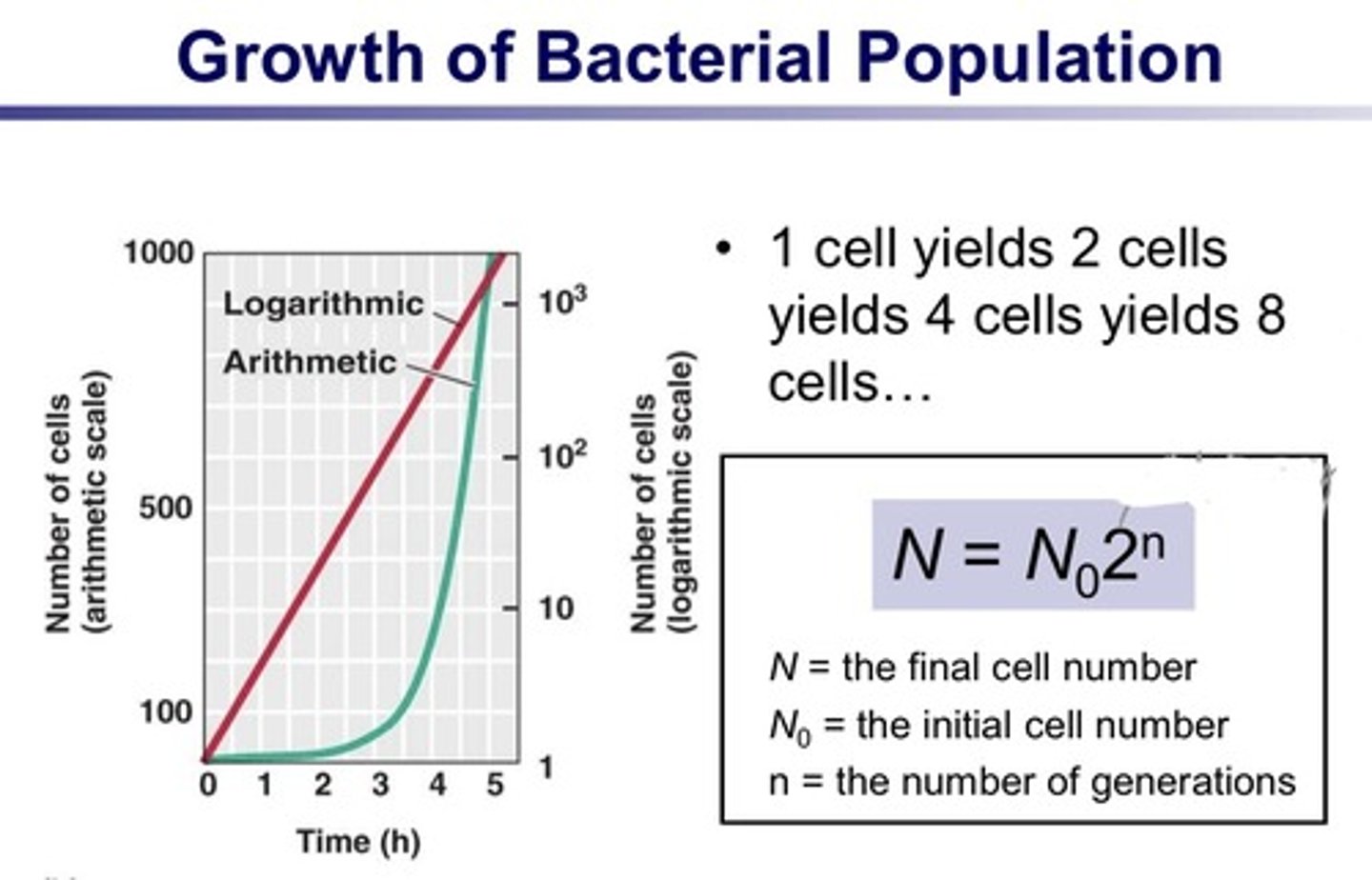
Formula for bacterial growth
Nf = (Ni)2^n
Obligate aerobe
requires oxygen
Obligate anerobe
organism that cannot live in the presence of oxygen
Faculative anerobe
uses oxygen but can grow without it
Microaerophile
requires a small amount of oxygen but won't grow at normal atmospheric levels
aerotolerant anaerobes
do not utilize oxygen but can survive and grow in its presence
psychrophile
organism that grows at temperatures of -15 °C or lower
mesophile
bacteria that prefers moderate temperature and develops best at temperatures between 25 C and 40 C
thermophile
an organism that has adapted to living in very high temperatures (heat), such as bacteria or algae
hyperthermophile
organism that grows at temperatures between 80-122 °C
sterilization
kills all microbes including endospores
disinfection
kills vegetative cells but not endospores
sanitization
both physically removes or kills some microbes
antisepsis
kills some organisms on living things
degerming
physically remove germs from living things
microbistatic
inhibits the growth of microbes
microbicidal
kills microbes
Mechanism of action of alcohol
destroys cell walls of bacteria
Mechanism of action of soap
destroys cell wall, inhibits ability for bacteria to adhere to a surface
Mechanism of lysol
destroys cell walls but remains on a surface for a long time
Mechanism of boiling
coagulates, denatures proteins
Mechanism of UV light
Forms T=T dimers in nucleic acids
Mechanism of steam sterilization
denatures proteins, destroys membranes
Examples of extremely resilient microbes
Endospores, prions
Examples of moderately resilient microbes
Protozoan cysts, mycobacteria
Examples of weakly resilient microbes
Enveloped viruses, vegetative bacteria