Electricity
 Call Kai
 Learn
Learn Practice Test
 Spaced Repetition
 Match
Match Flashcards
 Knowt Play
1/105

Earn XP
Description and Tags
Grade 9
Name | Mastery | Learn | Test | Matching | Spaced | Call with Kai |
|---|
No analytics yet
Send a link to your students to track their progress
106 Terms
Electricity
The movement or flow of electrons
Law of Charges
Like charges repel and unlike charges attract
What do uncharged or neutral atoms do?
They attract others
How does static work?
A build-up of charges causes unbalances and electrical discharge causes the shock
Electrical Discharge
The rapid re-balancing of charges
When a balloon and hair have static electricity how is the balloon charged?
The balloon has a negative charge while the hair has a positive charge
How is electricity like water flowing in a waterfall?
Current- The water
Voltage- The height of the waterfall
Resistance- The rocks (slows down the water)
Current
The continued flow of electrons
What is the relationship between voltage and electrons?
Voltage is the force of push on the electrons moving through a circuit
Resistance
The difficulty or slowing of a current
Grounding
We use electrons to move through wire to the ground (Earth can absorb re-donate electrons without becoming unbalanced)
Conductor
Any material that can allow transfer and passage of electrons
Examples of good conductors
Gold, aluminum, silver, copper
How do conductors work?
They hold their electrons loosely and can allow electron flow
What do we use conductors for?
To make wires and things that need electricity
Easy electron flow=
Low resistance
Semi-Conductors
Metalloids
Medium resistance
Used in energy conversions
(e.g. LED lights, microcontrollers, transistors)
Insulator
Any material that blocks the transfer and passage of electrons
How do insulators work?
They hold electrons tightly
What do we use insulators for?
To wrap wires and block harmful flow
Examples of insulators
Wool, rubber, plastic, wood, paper
Circuit
Allows the passage of electrons through a specified path
Open circuit vs Closed circuit
An open circuit does not allow electron flow, a closed circuit does
Series Circuit
Current flows through each component one at a time in a series
Current always stays the same BUT voltage lowers across each load
-Easier to construct
-Fewer materials
-If one thing breaks nothing works
Parallel Circuit
Current passes through multiple paths (current is divide between the different paths)
Voltage is constant across each load
-Each component can be controlled individually
-More energy is required
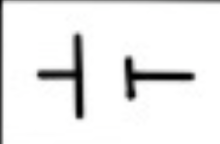
Cell
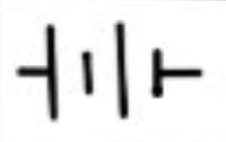
2-Cell (battery)
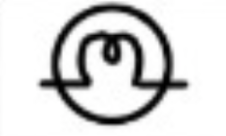
Light bulb
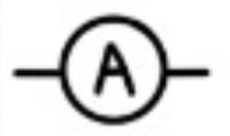
Amperemeter/ammeter
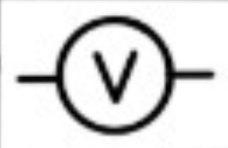
Volt meter
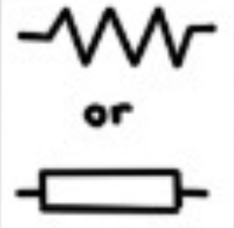
Resistor
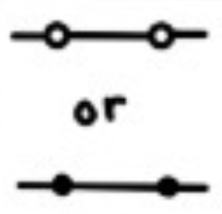
Closed switch
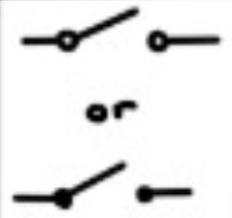
Open switch
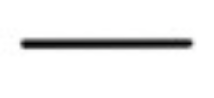
Conductor (straight line)
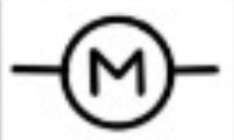
Motor
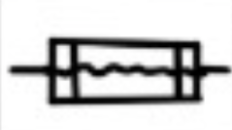
Fuse
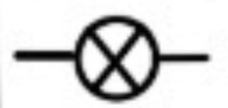
General load (e.g. light, heater, speaker, etc.)
In which directions do electrons flow to and from in a circuit?
From the negative terminal to the positive terminal through the circuit
Voltage
The difference in potential energy
What units is voltage in?
Volts (V)
How does voltage have to be measured?
Voltage must be measured between 2 different points on a circuit (across something)
Where is there a decrease or increase in volts across a circuit?
Increase in volts across a cell ro battery and a decrease across charges
What is the unit and symbol for current?
Unit: Amps (A)
Symbol: I
Resistors
Slows down the flow of the current
What is the unit for resistance?
Ohms (Ω)
Ohm’s Law
For a given conductor, the ratio if voltage to current (v/I) is CONSTANT
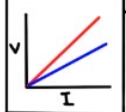
What is this?
The relationship between voltage and current
Typically, high voltage= high current
What is the formula for resistance?
R= V/I
What is the formula for voltage?
V= R x I
What are some factors that affect resistance?
Material
Length
Temperature
Diameter
How are home circuits wired?
In parallel- can use a lot of energy which can be a fire hazard
Fuses
A thing metal strip, all fuses have a low melting point and when there is too much heat the fuse will break first
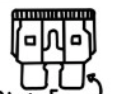
What is this?
A blade fuse
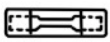
What is this?
A cartridge fuse
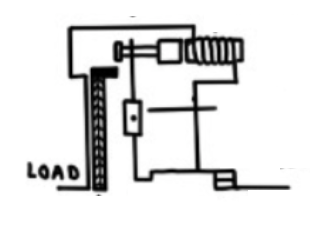
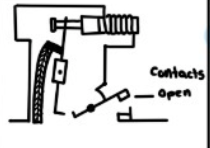
What is this and how does it work?
Bimetal Strip, When the circuit is not overheated, the strip is straight but if the circuit does overheat the strip bends flipping a switch and disrupting the circuit
Efficiency
the measure of how much energy is used and turned into useful energy
What is the formula for efficiency?
E= O/I x100
Why is tungsten used as a filament in incandescent light?
It resists the flow of energy
What do variable resistors do?
They control the flow of current (amount)
How can the resistance of a wire be reduced?
By increasing the diameter of the wire or decreasing the length
mA
milli Amps (0.001 Amps)
What is the relationship between generators and motors?
They are opposite, generators get electric energy from kinetic energy and motors get kinetic energy from electrical
Alternating current (AC)
Electrons flow in alternating directions and a regular pattern
Direct Current (DC)
Electrons flow through a circuit in one direction (continuous or in pulses)
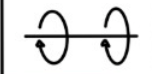
Use this diagram to explain electromagnetism
A magnetic field forms around metal when a current passes, it becomes electromagnetic (the more coils in the metal and the high voltage/current the better)
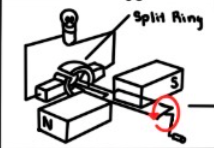
What is this?
A DC generator
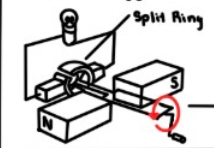
Explain the diagram
A DC Generator
SPLIT ring causes circuit to break so that electrons pulse in one direction
The wires move back and forth between magnets
We rotate the crank
How does an AC generator work?
About the same as a DC one but with either not split ring or two split rings
Explain how a St. Louis motor works
A motor works when an electrical circuit is complete and electrons flow throughout. A commutator begins to spin and creates electromagnetism, the field magnets are repelled by the permanent ones and eventually when it reaches the split in the ring the poles changes and that forces of repulsion and attraction continues.
Electrochemical cells
Cells that transform chemical energy into electrical energy
What do two cells contain?
2 electrodes (cathode and anode)
Electrolyte (ionic compound/acid)
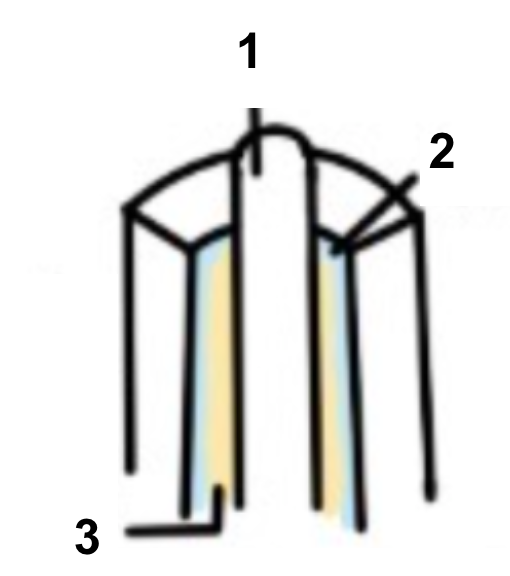
Label the diagram
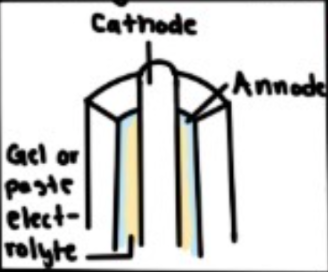
Describe the properties of a dry cell
Safer
More portable
Barely leaks unless electrode degrades
Describe the properties of a wet cell
Easily spills
Can be corrosive when it leaks
Easy to happen
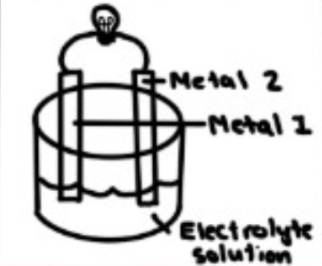
What is this?
A wet cell
Electro chemical cells work best when?
More surface area of electrodes in the electrolyte
High concentration of electrolytes
2 different metals for electrodes
Electrochemical cells do not work well when?
2 of the same metal
Molecular solution
How do electrochemical cells work?
Electrons flow from the anode to the cathode THROUGH the conductor (eventually the anode gets “used up”)
Rechargeable cells
We feed electrons to the cell, as we use an anode that can be “rebuilt” and can be used again (still not a renewable resource)
Non-rechargeable cells
Most cells, once the anode is used up the cell is useless
Microbial Fuel Cells
Different microbes can emit/release electrons when they consume/process nutrients in the soil (atoms, compounds, ions)
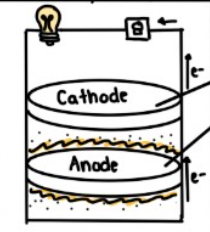
Explain this diagram
Electrons from the cathode come through the circuit, microbes process nutrients in the anode and deposit electrons for the circuit.
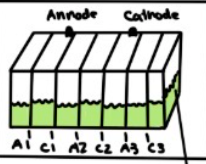
What is this?
A car battery
Wha are the properties of a car battery?
Lead battery
Made of the element of lead
Uses a strong acid
Unsafe and corrosive
Renewable energy source
Can be used/regenerated in a sustainable manner
Solar energy
We use photo-electric cells, sensitive to radiation energy (Radiation → Electricity)
Cons of solar energy
Not always reliable (depends on the weather)
Space (solar farms)
Expensive and insufficient
Wind turbines
The wind will push a turbine, which is a generator
Cons of wind turbines
Kills birds and bugs
Not always reliable (depends on weather)
Hydropower
Moving water will push a turbine, which is a generator
Cons of hydropower
Hazardous to marine life
Space
Flooding concerns
Geothermal energy
The use of heat from Earth’s mantle (from 30m to 120m)
Cons of geothermal energy
Only viable where we can dig and access geothermal vents (not an issue in Alberta)
Biomass/Bio fuel energy
“Burning” (Incinerating) organic matter to get energy
Cons of biomass/ bio fuel
Pollution/danger if we mess up
Expensive and hard
Nuclear power
A reactor performs fusion and fission to heat water, which creates steam which rises and spins a turbine
Cons of nuclear power
Space
Nuclear meltdown/fallout concerns
Concerns with waste management
Environment and health
SUSTAINABLE BUT NOT RENEWABLE
How can we increase sustainability?
Turn off devices
Wear a sweater or blanket
Use mass transportation
Insulate home
Double paned windows
Non-Renewable Energy Resources
These sources either cannot be replenished sustainability or at all
Coal
Produced from fossilized plants and trees from roughly 300 million years ago- abundant in Alberta (cheap and our primary energy source) AKA “dirty” energy