Xray class exam2
 Call Kai
 Learn
Learn Practice Test
 Spaced Repetition
 Match
Match Flashcards
 Knowt Play
1/10

There's no tags or description
Looks like no tags are added yet.
Name | Mastery | Learn | Test | Matching | Spaced | Call with Kai |
|---|
No analytics yet
Send a link to your students to track their progress
11 Terms
GH jt surfaces are ___mm apart (>___ mm= effusion and <___ mm= OA)
GH jt surfaces are 5 mm apart (>5 mm= effusion and <5 mm= OA)
Acromiohumeral joint space of ___mm or less is indicative of full thickness RTC tear
Acromiohumeral joint space of 6mm or less is indicative of full thickness RTC tear
AC jt space (0.____-0.___)
AC jt space (0.3-0.8)
Coracoid to clavicle is ___-___cm
Coracoid to clavicle is 1-3cm
Scap fx type 1
Type 1: scapular body
Scap fx type 2
Type 2: apophyseal fx of acromion and/or coracoid
Scap fx type 3
Type 3: fx of superolateral angle; glenoid neck and fossa
Carrying angle (___-___ degrees; if more than ___= cubitus valgus)
Carrying angle (5-15 degrees; if more than 15= cubitus valgus)
Radial articular/inclination angle (ulnar slant of radius)= ____-____ degrees
Radial articular/inclination angle (ulnar slant of radius)= 15-25 degrees
Ankle sprain normal angle and abnormal angle
Normal angle=5 degrees
Anything more than 10 is abnormal and indicates lateral ligament pathology
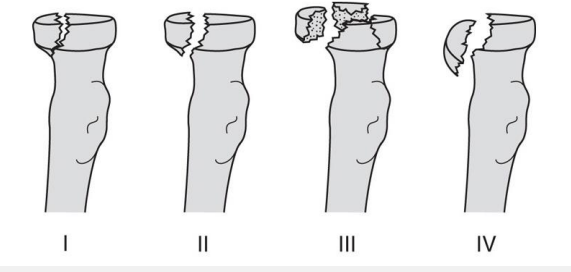
Radial head dislocation types 1-4
Type 1 = undisplaced
Type 2 = displaced with separation of fragment
Type 3 = comminuted fractures
Type 4 = radial head fracture associated with elbow dislocation