moral development dev psych
 Call Kai
 Learn
Learn Practice Test
 Spaced Repetition
 Match
Match Flashcards
 Knowt Play
1/21

There's no tags or description
Looks like no tags are added yet.
Name | Mastery | Learn | Test | Matching | Spaced | Call with Kai |
|---|
No analytics yet
Send a link to your students to track their progress
22 Terms
Moral Judgement
Research questions on moral development
▪ How do children think developmentally about moral issues?
▪ Does children’s reasoning about moral issues relate to their behavior?
▪ How early do caring and sharing or aggression and cruelty first appear in children?
▪ What factors contribute to differences among children in helpful and caring behaviors or antisocial behaviors?
▪ Can steps be taken to help children develop caring and helpful behaviors and reduce the likelihood of their developing immoral or antisocial behaviors?
Piaget's Theory of Moral Judgment
Piaget defined two stages in children’s moral reasoning (The Moral Judgment of the Child, 1932/1965).
Moral reasoning changes from rigid acceptance of rules of authorities to modifiable moral rules related to social interactions
The stage of heteronomous morality
Characteristic of children who have not achieved concrete operation
Younger than 7 years
Rules and duties to others regarded as unchangeable due to social and cognitive influence
Rigid acceptance of authorities’ rules
Qualitative change: a child's fundamental way of thinking, perceiving, and interacting with the world changes entirely as they grow
Piaget’s Transitional Period
Children reaching concrete operational stage of cognitive development
▪ Ages 7 to 10 years
▪ More interactions with peers
▪ Developing ability to perceive other’s perspectives and cooperate
Piaget’s autonomous morality
Rules based on social interaction & social agreements of groups
Ages 11 to 12 years
Moral relativism—no longer accept blind obedience to authority
Rules can be changed
Critique of Piaget’s theory
▪ Theory supported by research
▪ However, little support that peer interaction stimulates moral judgment
▪ Young children (even <2) incorporate intentionality into their judgements when it is made more obvious.
Kohlberg's Theory of Moral Reasoning
Kohlberg was interested in sequences through which children’s moral reasoning:
Develops over time
Proceeds through specific stages
Discontinuous and hierarchical
Advanced thinking with each new stage
Heinz dilemma used to assess moral reasoning
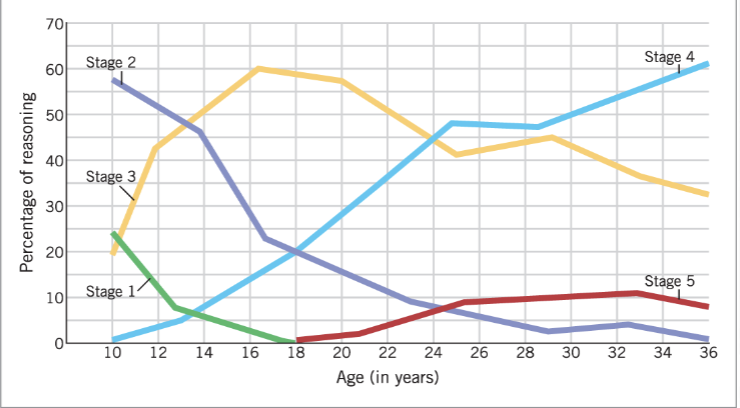
Kohlberg's Levels and Stages of Moral Reasoning
Preconventional level: self-centered, focusing on getting rewards and avoiding punishment
▪ Stage 1: punishment and obedience orientation
▪ Stage 2: instrumental and exchange orientation
Conventional level: centered on social relationships, focusing on compliance with social duties and laws
▪ Stage 3: mutual interpersonal expectations, relationships, and interpersonal conformity
▪ Stage 4: social system and conscience orientation
Postconventional level: centered on ideals, focusing on moral principles
▪ Stage 5: social contract or individual rights orientation
▪ Stage 6: universal ethical principles
Mean Percentage of Moral Reasoning at Each Stage for Each Age Group
Critique of Kohlberg’s theory
▪ Theory useful in understanding contribution of cognitive processes to moral behavior
▪ However, not sufficient distinction between true moral issues and social convention
▪ Reasoning not continuous
▪ Theory based on studies of boys
Gilligan: Gender and Moral Development
Gilligan’s theory
Differences in the way males and females reason morally because of the way they are socialized
Males tend to value principles of justice and rights, whereas females value caring, responsibility for others, and avoidance of exploiting or hurting others
Would cause males to score higher on Kohlberg’s hierarchy than others.
Inconsistent - boys do not score higher than girls
Consistent - girls do tend to exhibit more of the sort of moral reasoning
Gilligan suggested they would
Social Domain Theory of Moral Development
Growth in moral reasoning occurs through gradual changes based on child’s social interactions with peers and adults and through direct socialization from parents.
Differences in moral judgment are understood to result from differences in environments. Influence and relationships are bidirectional.
Contemporary theory: Morality develops continuously
Morality is socialized by parents, peers and other individuals
Argues that children must understand principles in 3 domains:
Moral Domain: Grasp universal concepts of right and wrong, fairness, justice, etc (ex: Cannot steal another child’s toy)
Societal Domain: Concepts regarding rules and conventions in a society (ex: manners, appropriate clothing for contexts)
Personal Domain: Individual preferences rather than right/wrong (ex: choice of friends)
Support for SDT has grown in last 20 years such that children regularly use and distinguish between these domains
By age 3: children believe that violations of moral rules are worse than are violations of social conventions.
By age 4: children believe that moral transgressions are wrong
Cultural Influences on Morality
Moral, societal and personal judgments are found across cultures and children’s ability to distinguish is constant
Some types of judgment (e.g., fairness) are fairly universal
Specific issues in societal and personal domains differ:
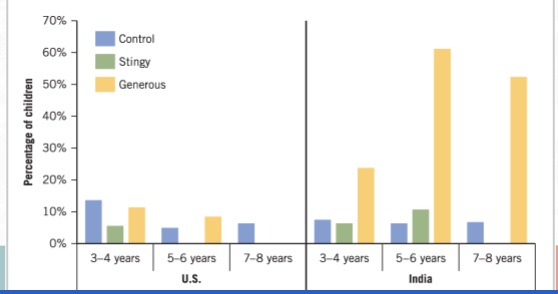
Children in India believe they have moral obligation to care for parents, friends and strangers, children in the U.S. see it as matter of personal judgment (Miller et al., 1990)
Candy experiment illustrates stronger parental influence in India than U.S.
The Development of Conscience
Conscience
An internal regulatory mechanism that increases the individual’s ability to conform to standards of conduct accepted in his or her culture
Restrains antisocial behavior or destructive impulses
Promotes children’s compliance with adults’ rules and standards and adherence to cultural standards
Fosters prosocial behavior
Conscience develops early
By age 2, children recognize moral standards; they exhibit guilt when they do something wrong.
With age, children take on their parents’ moral values.
Temperaments matter—fearless children show less guilt than do fearful children—even with gentle discipline
Prosocial Behavior
Empathy: an emotional response to another’s state or condition that reflects other person’s state or condition
Sympathy: feeling of concern for another in response to other’s emotional state or condition
Voluntary behavior intended to benefit othersBoth empathy and sympathy require taking others’ perspective
Some elements of perspective taking emerge early
14 mo become distressed when others are distressed
18-25 mo toddlers will share objects w/ adult who has been harmed
Children are less able to act on feelings of sympathy until 3 years
Hamlin (2013) Helping or Hindering Puppet Studies
did an experiment where she showed babies a video of a shape trying to climb a hill. One shape would come along to help the climber the hill, while another would hinder the climber's progress. Hamlin found that babies preferred the helper shape
The Origins of Individual Differences in Prosocial Behavior
Biological factors
Humans have a biological (evolutionary) predisposition for prosocial behavior; important for the survival of the species.
Genetic factors
Identical twins are more similar in prosocial behavior than are fraternal twins.
Specific genes identified that might contribute to individualized, prosocial tendencies
Temperament contributes to individual differences in social cognition
Parents socialize prosocial behavior in children by
Modeling and teaching prosocial behavior
Arranging opportunities for their children to engage in prosocial behavior
Disciplining their children and eliciting prosocial behavior from them
The Development of Antisocial Behaviors
Aggression: behavior aimed at harming or injuring others
▪ Instrumental aggression: aggression motivated by the desire to obtain a concrete goal
▪ Relational aggression: intending to harm others by damaging peer relationships; leads to conduct disorders
▪ Individual child use of both kinds of aggression tends to be consistent across childhood
The Development of Aggression
Aggressive behavior occurs before 12 months of age, usually over objects; it does not involve hitting (e.g., tugging at an object)
By 18 months, physical aggression is seen.
Physical aggression decreases and verbal aggression increases when language development and control over emotions and actions begin
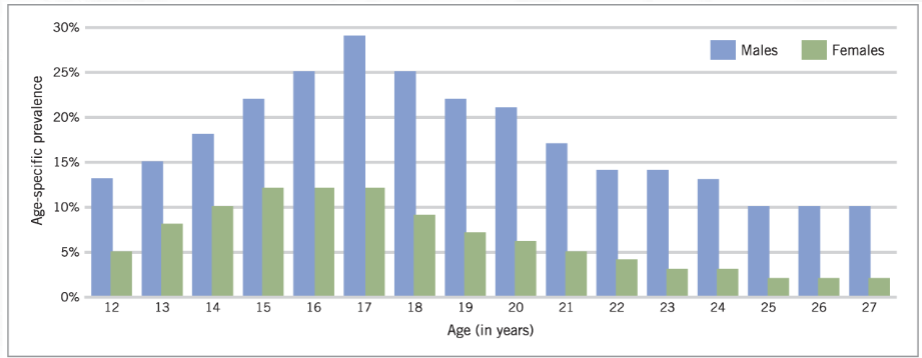
Prevalence of Self-reported Violent Crime for Males and Females at Different Ages
The Origins of Aggression
Consistency between aggressive behavior in childhood and adolescence
Biological correlates
Genetic risks, heredity, temperament
Neurological differences
Hormonal
Social cognition
Aggressive children tend to interpret the world through an “aggressive” lens.
They may evaluate aggressive responses more favorably.
Reactive aggression: emotionally driven, antagonistic aggression sparked by one’s perception that other people’s motives are hostile
Proactive aggression: unemotional aggression aimed at fulfilling a need or desire
Family influences
Harsh or low-quality parenting
Abusive parents
Parental punitiveness: cold, punitive parenting
Reciprocal relation between aggressive behavior and harsh punitive punishment
Troubled family interaction
Poor parental monitoring
Parental conflict
Poverty, neighborhood violence, and family stress
Peer influence on aggression
Having aggressive friends and being exposed to violence
Peer pressure
In cultures where there is less emphasis on adherence to adults' standards, peers have a greater influence
Interventions for Aggressive and Antisocial Children
Children with aggressive or antisocial problem behaviors can be successfully treated.
▪ Individual psychotherapy
▪ Combination of psychotherapy and drug therapy
▪ Parent education and intervention
▪ School-based intervention
▪ Community-based programs
▪ Positive youth development
▪ Service learning
Summary
▪ There is evidence of prosocial behavior and moral judgements early in life
▪ Both prosocial behaviors and moral judgements mature in complexity as children age.
▪ Antisocial behavior, like aggression is common in young children but typically decreases with age.
▪ Biology and socialization together can contribute to the maintenance of children’s aggressive tendencies