Microorganisms & Biotech
 Call Kai
 Learn
Learn Practice Test
 Spaced Repetition
 Match
Match Flashcards
 Knowt Play
1/8

There's no tags or description
Looks like no tags are added yet.
Name | Mastery | Learn | Test | Matching | Spaced | Call with Kai |
|---|
No analytics yet
Send a link to your students to track their progress
9 Terms
What is biotechnology?
Applying biological organisms/enzymes to synthesis, breakdown, or transformation of materials in the service of people
Examples of microorganism use in bioprocesses (6)
Food production: baking/bread, cheese-making, yoghurt making
Medicines: vaccines and antibodies
Useful products: foods and medicines in general
Useful services: sewage treatment, composting, bioremediation
Production of enzymes & chemicals for commercial use
Emerging uses: biofuels, hardy crop plants, bioterrorism/bio-warfare countermeasures
What microorganisms are used to make diff types of food
Diary (cheese, yoghurt) use BACTERIA
Others - yeast (alc. baking bread)
Penicillin - fungus
Insulin - Bacteria
Why are the use of microorganisms in manufacturing processes ideal? (7)
No welfare issues to consider
Huge range of them capable of carrying out many diff chemical syntheses/degradations
Have v. short life cycle & rapid growth rate (in right conditions, huge quantities can be made in short time)
Genetic engineering allows us to artificially manipulate microorganisms to carry out synthesis reactions they won’t naturally do
Nutrient requirements for them cheap & simple
GMan modify m.o. to utilise materials that usually wasted, making raw materials much cheaper than for other industrial processes
Conditions needed cheap to provide (rel. low temp, supply of O2, removal of waste gases, also provide own catalysts in form of enzymes)
Quick breakdown of how microorganism involved indirect food making
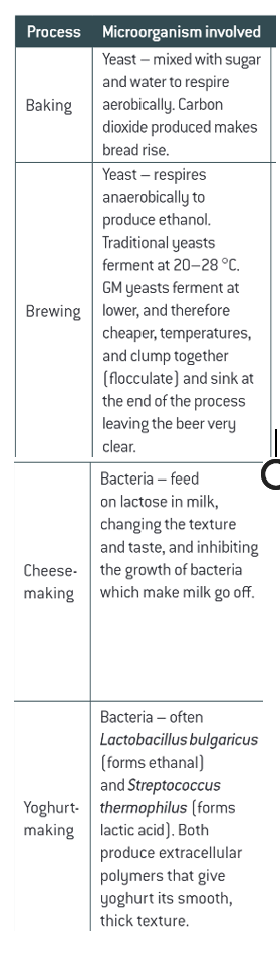
Disadvantages of using microorganisms indirectly in human food production (3)
If conditions not ideal/met, microorganisms don’t grow properly so don’t work efficiently
Conditions ideal for microorganisms can also be ideal for pathogenic m.o. & ones that cause food; processes must be sterile
Some people have ethical issues w. use of GM microorganisms
How is Quorn produced
Microorganisms clumped together with albumen (egg whites)
Advantages of using microorganisms to produce human food (7)
They reproduce fast & produce proteins faster than animals & plants
They have high protein content, w. little fat
They can use wide variety of waste materials, reducing costs
They can undergo GM to produce protein required
Their production takes place constantly, can be varied to match demand (doesn’t depends on weatheror breeding patterns)
No welfare issues to grow them
Can be made to taste like anything
Disadvantages of using microorganisms to produce human food (7)
Some of them can produce toxins if conditions not maintained at optimum
They have to be separated from nutrient broth & processed to make food
Need sterile, carefully controlled conditions, add to cost
Often involve GM organims, many people have concerns about eating GM food
Protein has to be purified
Many people dislike idea of eating m.os grown on waste
Has little natural flavour, needs additives