Lecture 6- Bio-Engineering Models (Skin Bio-engineering)
 Call Kai
 Learn
Learn Practice Test
 Spaced Repetition
 Match
Match Flashcards
 Knowt Play
1/29

There's no tags or description
Looks like no tags are added yet.
Name | Mastery | Learn | Test | Matching | Spaced | Call with Kai |
|---|
No analytics yet
Send a link to your students to track their progress
30 Terms
Why are organ-specific in vitro tissue models needed?
Because tissues in the body are highly organized, complex, and multicellular, so regenerative medicine usually needs a model of a specific organ system.
What common structural feature do skin, trachea, lung, oesophagus, stomach, and intestine share?
They are organized into distinct layers, each with a specific function.
What are the two main compartments in many tissue models?
Epithelial compartment
Stromal compartment
What is the function of the epithelial compartment?
It performs the tissue’s main activity, such as absorption, secretion, or protection.
What is the function of the stromal compartment?
It provides:
physical support
ECM
chemical and mechanical signals
nutrient/oxygen support and waste remova
What are the main layers of human skin?
Epidermis
Dermis
Hypodermis
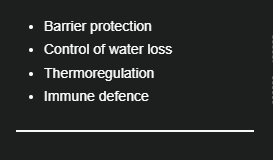
What are the main function of skin?
Barrier protection
Which cell types are found in skin?
Keratinocytes
Melanocytes
Fibroblasts
Immune cells
Sensory neurones
What are the three main types of in vitro skin equivalent shown in the lecture?
Epidermal, Dermal, Full-thickness
Why is there a need for bioengineered human skin equivalents?
Because cosmetic testing on animals was banned in Europe, increasing the need for animal-free in vitro skin models.
What is a major limitation of traditional 2D cell culture?
Cells grow as flat sheets on plastic

Why do 2D cultures often give non-physiological responses?
Because cells become flattened, have altered polarity and reduced cell-cell/cell-matrix interactions, so function changes.
Why are 3D culture environments preferred?
Because they better mimic the in vivo microenvironment and produce more realistic cell structure and function.
What criteria was Alvetex designed to meet?
It had to be:
inert
porous
stable for long-term culture
adaptable to existing culture formats
scalable for mass production
Why was polystyrene used for Alvetex?
Because it is inert, consistent, familiar in cell culture, and avoids adding extra biological cues.
What are the key structural properties of Alvetex membranes?
>90% porosity
about 200 µm thick
provide the third dimension for cell growth
Why is the 200 µm thickness important in Alvetex?
Because tissue diffusion limits are around 200 µm, helping prevent tissue death from poor nutrient or gas supply.
How is the Alvetex material made?
high internal phase emulsion (HIPE)

What monomers are used in the Alvetex material?
Styrene
Divinylbenzene (DVB) as crosslinker
2-ethylhexyl acrylate (EHA) for flexibility
What are the three Alvetex formats described?
Alvetex Scaffold
Alvetex Strata
Alvetex Polaris
How do the three Alvetex formats differ?
Mainly by void size and pore size, which affects whether cells can fully enter, partially enter, or not enter
Why are 3D culture systems significant?
Because structure relates to function — 3D systems often show enhanced properties and are more representative of in vivo tissues.
What benefit did 3D culture show for hepatocytes?
Hepatocytes in 3D showed better viability and more in vivo-like structure than in 2D culture.
What culture sequence is used to generate a full-thickness skin model?
Fibroblast pre-culture
Submerged culture
Air-liquid interface
What does immunofluorescence show in the epidermal/full-thickness skin equivalents?
It shows:
sequential keratinocyte differentiation
basement membrane formation
intercellular junctions
endogenous ECM deposition
What does TEM show in the full-thickness skin equivalent?
It shows:
desmosomes
hemidesmosomes
corneodesmosomes
terminal differentiation in the stratum corneum
How can skin model complexity be increased?
By adding more cell types

What is the main role of melanocytes in skin?
produce melanin

What happens in pigmented skin equivalents after chronic UV exposure?
They show:
increased melanin deposition
darker skin tone
increased melanocyte density and dendricity
What did the sunscreen proof-of-concept study show?
Without sunscreen, UV caused visible epidermal damage; with SPF50+, the epidermis remained organized and intact.