Benchmark exam II
 Call Kai
 Learn
Learn Practice Test
 Spaced Repetition
 Match
Match Flashcards
 Knowt Play
1/271

There's no tags or description
Looks like no tags are added yet.
Name | Mastery | Learn | Test | Matching | Spaced | Call with Kai |
|---|
No analytics yet
Send a link to your students to track their progress
272 Terms
what does the nervous system
-perception and experience of world
-voluntary movement
-consciousness, personality, learning, and memory
what aspects of homeostasis is regulated with the nervous system
-respiratory rate
- BP
-body temp
-sleep/wake cycle
-blood pH
what are the two anatomical divisions of the Nervous System?
Central Nervous System (CNS)
Peripheral Nervous System (PNS)
What are the functional divisions of the nervous system?
Sensory (afferent) Division (towards)
Motor (efferent) Division (away)
Integrative functions
what is the sensory (afferent) division of the Nervous system?
part of the PNS: 2 subdivisions
Somatic Sensory Division (special sensory division)
Visceral Sensory division
gathers information about internal and external environments
input from the 2 subdivisions carried from receptors to spinal cord or brain by spinal and cranial nerves
what is the somatic sensory division? (subdivision of afferent division)
special sensory division
carries signals from skeletal muscles, bones, joints, and skin
-organs for vision, hearing, taste, smell, and balance
what is the visceral sensory division? (subdivision of afferent division)
transmits signals from viscera
-heart, lungs, stomach, kidneys, and urinary bladder
what are the integrative functions of the nervous system?
analyze and interpret incoming sensory information and determine response
-99% of information subconsciously disregarded as unimportant
-remaining stimuli leads to motor response
what is the motor (efferent) division of the nervous system?
actions performed in response to integration by PNS: by organs that neurons contact
-motor neurons
-effectors
2 subdivisions
Somatic (voluntary)
Autonomic (involuntary)
what are motor neurons?
carry out motor functions
travel from brain and spinal cord via cranial and spinal nerves
what are effectors?
organs that carry out effects of nervous system
what is the somatic motor division? (subdivision of efferent division)
neurons transmit signals to skeletal muscles (voluntary control) voluntary motor division
what is the autonomic nervous system (ANS; visceral motor division) (subdivision of efferent division)
neurons carry signals to thoracic and abdominal viscera, homeostasis
regulates secretion of glands, contraction of cardiac muscle
involuntary (involuntary motor division)
what are neurons?
excitable cells- sending and receiving signals as APs
consist of three parts
-cell body (soma)
-Dendrites
-Axon
what is the cell body of a neuron?
most metabolically active
manufactures proteins needed for neuron
support high level of biosynthetic activity
what is the dendrite of a neuron?
short, branched processes
receive input from other neurons- transmit toward cell body as electrical impulses
multiple dendrites
what is the axon of a neuron?
only one axon (nerve fiber)
generate and conduct APs
distinct regions of axon:
-axon hillock
-axon collaterals
-axon terminals (synaptic bulbs)
-axolemma
what is the axon hillock of an axon?
where axon originates from cell body
what are the axon collaterals of an axon?
branches extending from main axon
what are the axon terminals (synaptic bulbs) of an axon?
arise from telodendria
components that communicate with target cell
what is the axolemma of the axon?
plasma membrane surrounding axon and its cytoplasm (axoplasm)
how do substances travel through axoplasm?
slow axonal transport
fast axonal transport
what is slow axonal transport?
transport substances (cytoskeleton proteins) from cell body through axon
rate of 1-3 mm/day
what is fast axonal transport?
requires motor proteins and consumes ATP
vesicles and membrane-bound organelles travel back toward (retrograde) or away (anterograde) cell body
rate of 200 mm/day and 400mm/day respectively
nervous tissue
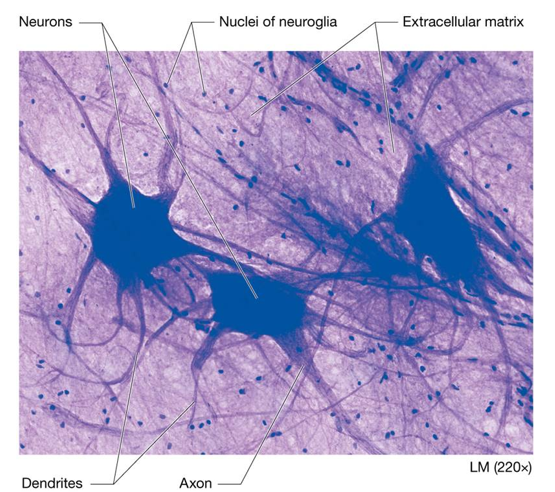
neuron structure
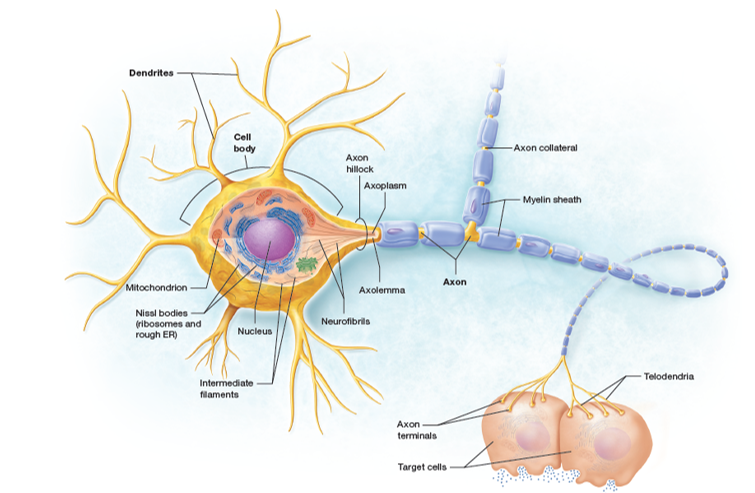
what are the 3 functional regions of a neuron?
Receptive region- dendrites and cell body
conducting region- axon
secretory region- axon terminal
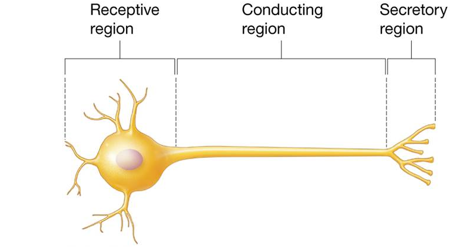
what are the three functional groups of a neuron?
-Sensory (afferent) neurons
-Interneurons (association) neurons
-motor (efferent) neurons
what are sensory (afferent) neurons?
carry information toward CNS
cell bodies in PNS receive information from sensory receptors and relay information via axons
pseudo unipolar or bipolar
what are interneurons (association neurons)?
relay information within CNS between sensory and motor neurons in body
multipolar
communicate with many other neurons
what are motor (efferent) neurons?
carry information away from cell body in CNS to muscles and glands
multipolar
what are multipolar neurons?
single axon and multiple dendrites: highly branched dendritic tree
motor. interneurons
found mostly in CNS, motor neurons in PNS
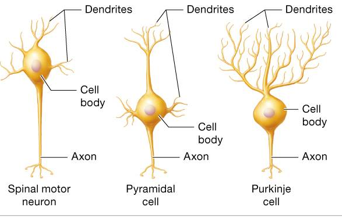
what are bipolar neurons?
one axon and one dendrite
sensory (afferent) neurons
found in special sense organs in PNS (retina and olfactory epithelium)
what are pseudo unipolar neurons?
single short process that splits into two axons (no dendrites); one fused axon divides into tow processes: one carries sensory information from sensory receptors to cell body
sensory (afferent) neurons
found in sensory neurons in the PNS associated with touch, pain, and vibration sensations
what are the neuron components in the CNS?
nuclei- clusters of neuron cell bodies
tracts- bundles of axons
what are the neuron components in the PNS?
Ganglia- clusters of neuron cell bodies
nerves- bundles of axons
what are neuroglia (neuroglial) cells?
provide structure support and protection for neurons
maintain their environment
4 types in CNS:
-astrocytes
-oligodendrocytes
-microglia
-ependymal cells
2 types in PNS:
-Schwann cells
-satellite cells
what are astrocytes?
anchor, transport, BBB
in CNS
what are oligodendrocytes?
myelin in CNS
what are microglia?
phagocytosis (recycling material and immune function)
what are ependymal cells?
CSF in CNS
what are Schwann cells?
myelin in PNS
what are satellite cells?
surround and protect
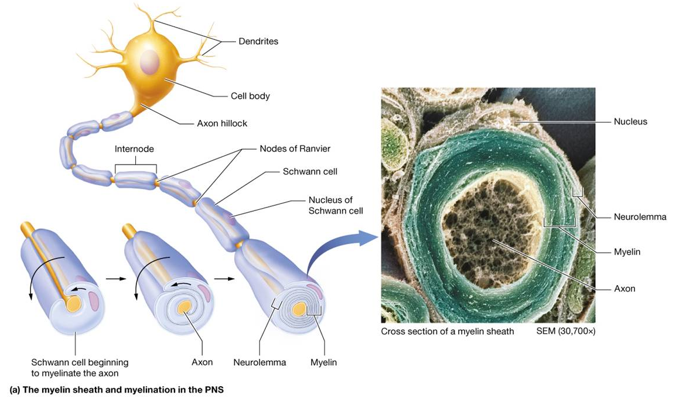
what is myelin Sheath?
layers of plasma membrane of Schwann cell (PNS) or oligodendrocyte (CNS)
what is myelination?
neuroglial cells wrap multiple layers of membrane (myelin) around axon
-lipid content insulates axon (prevent ion movement) increases speed of AP conduction
-myelinated axons conduct AP about 15- 20 times faster
what are nodes of Ranvier?
gaps between adjacent neuroglia; myeline sheath is absent
Myelin Sheath
what is the typical myelination of small axons in the CNS and PNS?
they are usually unmyelinated
what is white matter?
myelinated axons; appear white
what is gray matter?
composed of neuron cell bodies, unmyelinated dendrites and axons
appear gray
what is regeneration?
replacement of damaged tissue
where does regeneration occur and when can regeneration occur?
nonexistent in CNS and limited in PNS
can only regenerate if cell body remains intact
what breaks down after an axon is injured?
the axon and myelin sheath break down distal to injury (Wallerian Degeneration), helped by phagocytes
where do new growth processes start?
from the proximal end of the axon
what forms the regeneration tube?
Schwann cells and basal lamina
what guides the new axon to its target?
a single growth process growing into the regeneration tube
what happens when the new axon reaches its target?
it reconnects to the target cell
what type of stimuli can excite a neuron?
chemical signals, local electrical signals, and mechanical deformation
what do stimuli generate in neurons?
electrical changes across the neuron plasma membrane
how are electrical changes in neurons conducted?
they are rapidly conducted along the entire length of the membrane (conductivity)
what is the typical resting membrane potential (RMP) of a neuron?
-70 mV
what two forms of electrical changes occur in neurons?
Local potentials- travel short distances
action potentials- travel entire length of axon
what are local potentials (graded potentials)
small local changes in potential of neuron’s plasma membrane; triggers for long-distance APs
cause one of 2:
depolarization
hyperpolarization
what is depolarization?
positive charges enter cytosol; make membrane potential less negative (-70 to -60)
what is hyperpolarization?
either positive charges exit or negative charges enter cytosol; makes membrane potential more negative (-70 to -80)
what are local anesthetics?
lidocaine
administered for surgical or dental procedures; produce temporary numbness in specific areas
how do local anesthetics work?
block voltage-gated sodium channels in treated areas; prohibits depolarization; APs relaying pain do not go to CNS
nonselective; also affect sodium channels in muscles- temporary paralysis of muscles
what is the all-or-none principle?
refers to event that either happens completely or not at all
what is the refractory period?
period after neuron has generated AP; cannot be stimulated to generate another AP
2 phases:
absolute refractory period
relative refractory period
what is conduction speed?
rate of propagation; influenced by both axon diameter and myelination; determines how rapidly signaling can occur with nervous system
larger diameter- faster conduction-lower resistance
two types of conduction:
-saltatory
-continuous
what is saltatory conduction?
myelinated axons increase efficiency and speed of signal conduction; APs only depolarize nodes of Ranvier; jumps from node to node
what is continuous conduction?
unmyelinated axons; every section of axolemma from trigger zone to axon terminal must propagate AP; slows conduction speed as each section of axon must depolarize
what are type A fibers?
fastest conduction speed (120m/sec) largest diameter (5-20) and myelinated
sensory and motor axons- skeletal muscle and joints
what is type B fibers?
slower conduction speeds (15m/sec) mostly myelinated with intermediate diameter axons (2-3)
efferent fibers of ANS and sensory axons
what is type C fibers?
slowest (.5-2m/sec) smallest diameter (.5-1.5) unmyelinated axons
efferent fibers of ANS and sensory axons
pain, temp, pressure sensations
what is multiple sclerosis (MS)
certain cells of immune system attack myelin sheaths with CNS
autoimmune disorder
progressive loss of myelin sheath; loss of current from neurons
what are the symptoms of MS?
changes in sensation (numbness), alterations in behavior and cognitive abilities, and motor dysfunction, including paralysis
what are synapse?
where neuron meets target cell (neuronal synapse if another neuron) can be electrical or chemical
what is presynaptic neuron?
neuron sending message from its axon terminals
what is postsynaptic neuron?
neuron receiving message from presynaptic neuron at its cell body, axon, or dendrites
what are electrical synapse?
occurs between electrically coupled via gap junctions
how are cells physically arranged at synapses to allow communication through gap junctions?
the axolemmas of each cell are nearly touching and gap junctions align channels to form pores that allow ions or other small substances to flow through
in what type of brain areas are electrical synapses commonly found?
they are found in areas of the brain responsible for automatic behaviors like breathing
cardiac and visceral smooth muscle to allow for coordinated muscle activity
what are chemical synapses?
more efficient than electrical; no signal strength is lost
synaptic vesicles- transmit signals from presynaptic to postsynaptic neurons
synaptic cleft separate presynaptic and postsynaptic neurons
events at chemical synapse
1.Action potential in presynaptic neuron triggers opening of voltage-gated calcium ion channels in axon terminal
2.Influx of calcium ions causes synaptic vesicles to release neurotransmitter into synaptic cleft
3.Neurotransmitters bind to receptors on postsynaptic neuron
4.Ion channels open, leading to local potential and possibly action potential if threshold reached
what are postsynaptic potentials?
local potentials in membranes of postsynaptic neuron
what are excitatory postsynaptic potential (EPSP)
Membrane potential of postsynaptic neuron moves closer to threshold; caused by small local depolarization (sodium or calcium channels open)
what are inhibitory postsynaptic potential (IPSP)
Membrane potential of postsynaptic neuron moves farther away from threshold; caused by small local hyperpolarization (potassium or chloride ion channels open)
what is neural integration?
process in which postsynaptic neuron integrates all incoming information into single effect
what is summation?
all input from several postsynaptic potentials are added together (EPSPs + IPSPs) to affect membrane potential at trigger zone
types of summation:
-temporal summation
-spatial summation
what is temporal summation?
NT releases repeatedly from axon terminal of single presynaptic neuron; each local potential (EPSP) is short-lived
must be generated quickly to reach threshold and create AP
what is spatial summation?
simultaneous release of NTs from axon terminals of many presynaptic neurons
what are venomous arthropods?
spiders, and scorpions, many venoms affect neuronal synapses- neurotoxins
what do female black widows cause?
toxin causes massive release of NT, repetitive stimulation of postsynaptic neuron
what do bark scorpion cause?
most lethal of 40 species; prevents postsynaptic sodium channels from closing, membrane remains polarized, continues to fire APs
what are common symptoms of venom?
muscle hyperexcitability, sweating, nausea and vomiting, and difficulty breathing
what is treatment and prognosis for venom?
depends on amount and availability of medical care; severe cases usually require antivenin
what is acetylcholine (ACh)?
small molecule NT widely used by nervous system
cholinergic synapses bind ACh
largely excitatory; some inhibitory in PNS
synthesized from choline and acetyl-CoA- packed in synaptic vesicles
degraded by AChE
what is biogenic amines? (monoamines)
5 NTs synthesized from amino acids used CNS and PNS for regulation of homeostasis
first 3 form catecholamine subgroups (tyrosine)
excitatory
what is Norepinephrine? (biogenic)
catecholamine; noradrenalin
mainly in ANS influences HR, BP, and digestion
in CNS sleep/wake cycle, attention, and feeding