Ataxic Dysarthria: Profile
 Call Kai
 Learn
Learn Practice Test
 Spaced Repetition
 Match
Match Flashcards
 Knowt Play
1/20

There's no tags or description
Looks like no tags are added yet.
Name | Mastery | Learn | Test | Matching | Spaced | Call with Kai |
|---|
No analytics yet
Send a link to your students to track their progress
21 Terms
Ataxic Dysarthria
most evident issues: articulation and prosody
slow and inaccurate:
Force
• Range
• Timing
• Direction of movements
issue at level of Motor CONTROL
damage to cerebellum: coordination and timing of movement
Causes of ataxic Dysarthria
•Damage to cerebellum or its control circuits causing difficulties coordinating voluntary movements
•Cerebellar ataxia: movement deficits of timing, force, range, and direction
•Vermis: midpoint of cerebellum between cerebellar hemispheres upon which speech coordination is highly dependent
Ataxia
•Ataxia = dysmetria + dysdiadochokinesis _ decomposition of movement
•Ataxia movements
•Halting
•Imprecise
•Jerky
•Poorly coordinated
•Lacking in speed and fluidity
degenerative diseases (most common)
•Autosomal dominant cerebellar dysfunction of late onset
→ Hereditary disease usually beginning in middle age
•Idiopathic sporadic late-onset cerebellar ataxia
→ Similar to autosomal dominant cerebellar dysfunction, but does not include as many neurologic symptoms
•Friedreich’s ataxia
•Progressive hereditary disease affecting spinal cord as well as cerebellum
•Olivopontocerebellar degeneration
•Progressive cerebellar disorder that runs in families
Stroke
•Cerebellum has rich arterial blood supply
•Arteries serving cerebellum: Superior cerebellar, anterior inferior cerebellar artery
•Ataxic dysarthria can result in:
•Blockage to arteries serving cerebellum, ruptured aneurysms, arteriovenous malformations
•Cerebellar signs: limb ataxia, problems with balance, visual deficits, ataxic dysarthria
Toxic Conditions
•Most treatable with ataxic dysarthria resolving as toxic levels decrease
•Lead and mercury poisoning
•Long- and short-term alcohol consumption
•Exposure to chemicals such as acrylamide and cyanide
•Toxic levels that may not be irreversible
•Phenytoin (Dilantin): antiseizure drug
TBI
•Trauma to cerebellum tends to be diffuse, as with most head injuries
•Cerebellar peduncles especially vulnerable to twisting and rotational forces because cerebellum essentially an appendage attached to brainstem
Patient perceptions
•Slurred
•Drunken quality
•Dramatic deterioration with limited alcohol intake
•Inability to coordinate breathing
•Bite cheek or tongue while eating or talking
•Stumble over words
Speech characteristics of Ataxic Dysarthria
•Movements appear poorly coordinated
•Problems controlling timing/force for speech
•Slurred, monotonous articulation
•Primarily disorder of articulation and prosody
•Scanning speech:**
•Term to describe ataxic dysarthria, describing slow, deliberate production of syllables, with each syllable in word receiving equal stress
Oral Mech Exam
Speech alternate motion rates can be one of the most valu- able evaluation tasks when ataxic dysarthria is suspected. The overall rate will probably be slower than normal. In addition, many individuals with this dysarthria will be unable to maintain a steady rhythm as they repeat the target sounds. In the most severe cases, they might speed up abruptly and then, just as unexpectedly, slow down during this speech production task. Their difficulty in maintaining a regular rhythm highlights how cerebellar damage can affect the timing of movements by different muscle groups.
Reading, conversational speech, and repeating sentences containing numerous multisyllabic words also are important evaluation tasks (Duffy, 2020). The complexity of these longer speech activities will reveal any inaccurate speech movements. As such, they can be especially effective at evoking the irregular articulatory breakdowns that often appear in ataxic dysarthria. Remember that these break- downs tend to occur more frequently on multisyllabic words than on words of shorter length. Furthermore, these three tasks should reveal any prosodic errors that might be present in connected speech.
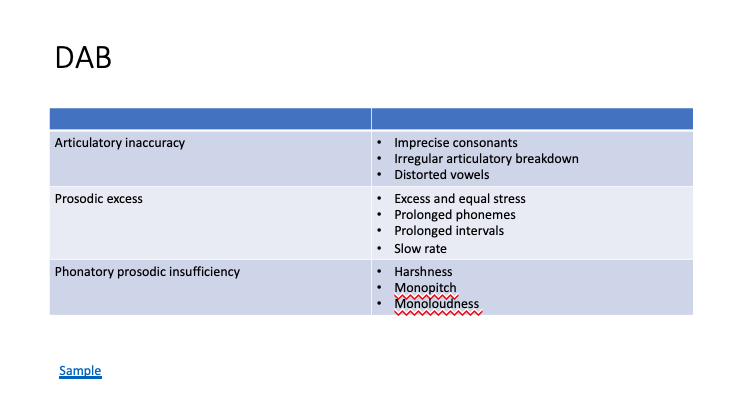
Differntial DX DAB
Articulation
•Articulation deficits significant problem
•Imprecise consonant production
•Most prevalent speech error
•Distorted vowels
•Imperfect articulation gives ataxic dysarthria slurred quality
•Caused by cerebellar damage disrupting timing, force, range, and direction of movements
•Irregular articulatory breakdowns
•Imprecise consonant and vowel productions vary from utterance to utterance
•Decomposition of movement: manifestations of cerebellar dysfunction, where instead of smooth coordinated movements, they are distinct and jerky
Prosody
•Equal and excess stress
•Distinguishing characteristic of ataxic dysarthria
•Prolonged phonemes and prolonged intervals between phonemes
•Slow movement on both single and repetitive motion tasks; hypotonia
•Monopitch and monoloudness
•Caused by hypotonia of speech muscles
Phonation
•Few phonatory deficits noted in ataxic dysarthria
•Harsh vocal quality
•Caused by decreased muscle tone in laryngeal and respiratory structures, preventing full contraction of these muscle groups
•Voice tremor
Resonance
•Hypernasality
•Seldom serious problem in ataxic dysarthria
•Hyponasality
•Intermittent
•Caused by timing errors between muscles of velum and other muscles of articulation
Respiration
•Uncoordinated movements in respiratory muscles, contributing to speech deficits
•Paradoxical movements: movements that occur when muscles work against each other rather than in coordination
•Paradoxical movements of intercostal muscles and diaphragm
•Leads patient to speak on residual air, which can lead to increased rate of speech, decreased loudness, and harsh vocal quality
Key Evaluation Tasks for Ataxic Dysarthria
•Speech alternate motor tasks
•Slower than normal, difficulty maintaining steady rhythm with repetition
•Severe cases: speed up abruptly then unexpectedly slow down
•Reading, conversational speech, and repeating sentences containing numerous multisyllabic words
Treatment of Ataxic Dysarthria
Respiration
•Do not need to address strengthening respiration
•Concentrate on controlling airflow more accurately during speech, as uncoordinated movements of respiratory muscles cause speech on residual air, affecting prosody and phonation
•Tasks to help improve breath control during speech
•Slow and controlled exhalation
•Speak immediately on exhalation
•Stop phonation early
•Optimal breath group: teaching how may syllables or words can be said clearly on one full inhalation
Prosody
•Prosodic problems involve:
•Rate, stress, and intonation
•By slowing rate, can improve intelligibility
•By incorporating more typical stress and intonation into utterances, speech may exhibit more natural quality
•Rate control
•Slow, irregular rate characteristic of ataxic dysarthria, but may attempt to speak too rapid for speech capabilities
•Articulators are not given enough time to reach target positions
•Listener not given enough time to assimilate spoken message
•Rate control tasks
•Reciting syllables to a metronome
•Finger or hand tapping
•Cued reading material
•Used with written sentences or paragraphs
•Clinician points to word or syllable at desired rate
•Slash marks or spaces to indicate necessary pauses when reading
Stress and Intonation:
•Contrastive stress drills
•Pitch range exercises
•Intonation profiles
•Show intonation changes in written sentences
•Chunking utterances into syntactic units
Articulation
•May improve with slowed rate
•Need to concentrate directly on improving production of phonemes
•Articulation tasks
•Intelligibility drills
•Phonetic placement
•Exaggerating consonants (overarticulation)
•Minimal contrast drills