T6 - IE2 - Oncology - Elsaid - Hormonal Agents
 Call Kai
 Learn
Learn Practice Test
 Spaced Repetition
 Match
Match Flashcards
 Knowt Play
1/113

There's no tags or description
Looks like no tags are added yet.
Name | Mastery | Learn | Test | Matching | Spaced | Call with Kai |
|---|
No analytics yet
Send a link to your students to track their progress
114 Terms
Aromatase inhibitors do NOT work on ______-________ women due to the negative feedback system
- (do NOT work on) pre-menopausal (women)
Aromatase inhibitors do not work on pre-menopausal women due to the __________ ________ system
- (due to the) negative feedback (system)
_________, _____, ______ regulate the hypothalamus-pituitary-gonadal axis via negative feedback inhibition
- GnRH
- LH
- FSH (regulate)
HPG axis
Hypothalamus-pituitary-gonad axis,
the negative feedback loop that regulates sex-hormone production.
Hypothalamus (female) has both ________ and _______ receptors similar to the pituitary gland
- (has both) estrogen
- progestin (receptors)
Hypothalamus (male) has both __________ and _______ receptors similar to the pituitary gland
- (has both) androgen
- estrogen (receptors)
Estrogen signaling - principal estrogenic hormone is _____ __________ (____)
- 17β estradiol (E2)
estrogen (E2)
17β estradiol
Estrogen signaling - E2 is synthesized by _________ of testosterone in the ovaries and other tissues
- (synthesized by) aromatization (of testosterone)
Estrogen signaling - E2 is synthesized by aromatization of testosterone in the __________ and other _________
- ovaries
- (and other) tissues
E2 mediates its effects via two types of receptors ERα and ERβ (both are nuclear receptors; i.e., transcription factors)
Estrogen signaling - E2 mediates its effects via two types of receptors _____ and _____ (both are _________ receptors; i.e., ____________ factors)
- ERα
- ERβ
- nuclear (receptors)
- transcription (factors)
Estrogen signaling - binding of E2 (an ER _________) to ER results in _________ of the receptor and recruitment of ____-________ proteins.
The chromatin network opens up and transcription of target genes is initiated
- (an ER) agonist
- dimerization (of the receptor)
- co-activator (proteins)
Estrogen signaling - binding of E2 (an ER agonist) to ER results in dimerization of the __________ and recruitment of co-activator proteins
The chromatin network ________ up and _________ of target genes is initiated
- (dimerization of the) receptor
- (network) opens (up)
- transcription (of target genes is initiated)
Estrogen signaling - estrogen _______ a wide array of cell ________, and modulates cell __________ in normal and specific type of cells
- modulates (a wide array)
- (cell) functions
- (modulates cell) proliferation
Estrogen signaling - E2 and Estrogen antagonists __________ interact with ER resulting in ____________ of target genes
- differentially (interact)
- transcription (of target genes)
Drug classes that target the function of ER2 in ER+ Tumors
SERMs
- Tamoxifen
- Raloxifene
- Toremifene
SERD
- Fluvestrant
Aromatase inhibitors
- aminoglutethimide
- anastrozole
E2 in ER+ cell results in: _________ cellular proliferation and increase in ___________
- enhanced (cellular proliferation)
- (increase in) angiogenesis
Thus, SERMs, SERD and aromatase inhibitors target E2 function in ER+ tumors
E2 in ER+ cell results in: reduction in __________ and estrogen was also shown to induce growth factor-induced activation of _________ ________ _______ family
- (reduction in) apoptosis
- (induced activation of) Human Epidermal Receptor (family)
Thus, SERMs, SERD and aromatase inhibitors target E2 function in ER+ tumors
SERMs, SERD, and aromatase inhibitors target _____ function in ER+ tumors
- (target) E2 (function)
SERMs also bind to the _________ receptor
- estrogen (receptor)
Does not agonize or antagonize but MODULATES the site
SERDs ________/_______ the estrogen receptor
- downregulate / degrade (the estrogen receptor)
Aromatase inhibitors inhibit _____ ____________
- (inhibit) E2 biosynthesis
SERMs
selective estrogen receptor modulators
Selective Estrogen Receptor Modulators (SERMs) - Tamoxifen: indicated for the __________ of breast cancer in _____-____ individuals and as __________ treatment in ER+ breast cancer in pre- and post-menopausal females
- prevention (of breast cancer)
- high-risk (individuals)
- adjuvant (treatment)
Adjuvant = in addition to surgery and chemotherapy
Selective Estrogen Receptor Modulators (SERMs) - Tamoxifen: indication for the prevention of breast cancer in high-risk individuals and as adjuvant treatment in _______ breast cancer in _____ and _______-________ females
- ER+ (breast cancer)
- pre-
- post-menopausal (females)
Selective Estrogen Receptor Modulators (SERMs) - Tamoxifen: can be used in BOTH _____ and _____-________ females
UNLIKE, aromatase inhibitors, which can only be used in _______-________ women
- (in BOTH) pre-
- post-menopausal (females)
- (can only be used in) post-menopausal (women)
Selective Estrogen Receptor Modulators (SERMs) - Tamoxifen: acts as an _________ in breast cancer cells, binding to the _____ results in dimerization and recruitment of corepressors that prevent gene __________
- (acts as an) antagonist
- (binding to the) ER
- (prevent gene) transcription
ER
estrogen receptor
Selective Estrogen Receptor Modulators (SERMs) - Tamoxifen: acts as an antagonist in breast cancer cells. Binding to ER results in _________ and recruitment of ___________ that prevent gene transcription
- (results in) dimerization
- (recruitment of) corepressors
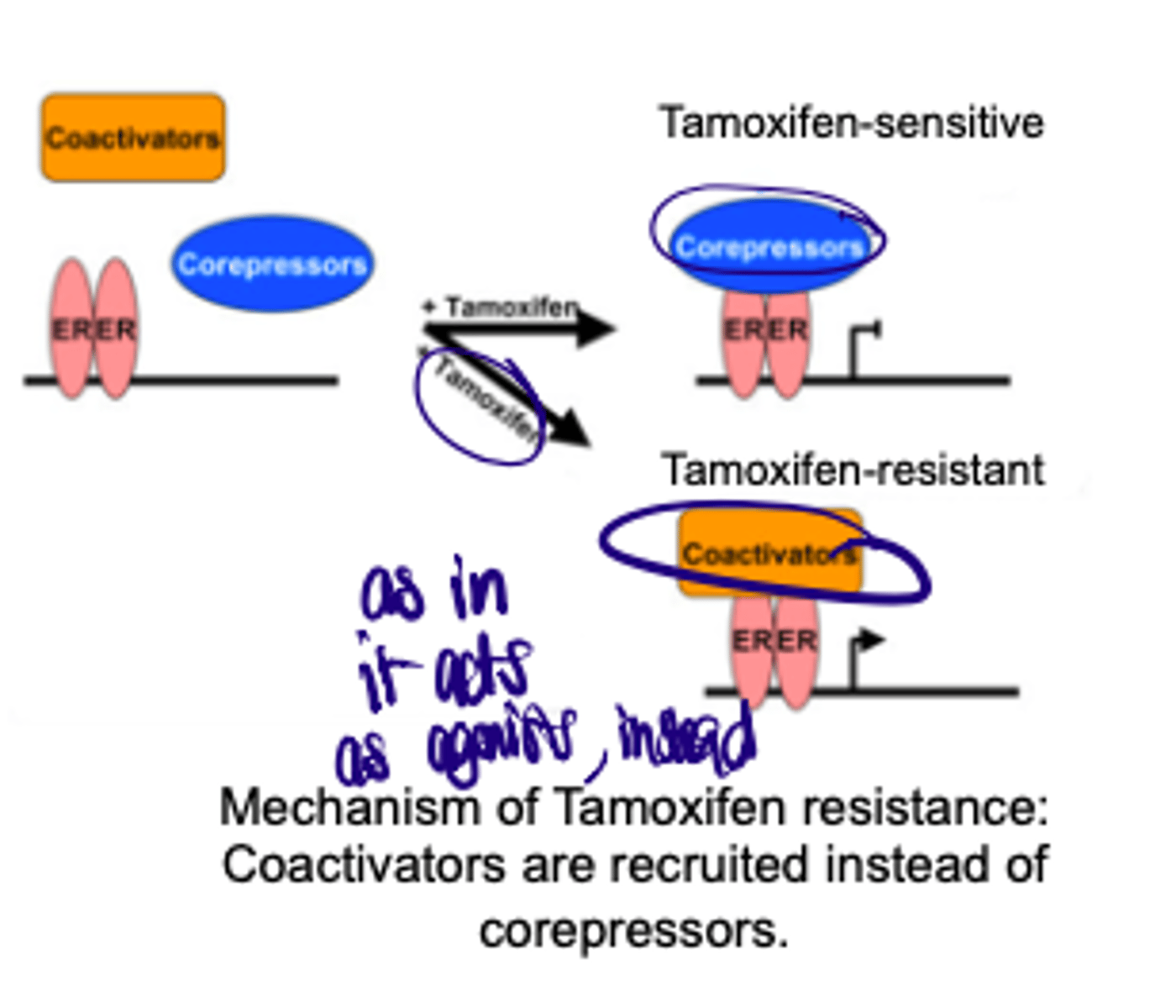
Selective Estrogen Receptor Modulators (SERMs) - Tamoxifen resistance: is due to the recruitment of ________ in Tamoxifen-bound ER instead of its former/typical function of recruitment of ___________
- (due to the recruitment of) coactivators
- (instead of its former/typical function of recruitment of) corepressors
Tamoxifen is a MODULATOR, so thus it has the ability to recruit both (but this is the mechanism of resistance)
Selective Estrogen Receptor Modulators (SERMs) - Tamoxifen: mechanism of tamoxifen resistance: coactivators are ________ instead of corepressors
- (coactivators are) recruited (instead of corepressors)
Selective Estrogen Receptor Modulators (SERMs) - Tamoxifen resistance figure
Selective Estrogen Receptor Modulators (SERMs) - other SERM drugs
Raloxifene
Toremifene
Selective Estrogen Receptor Modulators (SERMs) - SERMS are _______ ______ agonists or antagonists. It ______ either as an agonist or antagonist depending on the ___________
- NOT pure (agonists or antagonists)
- acts (either as an agonist or antagonist)
- (depending on the) tissue
Selective Estrogen Receptor Modulators (SERMs) - Tamoxifen: if there is resistance to tamoxifen, Raloxifene ________ usually overcome the resistance
- (Raloxifene) cannot (usually overcome the resistance)
Selective Estrogen Receptor Modulators (SERMs) - Tamoxifen: modulating effect (i.e., not pure agonist or antagonist) example: in breast tissue, tamoxifen is used to __________ ER+ breast cancer
Whereas in the uterus, tamoxifen may induce __________ _____ _______, associated with endometrial cancer
- (used to) treat (ER+ breast cancer)
- (Whereas in the uterus, tamoxifen may induce) endometrial cell growth
Selective Estrogen Receptor Modulators (SERMs) - Raloxifene: has ____ _______ in tamoxifen resistant breast cancer but effective at preventing breast cancer
Has a 2nd effect: may also prevent __________ ______ in the uterus, unlike tamoxifen
- no effect (in tamoxifen resistant breast cancer)
- (may also prevent) endometrial cancer (in the uterus)
Tamoxifen may instead cause endometrial cancer
Tamoxifen Metabolic Pathway: is metabolized by a combination of _________ and ________ to generate Endoxifen
- CYP3A4
- CYP2D6 (to generate Endoxifen)
Endoxifen has significantly higher binding affinity to ERα and ERβ and results in ER degradation
Tamoxifen Metabolic Pathway: is metabolized by a combiaontion of CYP3A4 and CYP2D6 to generate ___________
___________ has significantly higher binding affinity to ERα and ERβ and results in ER degradation
- (to generate) Endoxifen
- Endoxifen (has significantly higher binding affinity)
Tamoxifen Metabolic Pathway: Endoxifen has significantly higher __________ _____ to ERα and ERβ and results in ER _____________
- (significantly higher) binding affinity
- (results in ER) degradation
____________ is converted to Endoxifen through CYP2D6
- Tamoxifen (is converted to Endoxifen)
Endoxifen is more active than its parent drug
SERD
selective estrogen receptor downregulator / degrader
SERD drugs
Fluvestrant
SERD: Fluvestrant advantages - is effective in situations of Tamoxifen _____________
___________ _____ levels in the cancer cell
- (in situation of Tamoxifen) resistance
- Reduces ER (levels in the cancer cell)
SERD: Fluvestrant advantages - acts as a pure _______________
- (acts as a pure) antagonist
SERD: Fluvestrant adverse effects
vasomotor symptoms
- hot flashes
SERD: Fluvestrant Mechanism - estrogen receptor is _______ ________ and ER ______ and is tagged for degradation
- not dimerized
- (ER) dissociates (and is tagged for degradation)
SERD: Fluvestrant Mechanism - binding of fluvestrant to estrogen receptor __________ receptor dimerization and binding to estrogen response element and gene transcription.
Instead the Fluvestrant-bound ER is __________
- prevents (receptor dimerization)
- (Fluvestrant-bound ER is) degraded
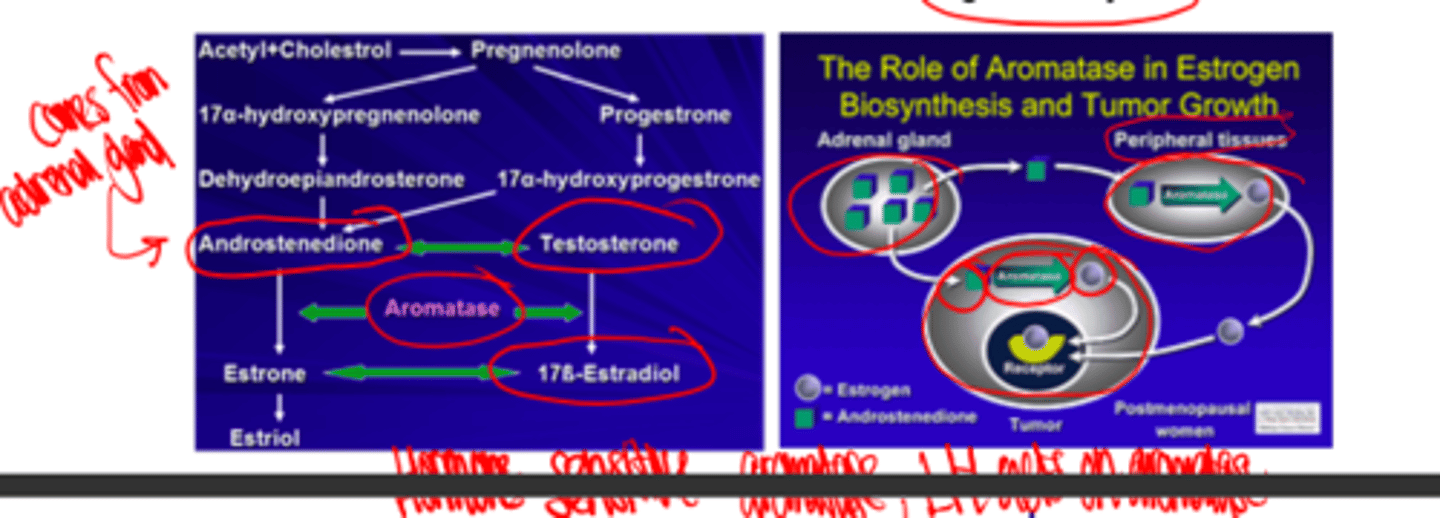
Distribution and function of aromatase - expression: in _______ tissues and ______ including ovaries, urogenital, brain, heart blood, vessels, breasts and adipose tissue
- multiple (tissues)
- organs (including ovaries...)
Distribution and function of aromatase - pre-menopause: ovarian aromatase is responsible for the majority of ____________ ___
- (majority of) circulating E2
Distribution and function of aromatase - pre-menopause: _________ _________ is responsible for the majority of circulating E2
- ovarian aromatase (is responsible for the majority...)
Distribution and function of aromatase - pre-menopause: ovarian aromatase is regulated by ______. Increasing circulating LH leads to increasing __________ _________
- (is regulated by) LH
- (increasing) aromatase expression
Distribution and function of aromatase - pre-menopause: ovarian aromatase is __________ by LH. ____________ circulating LH leads to increasing aromatase expression
- regulated (by LH)
- Increasing (circulating LH leads to increasing aromatase expression)
Distribution and function of aromatase - post-menopause: circulating E2 is produced by aromatase in ________ tissue, _________ gland and in ____________
Aromatase in these tissues is NOT regulated by LH
- (aromatase in) adipose (tissue)
- adrenal (gland)
- muscles
Distribution and function of aromatase - post-menopause: circulating E2 is produced by aromatase in adipose tissue, adrenal gland and in muscles
Aromatase in these tissues is _____ _________ by LH
Whereas, in pre-menopause, majority of circulating ER is produced by the _____________, where it is regulated by LH
- NOT regulated (by LH)
- (produced by the) ovaries
Distribution and function of aromatase - the majority of E2 is produced by the ovaries ______-_____________
The majority of E2 is produced by adipose tissue, adrenal gland, and in muscle _______-__________
- (produced by the ovaries) pre-menopause
- (adipose tissue, adrenal gland, and in muscle) post-menopause
Distribution and function of aromatase - aromatase inhibitors are ________-______ except for _____-________ women
- (are) first-line
- (except for) pre-menopausal (women)
Ovarian aromatase is also known as _________ ________ aromatase
- hormone sensitive (aromatase)
Distribution and function of aromatase figure
Aromatase inhibitors - first generation
Aminoglutethimide
Aromatase inhibitors - first generation (Aminoglutethimide) MOA: a _____-_________ _______ inhibitor of aromatase
- non-steroidal reversible (inhibitior of aromatase)
Types of aromatase inhibitors
Type I: steroidal
Type II: non-steroidal
Types of aromatase inhibitors (steroidal) are usually _______________ and create __________ bonds
- (are usually) irreversible
- (create) covalent (bonds)
Types of aromatase inhibitors: non-steroidal create ____________ bonds
- reversible (bonds)
Aromatase inhibitors - third generation drugs
Exemestane (steroidal)
Anastrozole
(non-steroidal)
Letrozole
(non-steroidal)
Aromatase inhibitors - third generation STEROIDAL (IRREVERSIBLE) drugs
Exemestane
Exemestane is steroidal and thus irreversible
Aromatase inhibitors - third generation non-steroidal (reversible) drugs
Anastrozole
Letrozole
Aromatase inhibitors - net result: ___________ in circulating estrogen levels
- reduction (in circulating estrogen levels)
Indicated in early and advanced ER+ breast cancer in postmenopausal women
Aromatase inhibitors are indicated in early and advanced ______ breast cancer in ___________ females
- ER+ (breast cancer)
- postmenopausal (females)
Aromatase inhibitors can only be given in premenopausal females AFTER _________ _________
- (premenopausal females AFTER) ovarian ablation
i.e., removal of ovaries
AI
aromatase inhibitor
Tamoxifen vs. Anastrozole Figure
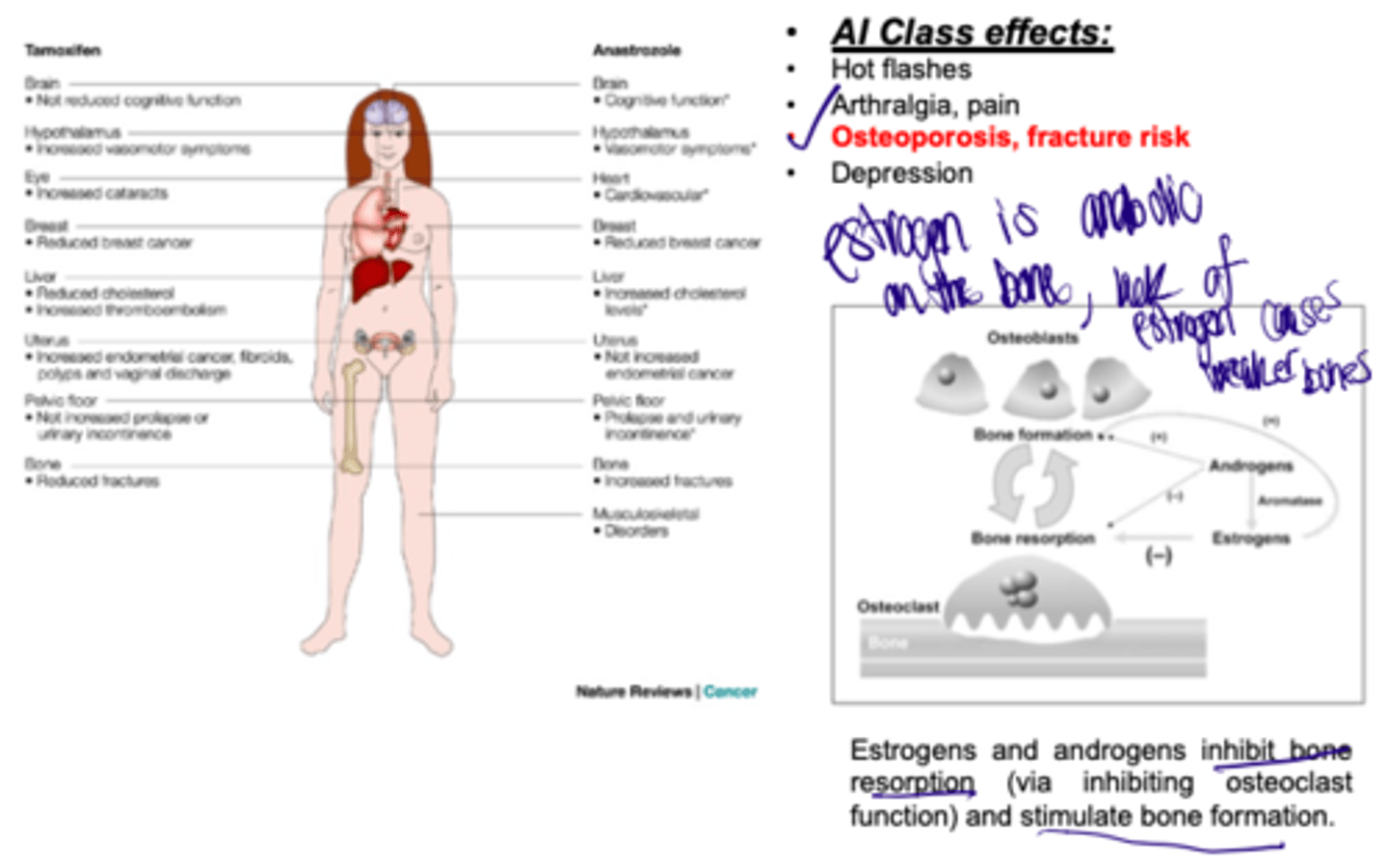
AI Class Effects
Hot flashes
Arthralgia, pain
Osteoporosis, fracture risk
Depression
Tamoxifen vs. Anastrozole: estrogen is ___________ on the bone, thus reduction in estrogen causes _________ bones
- anabolic (on the bone)
- (reduction in estrogen causes) weaker (bones)
Estrogens and androgens inhibit _________ _________ (via inhibiting osteoclast function) and stimulate ________ _________
- (inhibit) bone resorption
- (stimulate) bone formation
ADT
androgen deprivation therapy
Androgen deprivation therapy (ADT) classes
GnRH analogs
GnRH antagonists
Androgen deprivation therapy (ADT): GnRH analog drugs
Leuprolide
Triptorelin
Goserelin
Histrelin
Androgen deprivation therapy (ADT): GnRH antagonists
Degarelix
Androgen deprivation therapy (ADT) - GnRH Analogs / GnRH Antagonists Adverse Effects
Hot flashes
Decreased libido
Osteoporosis
Weight gain and loss of muscle mass
Fatigue and anemia
GnRH stimulates ___________ ________ to release FSH and LH
- (stimulates) anterior pituitary
GnRH stimulates anterior pituitary to release _______ and ________
- (to release) FSH
- LH
GnRH antagonists bind to GnRH receptors and prevent GnRH from binding and suppression of FSH and LH release
ADT: GnRH antagonists bind to GnRH receptors and prevent GnRH from __________ and __________ of FSH and LH release
Results in the decrease of prostate size (for prostate cancer)
- (prevent GnRH from) binding
- suppression (of FSH and LH release)
ADT: first-line for prostate cancer is still ________ ________ although other options include _______ ______ and _______ _________
- (is still) surgical removal
- GnRH analogs
- GnRH antagonists
ADT: GnRH analogs are formulated as ________ to allow ________ exposure to the drug
- (formulated as) depots
- (allow) sustained (exposure)
ADT: GnRH regulates the circulating levels of ______________
- (circulating levels of) androgens
ADT: GnRH releases in a ___________ manner
- pulsatile (manner)
ADT: either the GnRH analog or antagonist is able to _________ circulating androgens
- (GnRH analog or antagonist is able to) reduce (circulating androgens)
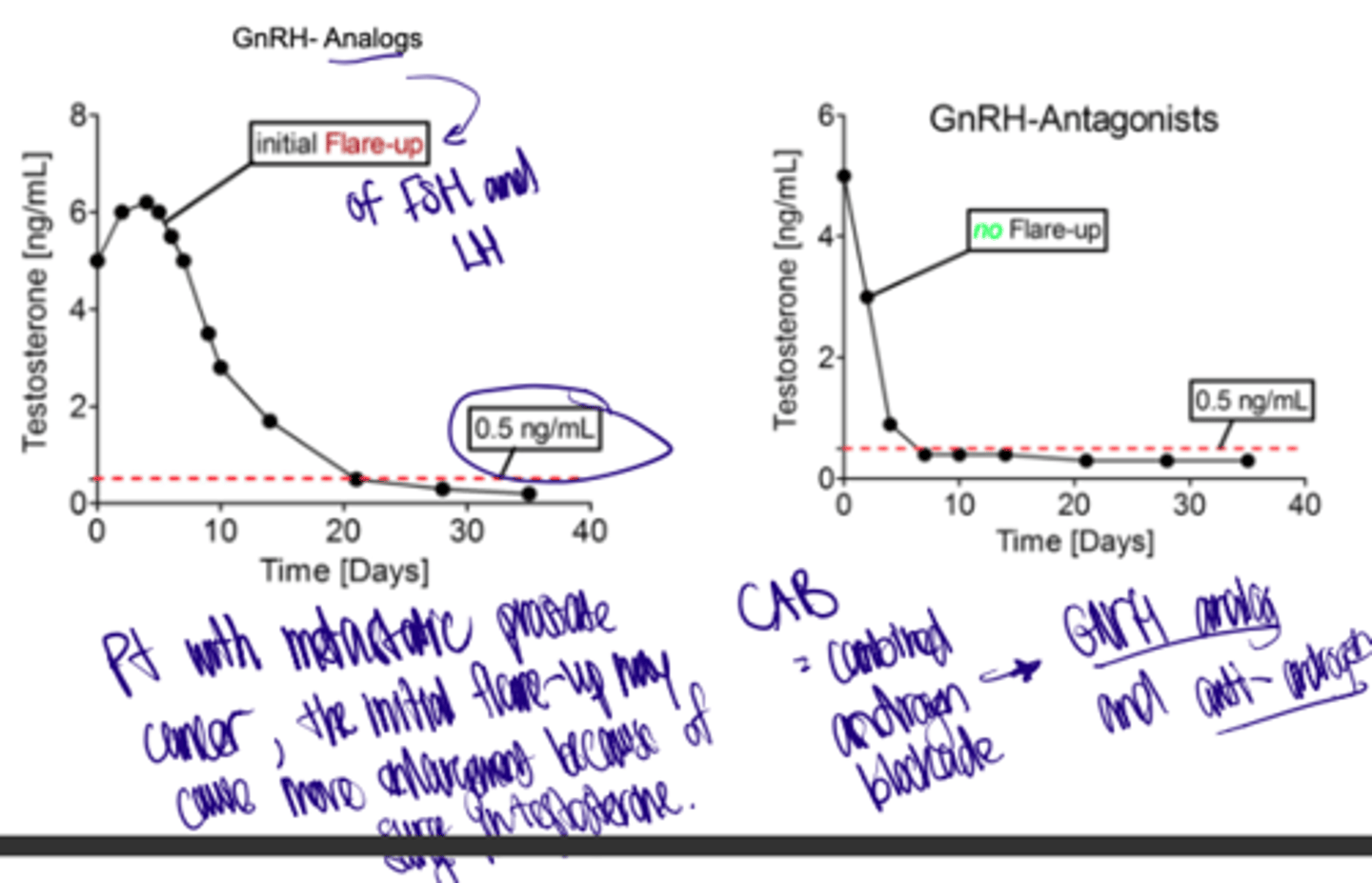
ADT: Initially, GnRH analogs _________ FSH and LH release.
_________ exposure to GnRH analog results in desensitization of GnRH receptor
- (GnRH analogs) stimulate (FSH and LH release)
- Sustained (exposure to GnRH analog)
ADT: initially, GnRH analogs stimulate FSH and LH release
Sustained exposure to GnRH analog results in ____________ of GnRH receptor
- desensitization (of GnRH receptor)
ADT: Patients with metastatic prostate cancer on GnRH analogs, may experience an enlargement during the __________ ______-____ due to a surge of __________
- (during the) initial flare-up
- (due to a surge of) testosterone
Thus, may be given with a CAB (combined androgen blockade; GnRH analog and anti-androgen)
ADT: Patients with metastatic prostate cancer on GnRH analogs, may experience an enlargement during the initial flare-up due to a surge of testosterone
Thus, may be given with a ______
- (may be given with a) CAB
CAB = combined androgen blockade; GnRH analog and anti-androgen
CAB
combined androgen blockade
Impact of GnRH analogs and GnRh antagonists on serum testosterone levels
Anti-androgens - androgen receptor antagonists: first-generation drugs
"conventional anti-androgens"
Flutamide
Bicalutamide
Nilutamide
Anti-androgens - androgen receptor antagonists: first-generation (Flutamide, Bicalutamide, Nilutamide) MOA
binding to AR (androgen receptor) and prevent androgens from binding to the AR
Downstream effect: reduce androgen-dependent prostate cancer cell proliferation
Anti-androgens - androgen receptor antagonists: first-generation (Flutamide, Bicalutamide, Nilutamide) MOA: binding to ____ (________ ______) and prevent androgens from _________ to the AR
- AR (androgen receptor)
- (prevent androgens from) binding (to the AR)
Anti-androgens - androgen receptor antagonists: first-generation (Flutamide, Bicalutamide, Nilutamide) downstream effects (from binding): reduce __________-________ prostate cancer cell proliferation
- (reduce) androgen-dependent (prostate cancer cell proliferation)
Anti-androgens - androgen receptor antagonists: first-generation (Flutamide, Bicalutamide, Nilutamide) - established mechanism of resistance - the anti-androgens instead behave like an _________ instead of an antagonist
- (behave like an) agonist
Mechanisms of resistance to ADT
1. more androgens are synthesized and released by the adrenal gland
2. AR activation by corticosteroids
3. AR activated growth factors
4. AR amplification
5. AR mutations