Strength and power
 Call Kai
 Learn
Learn Practice Test
 Spaced Repetition
 Match
Match Flashcards
 Knowt Play
1/26

There's no tags or description
Looks like no tags are added yet.
Name | Mastery | Learn | Test | Matching | Spaced | Call with Kai |
|---|
No analytics yet
Send a link to your students to track their progress
27 Terms
What are the effects of resistance training affect muscle protein?
During exercise = muscle protein synthesis decreases, and muscle protein degradation increases
After exercise = muscle protein synthesis increases, and muscle protein degradation decreases
How can hormones affect muscles?
Hormones such as testosterone facilitate muscle fibre hypertrophy
What is fibre hyperplasia?
The process where the muscle fibres split, and each half grows to the size of the parent fibre
How can strength be increased without hypertrophy?
Resistance training causes more synchronised motor unit recruitment, which increases the rate of force development
What are the 2 types of actions the nervous system carries out?
Voluntary = athlete sends signals to carry out the movement they want
Reflexive = signals are sent from the receptors in the body (e.g. tactile receptors when something is hot)
What are muscle spindles?
Senses length of a muscle
When a muscle is stretched they send an excitatory signal to spinal cord, causing the muscle to contract
e.g. the patella tendon tap test
What are golgi tendon organs?
Senses tension in a muscle
This sends an inhibitory signal to the spinal cord to reduce the muscles output
This prevents excessive muscle force on the tendon
What motor neurons send signals for all muscle contractions, and what do they connect?
Alpha motor neurons
They connect the spinal cord to the muscle
What is innervation ratio?
Number of muscle fibres innovated by a single neuron
Low ratio would be seen in the eye, whereas a large ratio would be seen in the quadricep
What is a motor unit made up of?
An alpha motor neuron + all the muscle fibres that it innervates
What size motor units are recruited first?
Smaller motor units are recruited first, and then larger motor units if more force is required
What methods can be used to increase muscle force?
Recruiting more motor units
Discharging motor units at a higher frequency
Produce a tetanic smooth contraction
What is post activation potentiation (PAP)?
The temporary increase in a muscles ability to produce force following a previous contraction, despite identical input from the nervous system
What is the application of post activation potentiation (PAP)
Shows how warm ups are effective to increase overall force production and reduce time taken during contraction to reach peak force
What speed do gross muscles use all of their motor units?
Gross muscles recruit their motor units over a long period of time, therefore increasing their force production by recruiting more motor units when necessary
What speed do fine muscles use all of their motor units?
Fine muscles recruit all their motor units at around 50% of maximum force, therefore to increase force production they must increase discharge rate
What is the onion skin phenomenon?
Smaller motor neurons membrane potential can be changed by a small synaptic current, therefore reaching the depolarisation threshold easily
This means they will recruited first
What is rate coding?
The rate at which motor neurons are discharges
How do quick movements obtain a rapid force?
Quick movements use pre-programmed, forward loop control methods
These achieve a very high discharge rate, allowing rapid contractions
How long does it take a healthy human to reach maximum muscle force?
200ms
What is the inflection point?
The change in the force-time or force-velocity curve
Symbolises a change in muscle performance
Early in a contraction → force increases rapidly due to fast motor unit recruitment.
After the inflection point → force increases more slowly as mechanical properties of muscle fibres limit additional force
What are the 3 types of motor units?
Slow twitch
Fast twitch (fatigue resistant)
Fast twitch (fatigable)
What are the 3 components of the Hill muscle model?
CE - Contractile element = The muscle fibres which actually contract
SE - Series elastic element = The elasticity of the cross bridge cycle and the tendons attached to the muscle
PE = parallel elastic elements = the passive connective tissues which transmits force that we produce to the skeleton and prevents overstretching
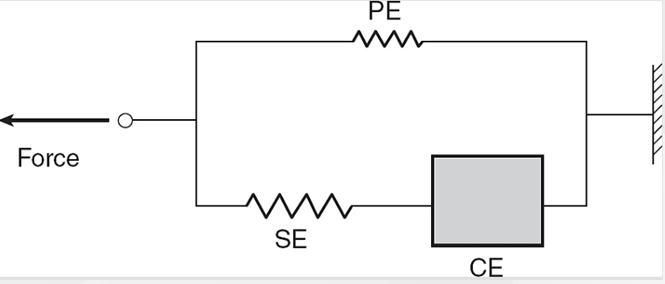
What is the force-velocity relationship for a concentric contraction?
Slow velocities allow the cross bridge to attach very readily and produce a large force
Fast velocities means the cross bridges cant attach easily, so a smaller force is produced
What is the force-velocity relationship for an eccentric contraction?
Not much change in force production regardless of change in velocity
Describe the force-length relationship on a graph?
Parabolic curve for maximum force produced
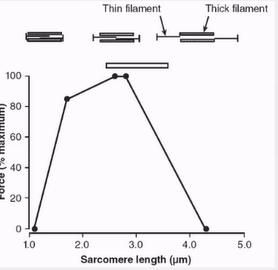
What is the stretch shortening cycle?
Consists of the eccentric phase, ammortisation phase (isometric), then the concentric phase