Model Fitting
 Call Kai
 Learn
Learn Practice Test
 Spaced Repetition
 Match
Match Flashcards
 Knowt Play
1/10

There's no tags or description
Looks like no tags are added yet.
Name | Mastery | Learn | Test | Matching | Spaced | Call with Kai |
|---|
No analytics yet
Send a link to your students to track their progress
11 Terms
Probability
Long-run relative frequency from a random process
Probability characteristics
Between 0-1
Cannot be negative
Sum of all probabilities over all possible mutually exclusive outcomes must equal 1
If 2 events are mutually exclusive, the probability of observing either events is the sum of their individual probabilities
Independence
Knowledge of one event provides no information about the probability that another event will occur
Joint probability
The probability that 2+ different events will occur P(A,B), P(A & B), P(A intersection B)
Probability density function (pdf)
Describes the probability of an event occurring for a continuous distribution (Total area under the curve is 1)
Ex: Normal distribution is a common pdf
Maximum likelihood estimation (MLE)
Involves finding the parameters that maximize the probability of generating the observed data
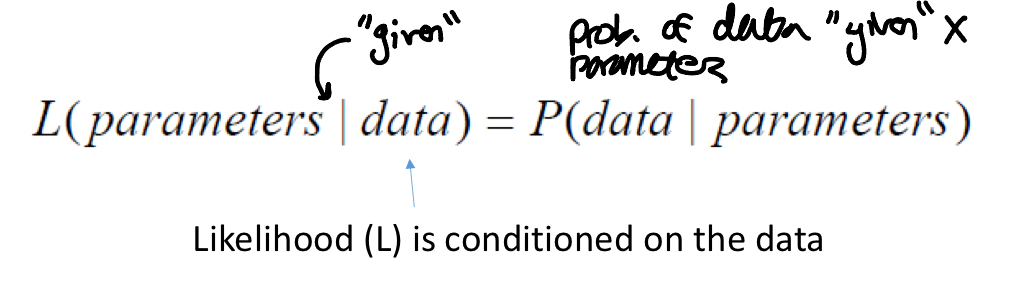
Likelihood does NOT equal probability
MLE parameter estimation
Treat the data as fixed and find parameters that maximize the probability of observing that data
Properties of likelihoods
Do not need to sum to one
Relative measure of model fit
Calculating products is difficult, so logs often used
Properties of MLEs
Invariant to log transformations
Asymptotically efficient (lowest possible var)
Asymptotically normally distributed
Asymptotically unbiased
Same as OLS id errors are normal, additive, and with constant var
Nonlinear optimization
Term for trying to find the max/min of a function
Potential problems with nonlinear optimization
Improper starting values
Model specification/coding error
(-LL) function may be undefined for some parameter values
Parameters action problems
Uninformative data