Patient Care - Intro and Patient Interactions (Unit 1)
 Call Kai
 Learn
Learn Practice Test
 Spaced Repetition
 Match
Match Flashcards
 Knowt Play
1/122

There's no tags or description
Looks like no tags are added yet.
Name | Mastery | Learn | Test | Matching | Spaced | Call with Kai |
|---|
No analytics yet
Send a link to your students to track their progress
123 Terms
Who discovered X-Rays?
Wilhelm Roentgen
What date were x-rays discovered?
November 8, 1895
Define Ionization:
Any process by which a neutral atom gains or loses an electron; acquiring a net charge
Why can mechanical, electrical, heat, nuclear, and electromagnetic energy all be described as “radiation”?
They can be and almost always must be transmitted through matter.
Re-list these forms of radiation based on their energy.
X-rays, Heat, Radiofrequency, Gamma, Light
Which ones are considered to be ionizing?
Heat, Radiofrequency, Light, X-ray, Gamma
X-ray and Gamma are ionizing.
List medical imaging modalities that use ionizing radiation:
X-ray, nuc med, CT, mammo, radiation therapy ,fluoro, PET CT, IR
List medical imiaging modalities that use non-ionizing radiation:
MRI, sonography
This ethical pledge is used by physicians and other health care providers. It includes guidelines for patient privacy and ethical conduct.
Hippocratic oath
What does RT(R) stand for?
Registered Technologist (Radiography)
Define Accreditation:
Voluntary peer-review process where an agency grants recognition to an institution for a program of study that meets criteria.
Define Licensure:
Process by which a government agency (usually a state) grants permission to individuals to practice their profession.
Define Registry:
List of individuals holding a certification in a profession.
Define Third Party Payers:
An entity , like an isurance company or government program (Medicare/Medicaid) that pays for healthcare services on behalf of the individual.
This organization accredits Radiologic Technology educational programs:
Joint Review Commitee on Education in Radiologic Technology (JRCERT)
This organization accredits hospitals and health care facilities:
The Joint Commission (TJC)
What organization do Radiologic technologist go through certification with?
American Registry of Radiologic Technologists (ARRT)
What are mandatory items that an individual or an organization must participate in?
OSHA
State Health Inspections
Continuing Education
Rules of Ethics
What are voluntary items that an organization may participate in?
JRCERT
TJC
Accreditation
ARRT Certification
This law sets national standards for the protection of certain patient health information:
Health Insurance Portability and Accountability Act (HIPAA)
Medical images are stored digitally using this system:
Picture Archival and Communication System (PACS)
What are Clinical Practice Standards?
Specific professional expectations and responsibilities determined by ASRT (job description)
Define direct supervision as it pertains to being a student:
Oversight of clinical procedures by a qualified professional present in the exam or treatment room with the student.
Define indirect supervision as it pertains to being a student:
Oversight of clinical procedures by a qualified professional immediately available to the student.
Milliampere-seconds (___): parameter that controls the ______ of x-ray photos being produces within the tube.
mAs
Quantity
Kilovolt peak (___): parameter that controls the ________ of the x-ray beam.
kVp
Quality/penetrating ability
Source-to-image distance (___): distance the _____& _______.
SID
Source
Image Receptor (IR)
When producing x-rays, the product is ____% x-ray photons and ____% heat
1%
99%
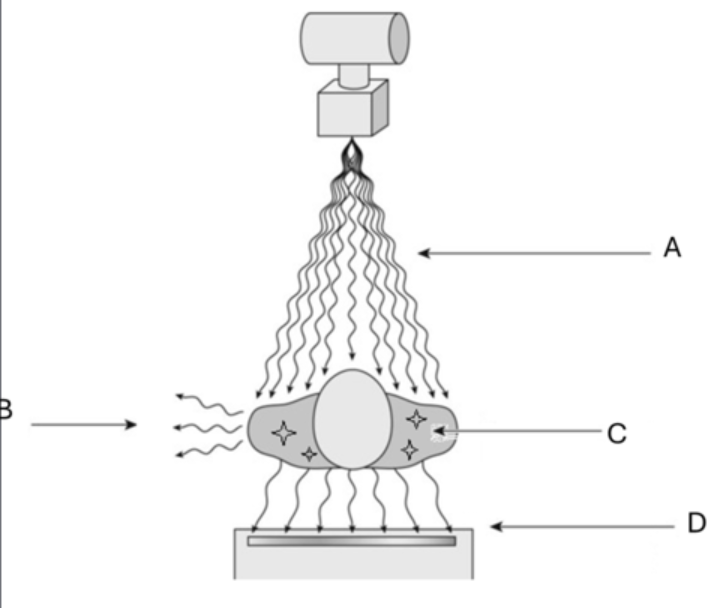
Label
A. Primary Radiation
B. Scatter Radiation
C. Absorbed Radiation
D. Remnant Radiation
What is the difference between radiolucent and radiopaque?
Radiolucent: Permitting the passage of x-rays or other forms of radiant energy with little attenuation.
Will show up dark/black
Radiopaque: Not easily penetrable by X-rays or other forms of radiant energy.
Will shoud up light/white
R/F system allow for this imaging technique
Real time fluoroscopy
List the 5 general/Generic controls the technologist will work with on the control panel/console:
1) Main power
2) X-ray tube rotor exposure
3) kvP
4) mAs
5) Timer
CR & DR both use different types of technology. What is the name of this technology?
Computed Radiography - cassettes
Digital Radiography - direct to monitor display
The greatest advantages of digital imaging include:
Lower dose of radiation
Quicker image presentation
Improved spatial resoution
The cathode element in the x-ray tube is made of _______ and has a _______ shape.
Tungsten
Helix
The difference between adjacent densities on a radiographic image is called . The prime controlling factor of this is _.
Contrast
kVp
What 3 factors must be present for x-rays to be produced?
A source of electrons
A means to accelerate the electrons
Something to rapidly stop this movement
Which SID would result in less radiation exposure for the patient? 40" or 72"?
72"
List 2 'extra' things that are used during fluoroscopy for the radiation protection?
Who are these meant to protect from radiation?
Bucky slot cover & lead drape
The doctor and tech
What does ALARA stand for?
As Low As Reasonably Achievable
List the 3 interactions of x-rays with matter that occur within the diagnostic realm of x-rays.
Classic/Coherent Scatter
Photoelectric Absorption
Compton Scatter
This x-ray interaction with matter is the primary factor in patient dose:
Photoelectric Absorption
This x-ray interaction with matter is the primary factor in occupational exposure dose:
Compton Scattering
What is the annual whole-body effective dose limit for radiologic technologist?
5 rem
What is the annual whole-body dose-equivalent limit for the general population?
0.5 rem
List (briefly describe) the 3 general stages of acute radiation syndrome:
Prodromal Stage
Latent Period
Manifest Stage
Describe the Prodromal Stage:
Nausea, vomiting, diarrhea
Describe the Latent Period:
Biological changes that lead to the final stage.
Describe the Manifest Stage:
Full effects of exposure is felt, leading to recovery or death.
Late effects or radiation is separated into 2 groups. (What are they?)
The most frequent symptoms/aliments from this effect are cataracts &_________.
Somatic effects and genetic effects
Carcinogenesis
When should you avoid shielding the gonads?
When the apron will interfere with the anatomy of interest.
List 3 cardinal principals of radiation protection; which one is the most effective for occupational workers?
Time
Distance
Sheilding
Describe how to manipulate collimation to decrease patient dose:
Restrict the primary beam to the anatomic area of interest never exceeding I.R size (collimate only to area of interest).
Describe how to manipulate the image receptor speed to decrease patient dose:
Use of high-speed image receptors allow images to be produced with reduced radiation. Minimizing exposure.
Describe how to manipulate kVp to decrease patient dose:
Increasing kVp increases the probability that Compton interactions will occur which results in reduced energy being absorbed by the patient.
Describe how to manipulate filtration to decrease patient dose:
Adding filtration will lower patient dose, aluminum is most commonly used.
What mm of lead should be worn during fluoroscopy?
0.5 mm of lead
What distance would decrease dose by 4x?
Double the distance
What is the length of timer placed on R/F machines?
5 minutes
Define Benficence:
Doing of good; active promotion of goodness, kindness, & charity.
Define Nonmaleficence:
Ethical principal that places high value on avoiding harm to others.
Define Veracity:
Duty to tell truth and avoid deception.
Define Fidelity:
Strict observance of promises or duties; loyalty and faithfulness to others.
Define Legal Rights:
Rights of individuals or groups that are established and guaranteed by law.
Define Consequentialism:
Worth of actions is determined by their consequences. Actions are right or wrong according to their balance of good and bad consequences.
Define Non-consequentialism:
Actions themselves rather than consequences determine the worth of actions. Actions are right or wrong according to the morality of the acts themselves.
Define Virtues:
Traits or character that are socially valued, such as courage.
Define Standards of Professional Conduct:
Practice behaviors that are defined by members of profession.
Compare and contrast: The Code of Ethics and The Rules of Ethics
Code of Ethics - acceptable and unacceptable behaviors (guideline for morals).
Rules of Ethics - mandatory rules of acceptable professional conduct for radiologic technologist. These rules are enforceable and punishable through the ARRT.
Describe the ARRT honor code. What might prevent a student (in any x-ray program) form taking the ARRT certification exam?
Honest, integrity & righteousness, suspension, dismissal, and being expelled from the radiology program = likely to prevent from taking ARRT exam again.
Define False Imprisonment:
Conscious restraint of the freedom of a person without proper authorization, privilege, or consent.
Define Libel:
A type of defamation which involves written or published comments or pictures (newspaper, magazine, etc).
Define Defamation:
A false statement that damages the good reputation of someone; spoken or written.
Define Slander:
Defamation by oral or spoken communication.
Define Tort:
A wrongful act or an infringement of a right (other than under contract) leading to civil legal liability.
Define Assault:
Any willful attempt or threat to inflict injury on the person of another, intentional display of force that would give the victim fear.
Define Battery:
Any unlawful touching of another that is without justification or excuse.
Define Res Ispa Loquitar:
The thing speaks for itself.
Define Respondant Superior:
Let the superior respond or the master speaks for the servant.
Define Negligence:
Failure to do something that a reasonable persone guided by the ordinary considerations that regulate human affairs would do.
What 4 elements must be proven in a case of negligence?
Duty: the defendant had a duty to care to the plaintiff
Breach of duty: the duty was breached or violated by the defendant
Causation: the defendant's actions directly caused the plaintiff harm or injury
Damages: the plaintiff suffered obvious damages
Describe Implied vs. Informed Consent:
Implied: Inferred by actions or inactions
Informed: Agreement to allow something to happen, typically invasive procedures. Patient must understand risks, benefits, alternatives.
A living will, health care proxy, and advanced health care direction are all legal documents that:
Are advanced directives. They provide an individual a means to direct healthcare if a situation occurs in which they are unable to make decisions.
How long do health records need to be retained?
5-10 years (7 years Colorado)
How long do medical images need to be retained?
5-10 years
How long do mammogram records need to be retained?
5 years minimum, but 10 years if there is only 1 on record.
List 5 things that must be on a radiology order before it can be performed:
Pt name
Pt DOB or Pt ID #
Reason for exam/procedure
What exam + what side
Ordering physician
TJC requires that all health record entries be ____ & __________ by their authors (in radiology, this is typically the tech's initials).
Dated and Authenticated
What must be considered when using abbreviations in medical records?
They are approved by the hospital/institution
Describe ICD-10-CM and ICD-10-PCS
ICD-10-CM: code used for diagnostic coding. The diagnosis, symptoms, or reason for visit. (clinical & outpatient setting).
ICD-10-PCS: code used to classify procedures performed in the inpatient setting.
After a written error in a patient record, how should it be fixed?
Crossed out, initialed and dated.
If a patient asks about their radiology report or their diagnosis, how should you respond?
Direct them to their physician/radiologist for any information or questions regarding their report or diagnosis.
The physical or electronic medical record belongs to the __, whereas the actual information within the medical record belongs to the ___.
Facility
Patient
Radiology reports should not be shared with the patient while the report is:
Not dated and authenticated (finalized) by the radiologist.
List some things a rad tech may need to chart during an x-ray exam.
Subjective + objective data, Pt history
Describe one bias that a rad tech might have that could affect their job or patient care
Age, ethnicity, race, gender, and religon
List Maslow's Hierarchy of needs; starting with the highest level to the lowest level
Self-actualization
Aesthetic needs
Cognitive needs
Esteem needs
Love and belongings
Safety needs
Physiological needs
What is paralanguage and why might it be important when communicating with a patient?
The music of language; cadence + rhythm of speech. Patients receive signals about your attitude towards them from your pitch, stress, tone, pauses, speech rate, etc.
Define Autonomy:
A person's self-reliance, independence, liberty, rights, privacy, individual choice, freedom of will, and self contained ability to.
List information that is required to be included on radiographic images:
Patient name and/or ID #
Marker (L or R)
Date of exam
Hospital/institution
What is the difference between subjective and objective patient history? Provide an example of each
Objective: data you can see, hear, or feel. Such as vital signs or lab results
Subjective: perceived by the patient, pain scale, tenderness, mainly feelings.