Exam 4 - PSY 361
 Call Kai
 Learn
Learn Practice Test
 Spaced Repetition
 Match
Match Flashcards
 Knowt Play
1/101

There's no tags or description
Looks like no tags are added yet.
Name | Mastery | Learn | Test | Matching | Spaced | Call with Kai |
|---|
No analytics yet
Send a link to your students to track their progress
102 Terms
Ages for Middle Childhood
6-12
Growth in inches and lbs per year
2 inches and 7.5 lbs
Secular trend in physical growth
successive generation over the past 150 years grow taller than the previous one due to improved health and nutrition
3 changes in 3 aspects of brain structure with age
total surface cortical area expands at age 3 and onward, reaches peak at 10 years in many areas of the brain, and slightly declines in adolescence
cortical thickness slightly declines btwn 3 and 20 years in all areas of the brain
white matter fiber tract has its independent growth pattern
Large-scale functional neural networks
regions in the areas of the brain has stronger connectivity within networks than between networks
What does fMRI scans detect?
Blood Oxygen Level Dependent signals of the brain
detects rising oxygen levels in blood in cognitive effort
Resting state fMRI
procedures that measures of the flutuations of oxygen use over a long period of time, helps maps on large-scale functional neural networks
What delays maturation of the brain?
Selective experiences of poverty
ADHD
characterizes by inattention and hyperactivity-impulistivity
Inattention
not paying close attention to details, making careless mistakes, failure to complete tasks, diffculty organizing tasks
Hyperactivity impulsitvity
interrupting or intruding on conversations, games or any organized activites, excessive locomotion, fidgeting, and talking
ADHD is co-morbid with
other common childhood disorders including dyslexia, oppositional defiant disorder, conduct disorder, and anxiety and depressive disorders
Subtypes
ADHD-I (predominately inattentiveness), ADHD-HI (predominately hyperactivity-impulsivity), ADHD-C (combined types)
Diagnoses requires
symptoms occur in more than one environment
symptoms occur more than 6 months
rating forms completed by teachers or parents (i.e. Conners, CBCL
Impairements
organizaitonal, academics, functionality, social
Symptoms of ADHD-I
inability to consistently focus (selective attention), unable to manage simultaneous stimuli and shift from one task to another, focuses on irrelevant information, easily distracted
central problems: control and self-regulation
Symptoms of ADHD-HI
rude, careless, accident-prone, disorganized,
Genes and Environment
ADHD is inherited from family and scientists are targeting several candiate genes such as varient genes such as DRD4 dopamine receptor genes
fetal alcohol exposure, environmental lead exposure, and maternal smoking while preganant
Cognitive deficits
deficits or delays in developmental brain’s external functioning system and combined neuropsychological deficits
certain areas of the brain such as prefrontal cortex in children with ADHD that is too small or less functional
Other possible deficits: delay aversion, exectutive functioning, emotional regulation, state dysregulation
Interventions
Medications (adderall, ritalin, concreta): reduce hyperactivity and impulsivity and focus more on school work and positive interactions with kids
Psychotherapy or behavioral management: minimizes behavioral problems and increase executive functioning, focus on strenghts and promoting change through reinforcement
Dynamic Systems Theory place emphasis, regarding motion, on
motivation, brain maturation, movement capacities, and opprotunites to practice
How long do adolescents need to engage in moderate to viagorous activity?
60 minutes
What has recent years revealed about physical activity?
reduced engagement in physical activity
When are children most active?
in middle childhood
Pediatric Inactivity Triad
3 barriers in physical activity including insufficent cardiovascular fitness (excerise deficit disorder), insufficent levels of muscle strength (pediatric dynapenia), lack of knowledge and motivation to engage in physical activity (physical illteracy)
Children’s motive for sports
testing abilities, learning new skills, excitement, having fun, personal accomplishment
Argument of Specialization
power law of practice, rule of 10+ years, required from certain sports
Argument of Diversification
consistent performances, long-standing interests, less injuries
Myopia
nearsightedness; variaitions of growth in the eye that causes the lens to focus image in front of the retina instead of exactly at the retina
Which has less problems in middle childhood: hearing or vision?
Hearing
What lower the risk of myopia?
going outside frequently
Recommended hours of lseep
9-11
3 primary sources of knowledge about illness
science education, cultural learning, intuitive biology
Children understand preventative behaviors of illnesses as early as
preschool
Unintentional injuries
one of the leading cause of death in ages 1 to 4 and 5 to 14
Motor Vehicle Accidents
frequent source of fatalities at 1 to 4
Overweight vs. obese
BMI above 95th percentile vs. BMI in 85th to 95th percentile
What lifestyle do people lead more presently?
Sedentary
Contributers to rising rates of obesity
frequent dining at fast food which contains carbohydrates and fat; it is convient for families
Consequences of obesity
chronic illnesses, poor sleep, low body image and self-esteem, obesity in adulthood, exclusion and teasing by peers
Weight bias
negative weight-related beliefs and attitudes towards people who are obese and overweight
Concrete Operational Stage Ages
7-11
Limits in Concrete Operational
inability to think abstractally and hypothetically (i.e. “if you get good grades, you can get into a college for the future”)
limited to concrete, tangible objects and events (can not understand why they can not get objects with a reason when promised)
Abilites
less egocentric, think logically about concrete objects and events, can understand conversation, can perform operation on concrete objects
Concrete operations
systematic mental rules or procedures that are reversible
Class inclusion: subordinate (i.e. dog) and superordinate (i.e. animals) relate
Seriation
ordering objects along its quantitive dimensions such as length and size
Transitvity
the ability to reason about the relations between objects in serial ordering (i.e. 3>2, 2>1, 3>1)
Egocentric frame of reference
naviagating based on the location of the object and landmark realitive to the viewer’s position
Allocentric Frame of reference
navigative locations based on other object and landmarks independent of viewer’s position
Cognitive map
encoding, route knowledge, transitioning to allocentric frame
Spatial skills
adapting your body to the environment
Performance may result from gradual shift in
informational-processing, knowledge and practice
Performance is dependent on
familiarity with materials
Executive control
working memory, inhibiting responses, shfiting mental tasks
When do processing speed increase rapidly until?
mid-adolescense
Improvements of processing speed
complex thinking, working memory and attention
3-Stage Memory Model
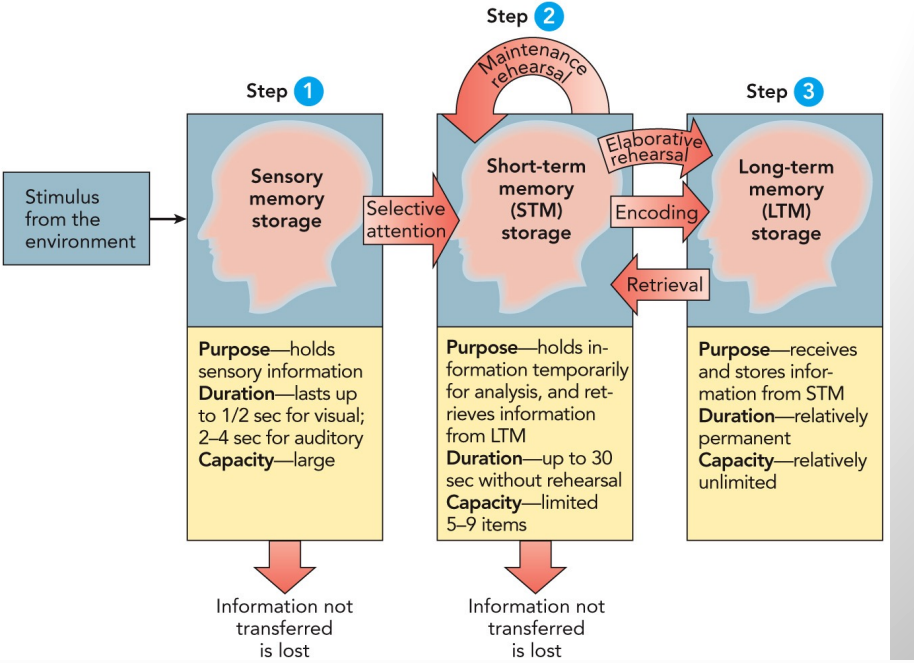
Maintenance rehearsal
repeating information to keep it in working memory
Elaborative rehearsal
building on from what you learned
linking new information to previously learned information creating deep levels of processing
Working Memory
seen as a workspace within the mind that carries out operations, stores information, and make decisions on a moment-to-moment basis
Baddley’s Influential Model
sees working memory as a limited storage capacity that holds information temporaily active to problem solve and think
4 Components of working memory
Center Executive
Visuospatial Sketching: holds spatial and visual information
Phonological looping: holds articulated sounds
Episiodic buffer: temporarily recounts events based on spatial, visual and auditory information
Semantic memory
a vast wide network of connections between concepts that includes words as well as themes
Consolidation
securing new information into storage
Memory Strategies
Rehersal: maintenance and elaborative
Organization: Acronym, method of loci, hierarchies
Metamemory: knowledge about memory
Meta-communication: meaning behind what someone says
Retrieval cues and types
cue or prompt that helps stimulate recall or retrieval of stored piece of information from long-term memory
Recall, recognition, elaborative rehersal, and priming
Recall vs. Recognition
rely on nonspecific cues (i.e. essay tests) vs. rely on specific cues (i.e. multiple-choice tests)
Priming
prior exposure to stimulus helps facilitate or indicate the processing of new information, with no unconsious memory of initial learning and storage
Encoding specificity Principles and types
retrieval of information is improved when the context of recovery is similiar to the context of the endcoding
Context-dependent memory (i.e. recalling information when sitting in a specific classroom)
Mood congruence (i.e. when partner makes you mad, you recount all the time they made you mad)
State-dependent memory (i.e. if you learned a joke while drunk, you will probably rememeber in that state of drunkness)
Acronym Method
Using the first letters of a stack of information you want to rememeber and create a code word (i.e. PEMDAS)
Method of Loci
Ex. remembering a speech by breaking it into parts and associating them with location such as justice with a courthouse by the garden where he practices the speech
Digit vs. Reverse span task
remebering a set of number forward vs. remembering a set of number backwards
Intellectual disability
a delay in cognitive development
otherwise known as mental re***dation
needs an IQ score of 70 or lower and adaptive behavior deficit before 18
Adaptive behavior deficit
inability to perform daily living tasks
Who performed the first intelligence test?
Alber Binet
What intelligence is most widely used today?
Weschler scale
General Intelligence
(g) identifies intelligence as a single entitiy
Hierarchical model of intelligence
general intelligence at the top, specific abilities in the middle, and individual skill at the bottom
Intelligence Quotient
forms normal distributive across populations
Limits of IQ
only measures cognitive skills, scores can fluctuate, not true for non-White and low-income
Twin/adoption studies on intelligence
50 percent of vaired intelligence is heritable, 25 percent is from shared environment, and 25 percent is from nonshared environment
Intellectually gifted
IQ score of 130 or higher or is highly creative and talented in one or more specific domains
Inclusion
spend most of the day in regular classroom with the assistance of instructor aid and part of the day in special education class in a small-group instruction with special education teachers
Rates of inclusion
60 percent spent 80 percent in regular classroom, 20 percent spent 40-80 percent, 14 percent spent less than 40
8 Distinct Kind of Intelligence
Visual-spatial, music, bodily kinesthetic, naturalistic, linguistic, logico-mathematical, intrapersonal, interpersonal
Sternberg’s Triarchic Theory of Successful Intelligence
Analytical intelligence, creative intelligence, practical intelligence
Prevelance of developmental language disorder
7 to 10 percent of children entering kindergarten
Metalinguistic awareness
ability to reflect on language (i.e. puns, knowing to stay quiet in the library)
English language learners
needing assistance in learning english
Substractive bilingual model
recieving instruction only in english (offering english as a second language)
bilingual educational approaches
recieving instruction in both languages
Additive bilingual models
prioritizing learning both first and second languages
Linguistic interdependence hypothesis
profeiencey in one language is transfered to second language competency (i.e. reading skills)
Reading comprehension: bridging inferences
information from one sentences or compound of a sentence is connected to another (i.e. The bridge collasped. The wood was rotten: the wood made the bridge collasped)
Elaborative inferences
adding optional details beyond what is written on the text (i.e. "The director and the cameraman were ready to shoot closeups when suddenly the actress fell from the 14th story." -> The actress died (or is severely injured).
Create meaning through situational model
memory representations that holds information presented in written text, inferences, and overall interpretation of events, while losing some of the detailed wording of sentences
Self-teaching mechanism
repeating phonological decoding to transition to sight-word recognition
Whole language approach
assumes child learns how to read naturally
uses meaningful text
has children read whole, interesting books early on
Phonics approach
assumes children need basic decoding skills first
teaches pattern recognition
uses worksheets
5 stages of compositional skills
Planning, drafting, revising, editing, publishing