Social constructivism
 Call Kai
 Learn
Learn Practice Test
 Spaced Repetition
 Match
Match Flashcards
 Knowt Play
1/14

Earn XP
Description and Tags
irt
Name | Mastery | Learn | Test | Matching | Spaced | Call with Kai |
|---|
No analytics yet
Send a link to your students to track their progress
15 Terms
basic assumptions
Social constructivism assumes that ideas play an important role in shaping/ constructing INT pol.
Can take many forms: - Perceptions/ expectations about others/ situations. - Definitions of interests - Values & ideology’s, scientific convictions - Framings of ideas, narratives, discourses, …
& these are socially constructed themselves, so individuals/ other actors influence each other in the forming of their ideas.
Constructivism has its roots in critical theory
= challenges rationalist theories like neorealism & neoliberal institutionalism on ontological & epistemological grounds
Ontological criticism:
Rationalists think actors are rational & their identities & interests are pre- given (related to their place in the INT system).
But: critical thinkers (& constructivists) think identities & interests are socially constructed instead of pre-given. —> ideas play a crucial role here
Epistemological criticism:
Rationalists think scientists are independent from the research subject & only make empirical observations.
Rationalists think scientists are independent from the research subject & only make empirical observations. But: critical thinkers (& constructivists) think that nobody is completely detached from the social reality they study. + they note that ideas can’t be measured w only empirical methods.
role theory
Within a social environment, actors (states, int orga’s..) adopt certain roles:
- Actors can form their own role conception (by which they prescribe for themselves how they should behave w others).
—> If they behave accordingly = role performance.
how is a role conception formed?
Through a combination of internal (an actor wants to have some agency to define its own identity and interests) and external (perceived) expectations of others actors, based on their role in the INT system) (= also role expectations) dynamics. ex. US defines itself as a beacon of hope & thus bound to lead & is also expected to by its allies
When actors have multiple roles, role conflicts can arise = when dominant role conceptions in role-sets are incompatible. ex. EU trying to combine role as human rights defender & tough guardian of member states’ borders.
international norms
Constructivists spend a lot of time explaining the development & effects of international norms (which prescribe ‘appropriate behavior for actors with a given identity - Finnemore and Sikkink).
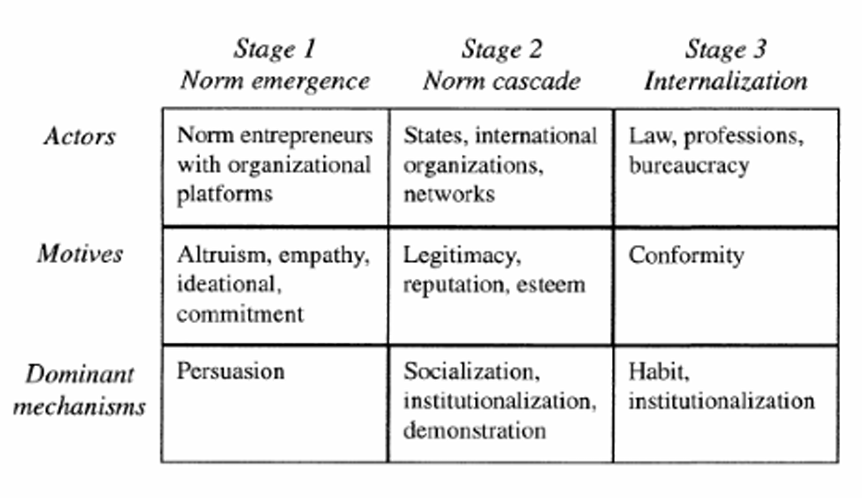
theoretical framework explaining norm diffusion in the form of a life cycle
norm emergence
norm cascade
norm internalization
norm emergence
= occurs through the activism of norm entrepreneurs who challenge existing norms (ex. Henri Dunant - impressed by the horrors of Solferino in 1859 - created the Red Cross to campaign for INT norms for warfare).
norm entrepreneurs
They are likely confronted by norm contestation by norm antipreneurs (who want to preserve the established norms)
+
Actors can even try to undermine the established norms, to bring back a previous normative order (= norm spoiling). —> often quite subtitle by making reinterpretations, new language, connecting with old discourses, …
This is quite actual today: is interesting to look at how phenomena like ISR expanding its settlements, Russias invasion & annexation, … have been eroding INT norms like non-agression and territorial integrity.
norm cascade
= after a while, a tipping point can occur; when more stats come to adopt the new norm (for the sake of their reputation, but also more deeply to confirm their identity as belonging to the right category of states)
norm internalization
= norms are no longer questioned, but taken for granted; can even become written INT law.
Alexander Wendt’s social constructivism
Wendt’s theoretical framework is made up by states as the main actors, that together form a INT structure (like Kenneth Waltz)