DM- CH 8 Impression Materials
 Call Kai
 Learn
Learn Practice Test
 Spaced Repetition
 Match
Match Flashcards
 Knowt Play
1/55

There's no tags or description
Looks like no tags are added yet.
Name | Mastery | Learn | Test | Matching | Spaced | Call with Kai |
|---|
No analytics yet
Send a link to your students to track their progress
56 Terms
Impression materials
A. Used to make replicas
• Impression is a negative reproduction
• Model, Cast, Die are positive reproductions
B. Impression material systems used for:
• Study Model
• Cast
• Die
Impression Material Systems:
Water/Powder
Heated/melted materials
*Paste/Paste
*Used with impression trays
Impression Materials costs
• Can be inexpensive - very expensive
• Depends on type of impression taken
Impression Trays
• Used to carry impression material to mouth, support impression and improve accuracy
Types of trays
• Impression
• Stock
• Custom
• Special-use
Custom trays
Made on study models, 2 steps:
• Make study model from alginate imp.
• Then make custom tray from that model
Special-use trays
Triple Tray
• Used to obtain replica of biting surfaces of teeth
Chemical reaction or physical change
thermoset and thermoplastic
Thermoset
Material sets by a chemical reaction
- Strong cross-link bond, strong covalent bonds bwetween polymer chains
Classification of impression materials
1. Chemical reaction or physical change
2. Use:
a). Elastic/inelastic
b). Accuracy
c). Flow and detail reproduction
3. Types of impression materials
Thermoplastic
Material sets by a physical change when it cools
- Weak intermolecular forces between polymer chains, no cross-links between chains (softens when heated)
Elastic
Used for dentulous patients, flows well
Inelastic
Used for edentulous pts. Sets hard/rigid
Accuracy
Different materials used for more or less accurate
impressions
Flow and detail reproduction
Viscosity of material; is it thick or thin
Inelastic impression material
1. Plaster
2. Wax and Impression Compound
3. Zinc Oxide-Eugenol (ZOE)
Aqueous elastomeric
1. Alginate: Irreversible Hydrocolloid
2. Agar: Reversible Hydrocolloid
Nonaqueous elastomeric
1. Polysulfide
2. Condensation Silicone
3. Polyethers
3. Addition Silicone
Plaster
Chemically set, edentulous pt. for dentures, seldomly used
Wax and Impression Compound
• Wax: Physically set, edentulous pts., inexpensive, can also be used to extend trays
• Impression Compound: Physically set, edentulous pts., it's wax with fillers, cools at temperature of the mouth
Zinc oxide-eugenol (ZOE)
Chemically set, limited use as imp. of edentulous ridges, hard/brittle, bad taste
b) Aqueous elastomeric
c) Nonaqueous elastomeric
Aqueous elastomeric material
Has water
• Water = Dehydration of material when exposed to air, leads to deformation
Alginate (Irreversible Hydrocolloid)
Chemically set, used for preliminary denture imp., custom trays, study models
Agar (Reversible Hydrocolloid)
Physically set, used for partial dentures, inlays, crowns, bridges
Nonaqeuous elastomeric material
Has no water
All are chemically set, used for full/partial dentures, inlay, crown, bridge, when very detailed impressions are needed
No water = No dehydration and deformation
• Polysulfide
• Condensation Silicone
• Polyethers
• Addition Silicone
Sol
fluid state
Reversible
Will return to sol state when heated
Irreversible
Not able to return to sol state
Alginate (Irreversible Hydrocolloid) Properties
• Aqueous (need water), elastic, chemically set, mix powder/water
• Easy to use, not accurate, not for detailed replicas
Alginate (Irreversible Hydrocolloid) Composition
• Powder has potassium alginate (seaweed), silica (provides body)
Alginate (Irreversible Hydrocolloid) Setting Reaction
• Reactor: Calcium sulfate
• Retarder: Sodium potassium
• Carboxylate groups work with calcium ions to form the gel
Alginate (Irreversible Hydrocolloid) Use and Handling
• Advantages: easy to pour, wets tooth surface and absorb oral fluids to decrease air bubbles
• Disadvantages: Distorts & shrinks when exposed to air
Dimensional change
expansion and shrinking
Taking an impression with Alginate:
A. Fluff container (wear mask)
• Silica can cause lung issues
B. Mix powder & water
• Cold = sets slower, warm = sets faster
C. Spatulate with pressure to remove air bubbles
D. Load tray
E. Take impression
F. Removal; quick snap motion to decrease deformation
G. Sets in 3-4 min (Reg) 1-2 min (fast set)
H. Disinfect, wrap, pour with gypsum
Agar (Reversible Hydrocolloid) Form of Material
Semisolid material in tubes and sticks
• Mostly water
• Used as a growth medium in biology
• Components include mold inhibitors and sulfate
compound; this improves hardness of gypsum when
poured
Agar (Reversible Hydrocolloid) Equipment
• Requires equipment to heat, cool and store agar material
• Specialty trays
Agar (Reversible Hydrocolloid) Preparation of material
• Boil to soften, store at 150 degrees until using, temper at 110 degrees when ready to use
Agar (Reversible Hydrocolloid) Hysteresis
• The characteristic of melting and gelling at different temperatures
• Melts at very high temperature, gels at cool temperature
Agar (Reversible Hydrocolloid) Advantages/Disadvantages
• Works well in wet environment, but very expensive for equipment
Agar (Reversible Hydrocolloid) Popularity
• Not popular due to expense and process
Nonaqueous Elastomeric (Rubber) Impression Materials
AKA rubber-based materials, elastomers, elastomeric
• Used for more detailed impressions for indirect restorative processes
Nonaqueous Elastomeric (Rubber) Impression Materials is set by
polymerization reaction
Polymerization reaction
Chemical process where many small molecules (monomers) combine to form larger molecules (polymers), leaves no biproducts and does not evaporate
Nonaqueous Elastomeric (Rubber) Impression Materials are
• More stable and accurate than hydrocolloid materials
• More expensive than hydrocolloid materials
ex: Polysulfide, Polyether, Condensation Silicone, Addition Silicone
Polysulfide Impression Materials Advantages
• Elastic, chemically set, accurate and stable
Polysulfide Impression Materials Disadvantages
• Smell and taste bad
• Need custom trays
• Long working time, up to 10 minutes
Mixing polysulfide
• 2 pastes; white base and brown accelerator
• Mixed for 30-90 seconds until homogenous
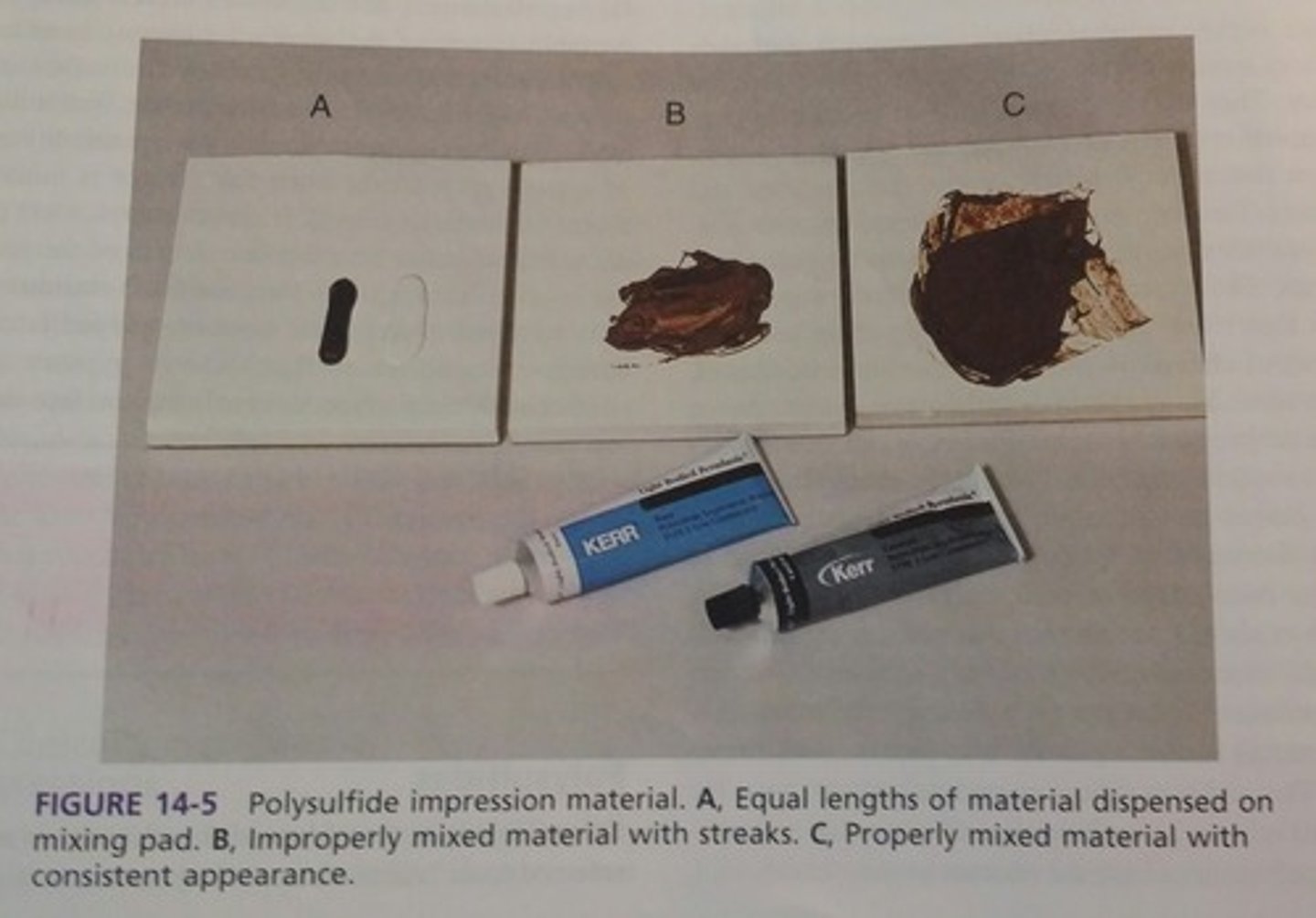
Use of polysulfide materials
• Used for final impressions of dentures, partials, crowns, bridges, inlays
• Much more accurate than alginate
Condensation Silicones
• Not used, difficult to pour
• Make many air bubbles
• Have an alcohol byproduct
Polyethers
1960's development
• Shorter working time than polysulfide material
• Stiff and accurate
• Easy to pour with gypsum
• Use disposable trays
• Bad taste
Addition Silicones
Most popular, most accurate and stable, used for crowns, bridges, etc
Addition Silicones Polymerization Reaction
• No evaporation or byproducts
Addition Silicones Viscosities and mixing
• Various available, automix gun can be used
Addition Silicones Use of putty
1. Purpose
• Fills majority of the tray, high viscosity, low viscosity material covers it
2. mixing, working, and setting times
• Manually knead 2 materials together with fingers
Addition Silicones Additives to the material
1. Surfactants: Increase wetting and decrease bubbles
2. Hydrogen absorbers: Prevent hydrogen bubbles when pouring up with gypsum