Physics U2 U3
 Call Kai
 Learn
Learn Practice Test
 Spaced Repetition
 Match
Match Flashcards
 Knowt Play
1/68

There's no tags or description
Looks like no tags are added yet.
Name | Mastery | Learn | Test | Matching | Spaced | Call with Kai |
|---|
No analytics yet
Send a link to your students to track their progress
69 Terms
What is the formula for phase difference
2λ/π x path difference
The filament in a lamp is a metal wire. A current in the filament causes heating. Explain how the resistance of the filament changes as the temperature of the filament increases
The (amplitude of) lattice vibrations increase
There is an increase in the frequency of collisions of electrons with the lattice
So the resistance increases
what is the formula for number of lines per mm?
1/ d x 1000
A teacher demonstrated the properties of radio waves. He used an aerial to detect the
radio waves.
Initially, the aerial was vertical, and a maximum intensity of radio waves was
detected. The teacher rotated the aerial by 90° so that it was horizontal.
He observed that when the aerial was horizontal, the radio waves were not detected.
Explain this observation
Oscillations are in one plane / one direction
So radio waves are polarised
polarization:
Polarisation = The direction in which a transverse wave oscillates.
Plane polarised = Oscillations in one plane only (e.g. up and down).
Unpolarised = Oscillations in many random planes.
only transverse waves can be polarized.
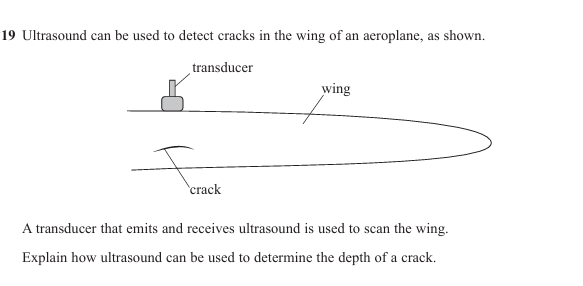
(6)
First, pulses of ultrasound are sent into the metal block. (
When the ultrasound meets the crack, it is reflected back towards the detector.
The time between sending the pulse and receiving the reflected pulse is measured.
Because the speed of ultrasound in the metal is known, the distance to the crack can be calculated.
Using the wave equation: speed=distance x time
Therefore, total distance travelled by ultrasound= speed × time
However, the time measured is for the ultrasound to travel to the crack and back.
So, the distance to the crack is half the total distance travelled.
Thus, the depth or position of the crack inside the metal can be found.
) The threshold frequency of the metal in the pixels is equal to the frequency of green light. The pixels were exposed to white light with the same intensity as the UV light. The UV light source was removed. Explain how this changed the percentage of photons that released electrons. (4)
When white light replaces UV light, the percentage of photons releasing electrons decreases.
This is because white light contains a range of frequencies.
Only photons with frequency greater than or equal to the threshold frequency (green light) have enough energy to release an electron.
Photons with lower frequencies (red, orange, yellow) do not have enough energy.
Therefore, a smaller percentage of the incident photons release electrons compared to UV light, where all photons had enough energy.
Explain why temperature increases with resistance.
(free) electrons collide with metal ions in the lattice
(As the temperature increases),
the lattice vibrations increase Increased rate of collisions between electrons and atoms / ions /lattice
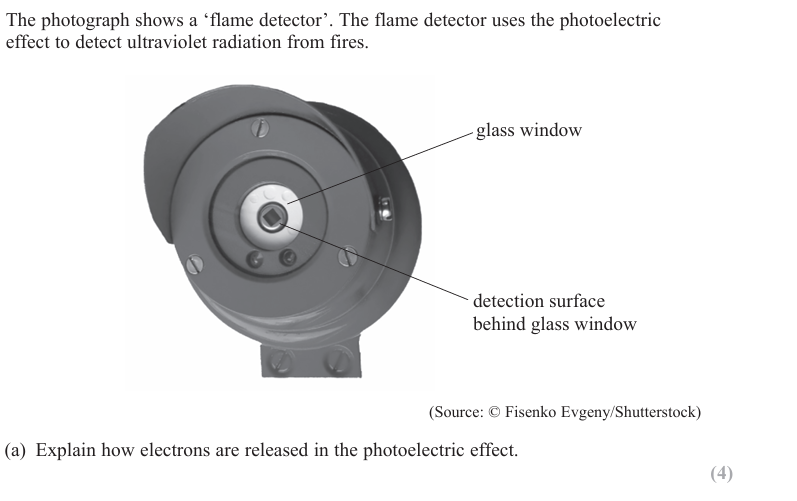
Photons incident on (metal) surface / plate
Energy of one photon is transferred to one electron
Photon energy is proportional to frequency
Some energy used to release the electron from the surface (of the metal)
Or
Some energy used to overcome the work function (of the metal)
Remaining energy transferred to kinetic energy of the electron (that are released)
State what is meant by coherent light
Constant phase difference / relationship
Explain why a series of bright dots was formed on the screen. (3
(At a bright dot) the path difference is equal to a whole number of wavelengths (So) these waves are in phase So constructive superposition / interference takes place
Accept path difference = nλ (for M1)
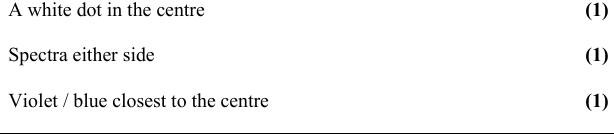
The student replaced the laser with a lamp that produced a narrow beam of white light. Describe the pattern that formed on the screen. (3)
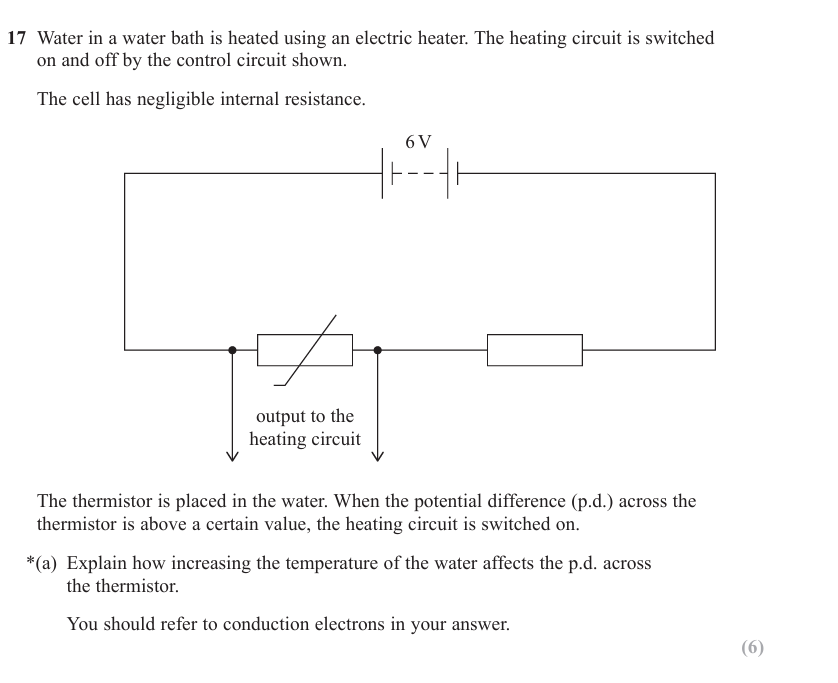
IC1 (As the temperature increases) electrons (in thermistor) gain energy
IC2 So more conduction electrons (are released)
IC3 So the resistance of the thermistor decreases
IC4 The thermistor and resistor are in series so the p.d. is shared Or Thermistor and resistor form a potential divider and share p.d.
IC5 Resistance of thermistor becomes a smaller proportion of total resistance in the circuit Or p.d across fixed resistor increases because current increases
IC6 So the p.d. across the thermistor decreases
Explain the difference between unpolarised light and plane polarised light. (3)
Unpolarised has oscillations / vibrations in all / many directions
Plane polarised has oscillations / vibrations in one direction
Which is perpendicular to the direction of (wave) travel
Explain why rotating the polarising filter will not change the intensity of the light that passes through the filter. (2)
The polarising filter only transmits light in one plane / direction (as the filter is rotated) a different single plane / direction of oscillation passes through, so the intensity stays the same
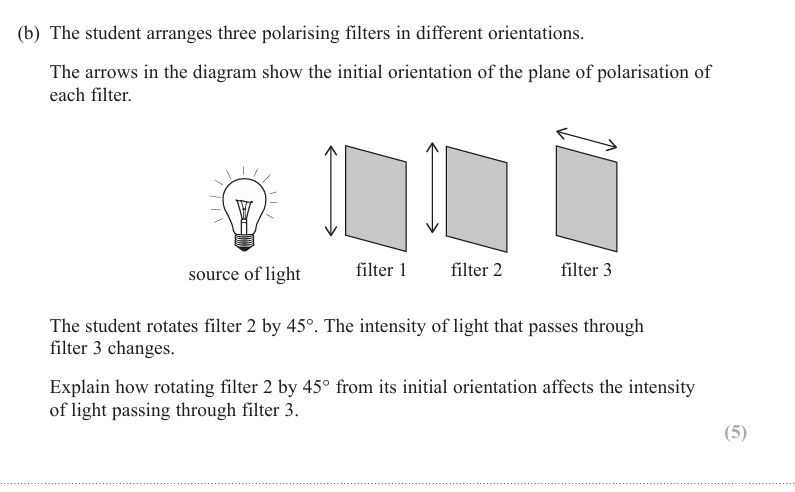
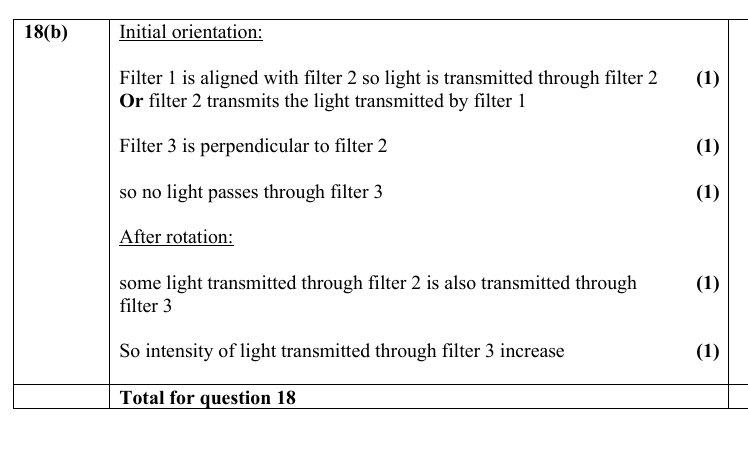
The student uses a polarising filter to view the light reflected by the glass block. Explain what she would observe as she rotates the filter. (3)
Intensity of light varies from a maximum to a minimum every 90 degree rotation The maximum intensity occurs when the (plane of) the polarising filter is in the same direction as the (plane of) oscillation of the light Or The minimum intensity occurs when the (plane of) the polarising filter is perpendicular to the (plane of ) oscillation of the light
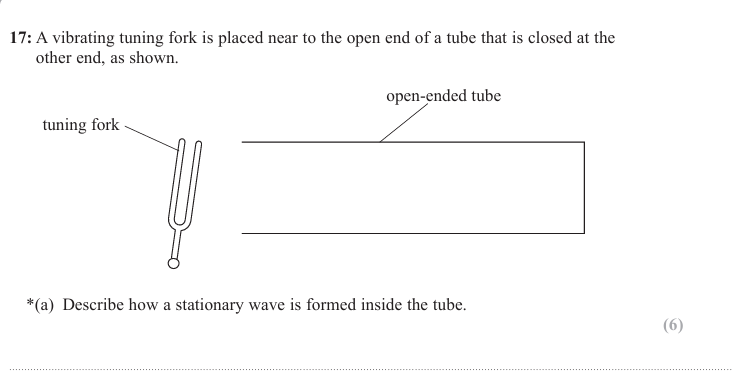
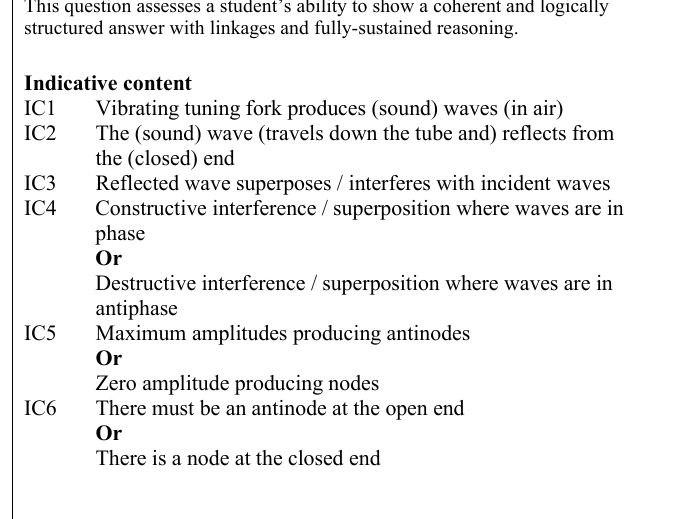
Light is a transverse wave.
State what is meant by a transverse wave. (1)
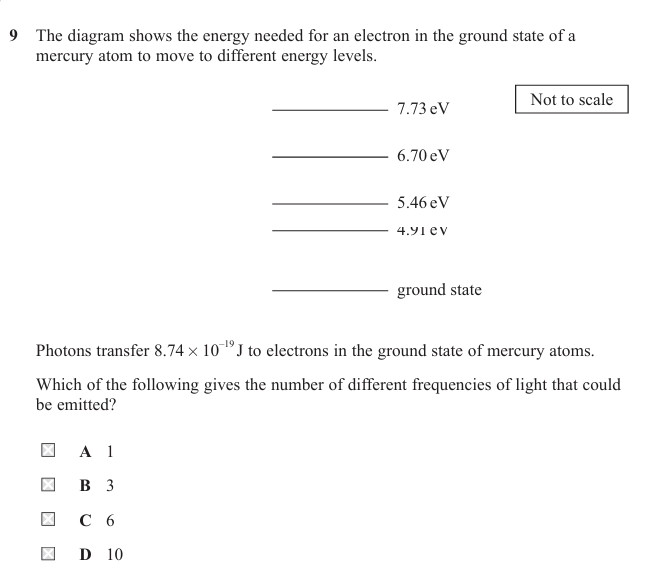
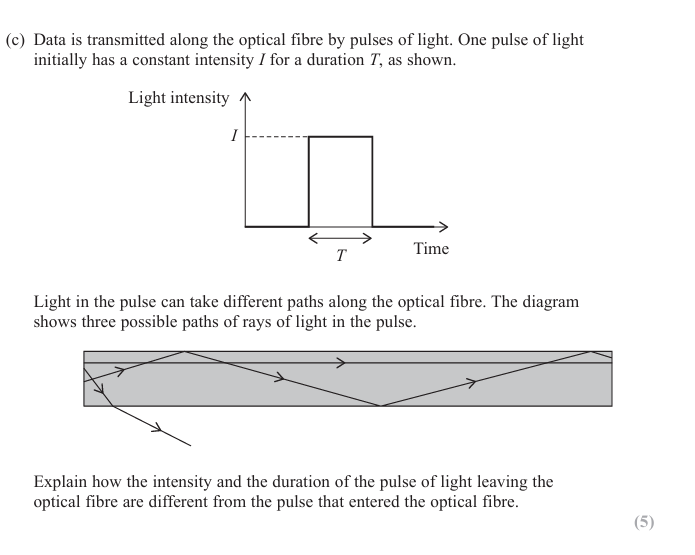
Rays of light have different (path) lengths / distances So different rays take different times (to travel to the other end of the optical fibre) So the duration of the (emerging) pulse is longer / greater And some rays refract out of the fibre So the intensity of the emerging pulse / light is lower
The transparent material has a lower refractive index than the glass of the
optical fibre.
Explain how the cladding affects the critical angle for light at the boundary of the
optical fibre.
There is a smaller difference in refractive index
Or There is a smaller difference in speed of light between the two materials
Or cladding has a greater refractive index than air
Or cladding has a refractive index greater than 1
(So) the critical angle is increased
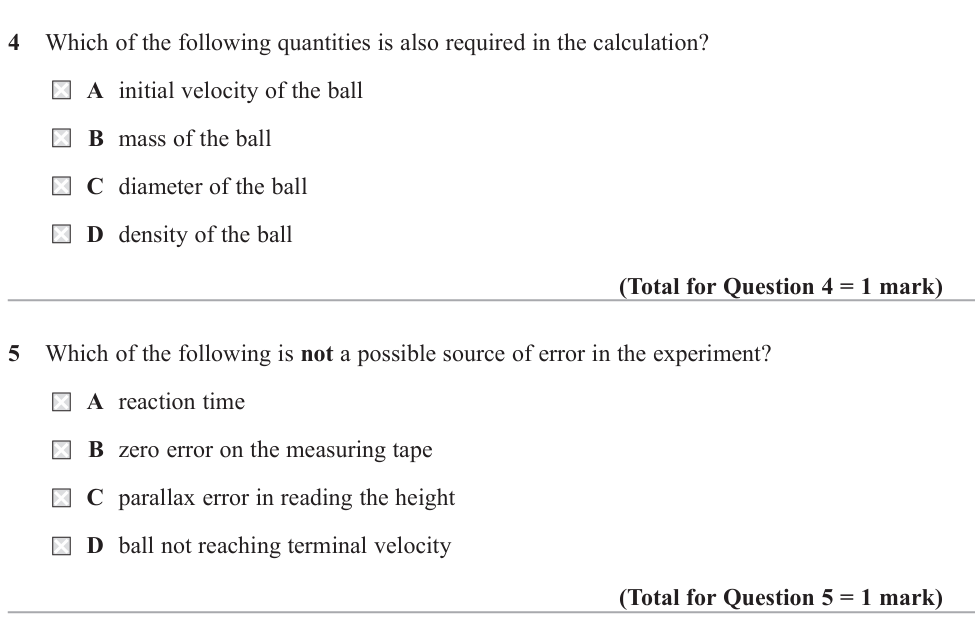
Calculation referred to is for acceleration.
Jan 2019
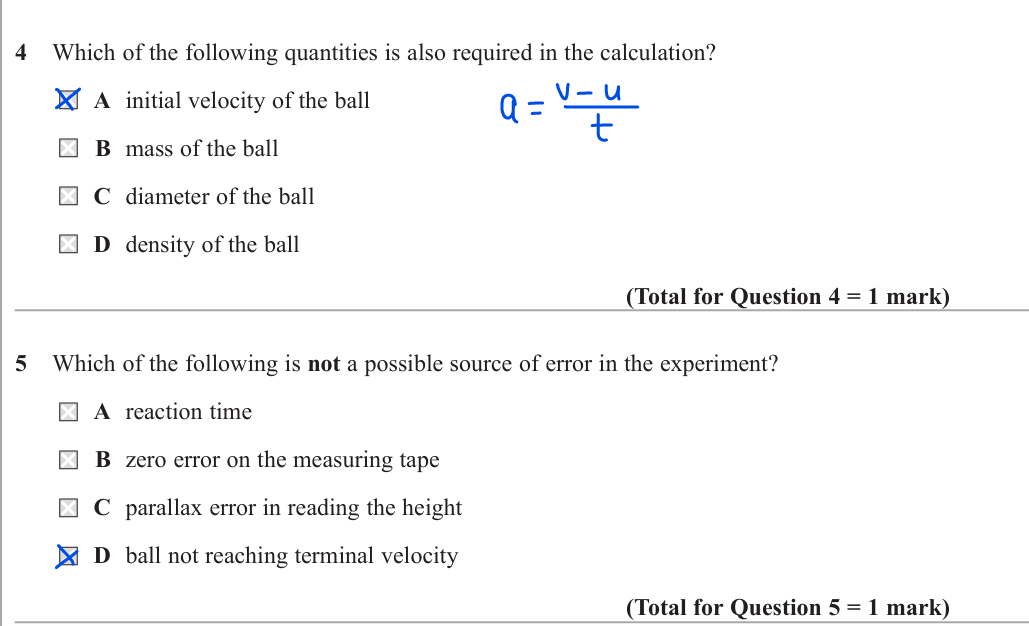
Draw a voltmeter and an ammeter
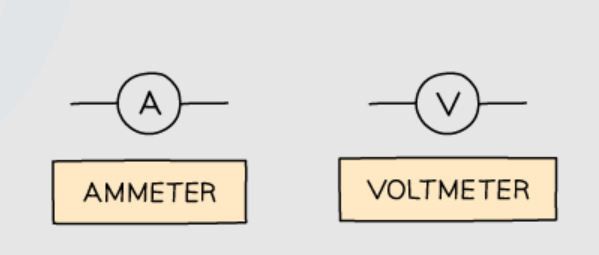
Draw a lamp and diode
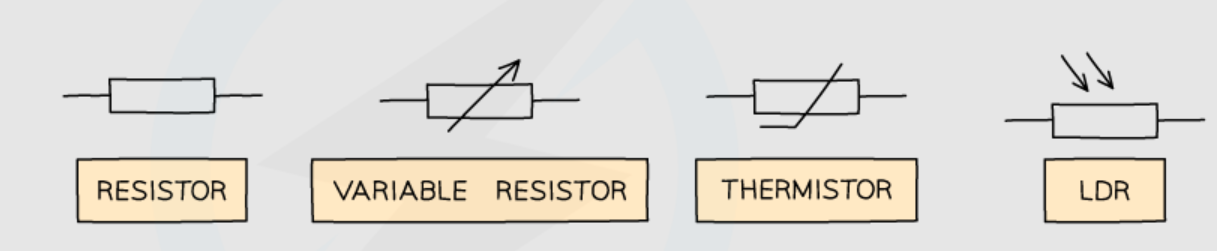
Draw a resistor, variable resistor, thermistor and LDR and label them.
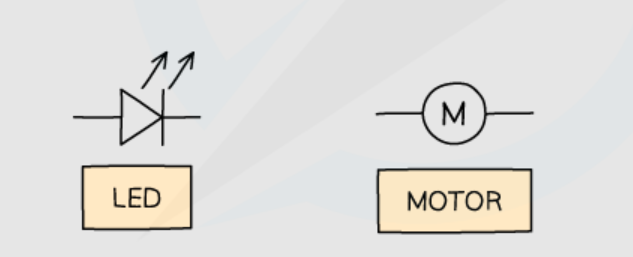
Draw LED and motor
Draw single cell, battery of cells, open switch and closed switch.

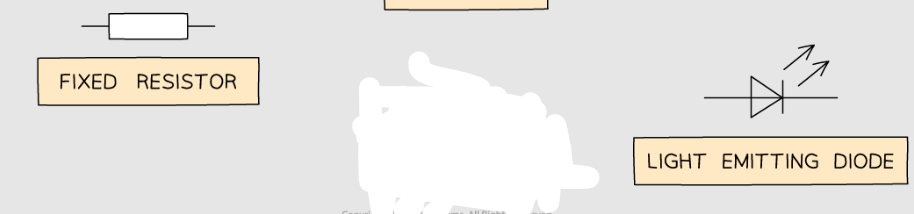
Draw a light emitting diode and a fixed resistor.
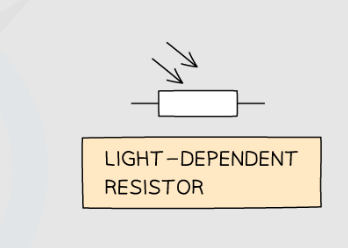
Draw a light dependent resistor?
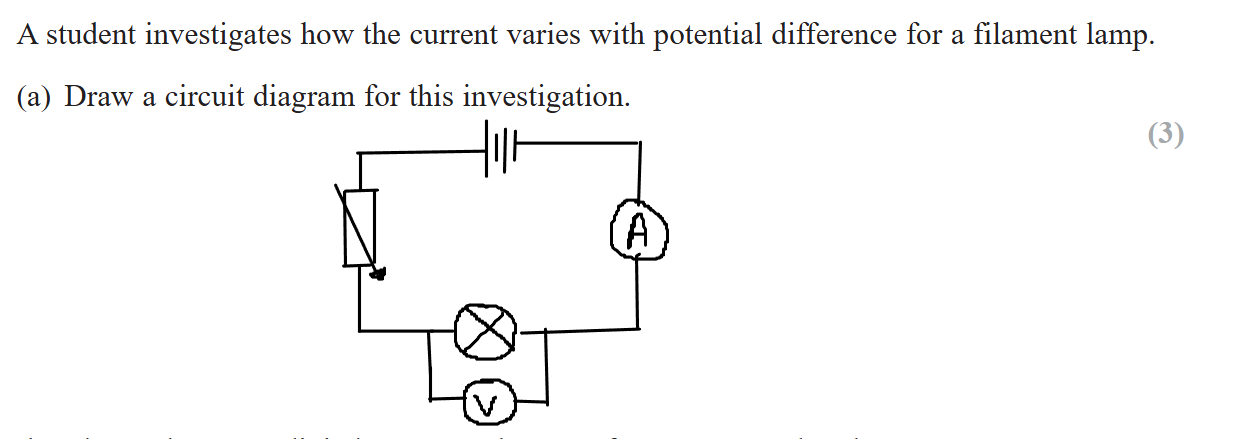
A student investigates how the current varies with potential difference for a filament lamp.
(a) Draw a circuit diagram for this investigation. (January 2019)
Power supply, lamp and ammeter in series (1)
Means to vary current in lamp (1)
Voltmeter in parallel with appropriate component (1)
The student uses digital meters. The manufacturer states that these meters are more accurate than analogue meters.
State one other advantage of using digital meters rather than analogue meters.
(1)
No parallax (error) Or Easy to switch range.
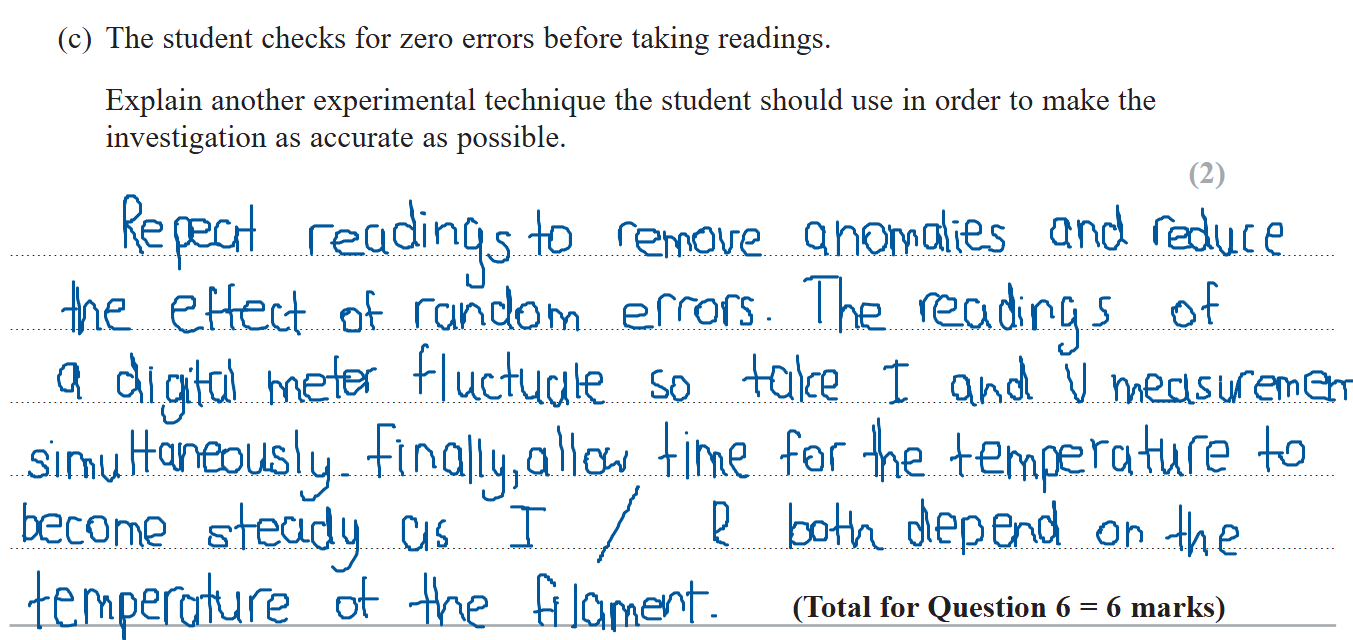
The student checks for zero errors before taking readings.
Explain another experimental technique the student should use in order to make the
investigation as accurate as possible. Jan 2019
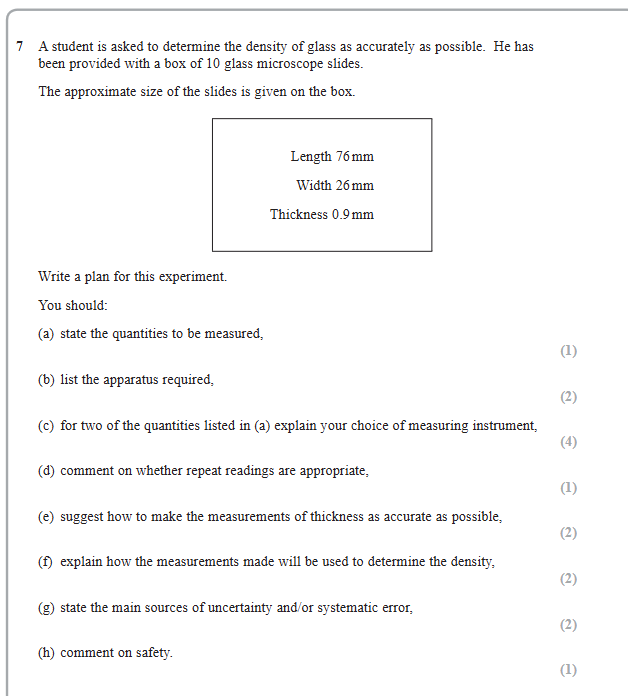
Jan 2019 (WRITING PLAN FOR EXPERIMENT)
(a) state the quantities to be measured
length, width, thickness and mass/weight (1)
b) list the apparatus required
Metre rule or Vernier callipers and micrometer [accept digital calliper in place of Vernier calliper and micrometer] (1)
Balance/scales (2)
c)for two of the quantities listed in (a) explain your choice of measuring instrument
For each quantity Instrument Justification, including indication of precision related to expected measurement
For example:
Thickness | Micrometer | Thickness is small (~0.9 mm). Micrometer precision = 0.01 mm, giving low % uncertainty. |
Length | Vernier caliper | Length ~76 mm. Vernier precision = 0.1 mm, better than ruler, reduces parallax error. |
(d) comment on whether repeat readings are appropriate
Repeat readings are appropriate to identify anomalies Or deal with random error Or deal with variation in named measurement. (e.g. Repeat readings with the micrometer are appropriate to identify anomalies when measuring thickness)
(e) suggest how to make the measurement of thickness as accurate as possible
Measure the thickness of all 10 slides together
Or
measure thickness in various places (or different slides) and average
To reduce the percentage uncertainty in the measurement
(f) explain how the measurements made will be used to determine the density
Use of volume = length × width × thickness
Use of density = mass/volume
(g) state the main sources of uncertainty and/or systematic error Max 2
Variation of thickness or length or width of slides
Thickness is small value
Zero error in named instrument
Volume incorrect as chip/dust on slide
(h) comment on safety. Hazard and precaution
Glass can have sharp edges or break so handle with care (to avoid injury) Don’t overtighten micrometer as the glass might break
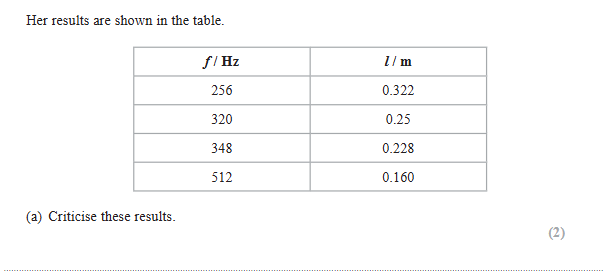
(2)
Small range Or uneven spacing
No repetition shown
Only 4 sets
Inconsistent sf/dp
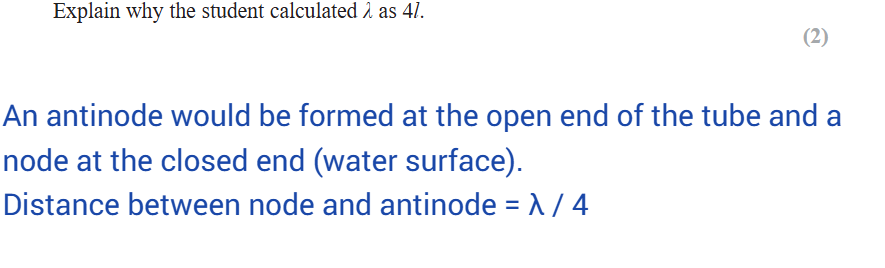
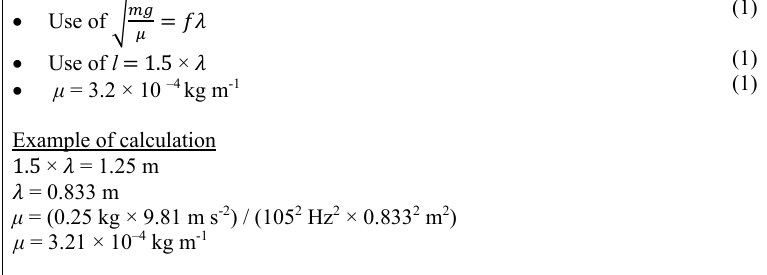
Explain why the student calculated λ as 4L
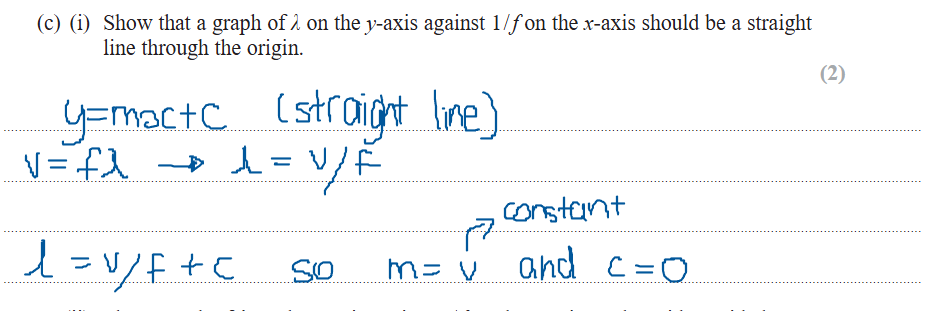
Show that a graph of λ on the y-axis against 1 / f on the x-axis should be a straight
line through the origin
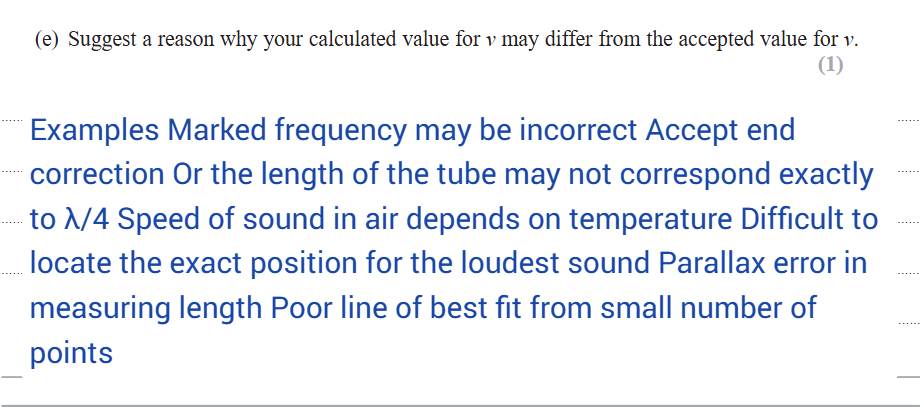
Suggest a reason why your calculated value for v may differ from the accepted value for v. (1)
What’s the resolution of the vernier caliper? (1)
Explain why this device is suitable to measure the diameter of the metal sphere. (2)
The student took further measurements of the diameter and calculated a mean. Describe how the student should use this measuring device to make the measurements as accurate as possible. (2)
0.1 mm
Percentage uncertainty is small • Because resolution much less than diameter of ball bearing
• Take readings in different orientations/positions • Check for zero error • Ensure measurement is at widest point
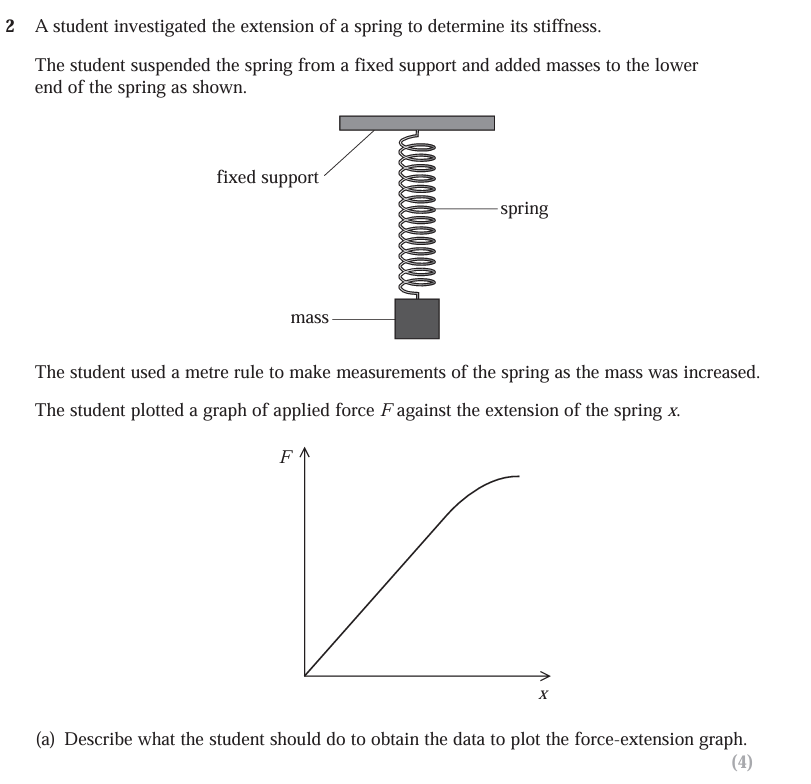
part 2: Explain how you would use the graph to determine the stiffness of the spring. (2)
part 2 ans:
K will be the gradient (k= stifness) as F = K x ∆x so F / ∆x will be K.
Gradient should be calculated using values from linear section of the graph (because hooke’s law is obeyed there)
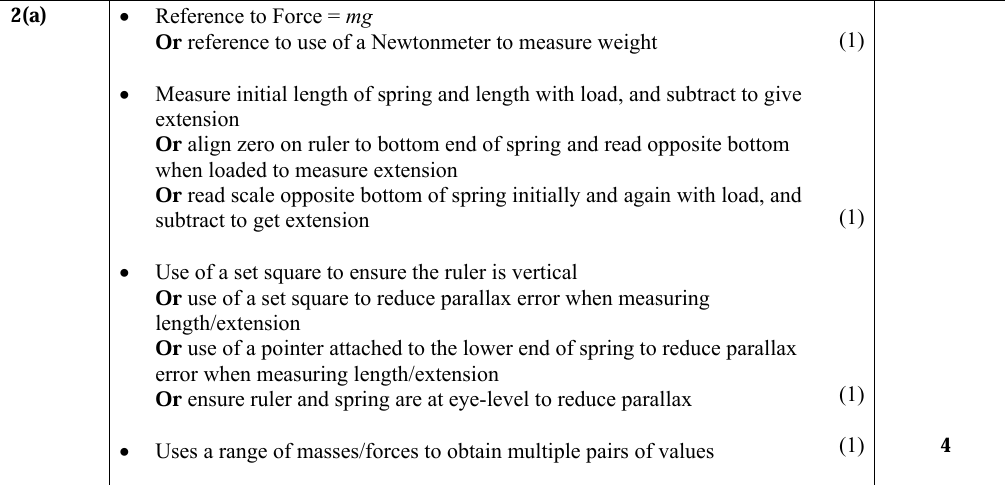
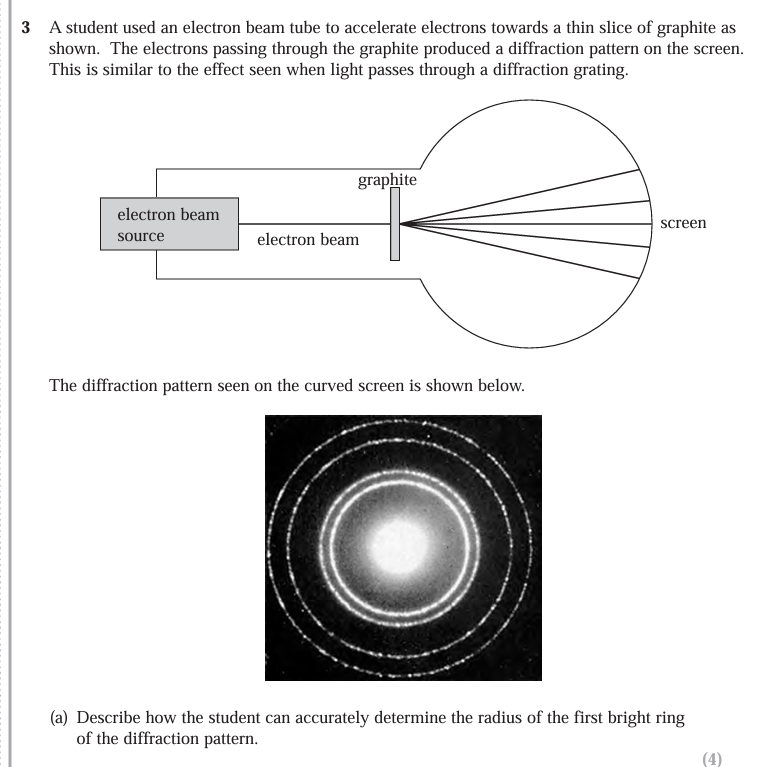
Use of Vernier calipers
• Measure diameter of (first) ring and divide by 2
• Measure in multiple orientations and calculate the mean
• Measure to the middle/brightest part of the ring
Explain how the diffraction pattern provides evidence for the wave nature of electrons. (2
(Diffracted) electrons experience (constructive) interference/superposition
Or the pattern is evidence electrons have interfered/superposed
• Diffraction/interference is a wave property
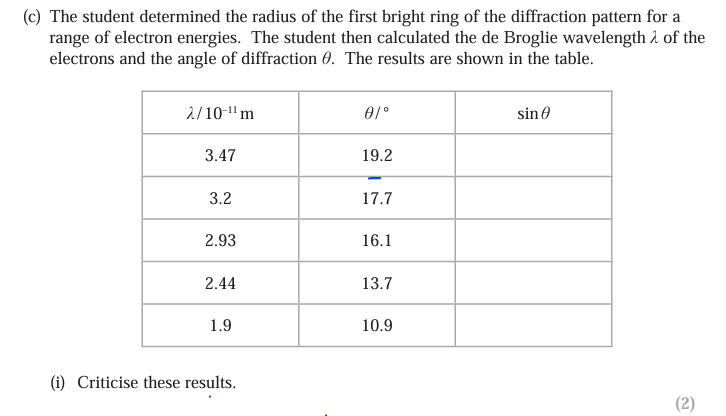
Criticize these results (2)
• Inconsistent number of significant figures (for wavelength)
• Only 5 sets of results
• Range of values of angle/wavelength is too small
• No evidence of repeat
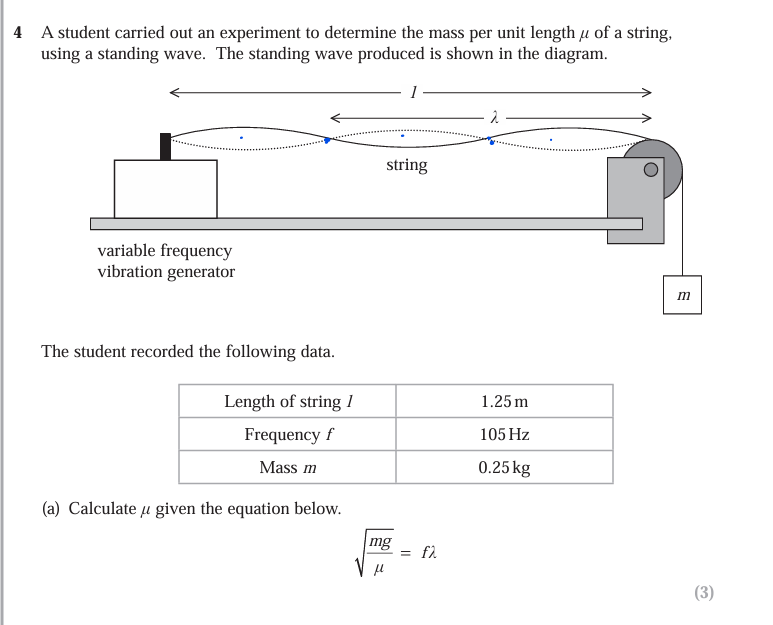
part 2 Identify two significant sources of uncertainty in the student’s measurements. (2)
Part 3: For each of these sources of uncertainty, describe an experimental technique the student could have used to obtain an accurate measurement. (4)
Max 2 from
Frequency
• Uncertainty in identifying when nodes form
• Uncertainty in identifying maximum amplitude
Length
• Parallax error when measuring length
• Uncertainty in measuring length to top of pulley Or uncertainty in measuring length as string is not straight
Mass
• Zero error on mass balance
___________________________________________________________________________________________
Frequency
• Repeat and calculate the mean frequency
• Vary frequency from above and below resonance to find two values for the frequency when the standing wave forms Length
• Use a set square to reduce parallax error in length Or hold ruler in contact with the wire to reduce parallax error in length Or ensure ruler and string are at eye-level
• Switch off vibrator Or ensure string is straight Mass
• Zero balance before each measurement
• To remove systematic error Or idea that this error is not reduced by repeating
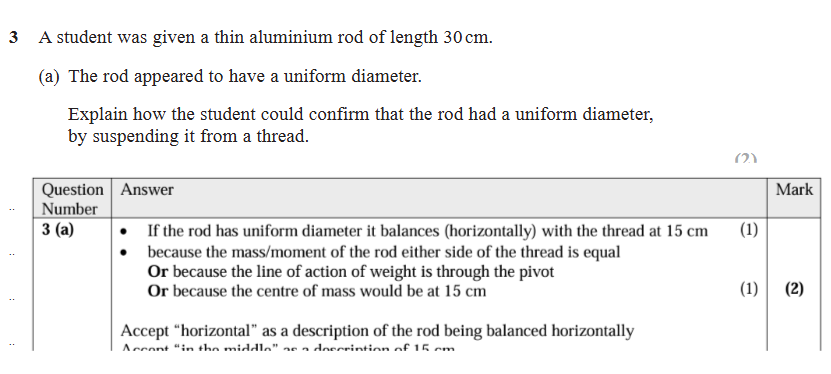
A student was given a thin aluminium rod of length 30 cm.
(a) The rod appeared to have a uniform diameter.
Explain how the student could confirm that the rod had a uniform diameter, by suspending it from a thread.
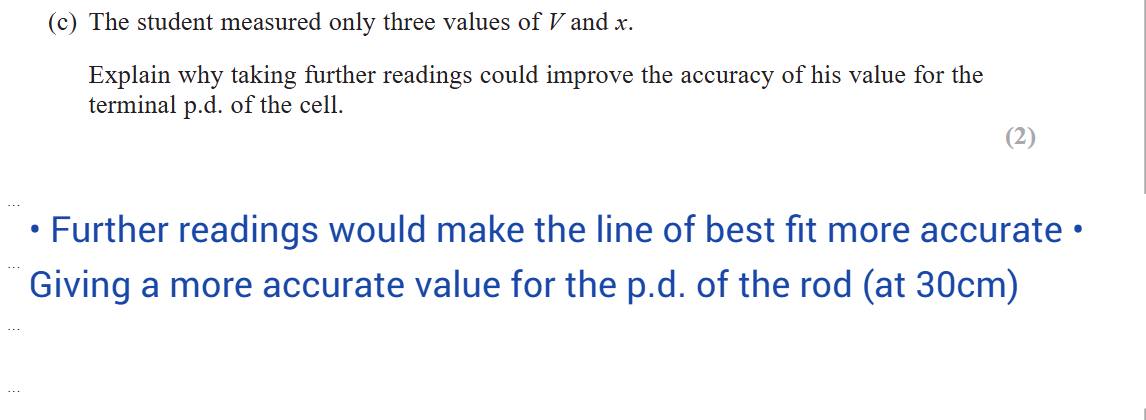
The student measured only three values of V and x.
Explain why taking further readings could improve the accuracy of his value for the
terminal p.d. of the cell.
(2)
The metal surface in this apparatus can be used to determine the Planck constant with
visible light. Other metals require higher photon energies.
Explain an advantage of using this apparatus. (2)
Higher photon energy means higher frequency light Or higher photon energy means using ultraviolet light
• There is an increased risk when using ultraviolet light Or using visible light is no/low risk
uggest two modifications that would improve the accuracy of the value of the Planck constant determined from this experiment.
(2)
• Block out external light sources
• Use a larger range of wavelengths/frequencies
• Use filters with a narrower frequency band
• Use LEDs of known frequency
• Use more sensitive ammeter
Explain what she should do with the vernier calipers before taking the measurement. (2)
Check (and correct) for zero error • To eliminate/reduce systematic error
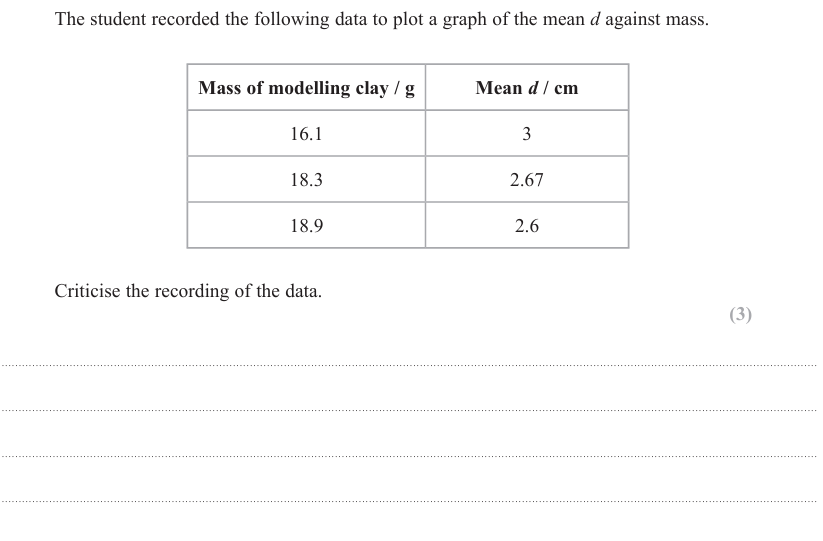
There are not enough sets of data (to draw a graph)
• Inconsistent decimal places in values of d
• More readings are needed below 16.1 g Or The range of masses is too small Or Repeat values of d not recorded
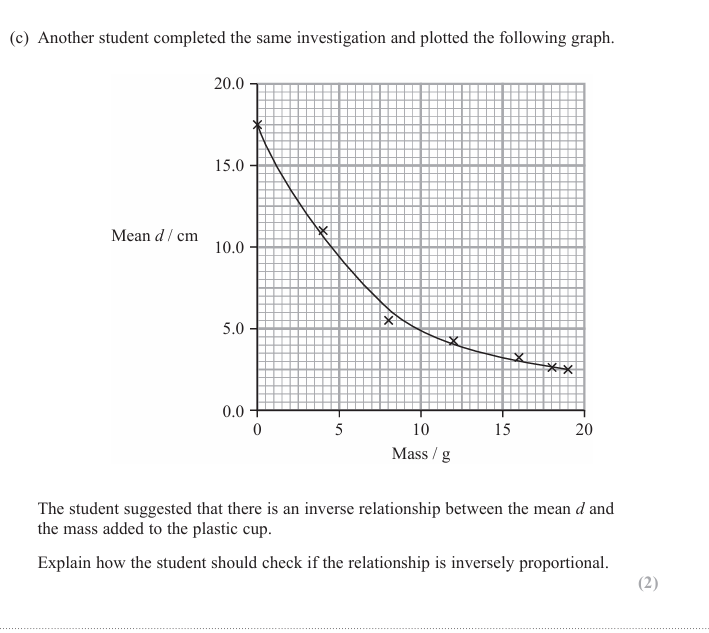
• Plot a graph of distance against 1/mass • It should be a straight line (through the origin if the relationship is inversely proportional)
OR
Take several pairs of readings from the line of best fit • Calculate distance × mass and check it is constant
Large distances, such as the distance s to the building, can be measured using a laser distance meter. A laser distance meter uses the pulse-echo technique with pulses of laser light. State two advantages of using laser light instead of sound to determine this distance. (2)
Speed of light remains constant (in all weather conditions) • Laser light will travel further • Light is more directional • Less interference from other sources with laser • Pulse of laser light will be detected before next pulse is emitted
The student used a metre rule to measure l. Describe an accurate method to determine a single value of l using a metre rule. You may include additional apparatus. (3)
Use a set square to ensure the metre rule is vertical Or Use a set square to ensure metre rule is perpendicular to the floor/ground
• Clamp/place metre rule close/near to the mass Or Read the height from the bottom of the mass Or Attach a marker to the mass/string
• Use set square to read off the scale Or View the scale perpendicularly
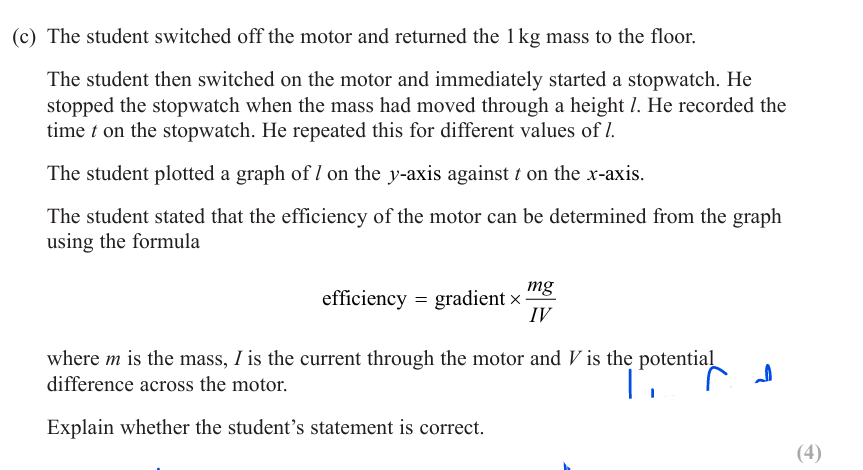
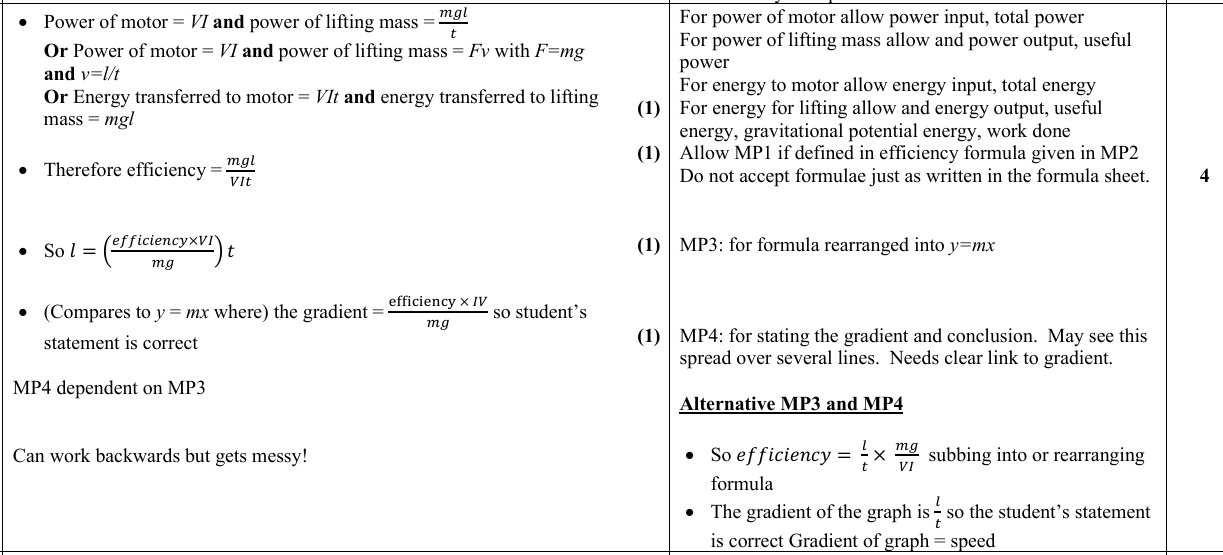
The student used a distance sensor connected to a data logger to determine l and t. Explain why using the sensor and data logger would improve the investigation. (2)
Data logger will measure distance and time simultaneously • Error caused by delay in stopping stopwatch at a specific height will be reduced/eliminated OR • Data logger has a high sampling rate • The accuracy of the graph will be improved
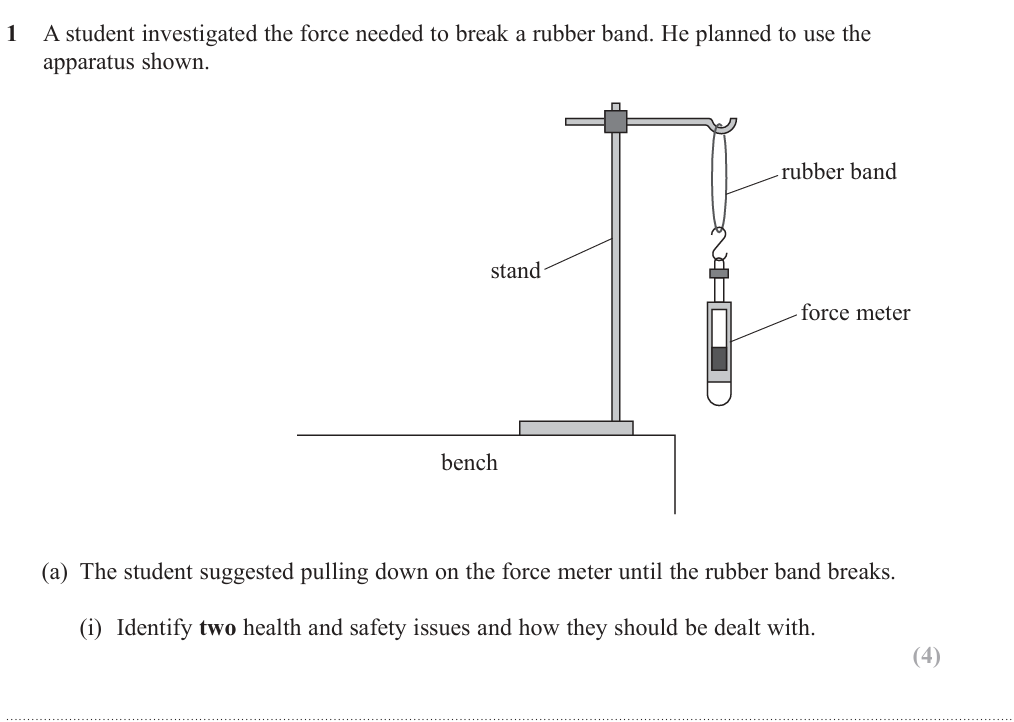
The stand may topple over Clamp (the base of the stand) to the bench Or Place a heavy mass on the (base of the) stand Or Turn the base (of the stand) round (by 180)
The (rubber) band may hit the student in the eye/face Or The (rubber) band may damage the eye
Wear eye protection
The student investigated how the breaking force of the rubber bands changed at low temperature. The student placed five identical rubber bands in a freezer at –10 °C. The student removed one rubber band from the freezer and determined the breaking force. He repeated this for the other rubber bands. Explain why it is appropriate to repeat the measurements. (2)
(Repeating the measurement) reduces (the effect of) random error (Caused by) variations in the temperature of the rubber bands
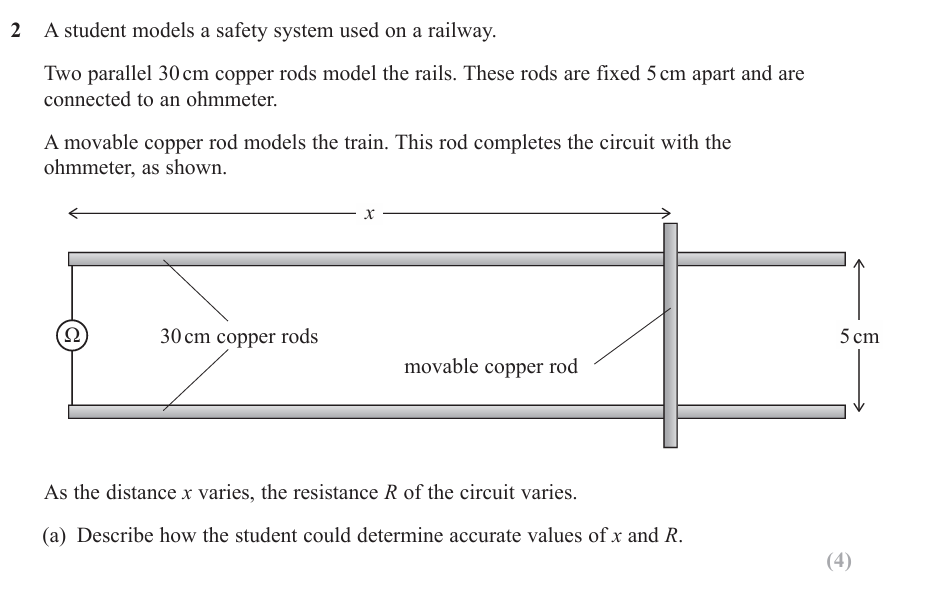
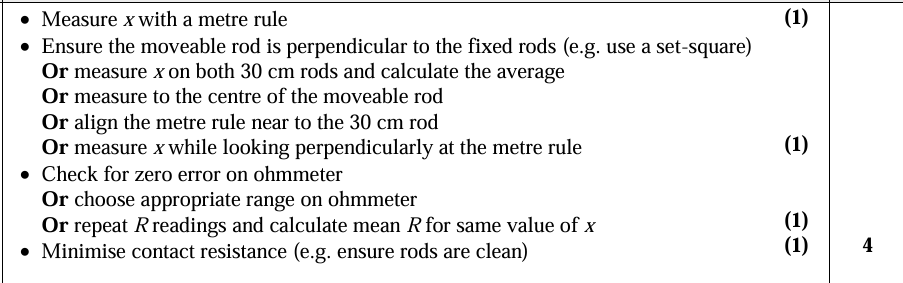
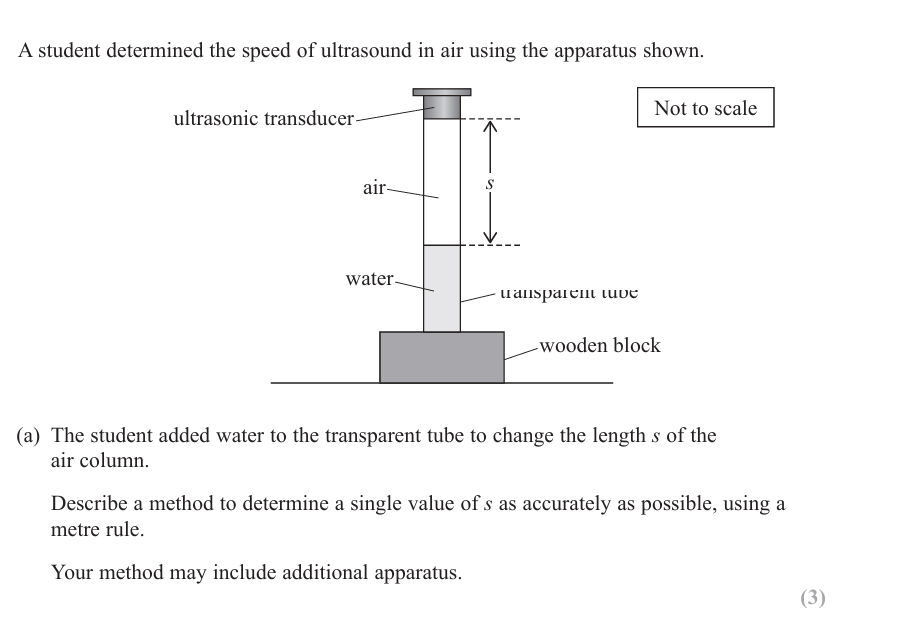
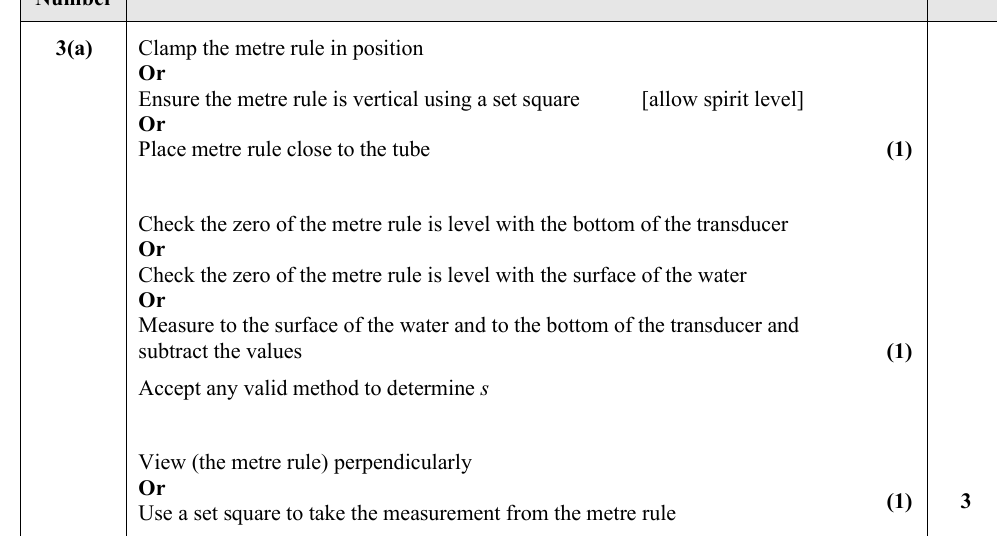
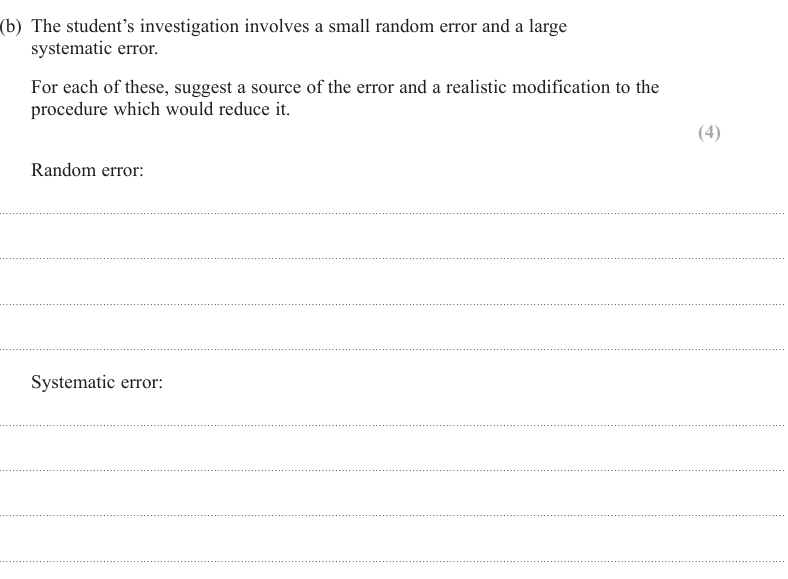
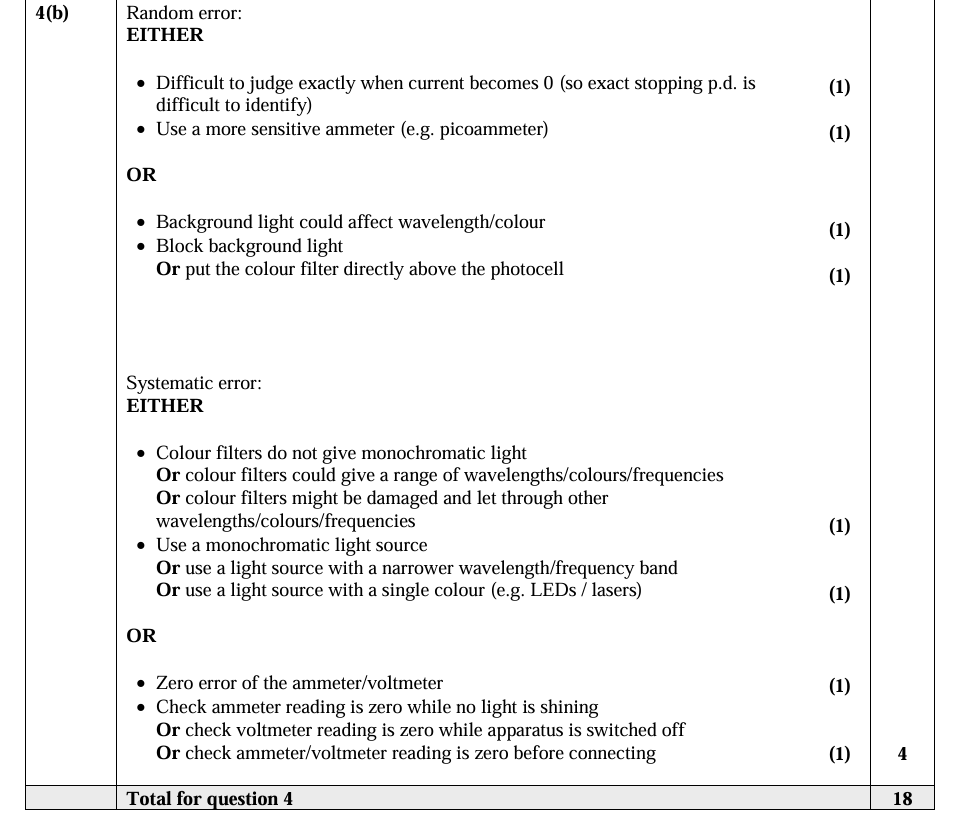
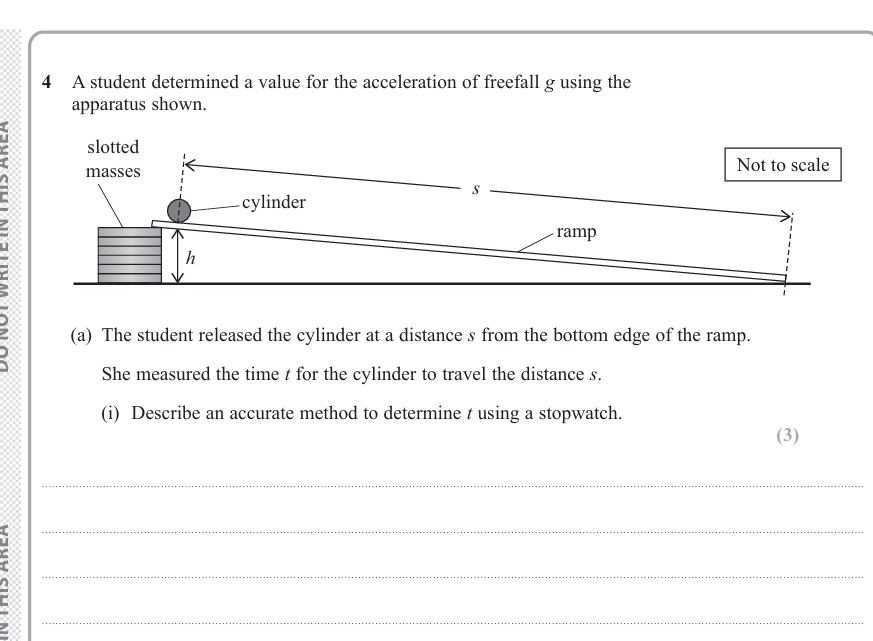
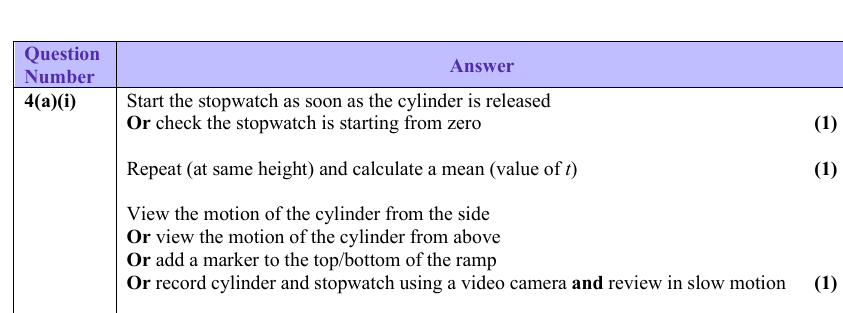
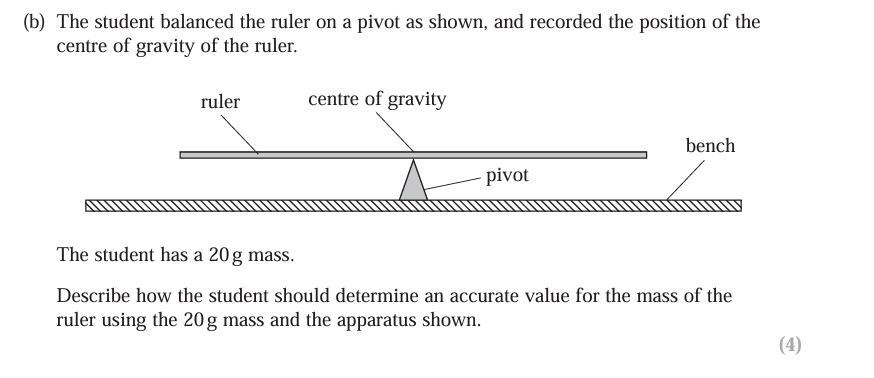
Balance the ruler on the pivot to find its centre of gravity.
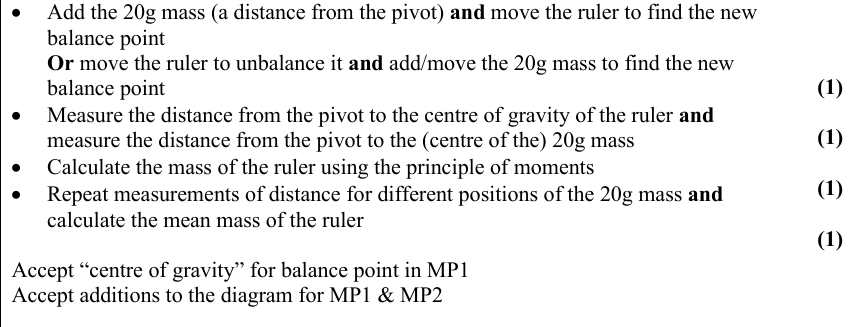
Place the 20 g mass at a measured distance from the pivot.
Move the pivot until the ruler balances again.
Measure the distance from the pivot to the ruler's COG and to the 20 g mass.
Mruler×d ruler = 20(g, mass) ×d mass
repeat with the mass at different positions and calculate the mean.
What is meant by coherant? (2)
Same frequency
Constant phase difference/relationship
Constant phase relationship means the phase difference between the two waves does not change over time — it stays the same (e.g., always 0°, always 90°, always 180°, etc.).
Adjacent node-to-node regions | ? |
Two neighboring sections separated by a single node