Botanica exam V
 View linked note
 Call Kai
 Learn
Learn Practice Test
 Spaced Repetition
 Match
Match Flashcards
 Knowt Play
1/45

Earn XP
Description and Tags
UPR Cayey
Name | Mastery | Learn | Test | Matching | Spaced | Call with Kai |
|---|
No analytics yet
Send a link to your students to track their progress
46 Terms
Requirements for seed germination
Temperature, Water, Oxygen.
Gene expression in plant cells
Not all genes are expressed in every plant cell; cells specialize by expressing only the necessary genes.
Virchow's generalization connection to Darwin's theory
Virchow's idea that all cells come from pre-existing cells explains how traits pass from generation to generation.
Difference between Parenchyma and Sclerenchyma
Sclerenchyma cells have lignin; Parenchyma does not.
Endosymbiotic theory
Eukaryotic cells originated from prokaryotic cells engulfing other prokaryotic cells; evidence includes mitochondria and chloroplasts having their own DNA.
Experiment design for Auxin (IAA) effect
Independent: Auxin concentration
Dependent: Amount of bending/growth
Control group: No auxin
Control variables: Same plant, same light, same water, same time
Plant hormones
Ethylene, Gibberellins, ABA (Abscisic Acid), Cytokinin, Auxin(IAA).
Definition of a seed
A plant embryo packaged with a food supply inside a protective coat.
Definition of a fruit
A mature ovary that protects and helps disperse seeds.
Benefits of Eubacteria
Nitrogen fixation and production of antibiotics.
Negatives of Eubacteria
Cause diseases and food spoilage.
Bacterial exchange of genetic material: Transformation
Uptake of free DNA from the environment.
Bacterial exchange of genetic material: Transduction
DNA transfer via a virus (bacteriophage).
Bacterial exchange of genetic material: Conjugation
Direct transfer of DNA between bacteria through a pilus.
Function of heterocyst in cyanobacteria
To fix atmospheric nitrogen into a usable form for the cell.
Why virus is considered living
It can reproduce and evolve, needs a host cell.
Function of streak plate method
To isolate a pure colony of bacteria from a mixture.
Cyanobacteria's impact on Earth
They produced oxygen, forming stromatolites and enabling evolution of aerobic organisms.
Reasons for recognizing Fungi as a separate kingdom
Fungi have chitin in cell walls; they obtain nutrients by absorption.
Reasons clay particles are essential for soils
Increase surface area and retain more water and nutrients.
Why are anions easily lost from soils
Because anions are repelled by negatively charged soil particles and leach away.
Definition of totipotency
The potential of a single cell to develop into an entire organism.
Definition of hydroponics
Growing plants without soil, using nutrient-rich water solutions.
Purpose of carnivorous plants capturing insects
For nutrient absorption, especially nitrogen and phosphorus.
Root pressure process
Active transport of ions into the xylem.
Decrease in water potential inside the xylem (because of the ion buildup).
Water enters xylem by osmosis from surrounding root cells.
Positive pressure builds up in the xylem, pushing water upward.
Two reasons tropical rainforest soils are bad for agriculture
Heavy rainfall leaches nutrients; soils are highly weathered and low in minerals.
Differences between red and blue light
Blue light has higher energy; red light has a longer wavelength.
What is C3 photosynthesis
C3 refers to the first stable product of carbon fixation being a 3-carbon molecule.
What is thigmonastic movement
A rapid plant movement in response to touch.
Why is photosynthesis more in the palisade layer
More chloroplasts per cell, tightly packed to maximize light absorption.
Evidence linking photosynthesis to glycolysis
Both use electron carriers and ATP suggesting a common origin.
Vascular tissue differences: Xylem
Cell types are tracheids and vessel elements, dead at maturity.
Vascular tissue differences: Phloem
Cell types are sieve tube elements and companion cells, living at maturity.
General equation for photosynthesis
CO₂ + H₂O → C₆H₁₂O₆ + O₂.
Advantages of secondary growth
Provides structural support and increases water/nutrient transport capacity.
Name and geological era for CAT (what does it stand for)
cohesion-adhesion-transpiration; evolved in Paleozoic Era.
Process of food transport to storage regions
Translocation; major energy source is ATP.
Theory explaining food transport in plants
Pressure-flow hypothesis.
Liquid pressure in xylem cells
Negative pressure.
Liquid pressure in phloem cells
Positive pressure.
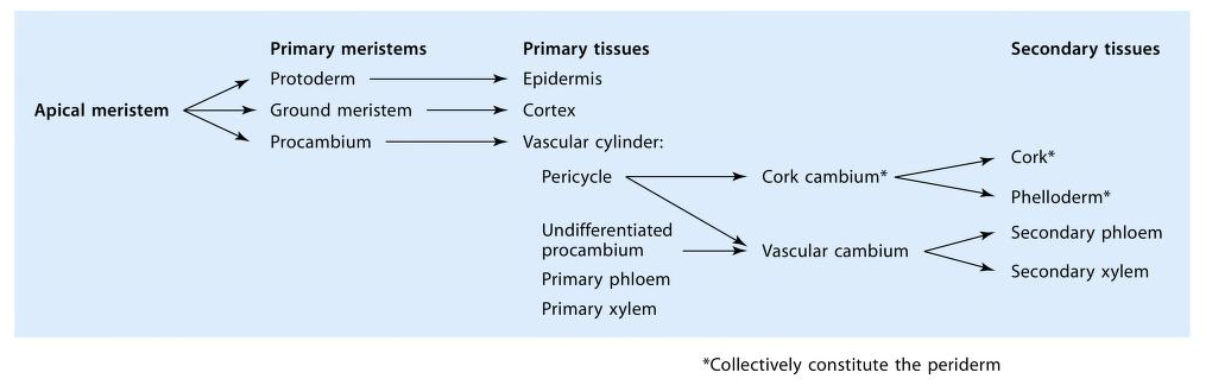
Sequence of tissues producing secondary tissues
Apical meristem → Procambium → underefitated cambrium (primary sylem and phloem) → Vascular cambium → Secondary phloem → Secondary xylem
Six plant organs
Roots, Stem, Leaf, Seed, Flower, Fruit.
Micropyle
The opening into the ovule.
Origin of seed coat (testa)
From the integument of the ovule.
Four types of Microtechniques
Whole mount, Cross section, Longitudinal section, Squashed.
Six types of Microscopy
Light microscopy, dark microscopy, Fluorescence microscopy, Scanning Electron Microscopy (SEM), Transmission Electron Microscopy (TEM), Confocal microscopy, phase constart