memory
 Call Kai
 Learn
Learn Practice Test
 Spaced Repetition
 Match
Match Flashcards
 Knowt Play
1/19

There's no tags or description
Looks like no tags are added yet.
Name | Mastery | Learn | Test | Matching | Spaced | Call with Kai |
|---|
No analytics yet
Send a link to your students to track their progress
20 Terms
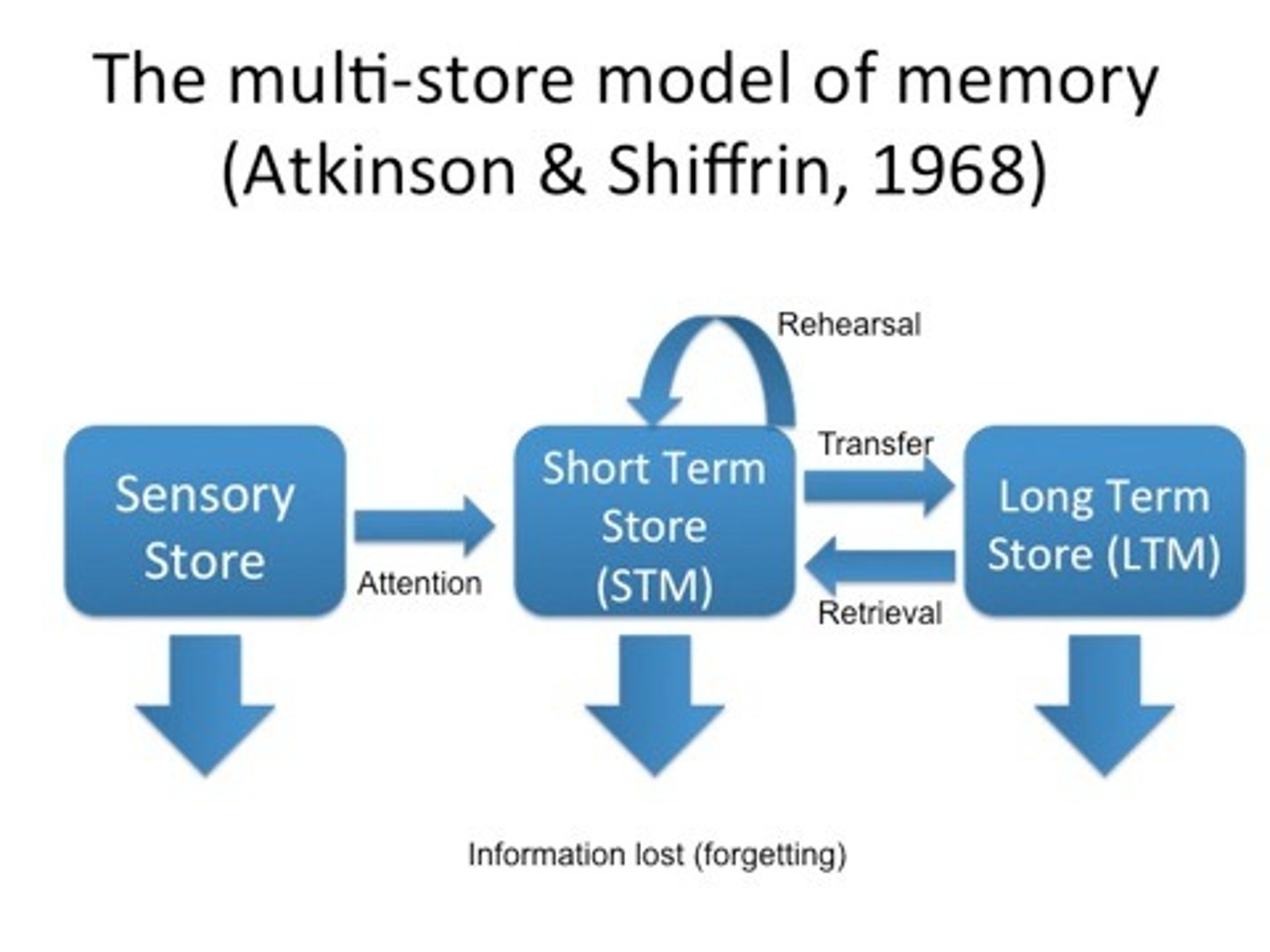
multi-store model
1968 Atkinson and Shiffrin.
Baddeley 1968 coding
coding- tested if LTM or STM encodes acoustically or semantically(meaning)
ppts 4 trials at learning order of words. 20 min delay to remove stm then ppts recalled words in order. compared 5th trial with 4th 20 mins before. he added an interference task in between.
to test STM they were asked to recall immediately.
findings:
stm was helping LTM out
LTM ppts struggles with similar semantic words
STM ppts struggled with acoustically similar words
Conclusions:
STM uses acoustic encoding
LTM uses semantic encoding
+
high control and standardised
-
lacks ecological validity
poor mundane realism
study on capacity of STM
Jacobs digit span. PPTS asked to recall digits in specific order. on average ppts could remember 7 digits.
study on length of STM
Peterson and Peterson to test how long STM lasts without rehearsal
ppts briefly shown trigram of three consonants
then given interference task
after intervals ppts asked to recall.
90% recal after 3 seconds
then got worse at 18s only 2-3%.
DURATION IS 13 seconds 20 at most.
Study of LTM capacity and duration
Linton 1985 woman
6 years made a diary of 5000 events
she could recall events and dates each month
so LTM has endless capacity and long term duration.
Study on high school yearbooks
Bahrick et al
392 graduates shows photos from yearbook.
1 condition they had to match a list of names to photos
90% correct after 14 years, 80% after 34yrs
another condition names ppts in a photo without list of names
60% accurate after 7 years
less than 20% after 47 years
Conclusion
people can remember certain information types for a life time. But the accuracy is high in recognition than recall.
types of LTM
episodic - ability to recall events. Time stamped and chronological
semantic- Knowledge of the world. Facts and concepts.
procedural- memory for actions and skills. Muscle memory
proved through clive wearing as his procedural memory still worked.
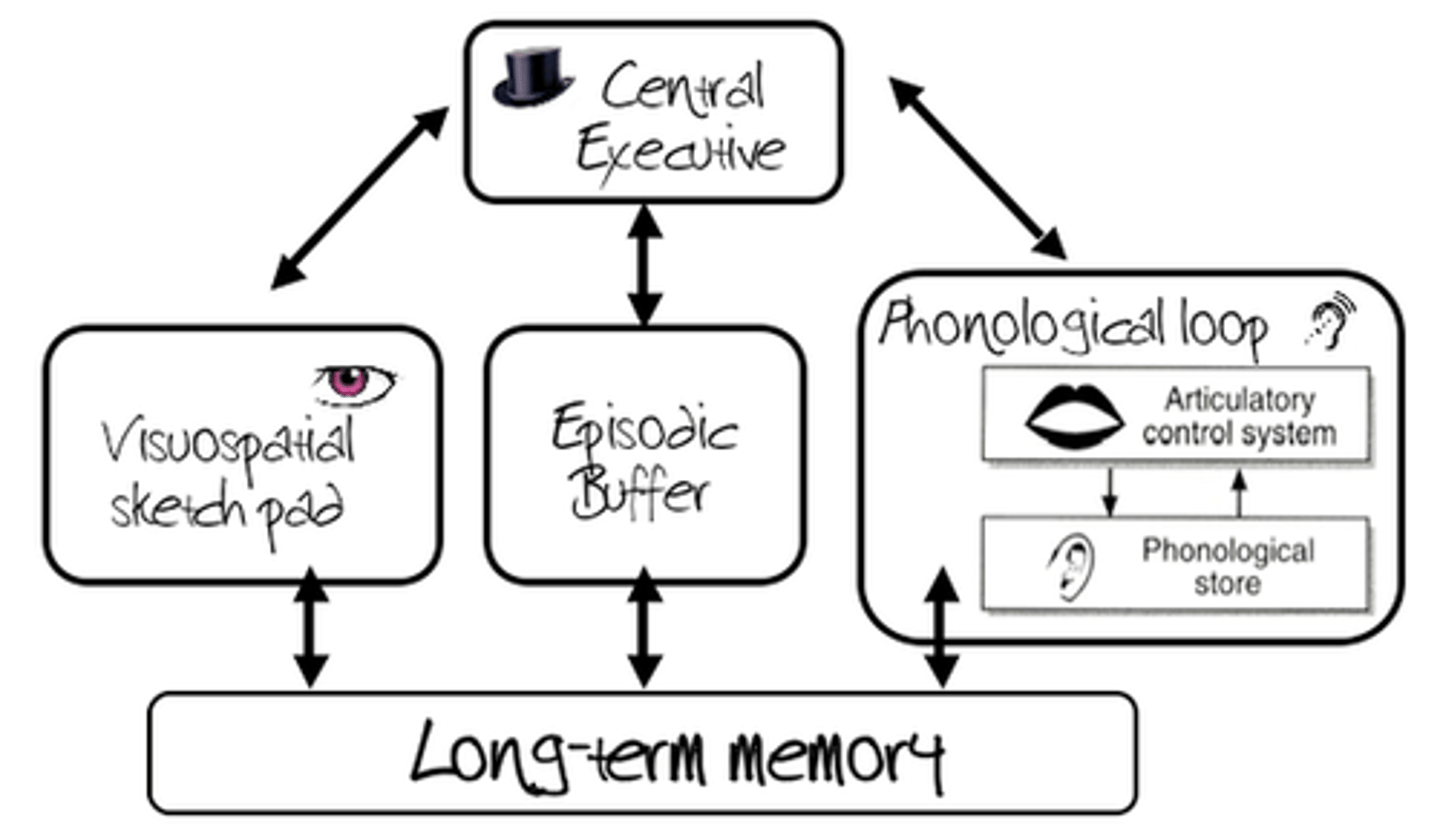
Working memory model
Baddeley and Hitch (1974)
proved by Baddeleys dual task technique. tasks usuing diffrent components could be completed whereas same part were hard.
WMM evaluation
Research support
Baddeley et al 1975 found that ppts found it harder to remember long lists of words compared to short lists of words. This supports the idea of the phonological loop.
Practical Application helps us understand mental disorders such as ADHD which are linked to stm
Lack of detail on central executive. research suggests it might have multiple components.
interference
explanation for forgeting
P roactive
O ld interferes with new
R etroactive
N ew interferes with old
interference evaluation
Henk Schmidt 2000 - retroactive
Remembering childhood street names
Positive association with number of times moved house outside the neighbourhood and the number of street names forgotton.
-Not a full explanation - explains what happens not the cognitive processes causing this
+support for Proactive - Keppel and Underwood found recall of older trigrams was harder than new trigrams
-lab study + controlled -artificial situation
Retrieval failure
Lack of accessibility rather than availibility of memory.
This may be due to insufficient cues to remember.
study on retrieval failure
Baddeley and Godden 1975 Asked to learn words on land and underwater.
Memory was 40% better when words were recalled in the same place.
retrieval failure evaluation
practical application
research support
--
Retrieval effects might be different in real life to experiment. EG environment change may be not so extreme so situation might not effect retrieval very much.
study on leading questions (eyewitness testimony)
Loftus and Palmer (1974) 45 american students watched clips of car accidents
when question was hit/smashed estimated speed was greater than collided/bumped etc
-lacks mundane realism as its not the same is witnessing a real car accident
+easy to replicate and controlled
+ethically sound
Post Event discussion
memories become distorted with false information
study supporting post event discussion
Gabbert 2003 71% of witnesses who carried out Post event discussion had inaccuracies.
-lab experiment
-Individual differences in age children under 12 most sucseptable to post event discussion, adults over 60 also more susceptable due to cognitive decline
Anxiety affecting EWT
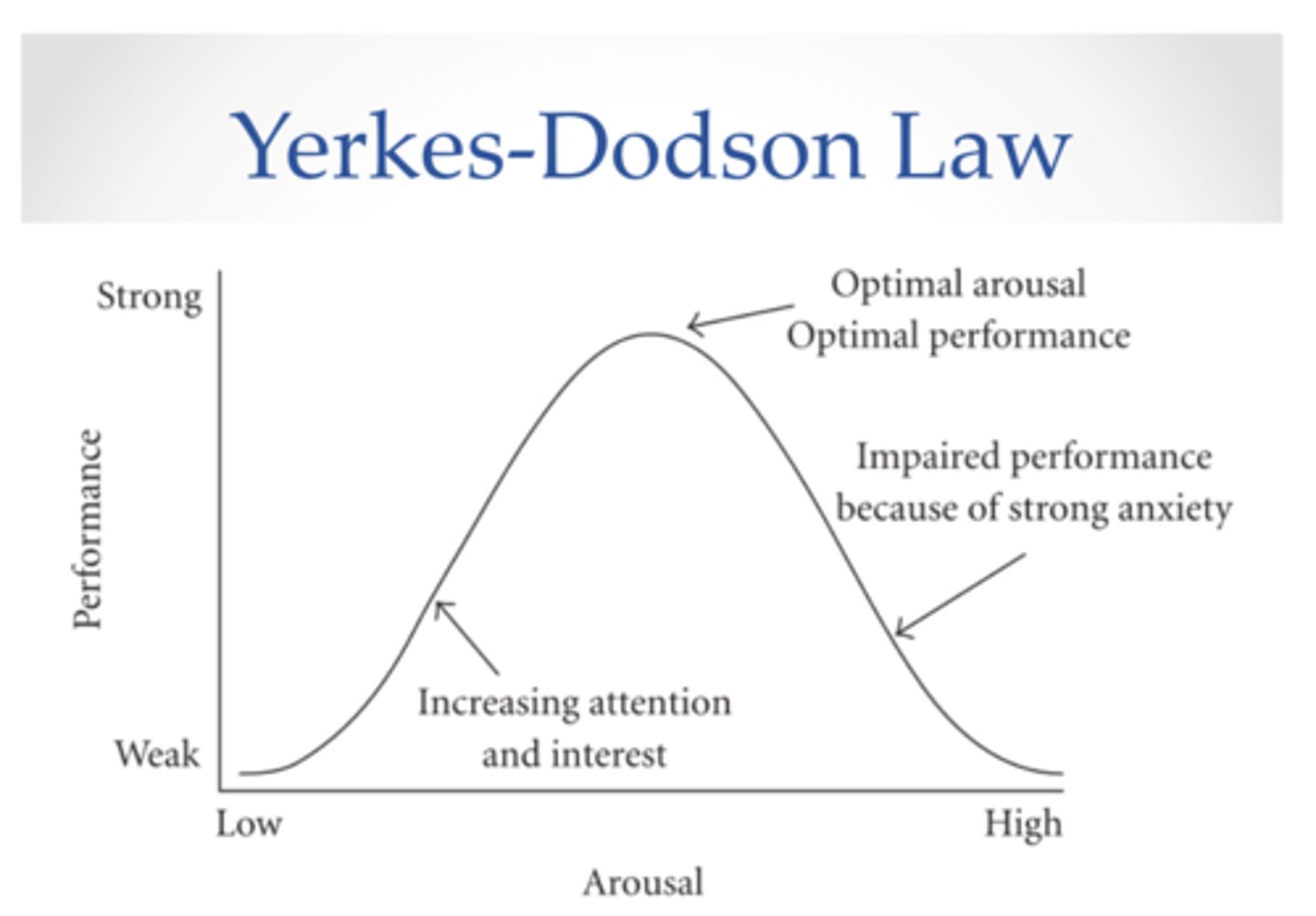
Depending on the incident the witness may have been scared and this may have affected the accuracy.
Very low anxiety causes low levels of accuracy
As anxiety increases accuracy increases
then if anxiety is too high accuracy decreases again
Supporting research for anxiety
Johnson and Scott 1976
shown 2 conditions an argument where knife walks out the room or a conversation where man walks out with pen and greasy hands.
found lower accuracy in high anxiety situation due to weapon focus affect
improving accuracy of EWT
cognitive interview technique
Change recall order
Recall from different perspective
Context reinstatement (say how you feel and what there is etc)
Report everything
Fisher developments
minimise distractions
make eye contact
encourage witness to speak slowly
ask open ended questions