5.2 Capacitors and RC Circuits
 Call Kai
 Learn
Learn Practice Test
 Spaced Repetition
 Match
Match Flashcards
 Knowt Play
1/10

There's no tags or description
Looks like no tags are added yet.
Name | Mastery | Learn | Test | Matching | Spaced | Call with Kai |
|---|
No analytics yet
Send a link to your students to track their progress
11 Terms
What is a capacitor?
A capacitor is a passive element found within RC/RLC circuits in which two conducting bodies surround an insulating medium; the capacitor has the capacity to store electric charge.
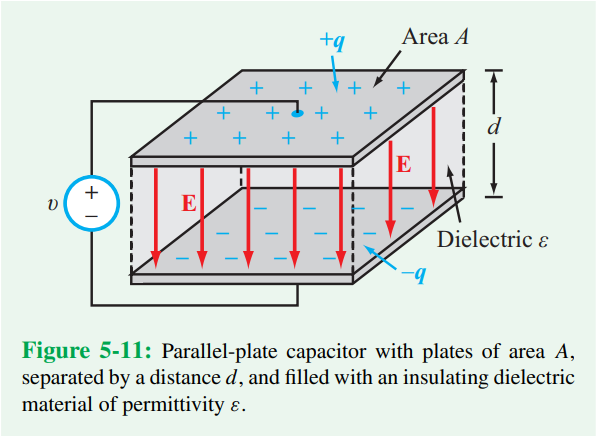
Parallel-Plate Capacitor
A parallel-plate capacitor is a specific type of capacitor in which two identical conducting plates (each with an area A) are separated at a distance D as a result of the insulating medium inbetween them.
A: The area of the conductive plates
Distance: The distance between the metal plates
+q, -q: The electric charges; the positive charge is at the top of the capacitor and the negative charges are at the bottom of the capacitor.
V: Voltage source that excites the capacitor
Dielectric e: The electric permittivity of the insulating material between the plates
Electrical Permittivity
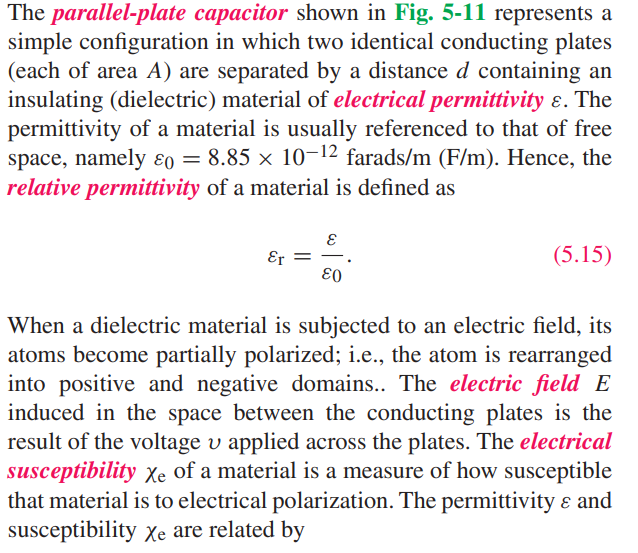
The extent to which an electric charge is permitted to be free within a medium.
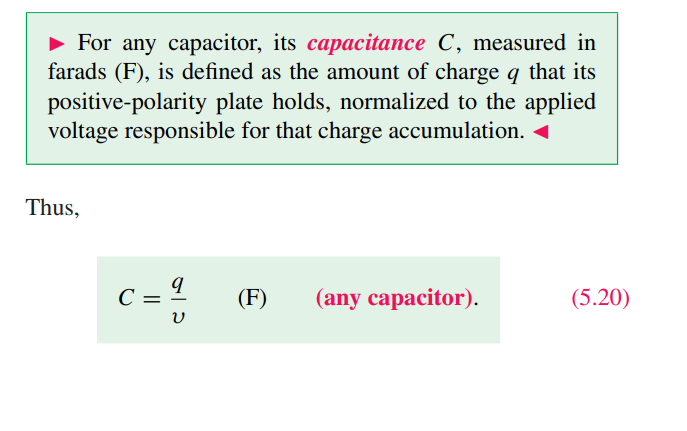
The Capacitance Constant (C) 155
The capacitance, C, is measured in farads (F) and acts as a measure of the amount of charge (q) that a plate holds divided by the source voltage.
C = q/v
C: Capacitance (farads/F)
Q: Electric charge (coulombs/C)
V: Source voltage (voltage/V)
Current Through a Capacitor (Part I)
Start with the definition of capacitance:
C = q/v
From there, solve for q:
q = cv
Then differentiate both sides with respect to time:
(dq/dt) = c(dv/dt)
Recall that dq/dt = i
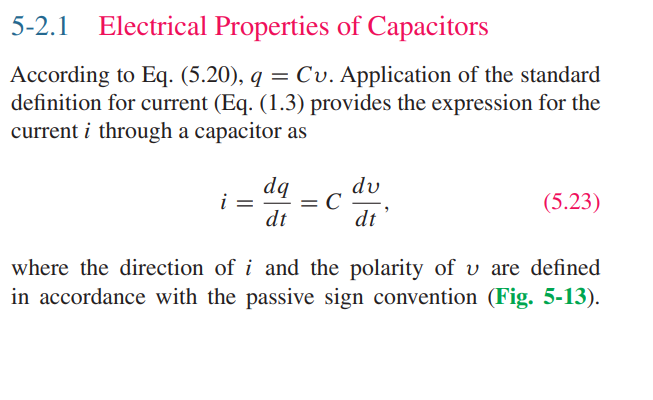
i = c(dv/dt)
Thus, the current through a capacitor is dependent on the capacitance of the capacitor and the time rate of change of the voltage function across it as well.
Current Through a Capacitor (Part II)
Property 1:
The definition of current through a capacitor tells us that the voltage cannot change instantly; this is due to the fact that if the time rate of change were instantaneous, then the difference of the time component would be 0, thus we would be dividing by 0, which produces an infinite current (impossible).
Mathematically:
i = C ((Vf -vi)/(t2 - t1))
If the change were instantaneous, then t2 = t1 and thus the denominator would be 0 and we would acquire an infinite current.
Property 2:
Since we are operating with a DC voltage, the voltage is constant and thus dv/dt = 0, thus the current through a capacitor is 0. This tells us that the capacitor in any DC circuit can be replaced with an open circuit, thus enabling for analysis of the circuit.
Property 3:
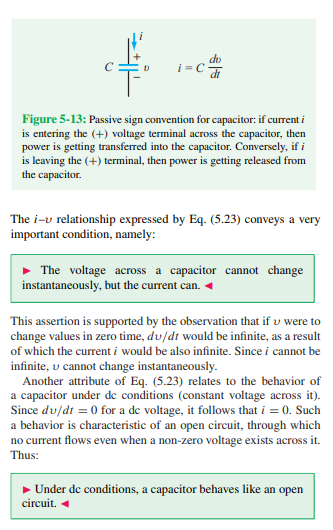
The current enters the capacitor through the + voltage terminal, then power is being transferred into the capacitor and it is being charged; inversely, if the current enters the negative terminal, then the capacitor is expending (discharging) power.
Voltage Across a Capacitor
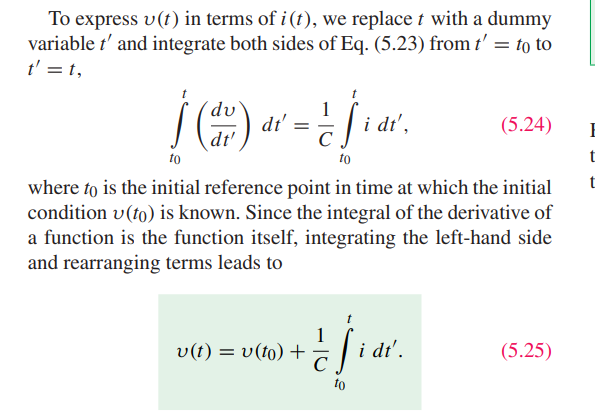
Utilize the equation i = C (dv/dt) and apply separable differential equations in order to solve for the voltage function.
The voltage across a capacitor is nothing more than the sum of the voltage with which it started added with the accumulated charge (recall that the integral of current IS charge).
In the same way how final position is the initial position + the integral of velocity, so too is final voltage the initial voltage + accumulated charge over some period of time.
If the capacitor is UNCHARGED at t = 0, then the start voltage is 0 because we do not start with any charge because there is no voltage.
Charging/Discharging a Capacitor
Charging a capacitor generates an electric field in the dielectric insulating medium between the capacitor’s conductors. The electric field is WHY the electrical energy can be stored in the insulating medium.
A capacitor can store energy (through charging) OR release previously stored energy; however, capacitors cannot dissipate energy due to the fact that they are passive elements.
The Power In/Out of A Capacitor 155
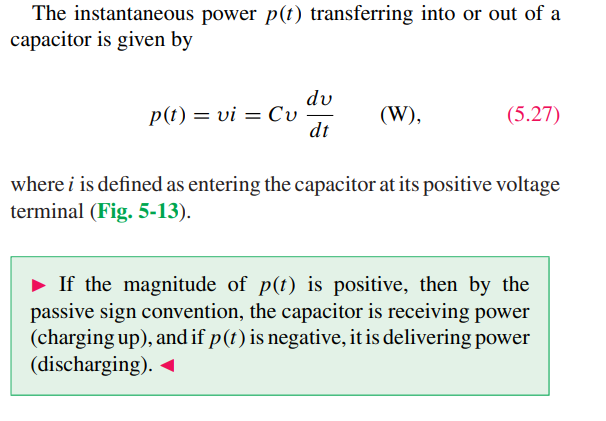
The power in/out of a capacitor can be derived by employing the relationship:
p = vi
whereby i = C (dv/dt)
Thus, P(t) = Cv(dv/dt)
If the sign of P(t) is positive, then the capacitor is receiving power and is thus charging up.
If the sign of P(t) is negative, then the capacitor is delivering power and is discharging.
Energy Stored in a Capacitor
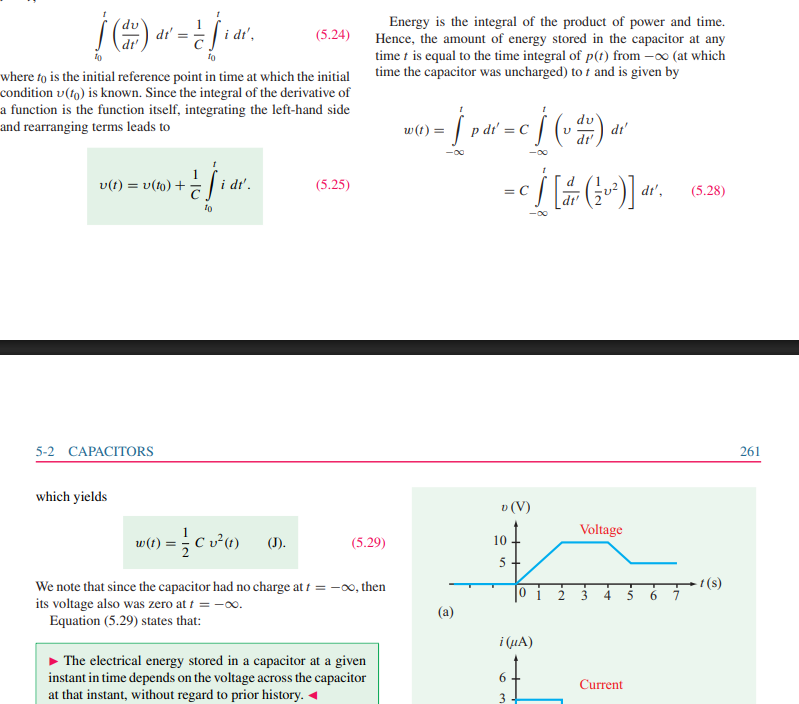
The energy within a capacitor is nothing more than the integral of the power in/out of the capacitor:
E(t) = (1/2)(C)(v(t))²
Analyzing an RC Circuit (Example)
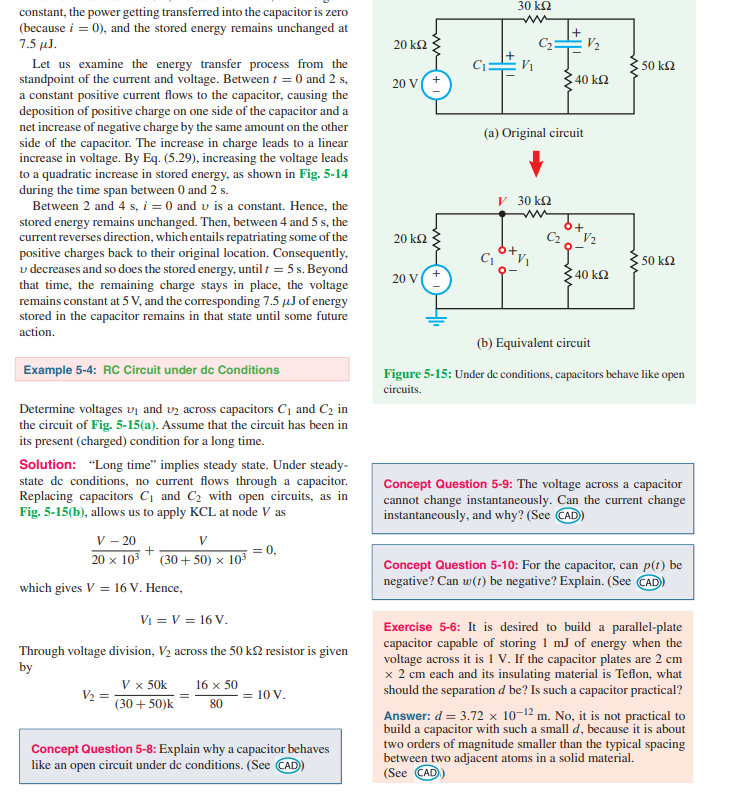
An RC Circuit is a circuit in which there is a resistor and a capacitor involved.
Take the circuit provided as a prime example:
Both C1 and C2 are replaced by an open circuit whereby the top of the capacitor is the + terminal and the bottom of the capacitor is the - terminal (recall that the top plate contains positive charge and the bottom plate contains negative charge).
From there, V is the same as V1 (since there are no loads to drop down the resistance).
Then V2 has the same voltage as the voltage across the 50kohm resistor; we disregard the 40kohm resistor because there is no current flowing through that branch and thus the voltage across the 40kohm resistor is 0V.