[EMB] 19: GENETICS
 Call Kai
 Learn
Learn Practice Test
 Spaced Repetition
 Match
Match Flashcards
 Knowt Play
1/76

There's no tags or description
Looks like no tags are added yet.
Name | Mastery | Learn | Test | Matching | Spaced | Call with Kai |
|---|
No analytics yet
Send a link to your students to track their progress
77 Terms
Genetics
Study of how genes bring about characteristics or traits of an individual and how these characteristics are inherited
Genes
These are segments of the DNA molecule that control discrete hereditary characteristics
mating (union) between male & female
Gentics result from __________________________, and predict the characteristics that will be inherited from the parents
Allele
The alternative gene is known as: _________
Identical alleles
These alleles result in a homozygous pattern of inheritance, meaning the child inherits the same allele from both parents.
Different alleles
These alleles result in a heterozygous condition, meaning the individual has two different alleles for a trait.
Genotype
This refers to an individual’s genetic makeup, determined by the specific genes inherited from the parents that reside on chromosomes.
Phenotype
This refers to the observable physical, chemical, and biochemical characteristics that result from the expression of an individual’s genotype.
law of dominance and uniformity
This law states that some alleles are dominant while others are recessive, and the presence of at least one dominant allele is sufficient for the trait to be expressed.
False. Opposite
(T/F) An organism require two dominant alleles to show the characteristic, whereas recessive traits needs only one allele (homozygous) to be expressed.
100%
When both parents are homozygous for the dominant trait, what percent of the offspring will express the dominant phenotype?
heterozygous (Aa),
If one parent is +__________________ the phenotype remains the same as the homozygous dominant, and offspring will still express the dominant trait.
the genotype distribution may be 50% homozygous and 50% heterozygous.
In such heterozygous (Aa), although all offspring show the dominant phenotype, what is the genotype distribution?
The law of segregation
This law states that each trait is controlled by two alleles, one inherited from each parent, which separate during gamete formation.
not all offspring will inherit the same trait.
In the law of segregation, segregated genes during gametogenesis will recombine during fertilization, restoring the pair in the offspring, but segregation means______________________
False. It cannot predict exactly which specific offspring will inherit a particular trait or disease.
(T?F) The law of segregation follows patterns similar to the law of dominance hence it can predict exactly which specific offspring will inherit a particular trait or disease.
The law of independent assortment
This law states that different pairs of genes are distributed randomly and independently of each other during gamete formation, resulting in varied combinations of traits in the offspring.
having a double set of chromosomes.
What is meant by diploid in humans?
23 pairs of chromosomes.
How many chromosome pairs do humans have?
22 pairs of autosomes and 1 pair of sex chromosomes.
How are human chromosomes classified?
46, XY
What is the male karyotype?
46, XX
What is the female karyotype?
mutation
This is any change in the usual DNA sequence.
Mutations can cause diseases or abnormalities, such as increased risk of cancer (e.g., BRCA gene in breast cancer, p53 deletion).
What can mutations cause?
No, some mutations contribute to genetic diversity or may have no effect on the individual.
Do all mutations cause disease?
Punnet square
It is used in predicting the genotypic ratios in the offspring
Each human has 46 chromosomes: 22 pairs of autosomes and 1 pair of sex chromosomes.
How many chromosomes does each human have?
Autosomal (dominant, recessive) and sex-linked (X-linked or Y-linked, which can be dominant or recessive).
What are the main patterns of inheritance?
Autosomal inheritance?
Inheritance involving genes located on the autosomes (chromosomes 1–22).
Sex linked
Inheritance involving genes located on sex chromosomes (X or Y)sex-linked inheritance
pedigree
A diagram that represents family relationships and tracks inheritance of traits across generations.
Pedigree charts and Punnett squares to determine possible offspring outcomes.
What tools are used to predict inheritance patterns?
Only one affected parent is needed, and both males and females are equally affected.
What characterizes an autosomal dominant trait?
All offspring will be affected.
What happens when a homozygous dominant (AA) individual marries a normal (aa) individual?
Because only one copy of the dominant allele is needed for expression.
Why do autosomal dominant traits appear in every generation?
There is a 50% chance that the offspring will be affected.
What is the outcome when a heterozygous (Aa) individual marries a normal (aa) individual?
Dominant: Cleft chin | Recessive: No cleftWhat is the dominant vs recessive trait for hairline?
What is the dominant vs recessive trait for chin shape?
Dominant: Widow’s peak | Recessive: No widow’s peak
Dominant: Dimples | Recessive: No dimples
What is the dominant vs recessive trait for dimples?
Dominant: Brown/black hair | Recessive: Blonde hair
What is the dominant vs recessive trait for hair color?
Dominant: Freckles | Recessive: No freckles
What is the dominant vs recessive trait for freckles?
Dominant: Brown eyes | Recessive: Gray/blue eyes
What is the dominant vs recessive trait for eye color?
Dominant: Free earlobe | Recessive: Attached earlobe
What is the dominant vs recessive trait for earlobes?
Neurofibromatosis (chromosome 17), Huntington’s disease (chromosome 4), thalassemia (defect in hemoglobin synthesis), tuberous sclerosis, retinoblastoma (malignancy of the retina), and achondroplasia.
What are examples of autosomal dominant disorders?
Autosomal recessive.
Given this pedigree, what is the pattern of inheritance for this disorder?
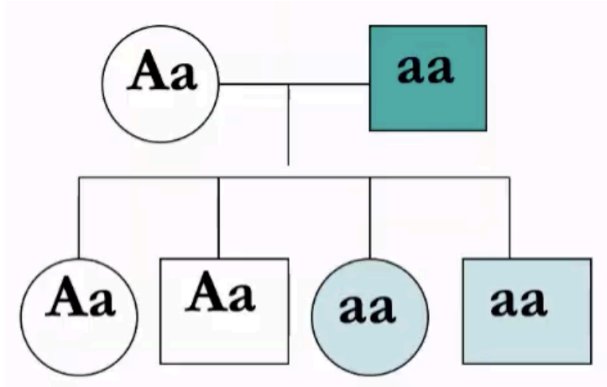
The trait may not appear in parents, affects both sexes equally, and requires homozygous alleles (aa) for expression.
What characterizes autosomal recessive inheritance?
50% of the offspring will be affected (aa) and 50% will be carriers (Aa).
What happens when an affected individual (aa) marries a heterozygous (Aa) individual? (autosomal recessive inheritance)
All offspring will be heterozygous carriers (Aa) but clinically normal.
What happens when an affected individual (aa) marries a normal individual (AA)? (autosomal recessive inheritance)
25% affected (aa), 50% carriers (Aa), and 25% normal (AA).
What happens when both parents are heterozygous (Aa)? (autosomal recessive inheritance)
consanguineous marriage
A marriage between related individuals who are more likely to share similar genes.
It increases the chance that both parents are heterozygous carriers of the same recessive gene.
Why does consanguineous marriage increase genetic risk?
The closer the relation, the higher the percentage of shared genes.
What is the genetic implication of degree of relation?
Marriage up to the third degree of relation is prohibited.
What is the general rule regarding consanguineous marriage?
sex-linked inheritance
A pattern of inheritance involving genes located on the sex chromosomes (X or Y).
At least one parent is affected, and both males and females can be affected.
What characterizes X-linked dominant inheritance?
he transmits the trait to 50% of her sons and 50% of her daughters.
How does an affected female transmit an X-linked dominant trait?
He transmits the trait to none of his sons and to all of his daughters.
How does an affected male transmit an X-linked dominant trait?
There is no male-to-male transmission, and males are more commonly affected since only one mutated X chromosome is needed.
What characterizes X-linked recessive inheritance?
He transmits the gene to all of his daughters (who become carriers) and none of his sons
How does an affected male transmit an X-linked recessive trait?
Sons may be normal or affected, while daughters may be normal or carriers.
What are the outcomes for heterozygous females (carriers)? (X-linked recessive trait?)
100% of sons will be affected, and 100% of daughters will be carriers.
What are the outcomes for homozygous affected females?(X-linked recessive trait?)
Because males only have one X chromosome, so a single mutation is enough to cause disease.
Why are males more commonly affected in X-linked recessive disorders? (X-linked recessive trait?)
Both X chromosomes must carry the mutation, which is rare.
What is required for females to express an X-linked recessive disorder? (X-linked recessive trait?)
Females are usually carriers.
What is the usual genetic status of females in X-linked recessive inheritance? (X-linked recessive trait?)
The pattern is similar, but disease expression is more frequent and apparent in X-linked dominant inheritance.
How does X-linked recessive compare to X-linked dominant inheritance?
Hemophilia
This is a classic example of an X-linked recessive disorder.
Sons are usually affected while daughters are typically carriers.
What is the general pattern of X-linked inheritance in hemophilia?
Sons may be affected or normal, while daughters may be carriers or normal.
What happens when a carrier female marries a normal male?
All daughters will be carriers and all sons will be normal.
What happens when a normal female marries a hemophilic male?
Y-linked (holandric) inheritance
A pattern of inheritance where the mutant gene is located on the Y chromosome and is observed only in males.
Because only males possess a Y chromosome.
Why are only males affected in Y-linked inheritance?
Hypertrichosis pinnae auris (excess hair on the auricle).
What is an example of a Y-linked trait?
The Y chromosome is smaller than the X chromosome and contains fewer genes.
Why are there few Y-linked disorders?
Mostly traits rather than diseases.
What types of conditions are usually associated with Y-linked inheritance?
Abnormalities often involve changes in chromosome number, such as duplication of the Y chromosome.
What kind of abnormalities commonly occur in the Y chromosome?