DNA replication?
 Call Kai
 Learn
Learn Practice Test
 Spaced Repetition
 Match
Match Flashcards
 Knowt Play
1/27

There's no tags or description
Looks like no tags are added yet.
Name | Mastery | Learn | Test | Matching | Spaced | Call with Kai | Chat |
|---|
No analytics yet
Send a link to your students to track their progress
28 Terms
when and where does DNA replication happen?
where -in the nuclues of a eukaryotic cell
when - interphase
difference between eukaryotes and prokaryotes
eukaryotes
-multicellular organism
-membrane bound
plant or animals
prokaryotes
-unicellular organisms
-not membrane bound
-bacteria
what enzyme is responsible for unzipping dna helix?
helicase - Breaks hydrogen bonds between base pairs
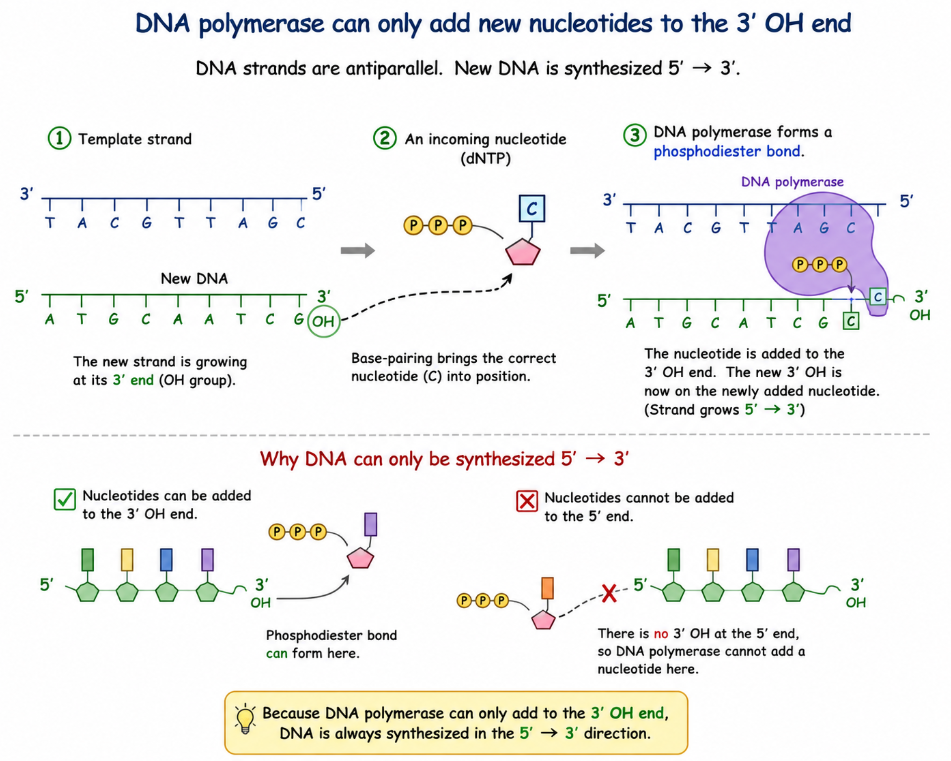
In what directions are nucelotides added during replication?
New nucleotides are added in the 5′ → 3′ direction.
👉 DNA polymerase can only add to the 3′ end of the growing strand
what enzyme bonds nucleotides together
DNA polymerase
👉 Adds complementary nucleotides
👉 Forms bonds in the new strand
⚠ If they specifically mean joining fragments on lagging strand:
👉 That enzyme is DNA ligase
Which enzyme is responsible for creating the covalent bonds (specifically phosphodiester bonds) that connect the sugar-phosphate backbone of the new DNA molecules?
DNA ligase is the enzyme responsible for forming covalent (phosphodiester) bonds that connect the sugar-phosphate backbone of newly synthesized DNA, especially joining Okazaki fragments on the lagging strand.
DNA polymerase → adds nucleotides during synthesis
DNA ligase → seals the backbone (forms phosphodiester bonds between fragments)
Describe the origin of each strand of the new double helices created after DNA replication?
Each new DNA molecule contains:
One original (parental) strand
One newly synthesized strand
This is called semi-conservative replication
Ensures genetic information is copied accurately
Why do you think DNA replication is important to the growth and development of a multi-cellular organism
Allows cell division (mitosis)
Ensures each new cell gets identical DNA
Supports:
Growth
Development
Tissue repair
Maintains genetic continuity
what would happen if DNA replication occured inncorectly?
If replication occurs incorrectly
Leads to mutations (changes in DNA sequence)
May cause:
Faulty proteins
Disrupted cell function
Can result in:
Genetic disorders
Diseases like cancer
what is the function of primase
creates a primer that tells DNA polymerase where to build
what is the function of SSB protiens
makes sure DNA strands dont rejoin when split by helicase
what is the function of toppisomerase
Prevents supercoiling (tension ahead of the fork)
Works in front of helicase
Cuts and rejoins DNA to relieve stress
Supercoiling is when DNA becomes over-twisted (tightly wound) on itself.
what are okizaki fragments?
because DNA polymerase can only build in the 5’ to 3’ direction its slower on the new strand creating a lagging and leading strand which makes spaces in between known as okizaki fragments ligase later joins these fragments
what does it mean by DNA strands are antiparrelal
Antiparallel means the two strands of DNA run in opposite directions.
5’-3’
3’-5’
what did miesher discover?
meicher discovered DNA called it nuclien at that time
what did hershy and chase discover?
they discovered DNA carries genetic information
what did watson and crick discover?
proposed double helix model
name the purines
double ring nitrogenous bases - adenine and guanine
name the pyramidines
single ring nitrogenous bases - uracil,thymine,cytosine
explain the meaning behind 5’ end and 3’ end in DNA
5’ end - phosphate group attached to 5 carbon of first sugar
3’ end - OH group on 3 carbon of the last sugar because new nucleotides attach to this direction
explain the 3 DNA replication models?
1.) Conservative - original double helix stays intact , new copy made entirely from new nucleotides
2.) semi conservative - each new molecule has old and new strand
3.) Dispersive - new molecule patchwork mix of old and new DNA segment
what did mendel discover?
genes determine traits
garrod discovered
mutations cause inhereted diseases
ingram discoverd?
single amino acid mutation causes sickle cell anemia
what is the triple codon hypothesis explain why this number
there are 20 amino acids with 4 possible base pairs
if there were 2 codons
4² = 16 possibilities which is short of 20 amino acids
4³ = 64 possibilities with 3 codons you can code for more than 20 amino acids while also leaving space for stop/start codons
what did crick discover?
confirmed the triple codon hypothesis
how are okizaki fragments made?
How Okazaki fragments form
DNA unwinds at the replication fork
Primase lays down RNA primers
DNA polymerase builds a short DNA section (5′ → 3′)
Fork moves again → new primer added
More short DNA pieces are made
These short pieces = Okazaki fragments
why DNA polymerase can only build in the 5’3 direction?
DNA polymerase can only add new nucleotides to the 3′ OH end of the growing DNA strand. Because nucleotides are only added to the 3′ end, DNA can only be synthesized in the 5′→3′ direction.