Yr 9 Biology Prep - General
 Call Kai
 Learn
Learn Practice Test
 Spaced Repetition
 Match
Match Flashcards
 Knowt Play
1/21

Earn XP
Description and Tags
This set is not applicable for the following games: match, tests, learn, and inverted flashcards (definition -> term). Each section is colour coded into it's appropriate category: Red (characteristics of life), Orange (Diffussion/Osmosis), Yellow (Homeostasis), Green (Excretory System), Blue (Nervous System) and Purple (Endocrine System)
Name | Mastery | Learn | Test | Matching | Spaced | Call with Kai |
|---|
No analytics yet
Send a link to your students to track their progress
22 Terms
What are the defining characteristics of vertebrates?
Have a backbone
Bilateral symmetry (two mirror-image halves along a single central plane)
Internal skeleton (endoskeleton) made of bone
What are the defining characteristics of mammals?
Mammary glands
Hair on body
Warm-blooded (endothermic)
Give birth to wild young
What are the defining characteristics of primates?
Forward-facing eyes
Opposable thumbs
Nails instead of claws
What are the 7 characteristics of life?
Movement – they move or change position
Respiration – they get energy from their food
Sensitivity – they respond to stimuli such as light, sound, temperature
Growth – they grow and develop
Reproduction – they have the ability to reproduce
Excretion – they get rid of waste products
Nutrition – they need food for energy
What is the organisation of an organism?
Chemical
Cellular
Tissue
Organelle
Organ
Organ System
Organism
Population
What are the two main roles of the human body?
Maintaining a continual supply of materials needed (e.g. glucose, oxygen)
A continual removal of waste materials
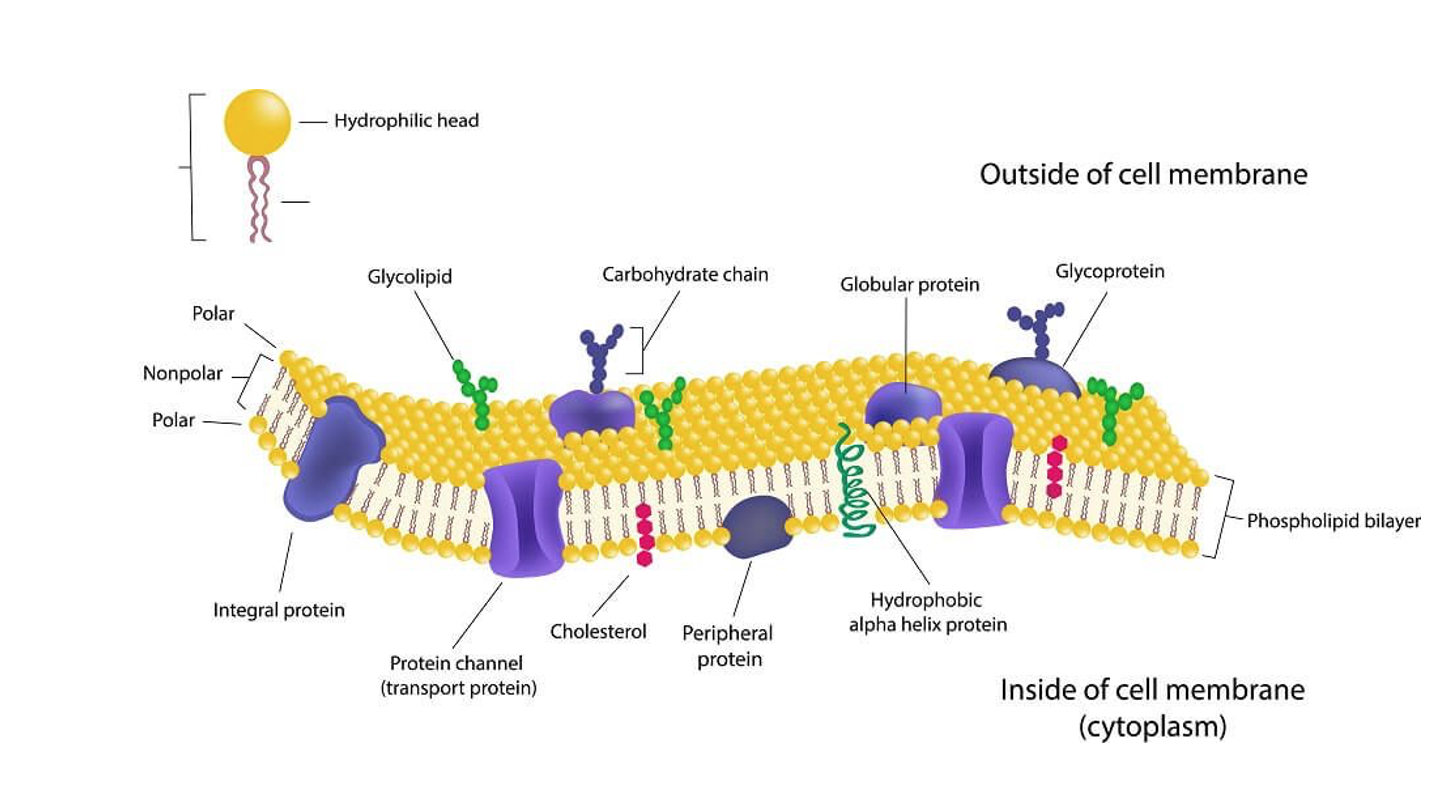
What is the cell membrane primarily composed of?
Lipids and proteins
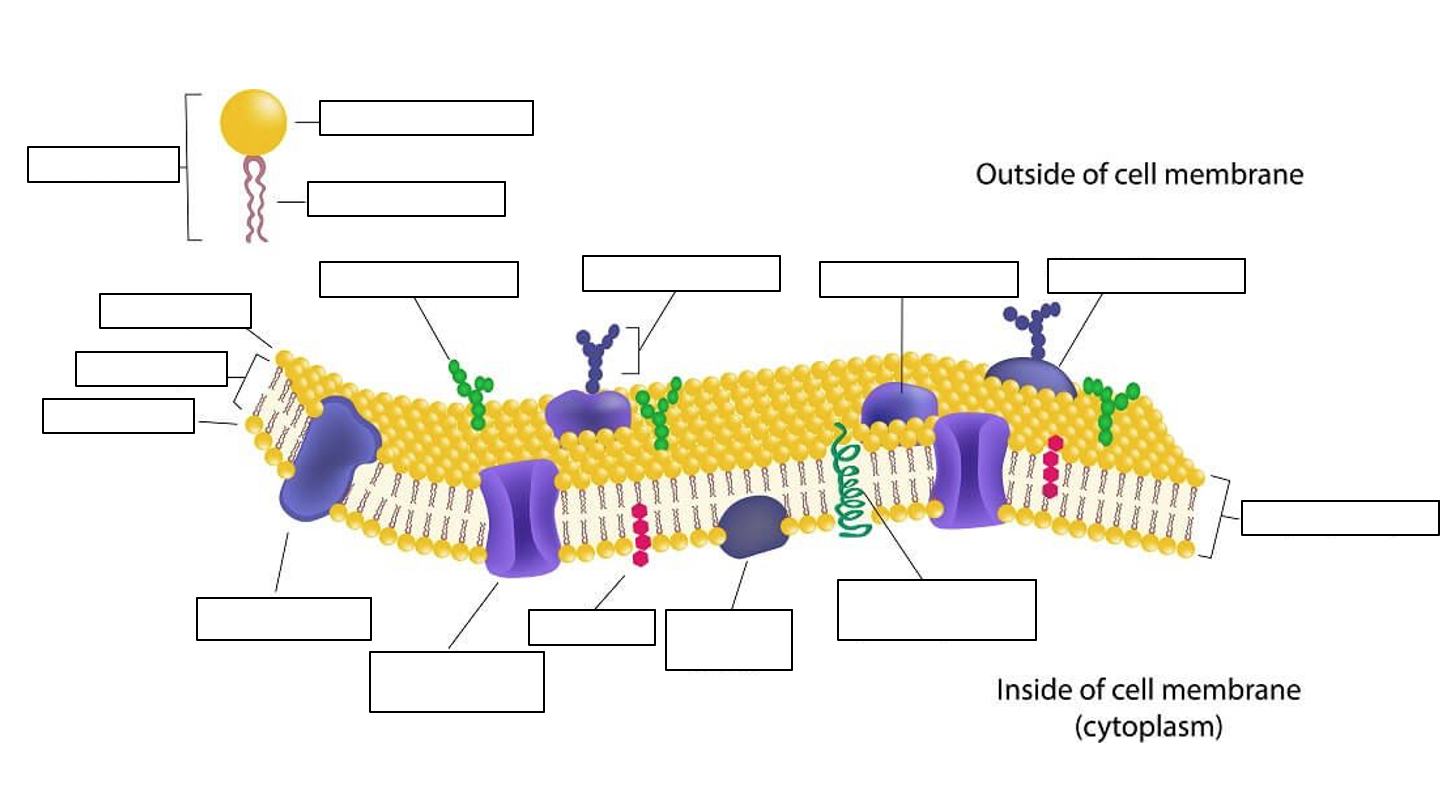
What is the phospholipid bilayer?
The phospholipid bilayer consists of two layers of phospholipid molecules arranged so that the hydrophilic (water-attracting) heads face outward toward the aqueous environment, while the hydrophobic (water-repelling) fatty acid tails are tucked inward
How do very small molecules (e.g. oxygen, carbon dioxide) pass through the cell membrane?
They pass through small gaps between lipids (simple diffussion)
How do fat soluble substances (e.g. alcohol, steroid hormones) pass through the cell membrane?
They diffuse across the membrane by “dissolving into the liquid” (simple diffussion)
How do water soluble substances pass through the cell membrane?
They are unable to pass through the lipid portion of the membrane, and must need another mode of transport, such as channel proteins and carrier proteins (facilitated diffussion)
What are the two types of proteins and how are they embedded through the membrane?
Integral protein: Bridges two sides of the membrane. These include channel and carrier proteins
Peripheral protein: Embedded on the outside of the membrane.
Cell membranes are differentially permeable. What does this mean?
They allow certain ions and molecules (e.g. nutrients)), while restricting others from entering (e.g. viruses)
What are the two types of transport?
Passive transport: Does not require energy from the cell [simple diffusion, facilitated diffusion]
Active Transport: Requires cell’s energy for transfer
What is diffusion?
The passive movement of particles from high concentration to low concentration down the concentration gradient.
What is a concentration gradient?
The difference in concentration between two areas. It’s what drives particles to move from high concentration to low concentration.
What is net diffusion?
The overall movement of particles from high concentration to low concentration
How do small, non-polar molecules diffuse through the membrane?
They directly pass through the membrane by simple diffusion.
How do large and/or polar molecules diffuse through the membrane?
They diffuse through the membrane by facilitated diffusion, using channel or carrier proteins.
What is the difference between simple diffusion and facilitated diffusion?
Simple diffusion is the passive movement of small, non‑polar molecules directly through the phospholipid bilayer without protein channels or carriers
Whereas, facilitated diffusion is the passive movement of large or polar molecules through specific protein channels or carriers down the concentration gradient.