Chapter 15: Non-Imaging Procedures and Radionuclide Therapy
 Call Kai
 Learn
Learn Practice Test
 Spaced Repetition
 Match
Match Flashcards
 Knowt Play
1/49

There's no tags or description
Looks like no tags are added yet.
Name | Mastery | Learn | Test | Matching | Spaced | Call with Kai |
|---|
No analytics yet
Send a link to your students to track their progress
50 Terms
Radioiodine therapy is given for:
All of the above
During a Schilling test, a flushing dose of B, is given:
Intramuscularly
P-32 chromic phosphate is a:
Both
Before administration, S r chloride must be assayed in a dose calibrator.
False
P-32 sodium phosphate is for:
Intravenous injection
Sr-89 chloride is used to treat:
Bone pain caused by metastases
Sr-89 chloride should be administered:
Through a patent intravenous line
Sr-89 and P-32 are effectively shielded by:
Plastic syringes
P-32 chromic phosphate is used to treat:
Malignant ascites
Absorption of vitamin B-12 in the small bowel requires:
Intrinsic factor
What will be the effect on the results of a Schilling test if the patient urinates once and forgets to collect it?
The percent excretion may be falsely low
A patient has a 24-h dose excretion of 4% on a stage I Schilling test. A stage II test is performed and the patient now has a 24 h excretion of12%. What is the most likely diagnosis?
Pernicious anemia
Calculate the percent excretion from a Schilling test given the following values: 55 cpm background, 13,500 p m in the 1% standard, and 850 cpm in the 5 ml urine sample. The total volume of urine collected was 1100 ml.
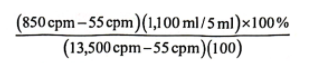
13%
Patient instructions for a Schilling test should include all of the following except:
Careful collection o f all urine for 48 h in a single container
Simultaneous performance of stage I and stage Il Schilling test uses:
Oral Co-57 labeled B-12 bound to intrinsic factor and oral Co-58 labeled B-12
Why must the p m measured in the standard during a Schilling test be multiplied by a standard dilution factor?
Both
Beta emitters are effective for therapy because:
They have a short range in soft tissue.
What is the meaning of polycythemia?
An excess of red blood cells
Which of the following measure the amount of red cells in circulating blood?
Both
The normal life span of a red blood cell is ________ days, following which it is removed from circulation by the _______
120, spleen
Red blood cells are also known as:
Erythrocytes
An empty syringe is used to draw 5 ml of blood. After several minutes the blood appears separated into a liquid and a solid portion. The liquid portion is called:
Serum
The functions of white blood cells include:
All of the above
A patient should be supine for at least 15 min before the start of a plasma volume determination because the plasma volume ________ when a patient is standing.
Decreases
If the dose rate measured at the bedside of a radioiodine therapy patient is 10 mrem/h, how long may a visitor (who is seated at bedside) stay?
12 min
A patient receives 45 mCi o f I-131 to treat thyroid cancer. A survey taken at 3 m immediately after administration of the dose reveals 60 mrem/h. If a survey taken 12 h later shows a dose rate of 30 mrem/h, how many mCi are left in the patient?
22.5 mCi
A patient advocate decides to question a patient undergoing radioiodine therapy regarding his or her opinion of the care provided. The dose at 1.5 m from the patient is 5 mrem/h, and it will take at least 30 min for her to interview the patient. What should be done?
Any of the above
According to the Code of Federal Regulations, at what point may a patient who has undergone radioiodine therapy leave the hospital?
Both
Which of the following objects in a patient's room have the potential to become contaminated from a patient who has received radioiodine?
All of the above
Preparations for radioiodine therapy include:
All of the above
Which of the following are used to calculate the dose of I-131 needed for administration in a patient with hyperthyroidism?
All of the above
A patient has a 6-h thyroid uptake of2 5% and receives a 20 µCi dose of I-131 for a thyroid uptake prior to radioiodine therapy. What will the concentration of activity in the patient's thyroid gland be at 6 h if his thyroid weighs 45 g
0.11 µCi/g
Which of the following make I-131 suitable for therapy?
Beta emissions
Alternatives to radioiodine therapy for patients with hyperthyroidism are:
Both
The wash method of labeling red blood cells for the determination of red cell volume involves repeated centrifugation of the collected sample. The advantage of this technique is that:
Free chromate ion is removed.
If a technologist mistakenly administers P-32 chromic phosphate intravenously, what is likely to be the result?
Severe radiation damage to the liver.
Discharge instructions for a patient who underwent therapy with I-131 may include all of the following except:
Patient should collect excreta and store for ten half-lives
A survey taken at 1 m from a patient who received 35 mCi of I-131 revealed a dose rate of 9 mrem/h. If the survey made 24 h later shows 6.9 mrem/h, what is the remaining dose in the patient, and can he or she be discharged?
27 mCi, yes
The NRC requires I-131 therapy patients to have private rooms, although they may share with another I-131 therapy patient.
False
According to the NRC, records of dose rate measurements taken immediately after administration of radioiodine to therapy patients must be kept for:
3 years
After injection of I-125 human serum albumin for determination of plasma volume, it is important to withdraw a small amount of blood into the syringe and reinject it, to ensure that the entire radioactive dose is administered
False
A patient who receives Sr-89 chloride for palliation of pain from bone metastases does not have to be admitted to the hospital.
True
Which of the following is used in the treatment of non-Hodgkin's lymphoma?
Y-90 ibritumomab tuxetan
Patients who have previously demonstrated allergic reactions to mouse proteins have an increased risk of allergic response to:
Both
To perform a thyroid scintigraphy, which of the following is correct?
All of the above
To perform a thyroid scintigraphy, which of the following is correct?
If Tc-99m pertechnetate is used, thyroid uptake can be obtained 10 min after tracer injection.
To perform a whole body radioiodine scintigraphy for thyroid cancer, which of the following is not correct?
Breast-feeding should be stopped and cannot be resumed for either 1-123 or I-131 test
What is the half-life of radium-225 dichloride?
11.4 days
Radium-225 dichloride is currently FDA approved for patients with what disease process?
Metastatic prostate cancer
How is radium-225 dichloride administered?
Intravenous injection