AP Comparative Government: Key Concepts and Country Profiles
 Call Kai
 Learn
Learn Practice Test
 Spaced Repetition
 Match
Match Flashcards
 Knowt Play
1/100

There's no tags or description
Looks like no tags are added yet.
Name | Mastery | Learn | Test | Matching | Spaced | Call with Kai |
|---|
No analytics yet
Send a link to your students to track their progress
101 Terms
Correlation
A demonstrated relationship between two variables
Causation
Scientific demonstration that changes in one variable cause changes in another variable
State
The institutions that maintain a monopoly on violence over a population within a defined territory - Max Weber
Sovereignty
The ability to carry out actions or policies within a territory independently from external actors or internal riots
Institutions
Actors which carry out the state's responsibilities (i.e., executive branch, bureaucracy, military, courts, etc.)
Nation
People group that is bound together through shared political aspirations (i.e., self government)
Regime
Fundamental rules and norms of politics
Government
The leadership presently entrusted with running the state
Human Development Index (HDI)
A measurement used to assess the social and economic development levels of countries
Gross Domestic Product (GDP)
The total value of goods produced and services provided in a country during one year
Democracy
A system of governance in which rulers are held accountable for their actions in the public realm by citizens
Characteristics of Democracy
1. The government is chosen and/or replaced through free and fair elections; 2. Citizens actively participate in politics and civic life; 3. Human rights of all citizens are protected; 4. Rule of law equally applies laws and procedures to all citizens
Authoritarian
Regime in which a small group of individuals exercises power over the state with no constitutional responsibility to the public
Corporatism
Labor, businesses, other interest groups bargain with the state over economic policy
Clientelism
State provides specific benefits to a person or group to elicit their support
Personality Cult
Promotion of the image of a leader as someone who embodies the spirit of the nation
Types of Authoritarian
1. Personal and Monarchical Rule; 2. Military Rule; 3. One-Party Rule; 4. Theocracy; 5. Illiberal Regimes
Democratization
Becoming more democratic, moving towards a fully liberal democracy
Democratic consolidation
Democracy is the 'only game in town' in a country for achieving desired political outcomes
Sources of Power and Authority
Constitutions, religious justification, military force, political party unity, electoral control of the legislature's majority, popular support for a leader
Regime change
Altering the fundamental system of politics and power, typically shifting to become either more democratic or more authoritarian
Revolution
Large portions of the population support an overthrow of the existing regime and new leadership arises to replace it; (Iran 1979, China 1949)
Coup d'etat
The existing government loses support, and the military intervenes to forcibly overthrow the government and take political power itself; (Nigeria, many instances 1966-1990s)
Election
New political leadership is brought into power by electoral victory, and uses the victory as a mandate to enact rapid regime change; (Russia, 1991-1993 (after collapse of the Soviet Union), Nigeria 1998-1999)
Reform
Incremental changes are made to the political system over time, transitioning gradually to a more democratic or more authoritarian system (Mexico 1980s - 2000s (democratic), Russia 2000-Present (authoritarian))
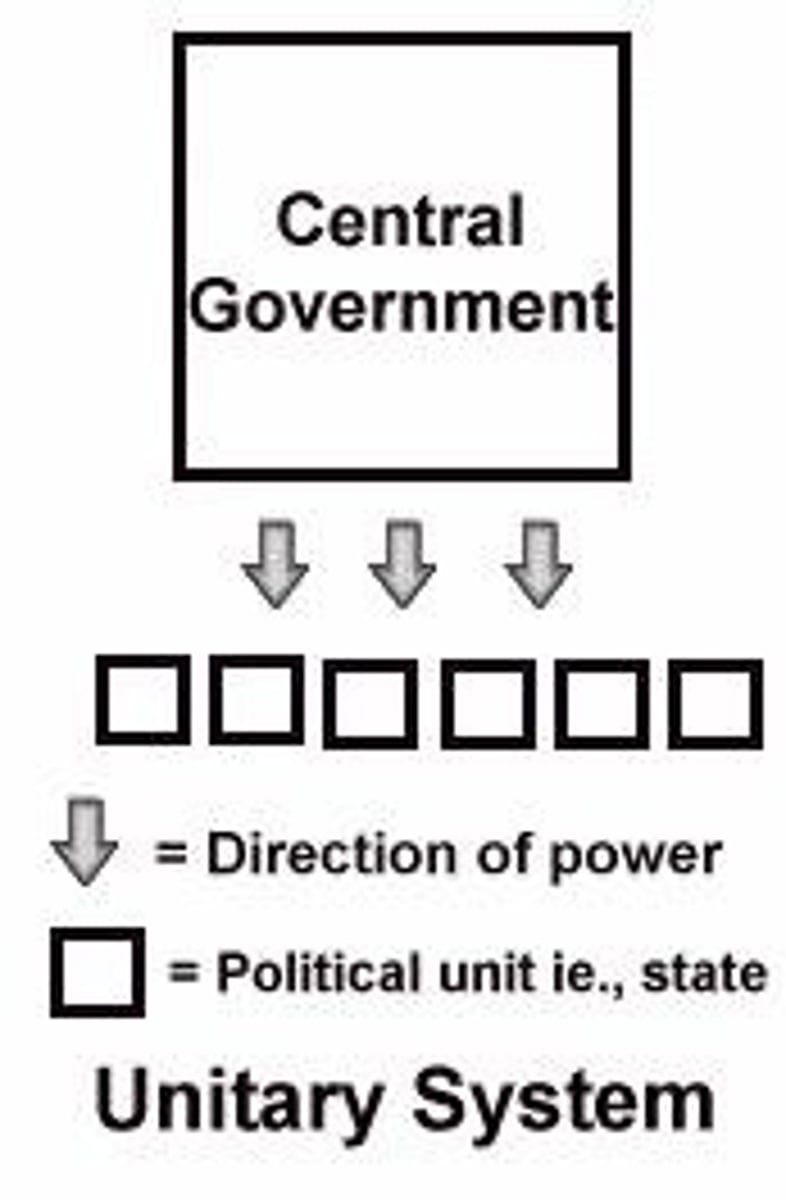
Unitary
One national government, local/regional units have little or no say in policy, or are only given authority by the central government (Examples: China, Iran, Britain)
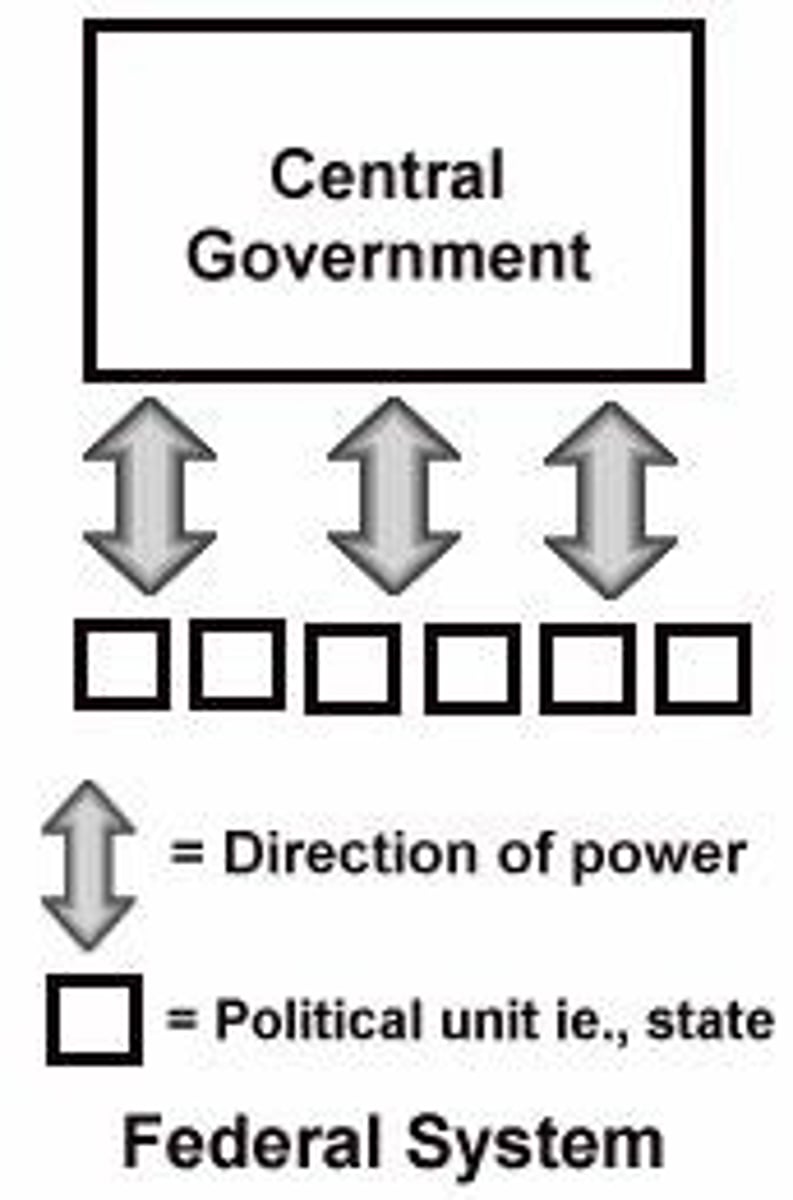
Federal
Local units are permanent, constitutionally established, and divide or share power with the central national government, operating independently on many matters (Examples: U.S., Mexico, Nigeria, Russia)
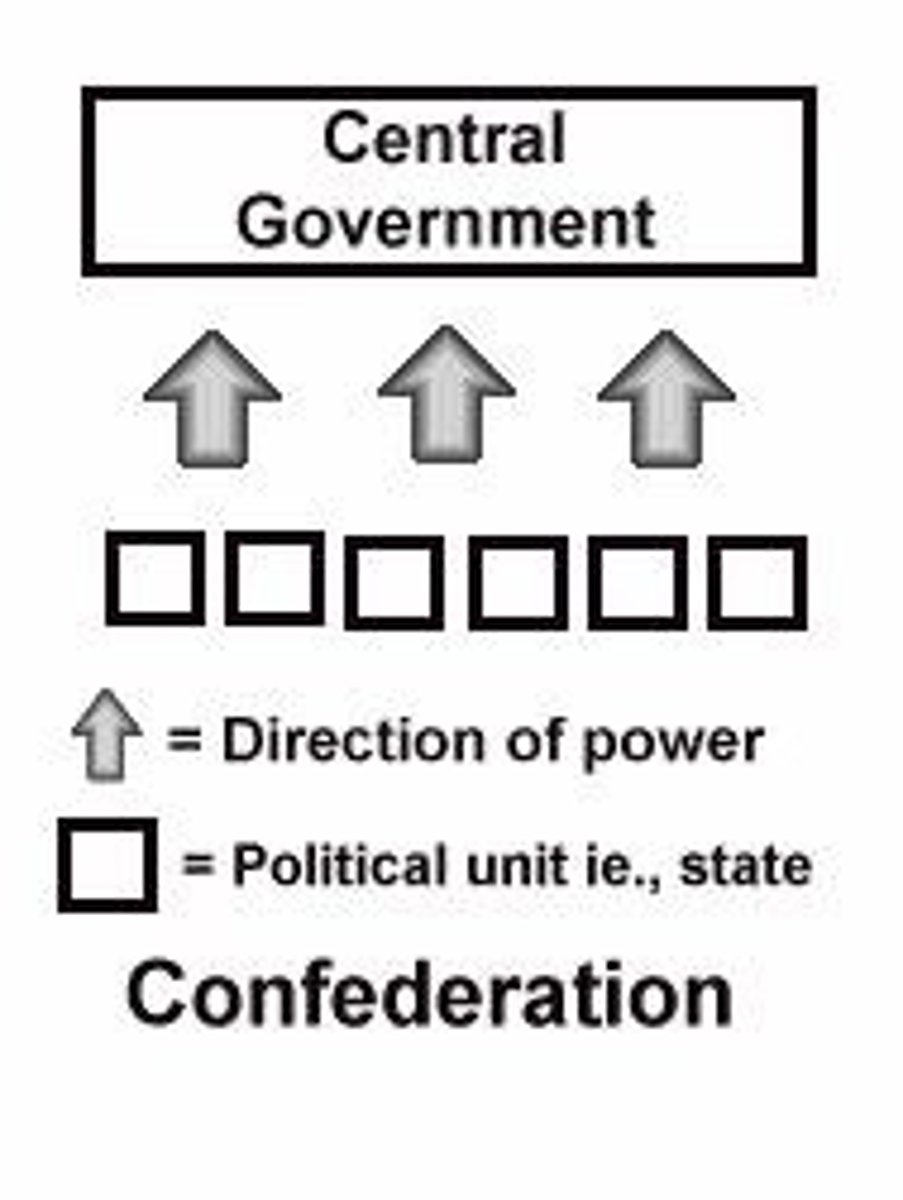
Confederal
Sovereignty is fully held by local levels of government, united by a weaker central government (Examples: European Union, other IGOs and supranational organizations)
Legitimacy
The people's belief / perception that the government has the 'right to rule' and is accepted by the citizenry
Sources of legitimacy
Election and faith in the democratic system or constitution, Nationalism, Tradition, Governmental effectiveness (such as economic growth and rising prosperity), Religious heritage and organizations, Policy Effectiveness
Maintenance of legitimacy
Maintenance of long-held traditions, Charismatic / popular leadership: inspires exceptional loyalty, Reducing crime, violence, corruption, Preserving the appearance of fair, transparent processes for selecting leaders, Policy effectiveness: government action works, Political efficacy: people feel they can understand and influence politics, Institutions laws: established as part of an official practice
How to lose legitimacy
Visible corruption, Perceived lack of fairness in the electoral process, Failing economy, Social Conflict, Inability to control violence and civil strife
How to repair legitimacy
Policy Effectiveness: laws, regulations, court orders, Regulation: get on the policy agenda, Representation: a seat at the political table, Reform: new or revised policy
Political Stability
Goal of governments is to maintain control over state sovereignty
Challenges to Political Stability
Loss of territory, Loss of population, Loss of government authority, Loss of sovereignty
Fragile State Index
A state that has not yet failed but whose leaders lack the will or capacity to perform core state functions.
Corruption Perception Index
Measures the perceived levels of public sector corruption in countries worldwide.
Head of State
Symbolizes and represents the people
Head of Government
Handles day to day tasks of governing the state
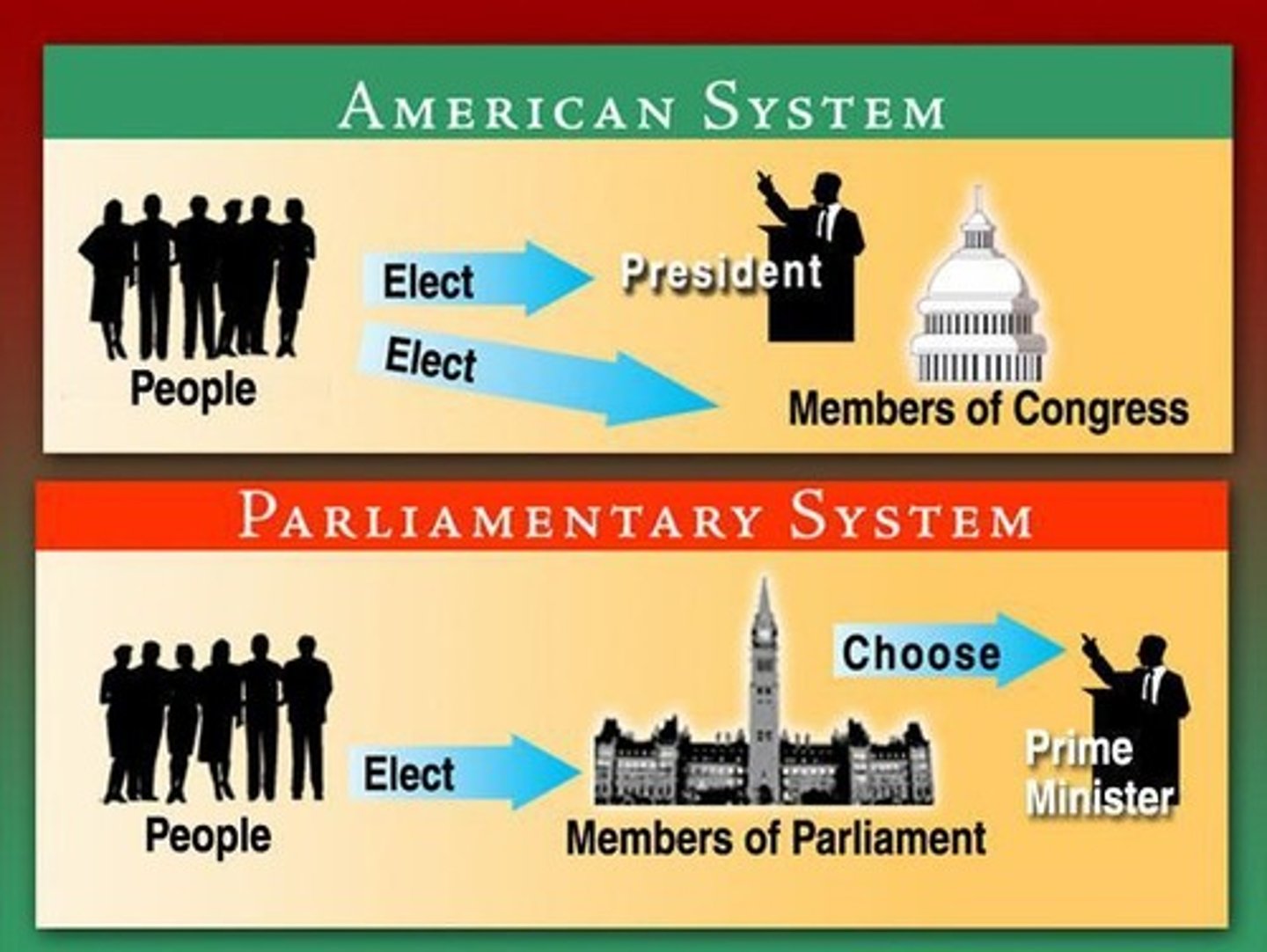
Presidential System
Voters choose chief executive by direct vote, separate legislative and executive institutions (usually including 'checks and balances')
Parliamentary System
Voters elect parliament, majority party in parliament elects prime minister; prime minister and cabinet control most legislation
Differences between Presidential and Parliamentary Systems
Policy gridlock is more likely in presidential systems; parliamentary systems have no separation of powers or checks and balances
Executive
The executive in the government, including the chief executive and the cabinet, are responsible for formulating, implementing, and enforcing public policies through different methods and agencies.
Fixed Term
The executive serves a fixed term and may not be removed by the legislature, except for misconduct through impeachment.
Legislative Independence
Practically, the processes for removing executives are more functional in some countries than others, and that can be a sign of relative legislative independence in each country.
Advantages of Executive Systems
Check executive power, prevent emergence of dictatorship, focus officeholder on governing rather than winning reelection, provide opportunities for new leaders and new policies.
Disadvantages of Executive Systems
Force good executives out of office, allow insufficient time for the officeholder to achieve their goals, impede policy continuity, weaken accountability to the public.
China's Executive
China's executive is comprised of senior CCP leaders in the party's Politburo, who are subsequently selected for roles including President, Premier, and various cabinet ministries.
President of China
Elected to a single 6-year term, head of state and head of government, commander-in-chief, leader of the bureaucracy, approves domestic legislation, and conducts foreign policy.
Prime Minister of China
Appointed by the President and confirmed by the Duma, can be removed by either, head of government, oversees civil service.
Monarch
Inherited, lifetime reign, ceremonial head of state, formally appoints the Prime Minister after election.
Prime Minister in Parliamentary Systems
Elected as a Member of Parliament, Party Leader for the leading party, then as Prime Minister, head of government, de facto commander-in-chief, chief executive over the civil service.
Executive Term Limits in China
Limited to one term of 6 years (sexenio).
Removal of Executives
Each of our countries of study has an official process constitutionally by which the legislature can remove the chief executive and other executives.
Vote of No Confidence
The House of Commons chose the Prime Minister and Cabinet, and can hold a 'Vote of No Confidence' that would remove them and cause new elections to be held.
Legislative Systems in China
Unicameral, National People's Congress; constitutionally, it is the supreme branch of government.
Congress of the Union
Bicameral, with the Chamber of Deputies representing the people and the Senate representing each state equally.
Parliament in Russia
Bicameral Parliament - The Duma and the Federation Council; the Duma passes legislation and confirms the Prime Minister.
Parliament in the UK
Bicameral Parliament - The House of Commons and House of Lords; the House of Commons holds all meaningful powers.
Legislative Powers
Legislative powers can be constrained by other governmental institutions, which can affect legislative independence.
China's Standing Committee of the NPC
About 300 members of the 3,000 member NPC; assumes legislative duties most of the year when the NPC is not in session.
Judicial Systems in China
Judges appointed by the CCP; targets opposition; includes Grassroots, Intermediate, higher, and Supreme People's Court.
Judicial Independence in the UK
Judges appointed by the President and Senate for a 15-year term; Supreme Court is the highest court.
Legislative Constraints
Legislatures have the potential to reinforce legitimacy and stability by responding to public demand, openly debating policy, and facilitating compromise.
Cabinet Ministries in China
Leadership decisions happen behind closed doors, then are confirmed (often unanimously) by the National People's Congress every 5 years.
Removal of the President in China
There is no known official process for removal of the President other than the official decision to 'choose' a President by the National People's Congress every 5 years.
Impeachment Process
The lower house may bring charges of impeachment, and the upper house acts as the jury, with a 2/3 vote resulting in removal of the President.
Term Limits for Prime Minister
No term limits on Prime Minister; can serve provided that their party wins control at elections every 5 years.
Judiciaries
Responsible for interpreting and applying laws, and resolving disputes that arise from the law.
Judicial Structure
Each country has its own judicial structure, and different methods to appoint judges, along with varying functions of the courts.
Judges Appointment in the U.S.
Judges are appointed by the President and confirmed by the Senate for 15 year terms.
PRI Rule
The system was formerly dominated by the PRI under one-party rule, and Presidents would fill the judiciary with loyalists.
Judicial Reforms in Mexico
Reforms have been enacted since 2000 to make the system more independent and transparent.
Public Trials in Mexico
Public trials have been required since 2009.
Highest Court in Mexico
Supreme Court.
Judges Appointment in China
Judges are appointed by the Chinese Communist Party through processes conducted behind closed doors.
Civil Law Reforms in China
Many civil law reforms have been made to comply with Western business and property practices.
Criminal Law in China
Criminal law remains largely unchanged and harsh to criminal suspects.
Rule by Law in China
Means the judicial system is subservient to the decisions of the Chinese Communist Party.
Highest Court in China
Supreme People's Court.
Judges Appointment in Russia
Judges are appointed by the President, approved by the Federation Council.
Judicial System in Russia
Russia's government uses the judicial system to target opposition.
Constitutional Court in Russia
Has the power of constitutional interpretation and judicial review.
Common Law System
Legal system based on common law - precedent is applied by courts to preserve consistent and predictable application of the law.
Political Culture
Collective attitudes, values, and beliefs of the citizenry and the norms of behavior in the political system.
Political Efficacy
The extent to which people believe their participation in politics can/will make a difference.
Political Socialization
The ways people develop their beliefs about politics.
Agents of Political Socialization
Family, School, Religious Institutions, Peers, Gender, Ethnic Identity, News Media, Social Media, Civic Institutions.
Political Ideology
Set of values and beliefs about the goals of government, public policy, or politics.
Individualism
Belief in individual civil liberties and freedom over governmental restrictions.
Neoliberalism
Belief in limited governmental intervention in the economy and society.
Communism
Belief in the abolition of private property with near total governmental control of the economy.
Socialism
Belief in the reduction of income disparities and the nationalization of major private industries.
Fascism
Extreme nationalist ideology that favors authoritarian rule and the rights of the ethnic majority.
Populism
Political philosophy that supports the interests and rights of the common people over that of the elite.
Political Participation
Can range from behavior supportive of a regime to oppositional behavior seeking to change governmental policies.
Political Violence
Certain political conditions make it more likely that citizens will engage in violent political behavior.
Institutional Explanations
Political or societal institutions contain values or norms that encourage the use of violence.
Ideational Explanations
Ideas without an institutional base spread in a viral fashion and motivate political violence.
Individual Explanations
People's individual circumstances, psychology, life experiences, upbringing, etc. motivate the individual to pursue political violence.