U3 Pysch - AOS2 Learning and Memory sac
 Call Kai
 Learn
Learn Practice Test
 Spaced Repetition
 Match
Match Flashcards
 Knowt Play
1/110

There's no tags or description
Looks like no tags are added yet.
Name | Mastery | Learn | Test | Matching | Spaced | Call with Kai |
|---|
No analytics yet
Send a link to your students to track their progress
111 Terms
Independant Variabele
Independent variable is a factor deliberately manipulated by the experimenter in a scientific investigation to measure its effect on the dependent variable
Dependant Variable
The factor being measured or observed in an investigation.
Extraneous Variables
An extraneous variable is any variable other than the IV that can cause a change in the DV and therefore affects the validity or accuracy of the experiment.
- if not controlled, extraneous variables become confounding variables.
Confounding Variable
A confounding variable is a variable other than the IV that has had an unwanted affect on the DV, making it impossible to determine which of the variables has produced the predicted change in the DV
Hypothesis
It is hypothesied that "population who is "exposed to the IV" would have a "impact on the DV- direction" than "population" not exposed to the "IV"
Within Experimental Design
Each participant or subject is in both experimental and control groups, exposed to all treatment conditions
Strengths of Within Experimental Design
The conditions are identical, therefore it can effectively control the unwanted influence of variables arising from individual participant differences. This design requires a smaller amount of participants as they are in all conditions.
Limitations of Within Experimental Design
Although this design keeps individual participant differences constant, it does not necessarily control all participant variables that can influence the results.
Between subjects design
An experimental design in which each participant is allocated to only one group or condition (either the experimental group or the control group). As a result, each participant contributes only one score to the data analysis. The results of each group will be compared against each other.
Strengths of a Between Experimental Design
Time efficent has both the experimental and control groups can be conducted at the same time. There is also no order effects between conditions to control
Limitations of a Between Experimental Design
There is often a need for a larger amount of participants to help ensure the spread of participant variables within the sample will match the distribution within the population.
Allocation Sampling Method
The method of assigning participants from a sample into different experimental conditions (e.g., control or experimental groups) after they have been selected.
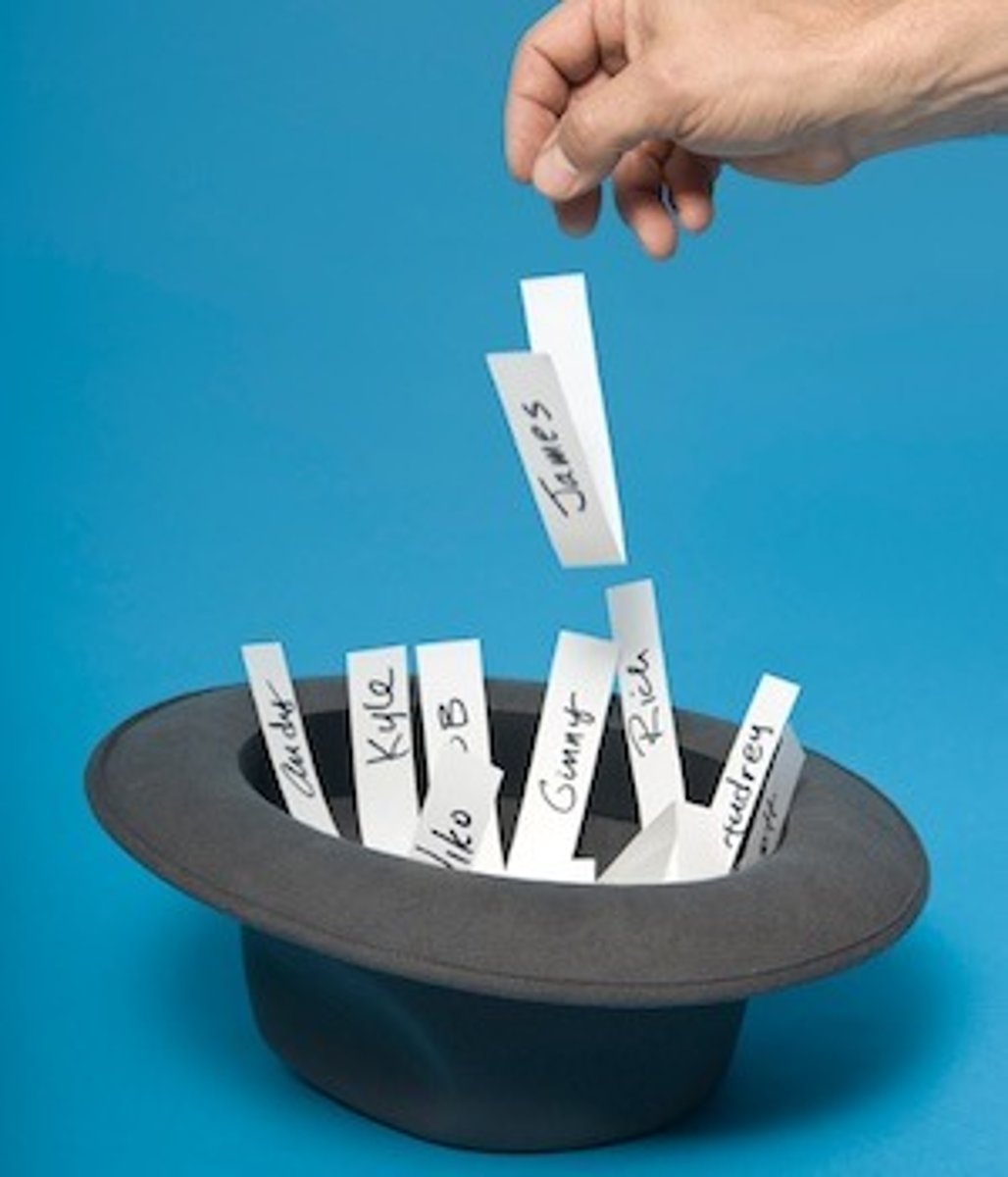
Random Sampling
Sampling technique that ensures every memeber of the population has an equal chance of being selected to be part of the sample
Stratified Sampling
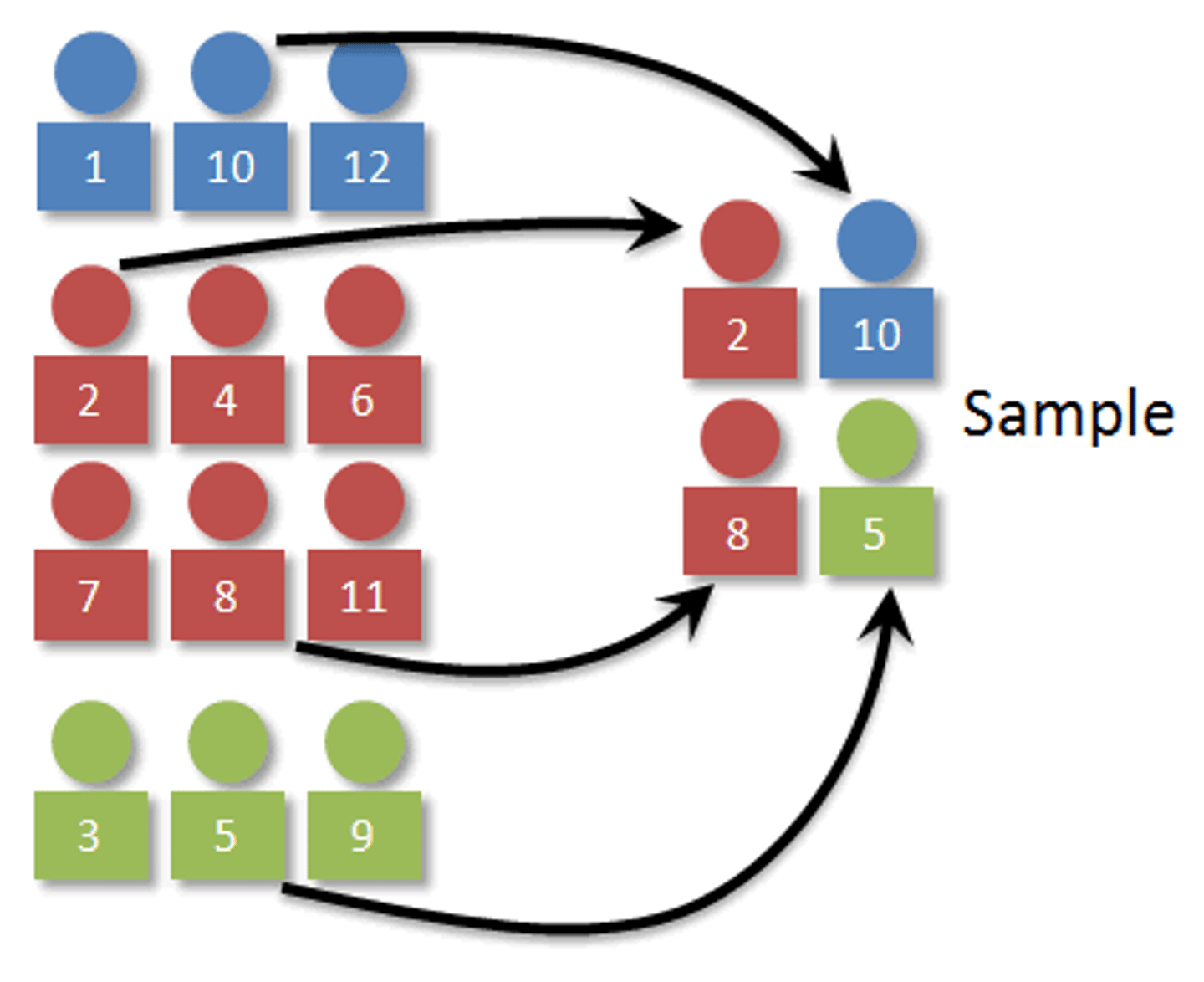
The process of selecting a sample from a population comprised of various subgroups, then selecting a separate sample from each subgroup.
Correlational Study
measures the relationship between two variables to determine its strength and direction, without manipulating either variable. A correlational study cannot establish cause and effect, as it only shows an association/relationship between variables.
- reference may be made to the direction of the relationship between the variables and the strength of the relationship
Positive Correlation
occurs when two variables change in the same direction, so that increases in one variable are associated with increases in the other
- as one variable increases, the other tends to increase
Negative Correlation
occurs when increases in one variable are associated with decreases in the other variable
- as one variable increases, the other tends to decrease
Zero Correlation
indicates a relationship is not present
Strengths and Limitaions of Corelational Studies
Although, Correlational Studied examine how variables are naturally related they do not permit the researcher to draw firm conclusions about its cause and affect relationship.
Controlled Experiment
An experimental investigation in which the independent variable is deliberately manipulated, the dependent variable is measured, while all other variables are controlled. This allows the researcher to determine a cause-and-effect relationship, where changes in the dependent variable can be attributed to the independent variable.
Fieldwork
The practical application of psychological theories in real-world settings outside the lab, such as schools, hospitals, or communities
- It involves direct observation, data collectiona and engagement with individuals to understand behaviour in a real-world setting
- does not control external variablers like weather
Simulation Modelling
A research method that involves recreating a real-world situation of interest in a controlled and realistic way in order to investigate the behaviour and/or mental processes of individuals within that environment
- Because simulations are artificial, they may not perfectly replicate real-life, leading to lower ecological validity compared to actual observations.
Difference between Quantitative and Qualitative Data
Quantitative data is numerical, measurable, and answers "how many" or "how often," while qualitative data is descriptive, interpretative, and answers "why" or "how"
Primary Data
Raw information that is collected directly by researchers through methods like interviews, experiments, observations and surveys.
- tailored to answer specific reseach questions however can require significant amount of time effort and costs
Secondary Data
Information collected by someone other than the user, such as previous research studies, government statistics, or archival records.
- it is generally a cheaper, faster and more convenient way to gather data
- The researcher has no control over the data collection process, which may lead to invalidity and outdated data.
Measures of Central Tendency
Mean, median, mode
Standard Deviation
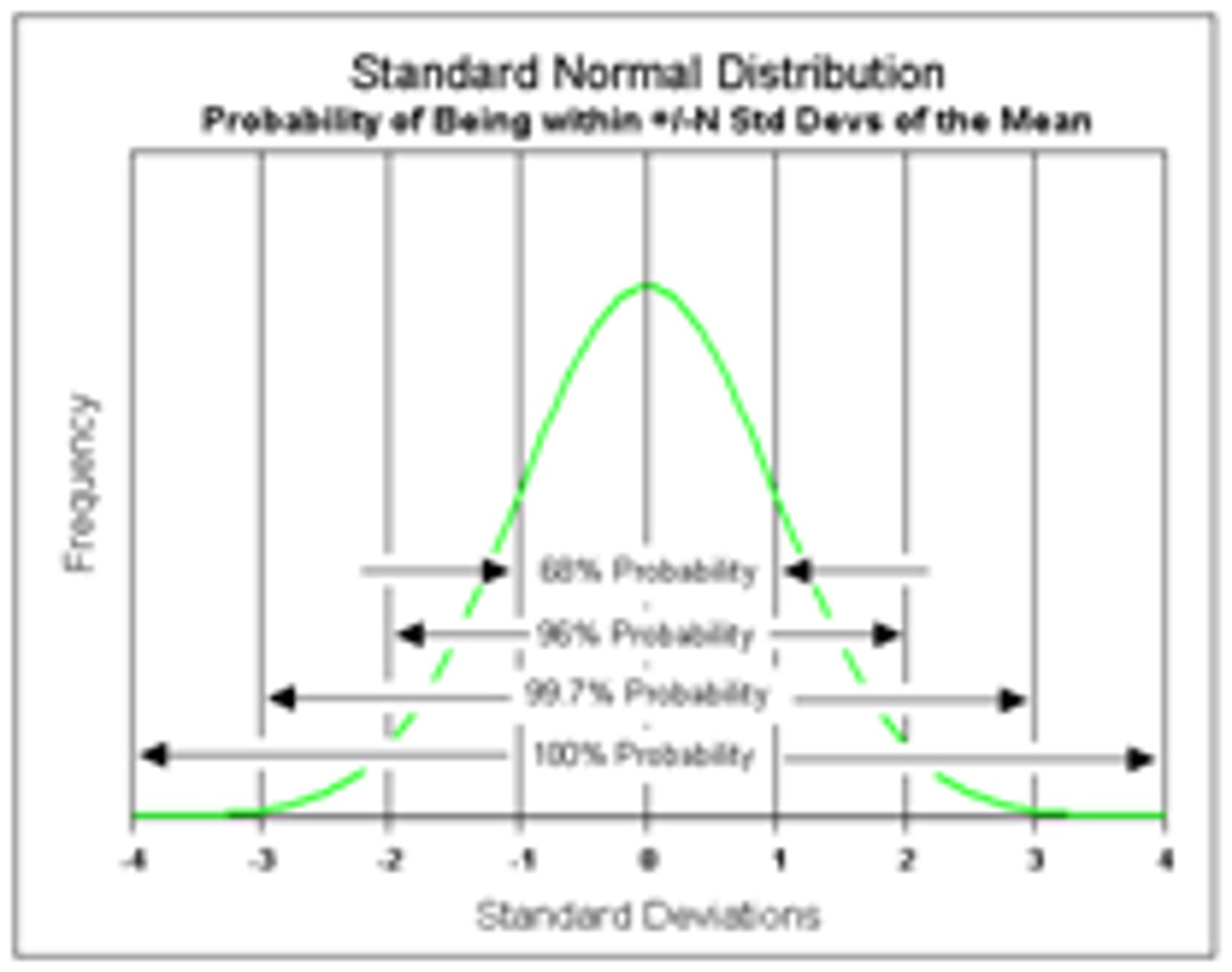
Indicates that the widely distributed scores are distributed around a central point
- a higher standard deviation indicates a greater spread of scores from th mean
Low standard Deviation
the data points in a dataset are clustered tightly around the mean (average) value, inclduing high consistency.
Repeatability
The degree in which a specific research investigation obtains similar results when it is conducted again under the same conditions on all occasions
Reproducibility
How close the results are to one another when an investigation is replicated under changed conditions such as different day, temperature, etc.
Validity
refers to the extent to which the procedures used for a research study measure what it is intended to measure.
Beneficence
Minimise risks and ensure benefits in society
Integrity
Accurate and responsible reporting of findings
Justice
There is a far distrubution of costs and benefits of the investigation
Non Maleficence
Avoiding the causations of harm
Respect
Recognise that all individuals, both human and non human have values and importance.
Voluntary Participation
Participants must be willing and not feel pressured to take part in the study
Informed Consent
If appropriate, the participant must be informed of the nature and purpose of the study. A form or document must be signed to participate in an experiement.
Confidentiality
Participants have a right to privacy, and the details of their involvement should not be published in a way that enables them to be identified.
Withdrawel Rights
Participants have the right to decline to participate the study without giving reason and without receiving any negative consequences
Debriefing
On completion of the study, the participant must obtain information about the study, including its true purpose, the procedure, reuslts and conclusions
Decpetion
Information is withheld from the participant or they are deliberately misinformed as their knowledge of certain information may influence the results.
Define active Learning
Active learning refers to any educational approach or learning activity where the student is directly engaged in the learning process, involving cognitive, physical and social interactions with the material.
Passive Learning
Passive learning is when a learner acquires knowledge or behaviour by observing or receiving information without actively participating or engaging in the learning process.
Define Classical Conditioning
A simple form of learning which often occurs through the association of two different stimuli to produce a naturally occurring response
IMPORTANTLY - nature of the response = reflexive, INVOLUNTARY and thus the role of the learner is passive
Phase 1: Before Conditioning
In the first phase, there is no learning taking place. There is an unconditional stimulus which consistently produces a naturally occuring, automatic response
Phase 2: During
During conditioning, the two stimuli are repeatedly associated with one another. The neural stimulus is presented first and is immediately followed by the unconditioned stimulus. This step is repated multiple times so that the two stimuli become paired within the learner.l
Phase 3: After Conditioning
The neutral stimulus becomes a conditioned stimulus. This produces a conditioned response (usually similar to the unconditioned response). In this case, learning has successfully occurred.
Neural Stimulus
Stimulus that produces no naturally occuring response
Unconditioned Stimulus
A stimulus that evokes an unconditioned response without previous conditioning
Unconditioned response
A biological response that occurs upon presentation of an unconditioned stimulus.
Conditioned Stimulus
A stimulus that, when repeatedly paired with an unconditioned stimuli, produces a conditioned response.
Conditioned Response
a learned response to a previously neutral stimulus
Define Operant Conditioning
Learning through the association of a behaviour and the consequence it receives
a form of learning where voluntary behavior is shaped and maintained by its consequences (reinforcement or punishment)
The 3 phase model
The 3-phase model involves an antecedent, behaviour and consequence, where by the consequence of a behaviour determines the likelihood that it would recoccur.
Antecedent
Stimulus or event that triggers behaviour
Behaviour
Voluntary actions that occur in the presence of the antecedent.
Cosequence
Outcome of the behaviour which determines the likelihood that it will occur again
Reinforcement
A consequence that increases the likelihood of a behaviour reoccuring
Positive Reinforcement
Occurs when a behaviour is followed by adding a desirable or pleasant stimulus, increasing the likelihood of the behaviour occuring again
eg. getting a gold star for doing homework
Negative Reinforcement
Occurs when a behaviour is followed by the removal of an undesirable/unpleasant stimulus, increasing the likelihood of the behaviour recurring again.
eg. being let off doing chores to study
Punishment
A consequence that decreases the likelihood of a behaviour reoccuring
Positive Punishment
Occurs when a behaviour is followed by the addition of an undesirable/unpleasant stimulus
eg. getting detention for not doin homework
Negative Punishment
The removal of a desirable stimulus decreases the likelihood of a behaviour occurring again for instance, losing tv privliages for swearing at home
Effectiveness of Consequences
Order, Timing, Appropraiteness
Compare Classical and Operant Conditioning
Compared to Classical conditioning, which is passive, operant conditioning is active, as the learner is voluntarily aware of the behaviour they are exhibiting in response to stimuli. In classical conditioning, the stimulus is also presented before the response, where as in operant conditioning, the consequence is presented after the response otherwise known as the behaviour/
Observational Learning
a social-cognitive approach to learning that occurs when an individual intently observes the behaviour of a model and the consequences of that behaviour, and then uses this information to guide their own future actions.
attention, retention, reproduction, motivation and reinforcement
Steps in Observational Learning
1. Attention
2. Retention
3. Reproduction
4. Motivation
5. Reinforcement
Step 1: Attention
The learner actively/ intently observes a models behaviour and its consequences
Step 2: Retention
The learner stores a mental representation of the models behaviour to retain it in their long term memory for future use
Step 3: Reproduction
In order to perform, the behavior of the model, the learner must have the necessary physical and mental capabilities
Step 4: Motivation
At this stage, the learner's motivation or willingness to imitate the model's behaviour influences whether they will reproduce the behaviour
Step 5: Reinforcement
Reinforcement in observational learning involves the learner being influenced by the model's consequences, affecting whether the behaviour is imitated
Memory
Memory is an information processing system that actively receives, stores and recovers information. For memory to work efficiently, information must go through a sequential process, consisting of 3 diffent stores called sensory memory, short term and long term memory.
Encoding
A cognitive process that involves converting information into a usable form. It serves as a crucial gateway between short-term and long-term memory, involving attention and processing to move information from STM into permanent storage.
Storage
The retention of encoded information over a period of time
Retrieval
Accessing information that has previously been stored from LTM and converted to STM for conscious use
-recall, recollection, rememmberring
1. Sensory Memory - role
Entry point for RAW sensory information, filters out unnecessary information, stores information long enough so that we perceive the world as continuous
Capacity of Sensory Memory
Holds unlimited items
Duration of Sensory Memory
Holds items for 0.2-4 seconds
2. Short Term Memory (STM)
Information is transferred to short-term memory (STM) when attention is paid to information in sensory memory. STM actively manipulates and processes information so it remains in conscious awareness long enough to be used. Short-term memory is where conscious thinking, learning and perceiving occur. When information is rehearsed and encoded effectively, it can be transferred into long-term memory (LTM)..
Capacity of Short Term Memory
5-9 items - extended by chunking
Duration of Short Term Memory
12-30 seconds - extended by rehersal
3. Long Term Memory
After information in short-term memory (STM) has been processed, it is transferred to long-term memory (LTM), where it is encoded according to its meaning. Stored information can later be retrieved from LTM back into STM, where it enters conscious awareness
Capacity of Long Term Memory
Unlimited
Duration of Long Long Term Memory
Stored for a relativly permenant amount of time
Steps in Atkinson Shiffron Model
1. Information from the (environment) first enters Sensory Memory, where it is briefly stored in its unprocessed form in (echoic or iconic) memory for (0.2-0.4 secs) (3-4 seconds)
2. Information that is attended to is transferred into short-term memory (STM), where it is held in conscious awareness for approximately 12 –30 seconds.
3. Maintenance rehearsal can also be used to extend the time information is retained in short-term memory. This can assist in the tranfer to LTM
4. This is then encoded into a usable form, where it enters long-term memory for a relatively permanent period until retrieved back into STm for conscious use
Explanatory Power of the Attkinson Shiffrin Model
1. The model distinguishes between the different stores involved in memory
2. The Attkinson Shiffrin Model multi store model of memory may be considered over simplifyed and does not account for individual differences.
Explicit Memory
a type of long‑term memory that involves the conscious, voluntary, intentional recall of information eg. remembering a phone number, recalling a wedding day
Implicit Memory
a type of long‑term memory that involves unconscious, involuntary recall, where information is retrieved without deliberate awareness
eg. riding a bike or driving a car without actively thinking about each step
Episodic Memory
The long‑term explicit memory of personally experienced events that includes contextual details such as time, place, and emotions
Examples of Episodic Memory
Personal events: weddings, graduations, birthday parties
Other types of events: lists of words or other stimuli
Semanic Memory
The long‑term explicit memory of facts, concepts, meanings, and general knowledge about the world that is not tied to personal experience
Examples of Semantic Memory
knowing that Paris is the capital of France, the alphabet
Aphantasia
Aphantasia is a phenomenon in which individuals lack the capacity to generate mental imagery. In other words, they are unable to form a visual representation without sensory stimuli.
Alzheimers Disease
Alzheimer's disease is a neurodegenerative disorder characterised by the progressive widespread degeneration of neurons
How does Alzheimers Disease occur?
Occur through the buildup of beta amyloid proteins that form plaques between the synapes of neurons, interfering with neural communication. The flow of information within neurons can be disrupted as a result of the buildup of neurofibrillary tangles inside the neuron.
Alzheimers Disease effect on retrieving autobiographical memories
Alzheimers patients have a reduced ability to retrieve LTM of autobiographical events. As a result, individuals experience a decline in the ability to access episodic memories of personal events. This contributes to the loss of personal history and identity.
Mnemonics
Mnemonics are devices or techniques used to aid the encoding, storage and retrieval of information. It helps to organise differenr pieces of information into a more meaningful and cohesive whole.
Acronym
A mnemonic that uses the first letters of items to form a single pronounceable word that represents the information.
Example: ANZAC