Locked for Econ 1p92
 Call Kai
 Learn
Learn Practice Test
 Spaced Repetition
 Match
Match Flashcards
 Knowt Play
1/43

There's no tags or description
Looks like no tags are added yet.
Name | Mastery | Learn | Test | Matching | Spaced | Call with Kai |
|---|
No analytics yet
Send a link to your students to track their progress
44 Terms
What is the growth rate of GDP?
G = ((GDP in one year - GDP in a prior year ) / GDP in prior year ) * 100%
Ex: Ontario GDP in 2024 was about 870 billion dollars. Its GDP in 2023 was 865 billion dollars.
G = ((870 Billion - 865 Billion) / 865 billion) * 100%
G = 0.58%
What is the rule of 72]
This rule is the way to calculate how long it takes your investment to double (does not apply to bonds)
Take the number 72 divide by your annual return, and the resulting number is how long it takes your investment to double
Example: if your investment pays a 3% return per year. It will take 72 /3 = 24 years
Formula for Economic Growth?
72 / X
Who is Thomas Malthus
Similar to Thanos, believed that population, when unchecked, increases the amount of resources needed. Population increases exponentially, but resources can only increase linearly.
What is an example of Malthusian Dynamics Diagram
Most people tend to have fewer children as they tend to be wealthier (not the case prior the industrial revolution)
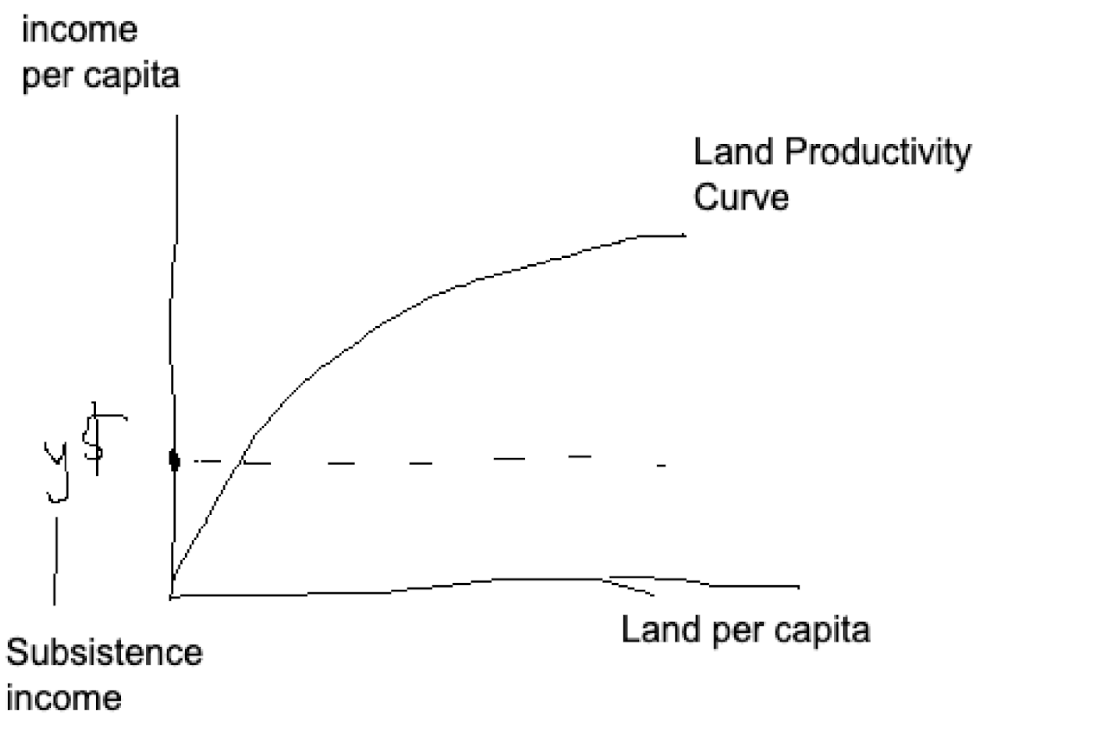
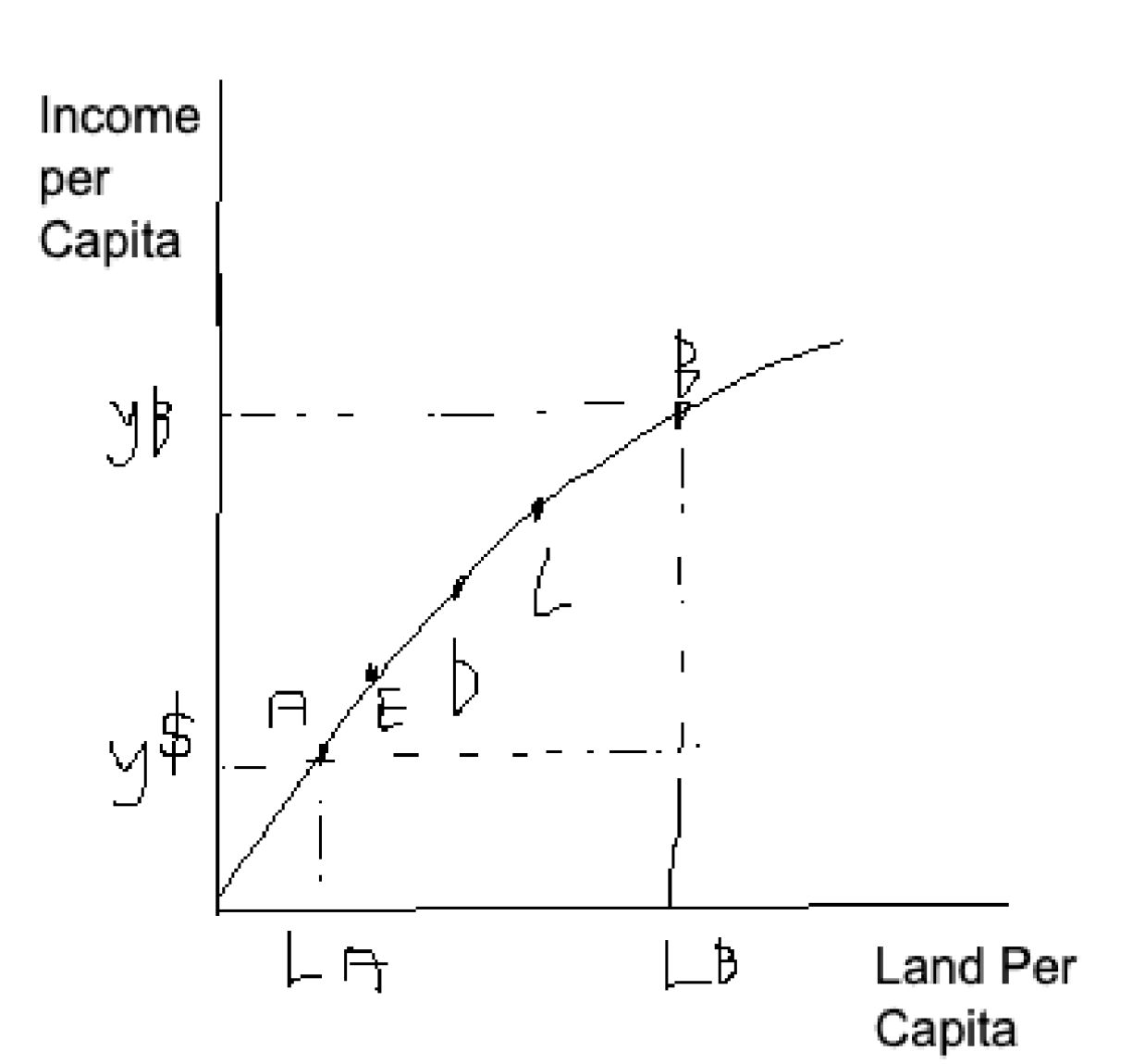
How would a Thanos Snap Malthusian Diagram look like?
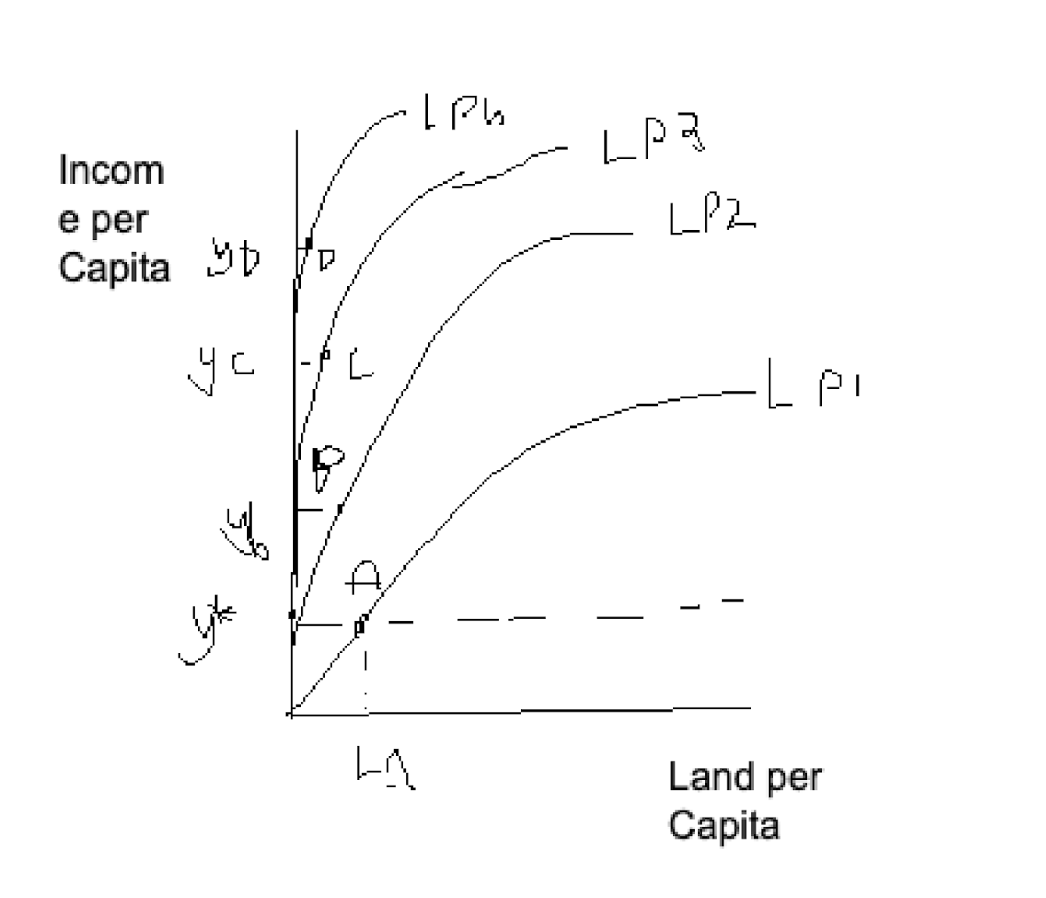
Point A was the original. Point B is when everyone dies, you inherit more land. However, point C, D, and E refer to the future generations of you having kids (The Malthusian thing is the assumption that more income leads to more kids), and each of those kids inherit less and less, meaning it eventually returns to point A.
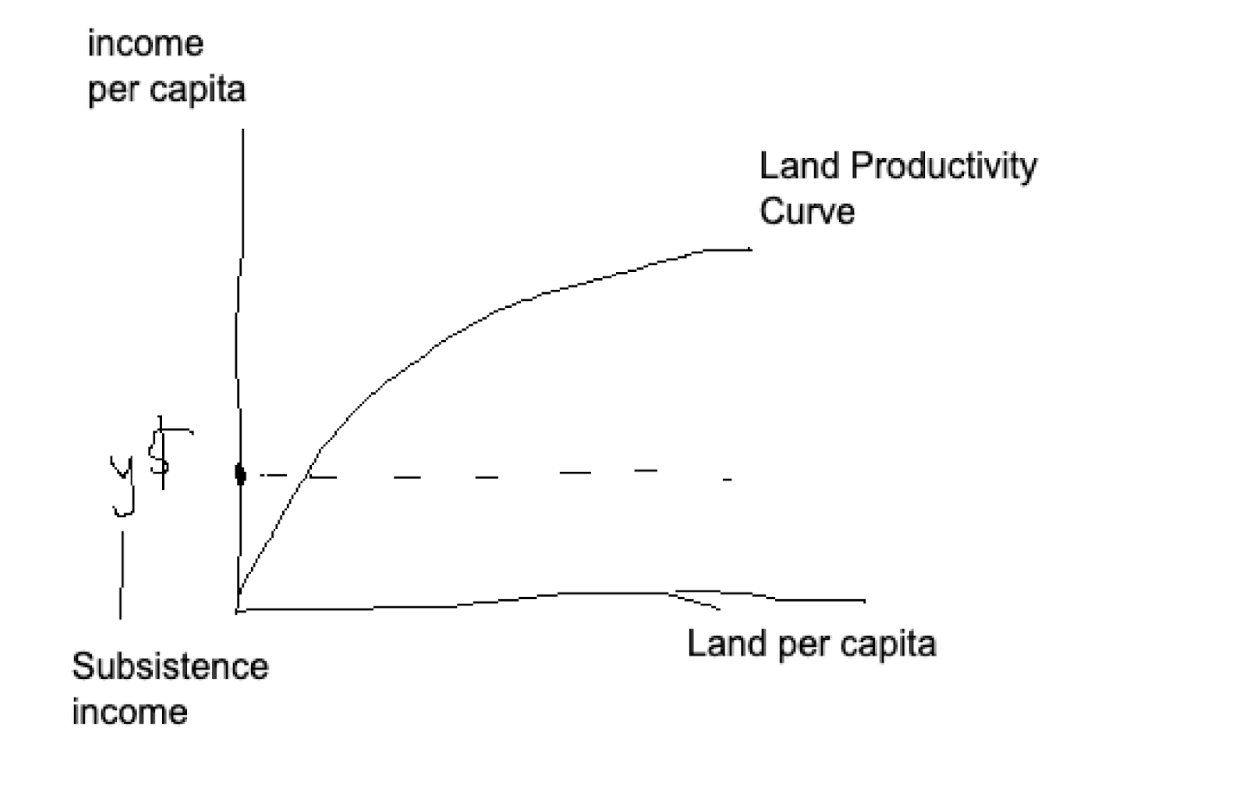
Japanese Hygiene Program Malthusian Diagram
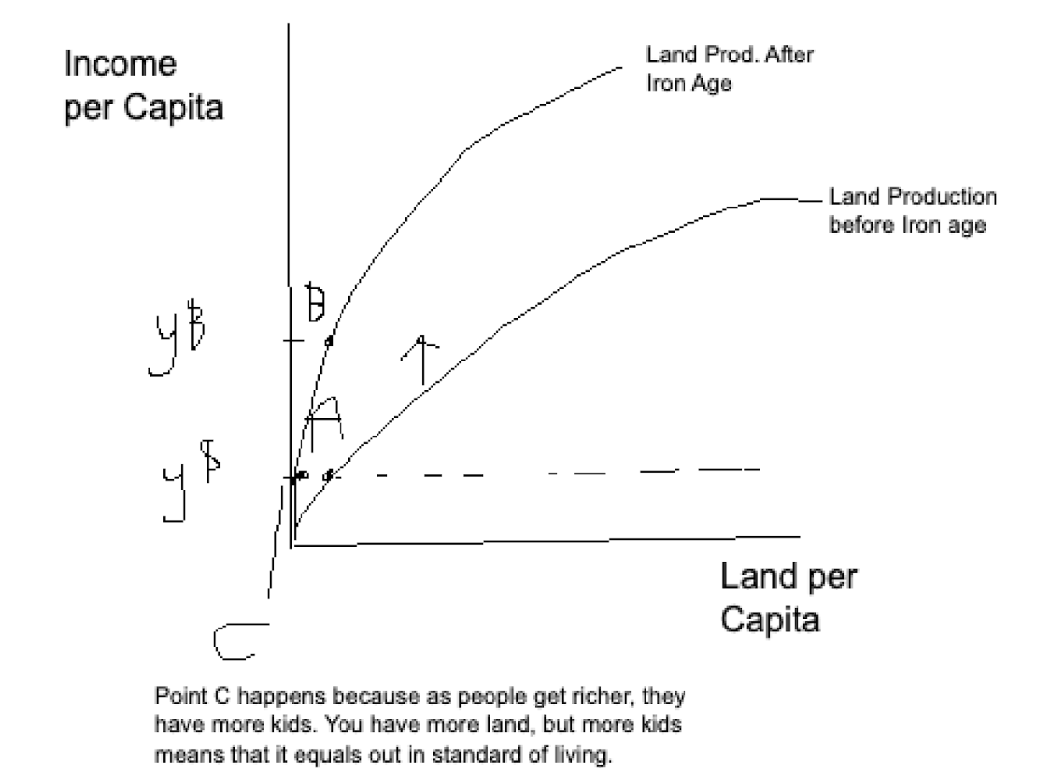
Transition from Bronze Age to the Iron Age Malthusian Diagram?
3 Problems with Malthusian Economics?
As people got wealthier with the industrial revolution, they did not want to have more kids. Partially due to women working in the labour force, and not at home.
Malthus was wrong about population growth, since population is declining or has stabilized in the wealthiest countries. As industrialization improved living standards and female education, fertility fell
Malthus under-estimated the development of agricultural technology. We now have tractors and haymakers instead of horses – and food scientists have engineered high yield crops. There are also pesticides and fertilizers that are highly efficient (though these may have ecological problems)
Whats a realistic graph of LP1 to LP2 and LP3
What factors impose limits on economic growth?
War(?)
Education(?)
Natural Disasters(?)
Geography
Culture
Political and Economic institutions(?)
Debt(?)
Population Slowdown(?)
Technological knowhow(?)
Genetics
Other theories of economic growth?
Capital Accumulation, Geography, Culture and Religion, Historical Events, Genetics and IQ, Productivity,
What is Capital Accumulation?
is the process of investing increasingly more money into capital goods (machines, factories, education, tractors, etc.)
Positive feedback loop (Virtuous cycle)
Negative feedback loop (Vicious cycle)
Idea: More savings/profits → more investment in capital → more growth → more savings/profits etc.
What is Positive feedback loop (Virtuous cycle)?
A cycle in which two variables positively promote each other
E.g: Capital accumulation leads to more economic growth. More economic growth leads to more money. This means you have more capital accumulation, and it is a positive feedback loop.
E.g: Good politics can lead to higher economic growth. This means you can invest more into the political system with less corruption. This is another feedback loop.
What is Negative feedback loop (Vicious cycle)
A cycle in which two variables demean each other in a cycle.
What is Geography?
Regions with domesticable crops and animals, abundant water, and fertile soil are more likely to thrive
See Jared Diamond's Guns, Germs, and Steel
Jeffery Sachs: Transport costs, access to trade, disease burden, and agricultural productivity impose limits on economic growth
Problem: What about Singapore? Middle East? Burundi? DRC?
What are Political and Economic Institutions?
Institutions are mechanisms that govern behaviour within a community
E.g: Constitutions, courts of law, free and fair elections, constraints on the executive, licensing bodies, business regulations, etc
Prediction: The more open and inclusive institutions are, the greater economic growth will be.
You’d rather open a business in a country with stable business practices, rather than one in which the dictator can expropriate you at any time!
Problem: What about China, Singapore, South Korea (under Park Chung hee), Saudi Arabia, Haiti under Toussaint Louverture, etc?
What is Culture and Religion?
Some cultures are more conductive to economic Growth
Some other things (He mentioned in lecture)
Resistance to technology
Effect on attitudes to education/learning
Cultural Caste Systems
Bigotry
Attitudes to entrepreneurship and hard work
Trust (Main one). The West has a high trust system, where people trust each other.
What is Historical Events?
Nathan Nunn claims that the slave trade in Africa leads to lower economic growth today
Former Soviet countries are behind Western ones today
Michalopoulos and Papaloannou show that the Partition of Africa causes lower growth today
Oded Galor shows that ancient migration out of AFrica predicts economic growth today, based on the mechanism of genetic diversity
This research is controversial
What is Genetics and IQ?
Some beneficial traits are inheritable
Garret Jones (2016) argues that modest differences in national IQ explain most of the cross-country differences in income
Gregory Clark claims that selective survival of the genetically superior British upper class, between 1200 and 1800, led to downward mobility, which infiltrated all classes of society and led to the Industrial revolution
Oded Galor says that there is a peak level of genetic diversity – too much diversity inhibits trust, while too little stifles innovation
Suppose you are the most brilliant person who has ever lived. You are dropped down into a city where the average IQ is 75. You try your hardest but fail to grow the town’s economy.
What is Productivity?
Productivity is the quantity of goods and services produced from each hour of a typical worker’s time
Determinants of productivity: Physical capital per worker, human capital per worker, natural resources per worker, technology.
Why is Canada’s labour productivity so bad?
Less capital and worse technology
Less innovation
Lack of market competition
Lack of talent
Tight regulation
Poor quality healthcare
Low-productivity immigration
What is a Business cycle?
refers to fluctuation in the growth of real GDP.
What is a recession
a significant wide-spread decline in real GDP.
What are the two groups of people the economy consists of?
Spenders and Producers
What are Spenders?
What are Producers?
What is Aggregate demand?
Aggregate demand is the total demand for all final goods and services in an economy
Aggregate demand is total demand for the real GDP * (Total spending in the economy)
Aggregate demand (AD) = C + I +G + NX
C is consumption
I is investment
G is government spending
NX is net exports (X - M)
We can plot aggregate demand in a diagram, with the price level on the y-axis and the real GDP on the x-axis
What is Aggregate supply?
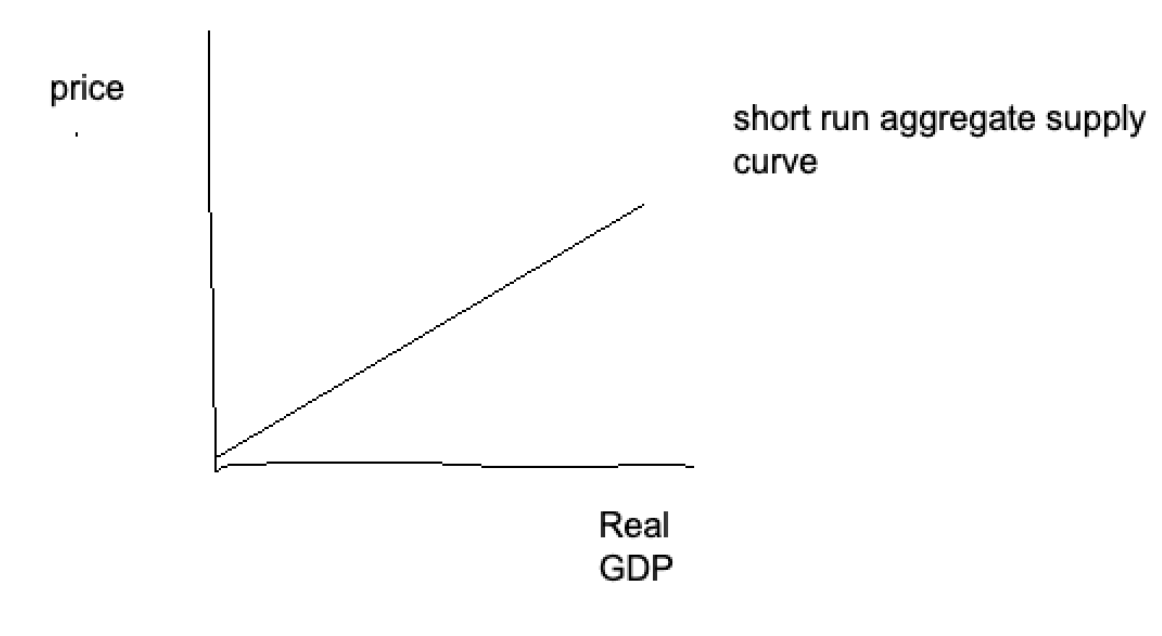
The aggregate supply (AS) is the total quantity of goods/services that firms produce and sell in an economy, of various price levels.
What is Short-run Aggregate
The short-run aggregate supply is the aggregate supply in the short-run
In the short-run, prices are often fixed
Why is short-run aggregate supply upwards sloping?
The wealth effect: As prices rise, people drain their resources and savings to be able to afford necessities and maintain their standard of living as real GDP due to a lack of investment
The interest-rate effect (Keynes) - as prices fall, people spend more money instead of investing it, meaning banks lower their interest rates to attract more savers/investors and lowers interest rates attract businesses who take out more more loans to spend on investments → I increases which leads to Y increases
Exchange-rate effect - When prices fall, domestic goods become cheaper compared to foreign goods, so that means exports rise while imports go down, which means net exports go up, which means real GDP goes up
What is Long-Run Aggregate Supply?
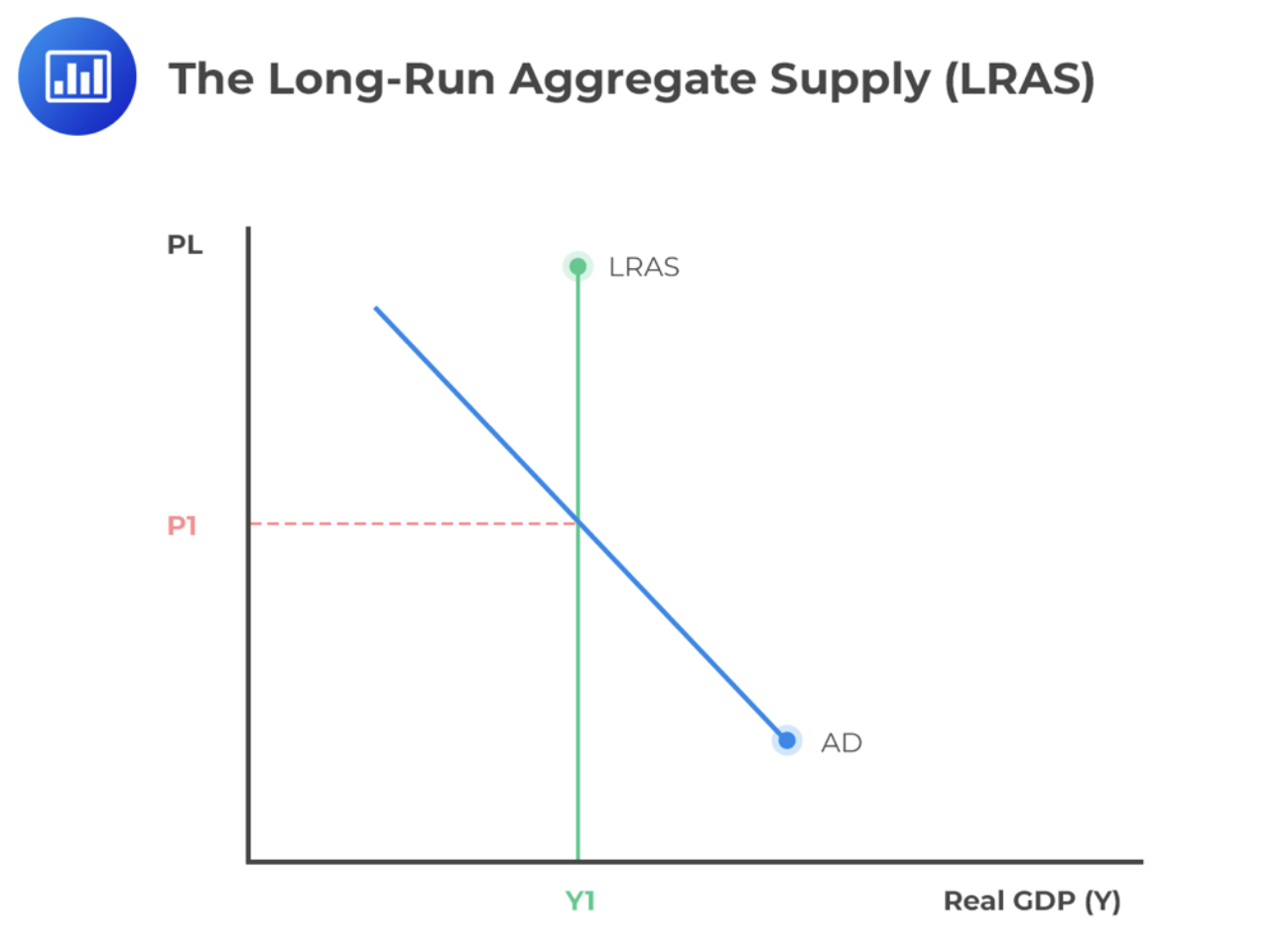
The Long-run aggregate supply is aggregate supply in the long-run, when all prices are flexible.
What is long-run aggregate supply?
1. Total factor productivity (A)
Most of this is due to technology.
2. Capital (K)
3. Labour (L)
LRAS = A * f(K, L)
What is Short-Run aggregate Supply?
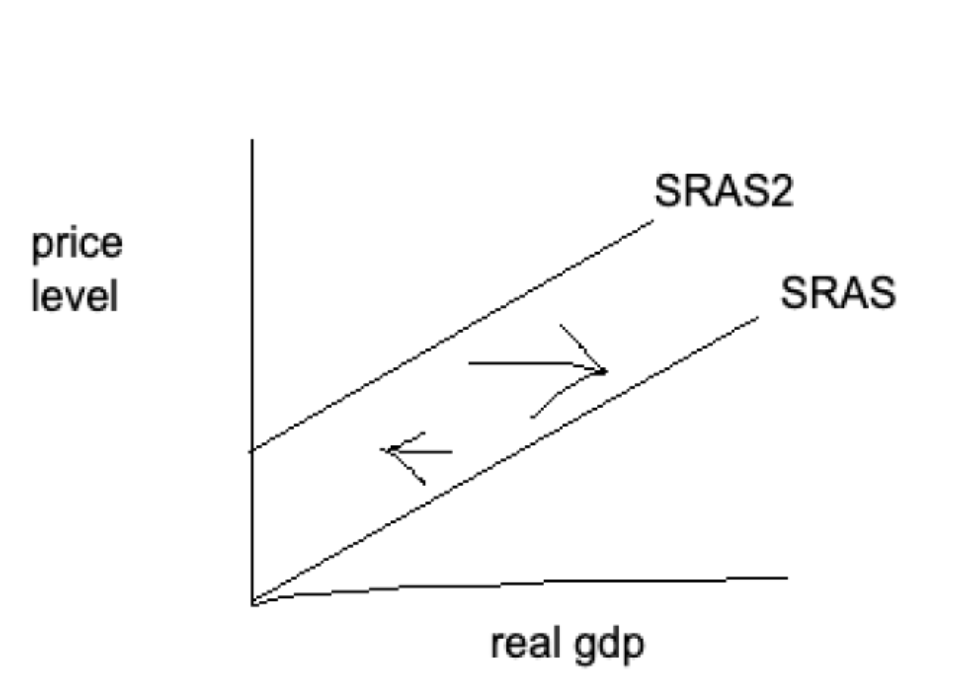
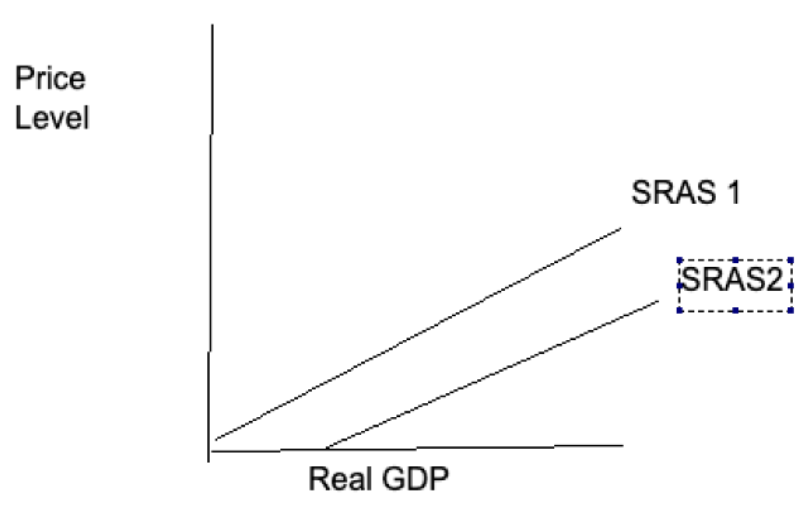
These cause SRAS to shift (move either left or right) and then to return back to its original position.
What is Temporary shifts?
These cause SRAS to shift (move either left or right) and then to return back to its original position
E.g: oil price hike, natural disasters, bumper harvest.
E.g: Oil price hike → SRAS will go down. This is because business costs go up.
What is Permanent Shift in SRAS?
(This also shifts the long-run aggregate supply curve, LRAS)
E.g: Technological breakthroughs, more workers, higher capital stock, etc.
This causes short-run aggregate supply to shift for good, absent other changes.
E.g: An AI breakthrough boosts productivity. This means the SRAS shifts to the right.
What is stock?
Also called a share, or equity, represents ownership in a company.
What are the two type of stocks?
Private stock and Public stock
What is Public stock?
Ownership in a company that is public – can be bought or sold by any member of the public subject to regulation. E.g: Shopify, Nvidia, Walmart, costco
What is Private stock?
Ownership in a privately held company, and cannot be traded by the general public. E.g: Stock in Cargill, Mars, SpaceX, OpenAI, etc.
Why do companies sell their stock on public exchanges?
To raise money for the company (E.g: If the company wishes to expand)
How do companies sell their stock on public exchanges?
An Initial Public Offering (IPO) is when a company first offers its stock on a public exchange.
How do you make money on the stock market
Capital Gain and Dividend Yield
Three types of real estate?
Residential, Commercial, Agricultural
How ti