DONE Geoscience Chapter 4 Exam
 Call Kai
 Learn
Learn Practice Test
 Spaced Repetition
 Match
Match Flashcards
 Knowt Play
1/80

There's no tags or description
Looks like no tags are added yet.
Name | Mastery | Learn | Test | Matching | Spaced | Call with Kai | Chat |
|---|
No analytics yet
Send a link to your students to track their progress
81 Terms
1. ____________ was an ancient reptile that lived in South America and Africa during the late Paleozoic.
a. Granopteris b. Monastarious c. Glossopteris d. Mesosaurus
d. Mesosaurus
2. In the early part of the 20th century, ____________ argued forcefully for continental drift.
a. Karl Wagner b. Peter Rommel c. Alfred Wegener d. Bill Kohl
c. Alfred Wegener
3. The former, late Paleozoic super continent is known as ____________.
a. Pandomonia b. Pancakea c. Pangaea d. Panatopia
c. Pangaea
Today, ____________ is in about the same geographic position as during late Paleozoic time.
a. India b. South America c. Australia d. Antarctica
d. Antarctica
5. Which of the following paleoclimatic evidence supports the idea of the late Paleozoic super continent in the Southern Hemisphere?
a. lithified loess (wind-blown) deposits in the deserts of Chile, Australia, and Africa
b. tillites (rocks formed by glaciers) in South Africa and South America
c. thick sediments in the Amazon and Congo deltas of South America and Africa
d. cold water fossils in the deep-water sediments of the South Atlantic abyssal plain
b. tillites (rocks formed by glaciers) in South Africa and South America
6. The ____________ is an example of an active, continent-continent collision?
a. Arabian Peninsula slamming into North Africa under the Red Sea
b. westward movement of the South American plate over the Nazca plate
c. northern movement of Baja California and a sliver of western California toward the Hawaiian Islands
d. northward movement of India into Eurasia
d. northward movement of India into Eurasia
7. Pull-apart, rift zones are generally associated with a ____________ plate boundary.
a. transform b. divergent c. convergent d. all plate boundaries
b. divergent
8. The temperature below which magnetic material can retain a permanent magnetization is called the ____________.
a. Darcy temperature b. Vine temperature c. Bullard point d. Curie point
d. Curie point
9. A very long-lived magma source located deep in the mantle is called a ____________.
a. magma welt b. basalt spout c. melt well d. hot spot
d. hot spot
10. Linear, magnetic patterns associated with mid-ocean ridges are configured as ____________.
a. concentric circles about a rising plume of hot, mantle rocks and magma
b. reversed magnetizations along the rift valleys and normal magnetizations along the ridge
c. normal and reversed magnetized strips roughly parallel to the ridge
d. normal and reversed magnetized strips roughly perpendicular to the ridge axis
c. normal and reversed magnetized strips roughly parallel to the ridge
11. The ____________ is (are) a logical evolutionary analog of the African Rift Valleys ten million years from now.
a. Ural Mountains b. San Andreas fault c. Peru-Chile trench d. Red Sea
d. Red Sea
12. A typical rate of seafloor spreading in the Atlantic Ocean is ____________.
a. 2 ft per year b. 0.1 inches per year c. 20 feet per year d. 2 centimeters per year
d. 2 centimeters per year
13. Which of the following energy sources is thought to drive the lateral motions of Earth’s lithospheric plates?
a. gravitational attractive forces of the Sun and Moon
b. electrical and magnetic fields localized in the inner core
c. export of heat from deep in the mantle to the top of the asthenosphere
d. swirling movements of the molten iron particles in the outer core
c. export of heat from deep in the mantle to the top of the asthenosphere
14. The continental drift hypothesis was rejected primarily because Alfred Wegener could not __________.
a. find geologic similarities on different continents
b. disprove competing theories that were more accepted by scientists
c. identify a mechanism capable of moving continents
d. all of the above
c. identify a mechanism capable of moving continents
15. All of the following are evidence supporting the theory of plate tectonics except for __________.
a. changes in the Moon’s orbit due to shifting plates
b. ocean floor drilling
c. hot spots
d. paleomagnetism
a. changes in the Moon’s orbit due to shifting plates
16. ____________ was never proposed as evidence supporting the existence of Pangaea.
a. Geometrical fit between South America and Africa
b. Islands of Precambrian rocks along the Mid-Atlantic Ridge
c. Late Paleozoic glacial features
d. Similar fossils on different continents
b. Islands of Precambrian rocks along the Mid-Atlantic Ridge
17. Which one of the following most accurately describes the volcanoes of the Hawaiian Islands?
a. stratovolcanoes associated with subduction and a convergent plate boundary
b. shield volcanoes fed by a long-lived hot spot below the Pacific lithospheric plate
c. shield volcanoes associated with a mid-Pacific ridge and spreading center
d. stratovolcanoes associated with a mid-Pacific transform fault
b. shield volcanoes fed by a long-lived hot spot below the Pacific lithospheric plate
18. Which of the following statements apply to the asthenosphere, but not the lithosphere?
a. zone in the upper mantle that deforms by plastic flowage
b. cool, rigid layer of crust and upper mantle that forms the tectonic plates
c. deforms mainly by brittle fracturing and faulting
d. partial melting of rising granitic plumes produces huge volumes of basaltic magma
a. zone in the upper mantle that deforms by plastic flowage
19. New oceanic crust and lithosphere are formed at ____________.
a. divergent boundaries by submarine eruptions and intrusions of rhyolitic magma
b. convergent boundaries by submarine eruptions and intrusions of rhyolitic magma
c. divergent boundaries by submarine eruptions and intrusions of basaltic magma
d. convergent boundaries by submarine eruptions and intrusions of basaltic magma
c. divergent boundaries by submarine eruptions and intrusions of basaltic magma
20. Cooler, older, oceanic lithosphere sink into the mantle at ____________.
a. subduction zones along convergent plate boundaries
b. transform fault zones along divergent plate boundaries
c. rift zones along mid-ocean ridges
d. sites of long-lived, hot spot volcanism in the ocean basins
a. subduction zones along convergent plate boundaries
21. Deep ocean trenches are surficial evidence for ____________.
a. rifting beneath a continental plate and the beginning of continental drift
b. sinking of oceanic lithosphere into the mantle at a subduction zone
c. rising of hot asthenosphere from deep in the mantle
d. transform faulting between an oceanic plate and a continental plate
b. sinking of oceanic lithosphere into the mantle at a subduction zone
22. A transform plate boundary is characterized by ____________.
a. stratovolcanoes on the edge of a plate and shield volcanoes on the adjacent plate
b. two, converging, oceanic plates meeting head-on and piling up into a mid-ocean ridge
c. a divergent boundary where the continental plate changes to an oceanic plate
d. a deep, vertical fault along which two plates slide past one another in opposite directions
d. a deep, vertical fault along which two plates slide past one another in opposite directions
23. Which one of the following is an important fundamental assumption underlying the plate tectonic theory?
a. Earth’s magnetic field originates in the outer core
b. Earth’s diameter has been essentially constant over time
c. radioactive decay slows down at the extreme pressures of the inner core
d. Earth’s ocean basins are very old and stable features
b. Earth’s diameter has been essentially constant over time
24. The modern-day Red Sea is explained by plate tectonics theory because it is ____________.
a. a tiny remnant of a once immense ocean that was closed as Africa moved Asia
b. the site of a transform fault along which Arabia is moving away from Africa
c. a rift zone that may eventually open into a major ocean if Arabia and Africa continue to separate
d. a rare example of a two continent subduction zone where the African continental plate is sinking under the Arabian continental plate
c. a rift zone that may eventually open into a major ocean if Arabia and Africa continue to separate
Mount St. Helens and the other Cascade volcanoes are____________.
a. young, active stratovolcanoes built on a continental margin above a sinking slab of oceanic lithosphere
b. a row of young, active, shield volcanoes built as western North America moved over a hot spot deep in the mantle
c. old, deeply eroded stratovolcanoes built before the Pacific Ocean existed
d. old, deeply eroded, basaltic shield volcanoes built when western North America was over the present-day site of the Hawaiian hot spot
a. young, active stratovolcanoes built on a continental margin above a sinking slab of oceanic lithosphere
The volcanoes and deep valleys of east Africa are related to a ____________.
a. continental rift along which parts of the African continent are beginning to slowly separate
b. fault allowing Arabia to slip westward past east Africa and penetrate into Turkey
c. transform fault aligned with the Red Sea carrying the Arabian and African blocks in opposite directions
d. continental collision zone between Africa and the Zagros Mountains along the southern margin of Eurasia
a. continental rift along which parts of the African continent are beginning to slowly separate
The Aleutian Islands occur at a ____________.
a. convergent boundary on a volcanic arc above a northward-subducting Pacific plate
b. transform boundary where North America has moved towards Alaska
c. divergent boundary where shield volcanoes are forming
d. convergent, continental margin with uplifted fault blocks, much like those of the Basin and Range Province
a. convergent boundary on a volcanic arc above a northward-subducting Pacific plate
28. ____________ most effectively outline the edges of the lithospheric plates.
a. Lines of active stratovolcanoes b. Margins of the continental shelves
c. The locations of deep mantle hot spots d. Lines of earthquake epicenters
d. Lines of earthquake epicenters
29. Deep-oceanic trenches are most abundant around the rim of the ____________ ocean basin.
a. Atlantic b. Indian c. Arctic d. Pacific
d. Pacific
30. Where would you drill to recover samples of the oldest basalts of the oceanic crust, which are Jurassic in age?
a. crest of the East Pacific, mid-ocean ridge b. oceanic side of the Aleutian trench
c. just offshore from the Hawaiian Islands d. Mid-Atlantic Ridge under Iceland
b. oceanic side of the Aleutian trench
31. ____________ first related the symmetrical magnetic patterns in seafloor basalts to seafloor spreading at a mid-ocean ridge.
a. Evans and Novak b. Vine and Matthews
c. Matthews and Marks d. Wegener and Wilson
b. Vine and Matthews
Early results of the Deep Sea Drilling Project clearly justified the conclusion that ____________.
a. the oceans have not always contained most of Earth’s water
b. the ocean basins are relatively young; most ocean basin rocks and sediments are Cretaceous or younger in age
c. Proterozoic rocks are found only as seamounts in the deepest parts of the ocean basins
d. the youngest sediments were deposited directly on the oldest seafloor basalts
b. the ocean basins are relatively young; most ocean basin rocks and sediments are Cretaceous or younger in age
Which statement best describes the paradigm shift from a "contracting earth" model to the theory of plate tectonics?
A. Earth surface features shaped by horizontal rather than vertical forces.
B. Earth surface features shaped by vertical rather than horizontal forces.
A. Earth surface features shaped by horizontal rather than vertical forces.
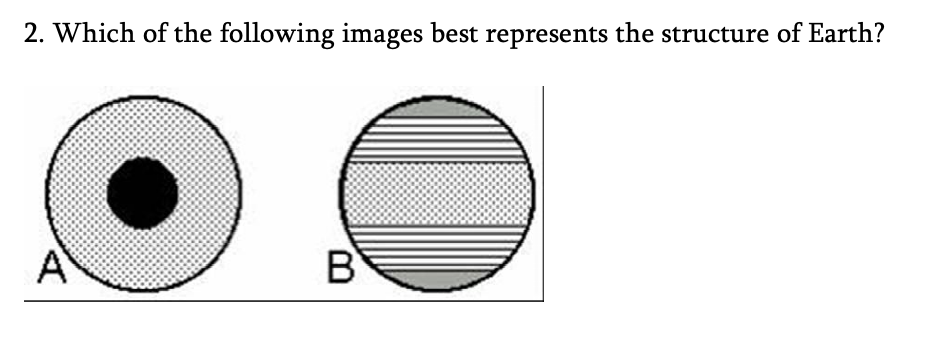
A. Diagram A
B. Diagram B
A. Diagram A
What happens to tectonic plates at a transform boundary?
A. They are formed.
B. They are recycled.
C. They are not formed or recycled
C. They are not formed or recycled.
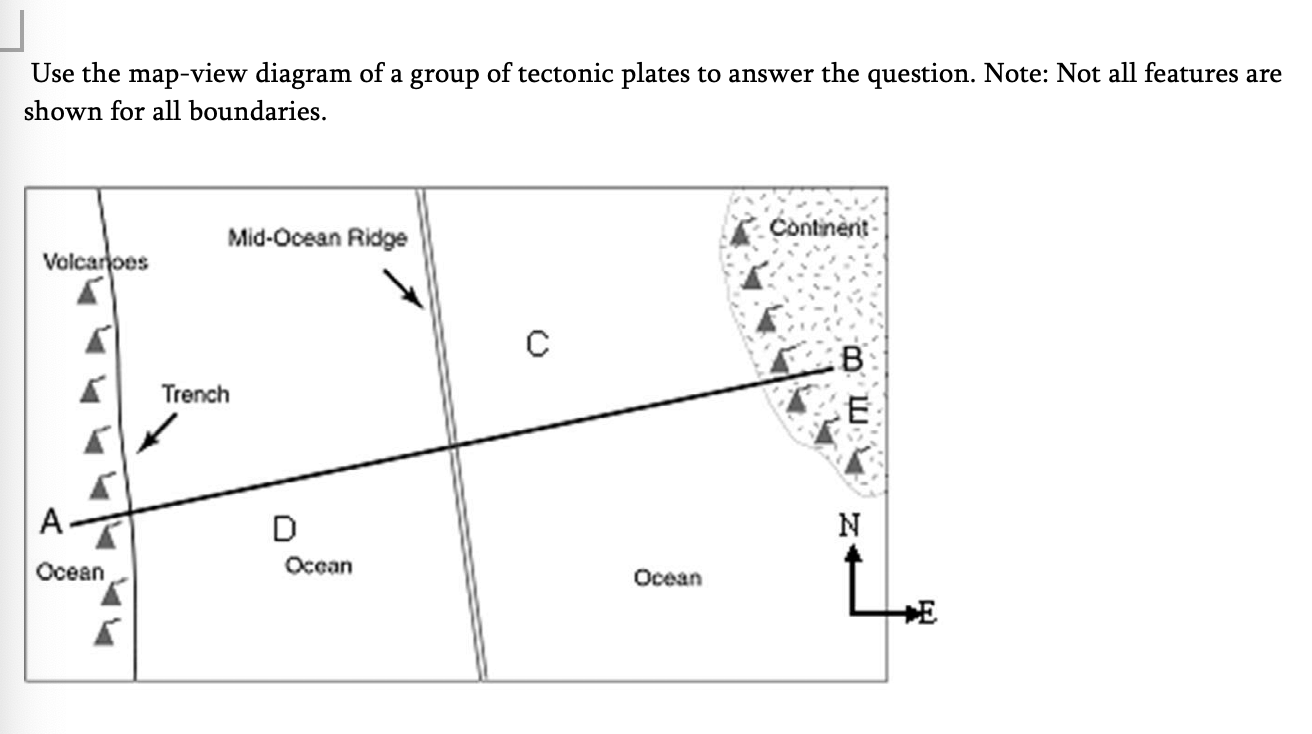
How many tectonic plates are represented in this diagram?
A. 2
B. 3
C. 4
D. 5
C. 4
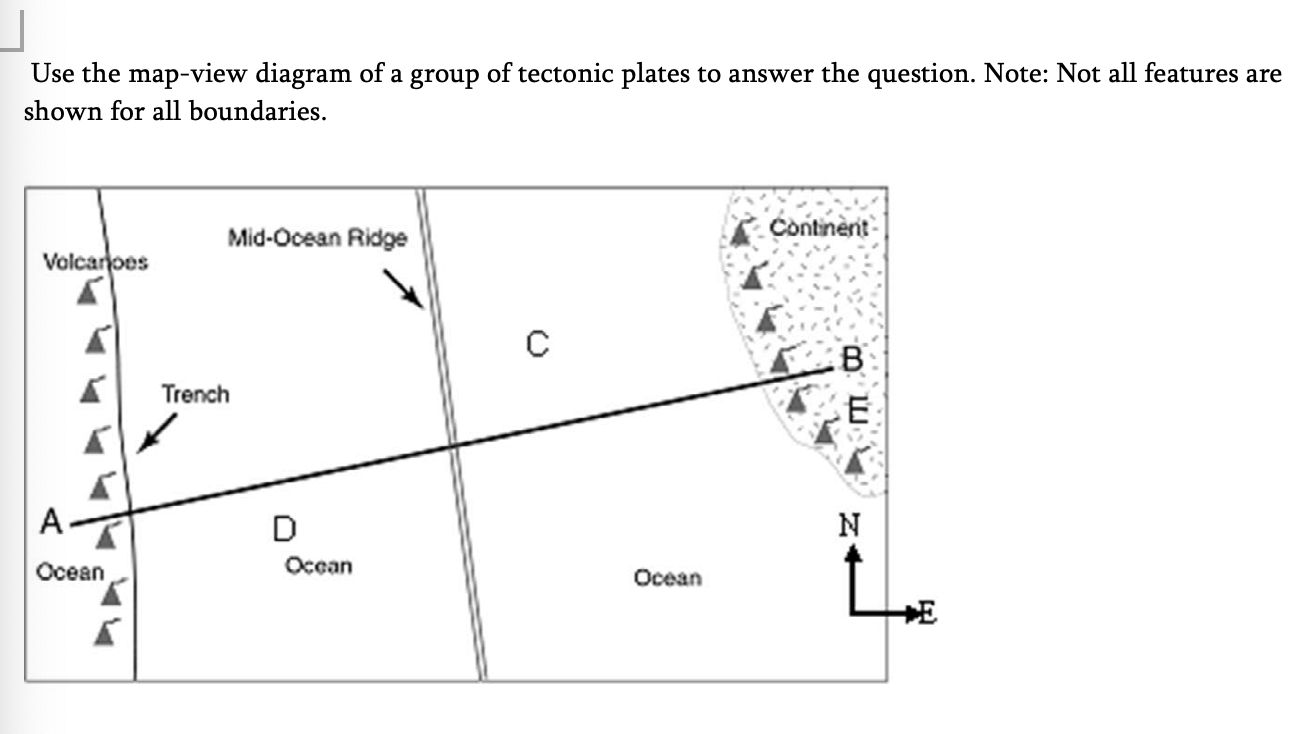
Which location has a volcanic arc?
A. Near A
B. Near B
C. Near C
A. Near A
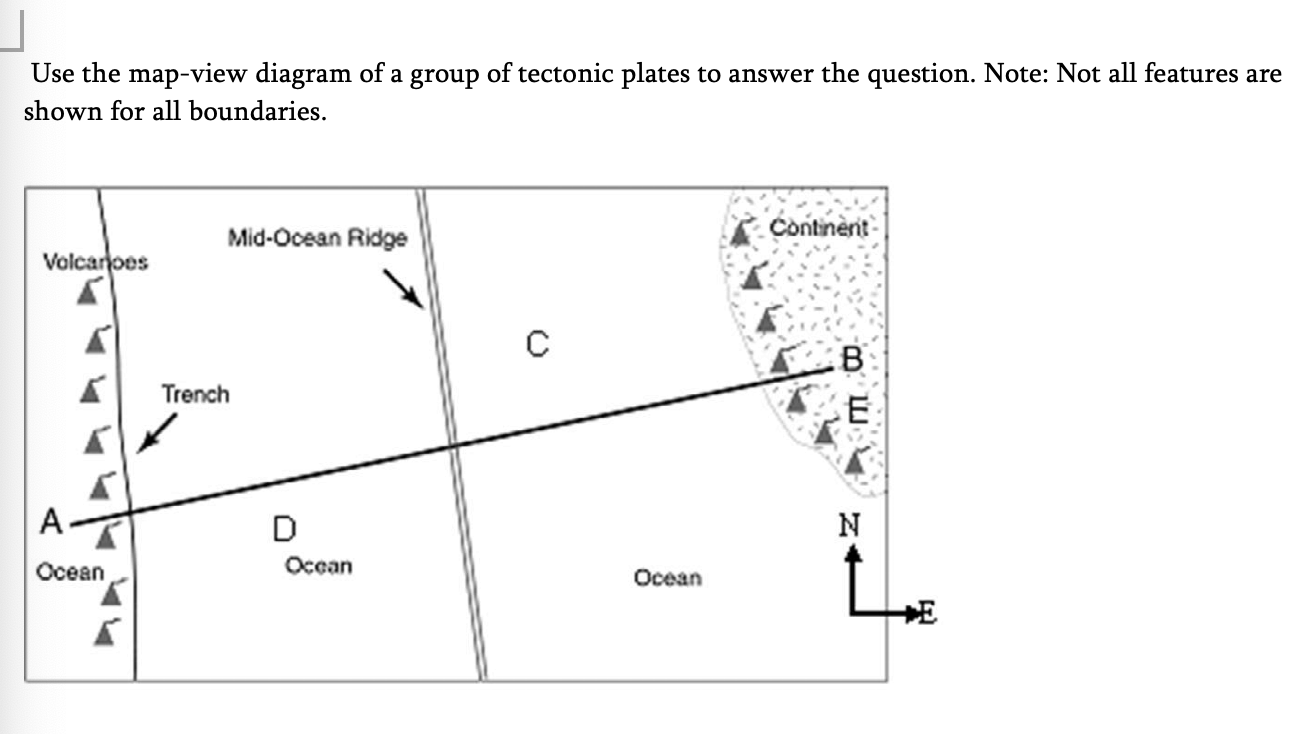
Where do you predict there are deep earthquakes?
A. Below A
B. Below B
C. Below C
D. Below A and B
E. All of those locations.
D. Below A and B
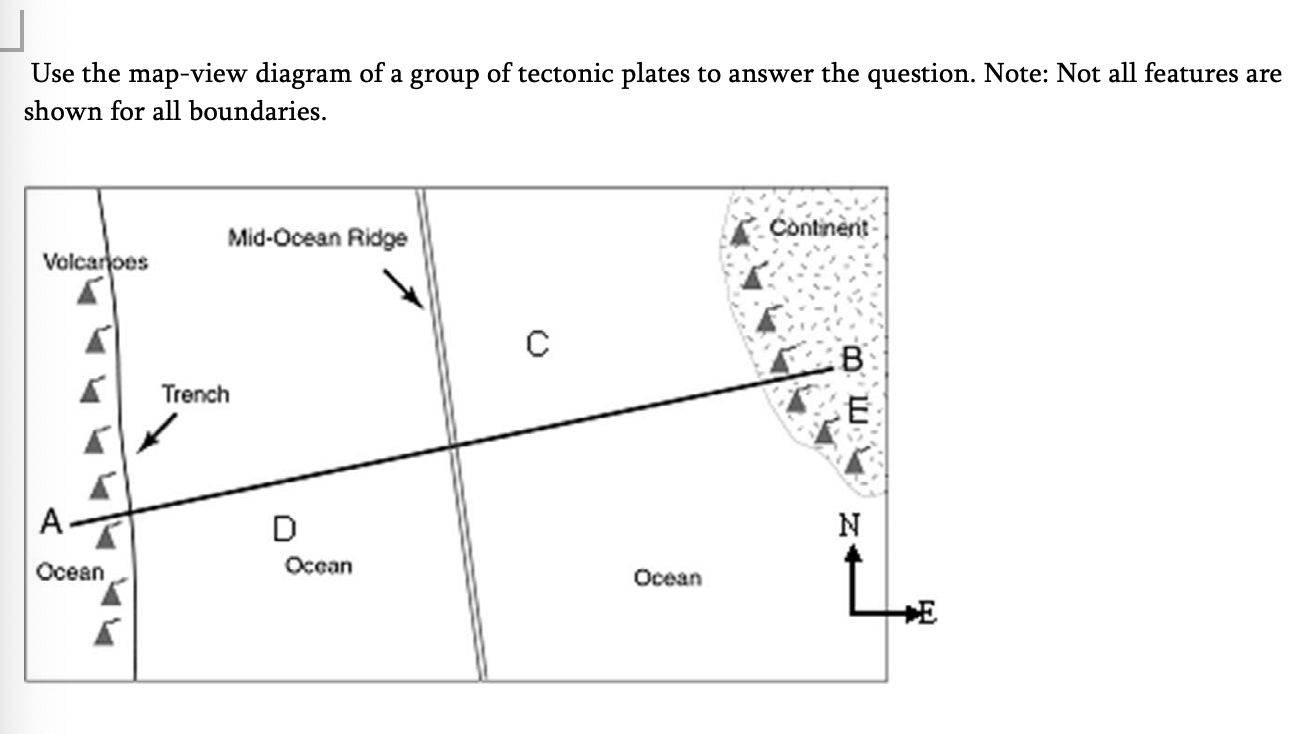
7. What is the relative direction of motion for points A and D?
A. Convergent
B. Divergent
C. Transform
A. Convergent
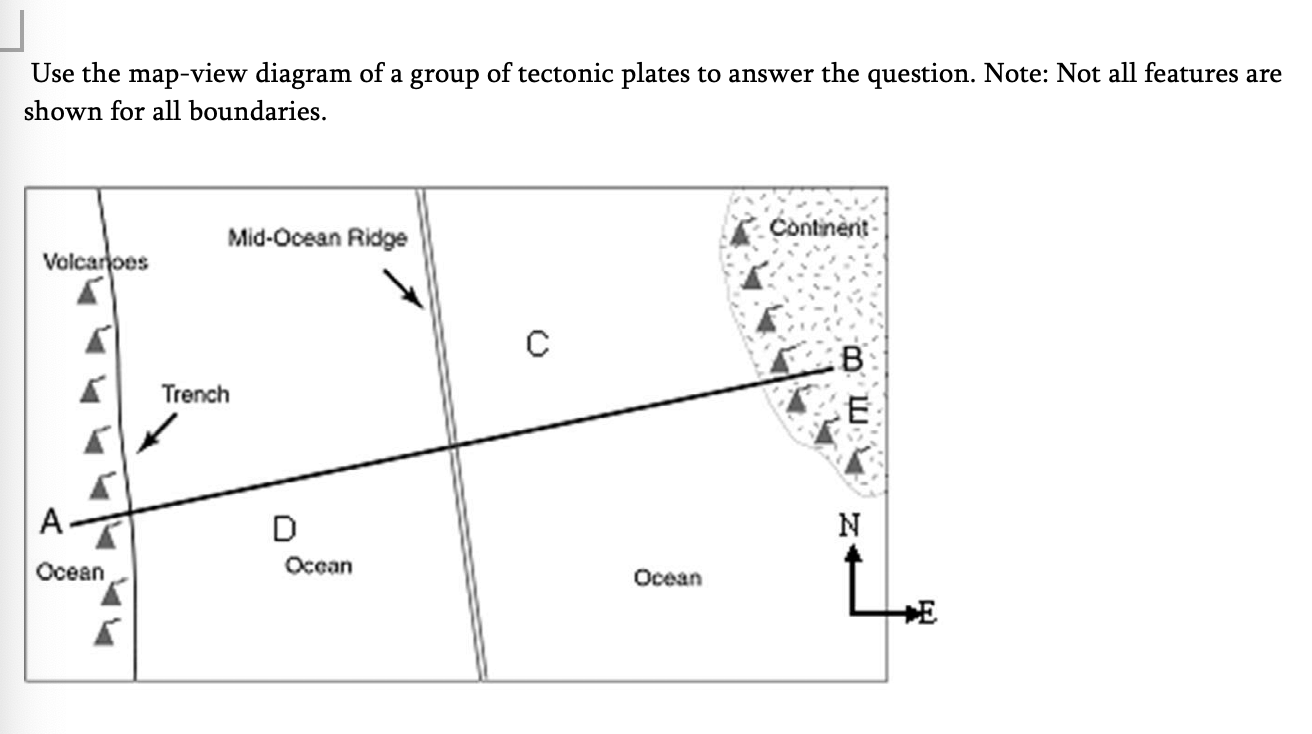
What is the relative direction of motion for points D and E?
A. Convergent
B. Divergent
C. Transform
C. Transform
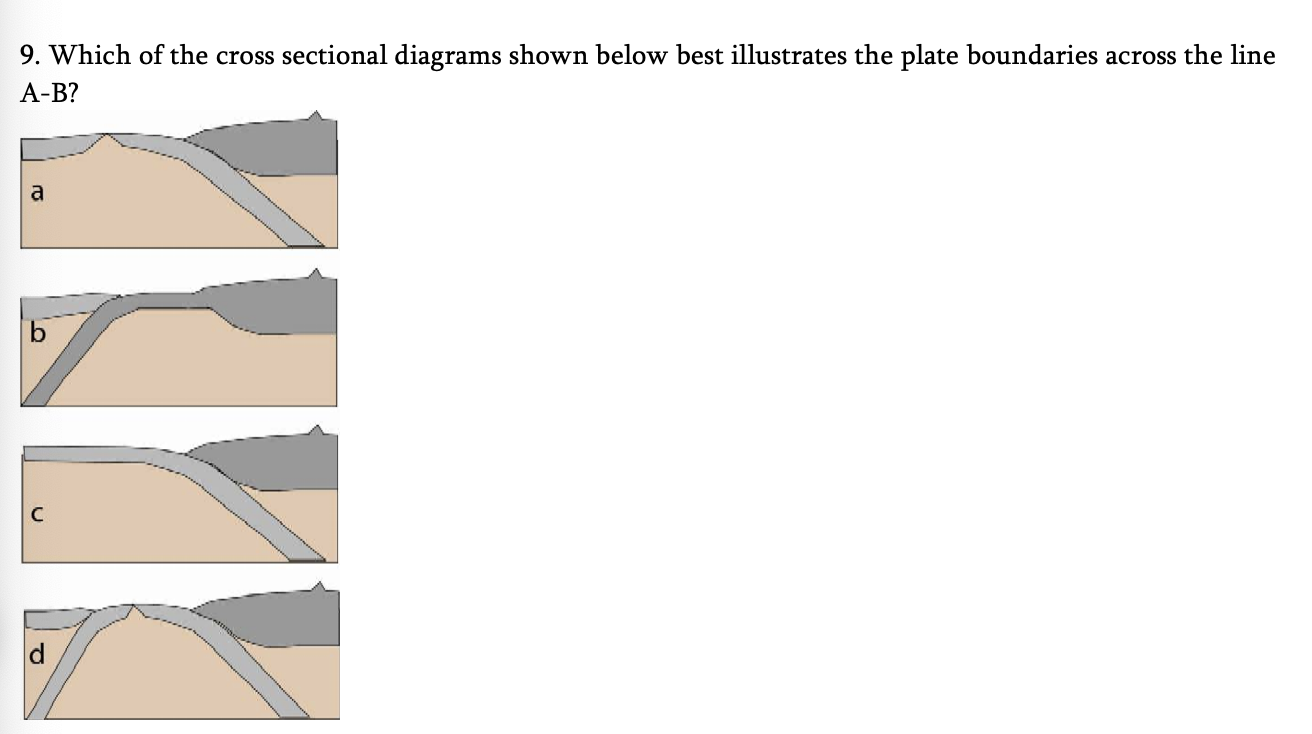
A. Diagram a
B. Diagram b
C. Diagram c
D. Diagram d
D. Diagram d
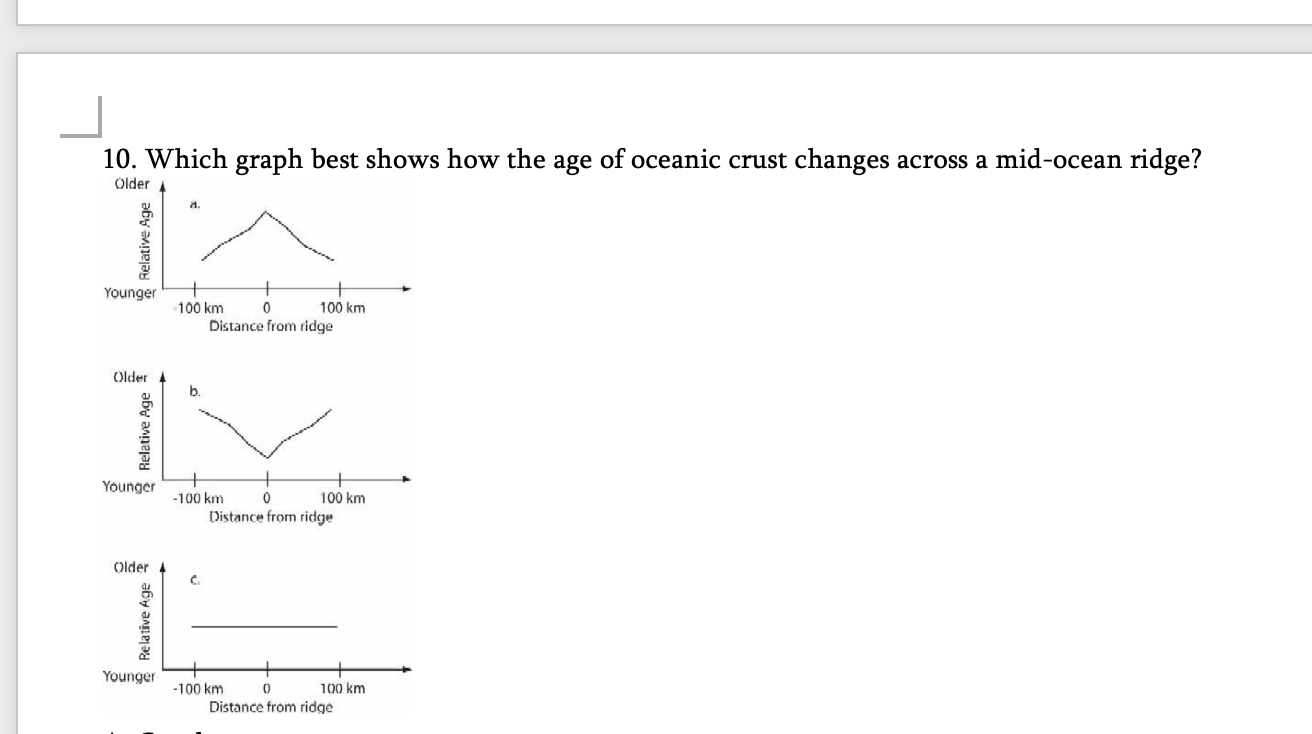
A. Graph a
B. Graph b
C. Graph c
B. Graph b
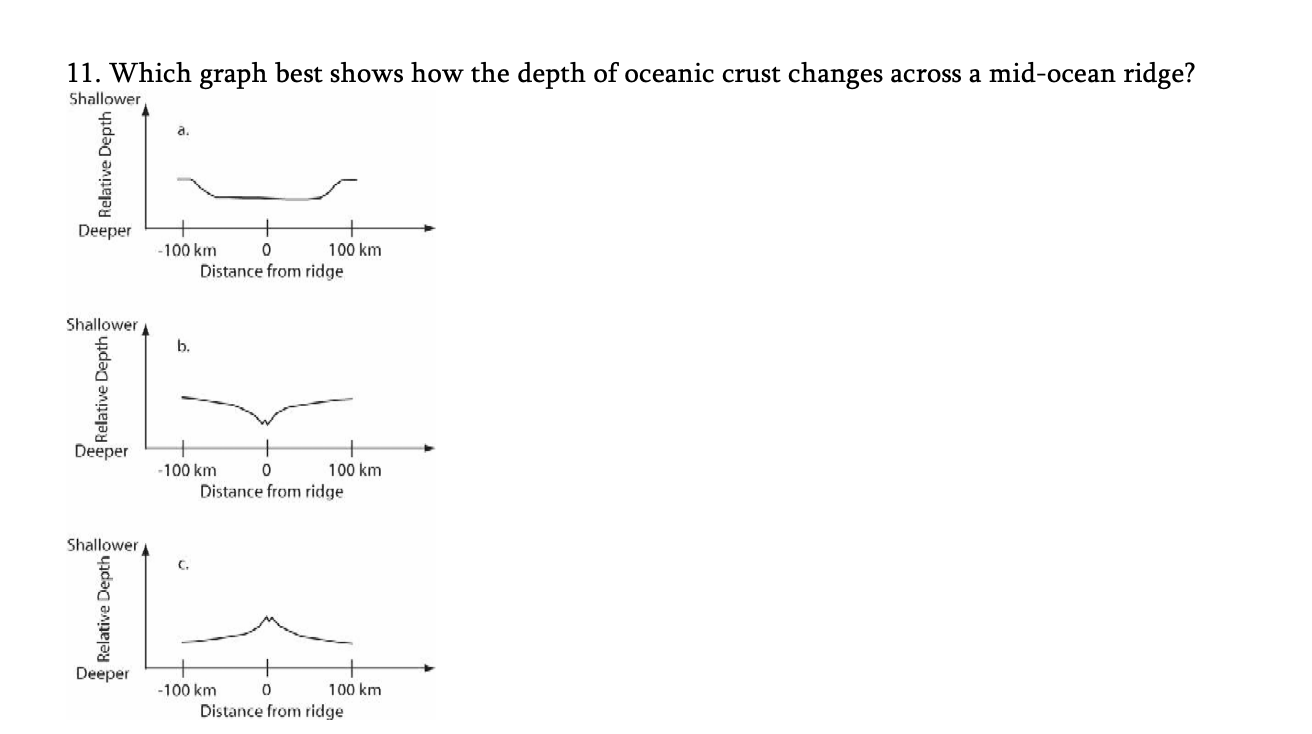
A. Graph a
B. Graph b
C. Graph c
C. Graph c
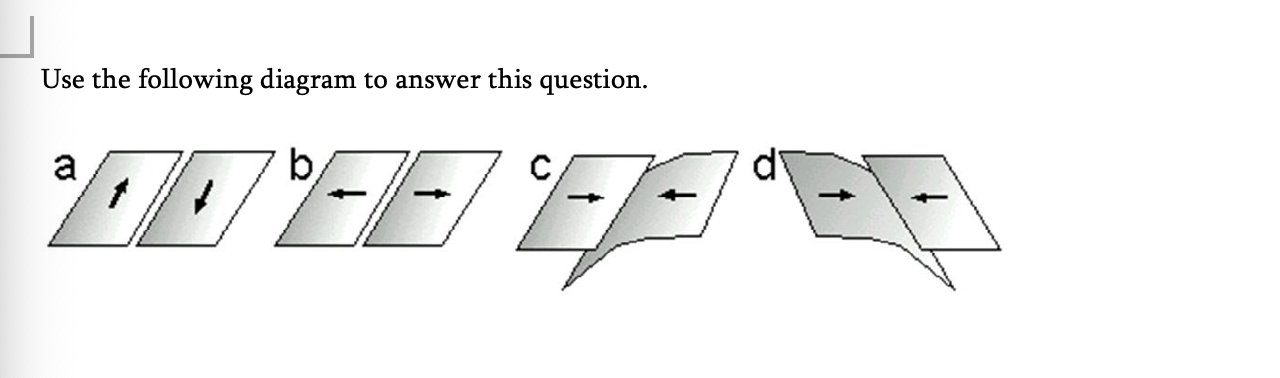
Which of the images best represents the plate boundary between the Nazca and South American plates?
A. Diagram a
B. Diagram b
C. Diagram c
D. Diagram d
D. Diagram d
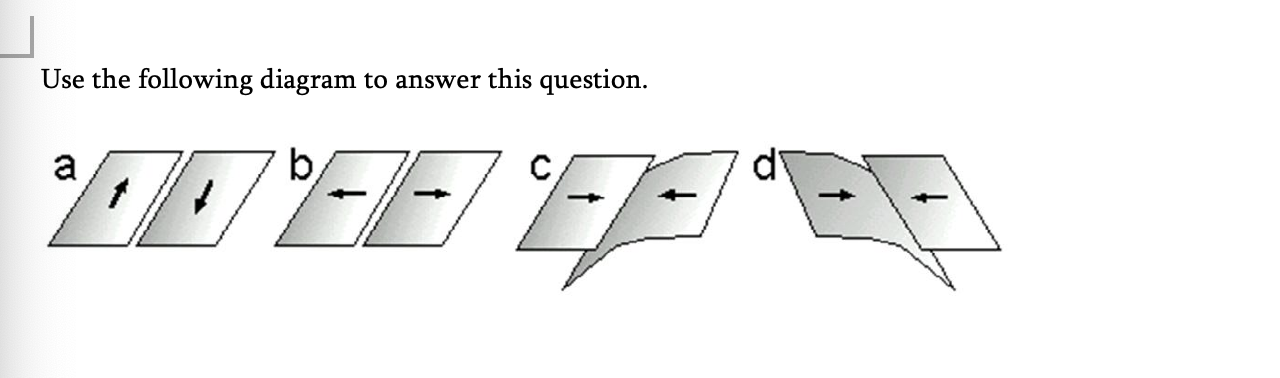
Which of the images best represents the plate boundary between the South American and African plates?
A. Diagram a
B. Diagram b
C. Diagram c
D. Diagram d
B. Diagram b
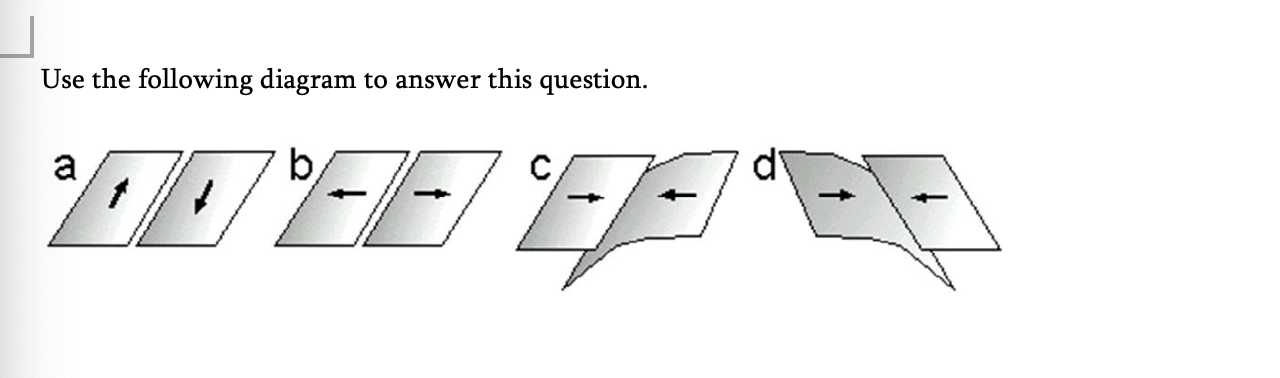
14. Which of the images above best represents the plate boundary between the North American and Pacific plates along the San Andreas Fault?
A. Diagram a
B. Diagram b
C. Diagram c
D. Diagram d
A. Diagram a
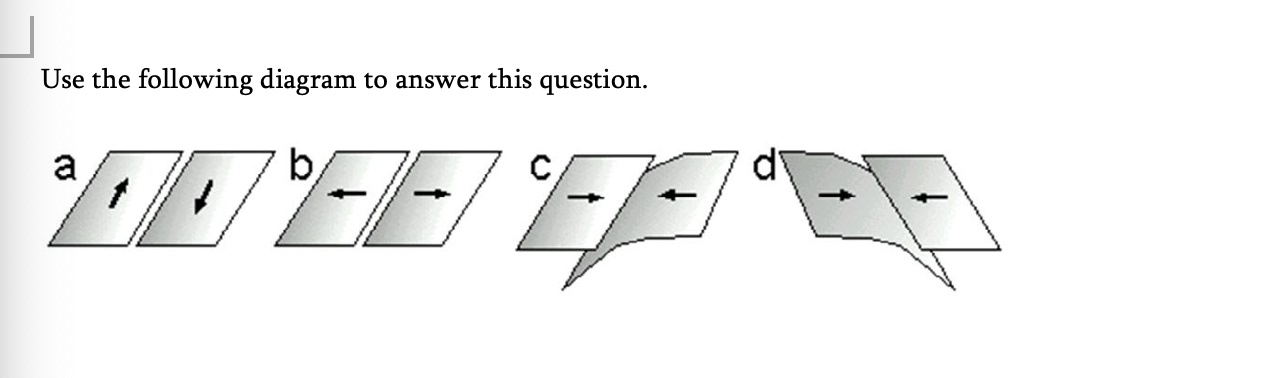
15. Which of the images would be potential sites for active volcanoes and deep earthquakes?
A. Diagram a and b
B. Diagram b and c
C. Diagram c and d
D. Diagram a, b, c, and d
C. Diagram c and d
The magnetic North Pole migrated northward from 1902-2002.
How did magnetic inclination readings in the continental United States change during that period?
A. Inclination increased
B. Inclination decreased
C. Inclination remained constant
B. Inclination decreased
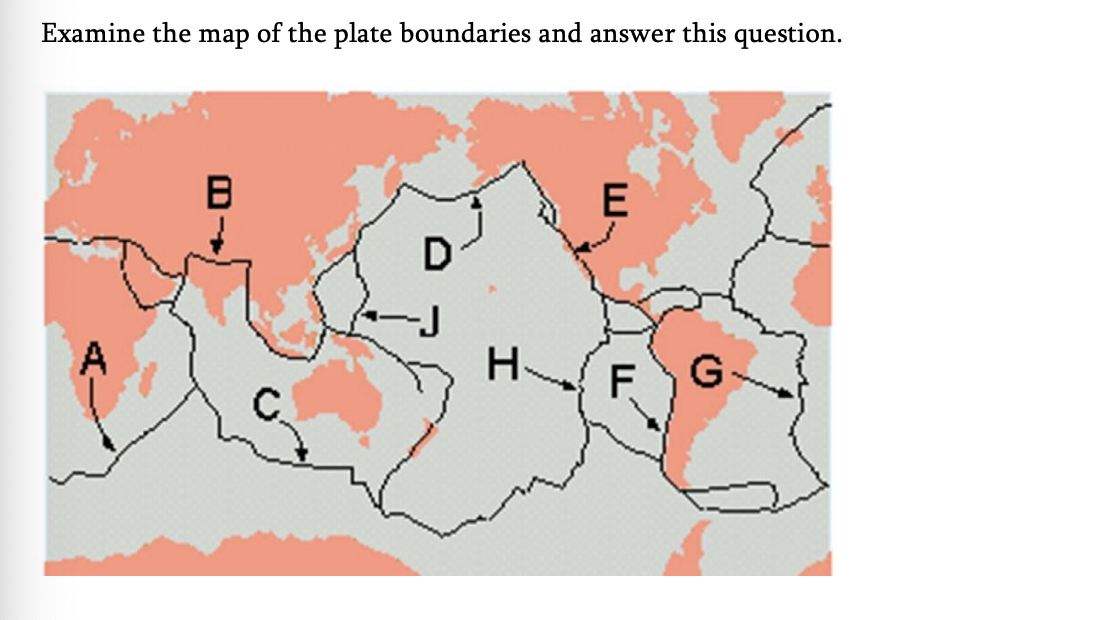
17. Oceanic ridges are present at all of the following locations.
A. A, C, H, G
B. D, J, E
C. F, H, J, D
D. G only
A. A, C, H, G
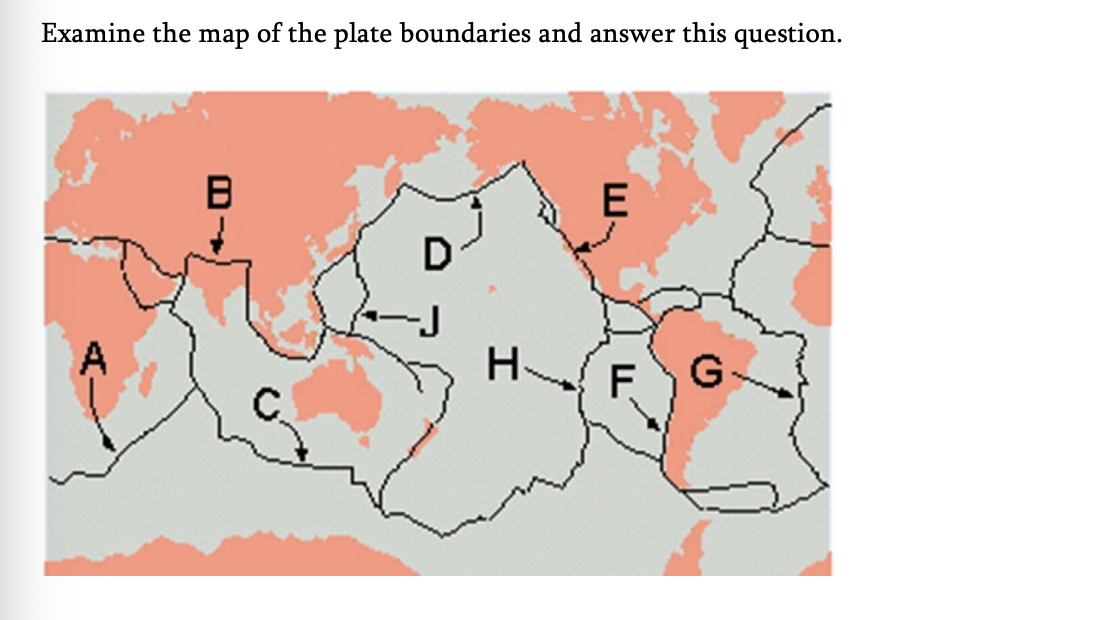
18. Oceanic trenches are present at all of the following locations.
A. A, C, H
B. H, J, E
C. F, J, D
D. B, E, C
C. F, J, D
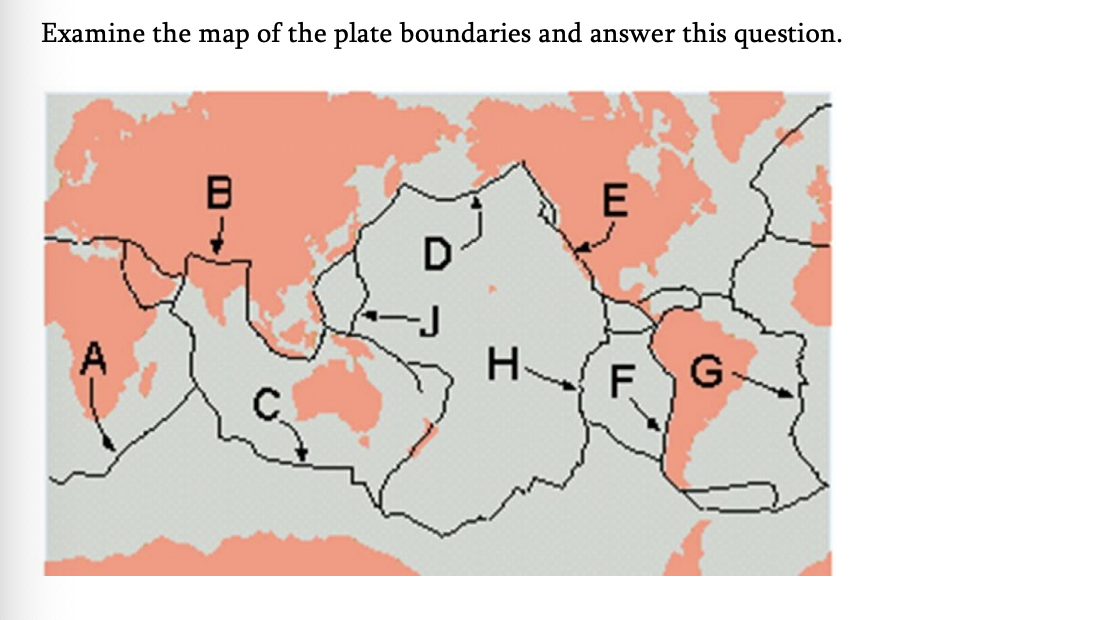
19. New oceanic floor is being created at ____.
A. J
B. B
C. C
D. F
C. C
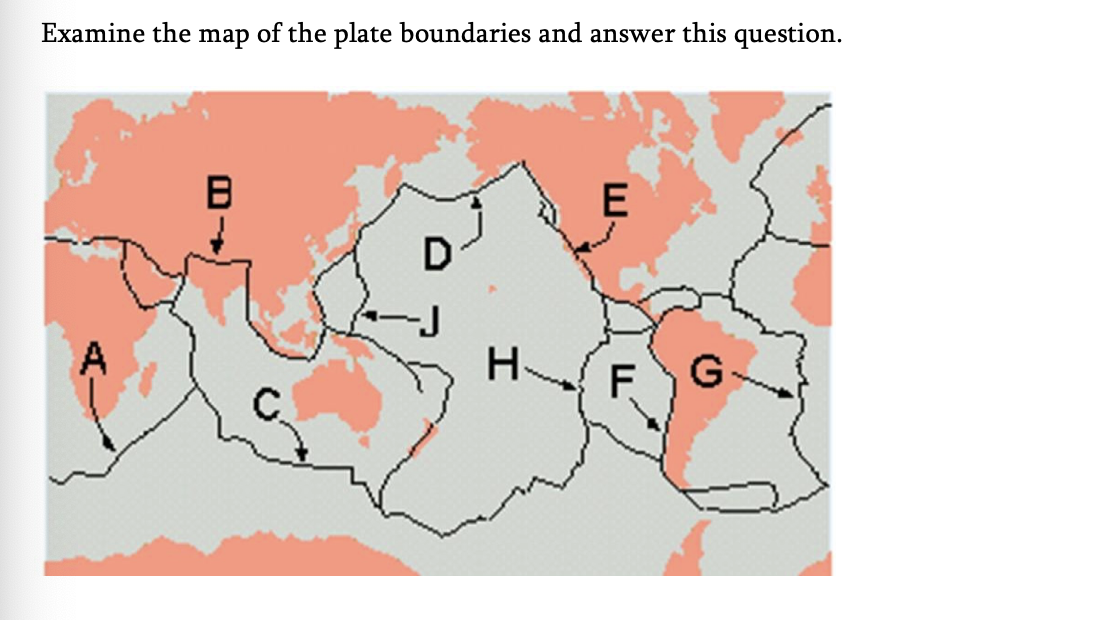
20. A transform plate boundary is present at ____.
A. A
B. B
C. C
D. D
E. E
E. E
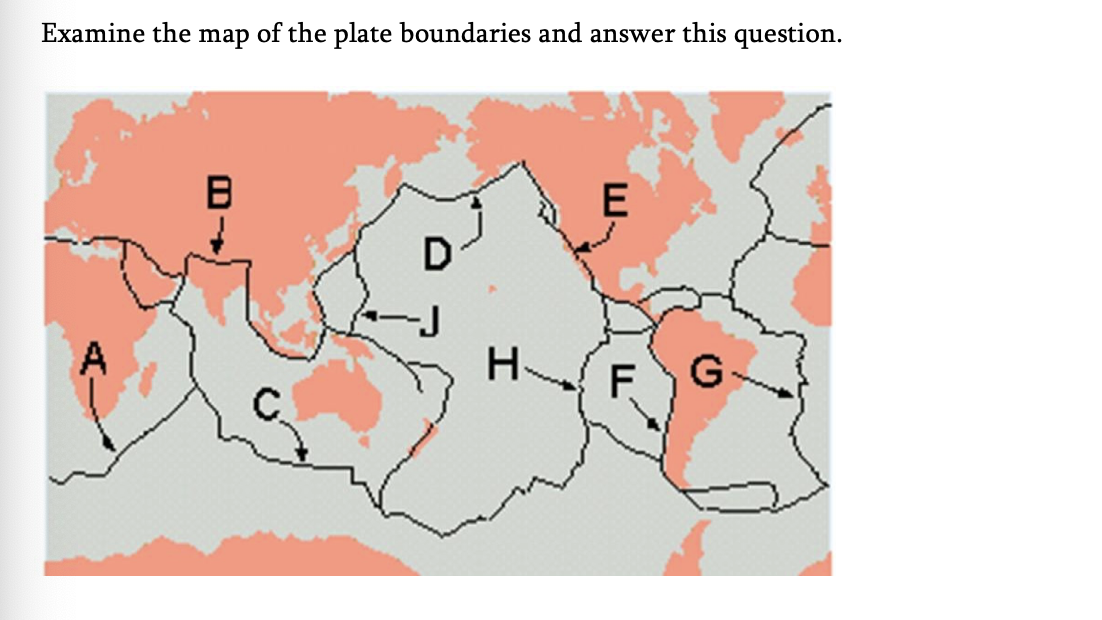
21. A subduction zone is located below ____.
A. C
B. D
C. H
D. G
B. D
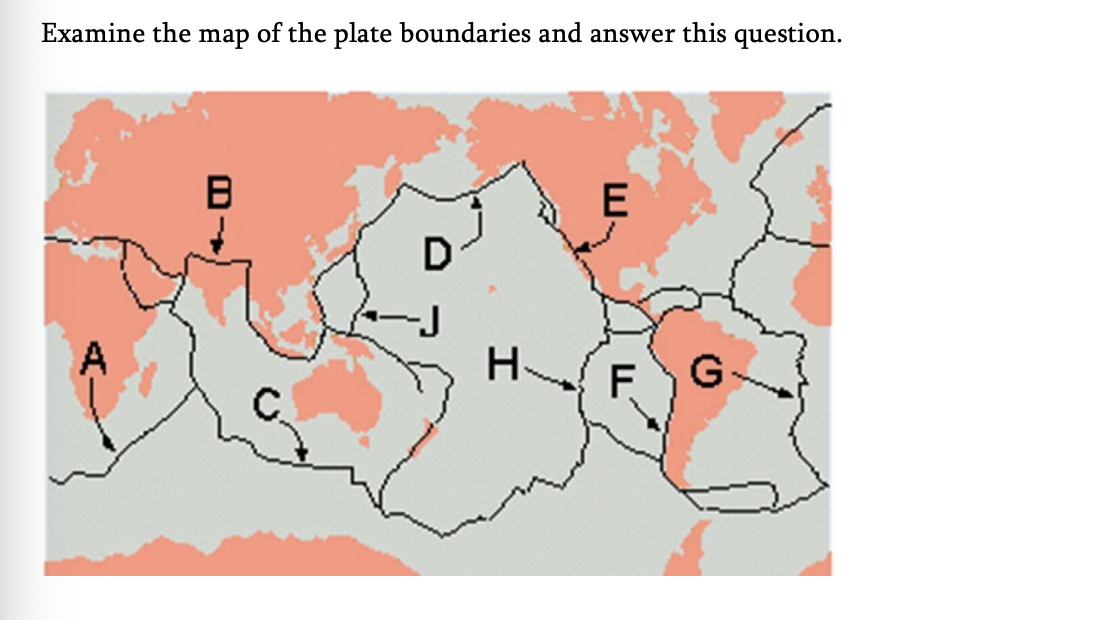
22. Oceanic lithosphere is being destroyed at ___.
A. C
B. D
C. H
D. G
B. D
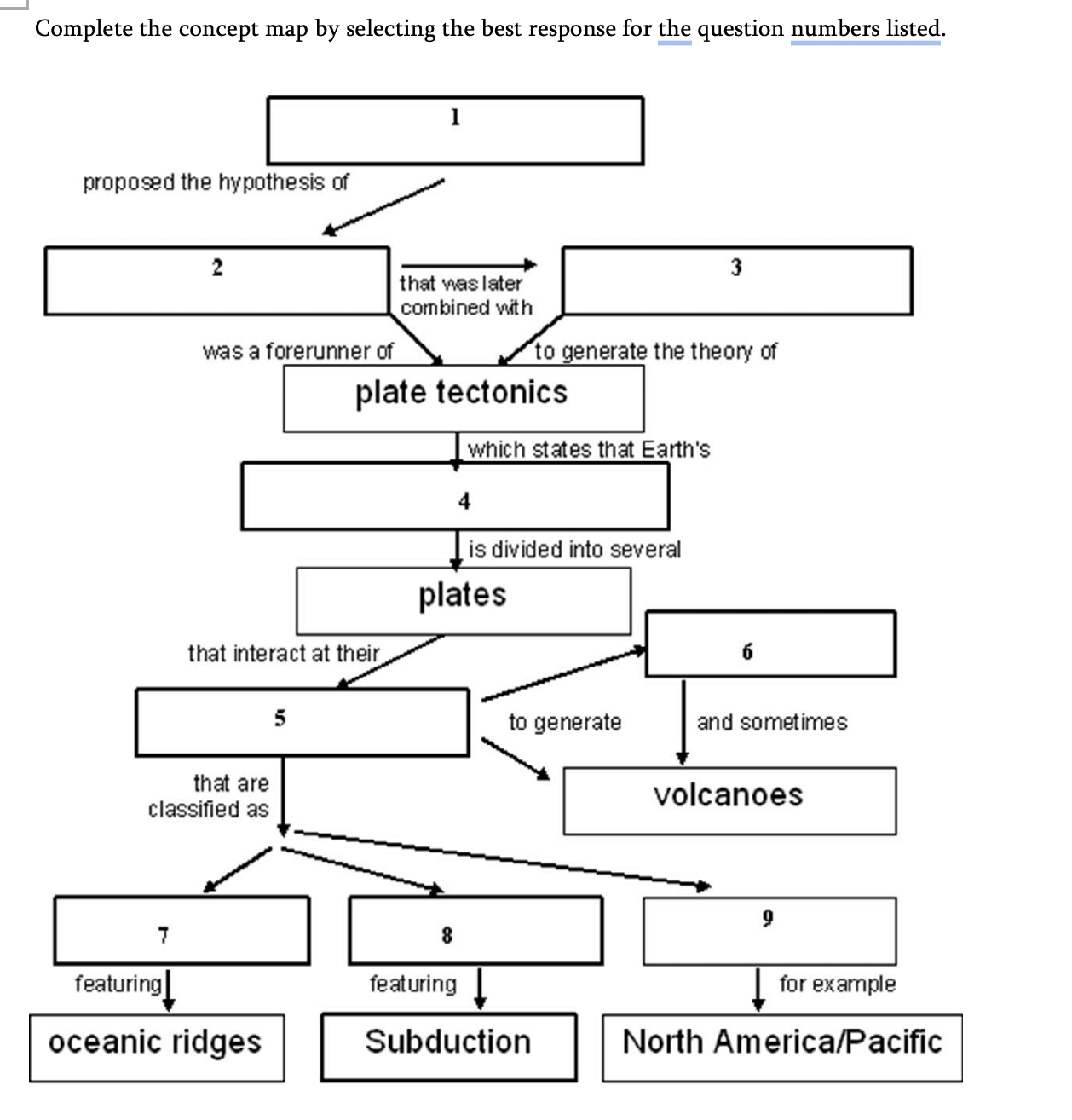
23. Complete the concept map by selecting the best response for question number 1.
A. Hutton
B. Wegener
C. Darwin
B. Wegener
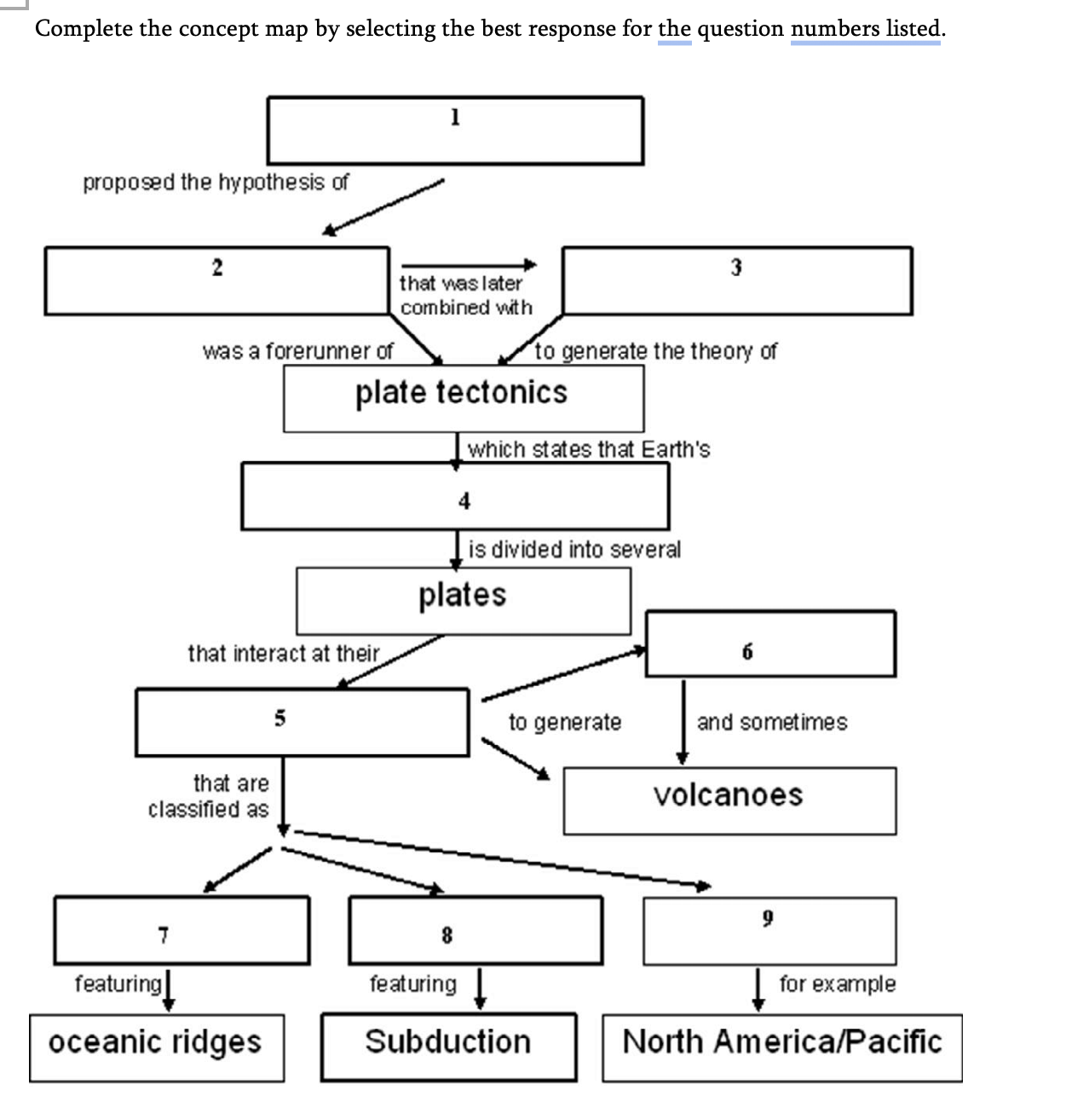
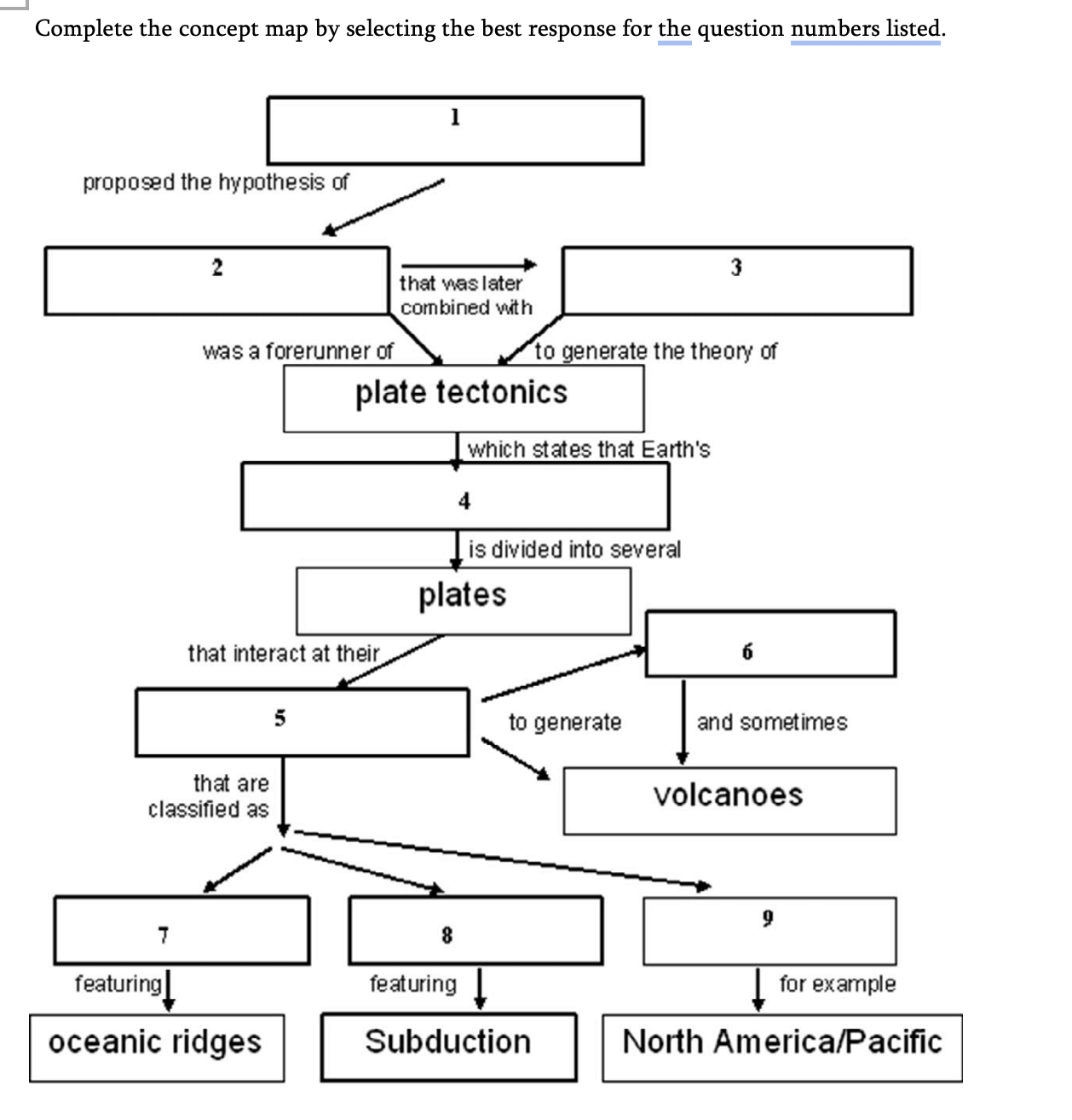
24. Complete the concept map by selecting the best response for question number 2.
A. Pangaea
B. Sea-floor spreading
C. Continental drift
C. Continental drift
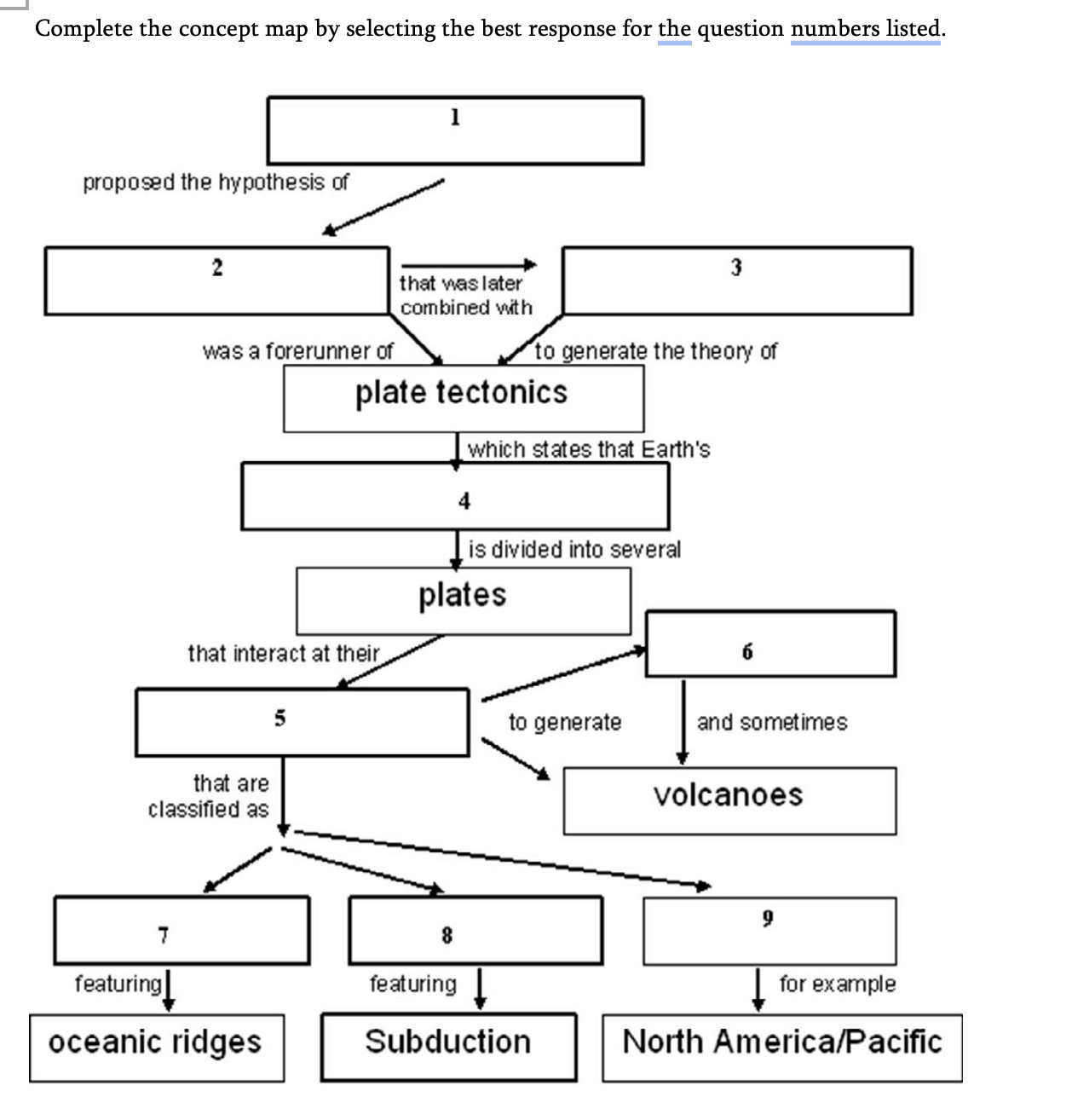
25. Complete the concept map by selecting the best response for question number 3.
A. Pangaea
B. Sea-floor spreading
C. Continental drift
B. Sea-floor spreading
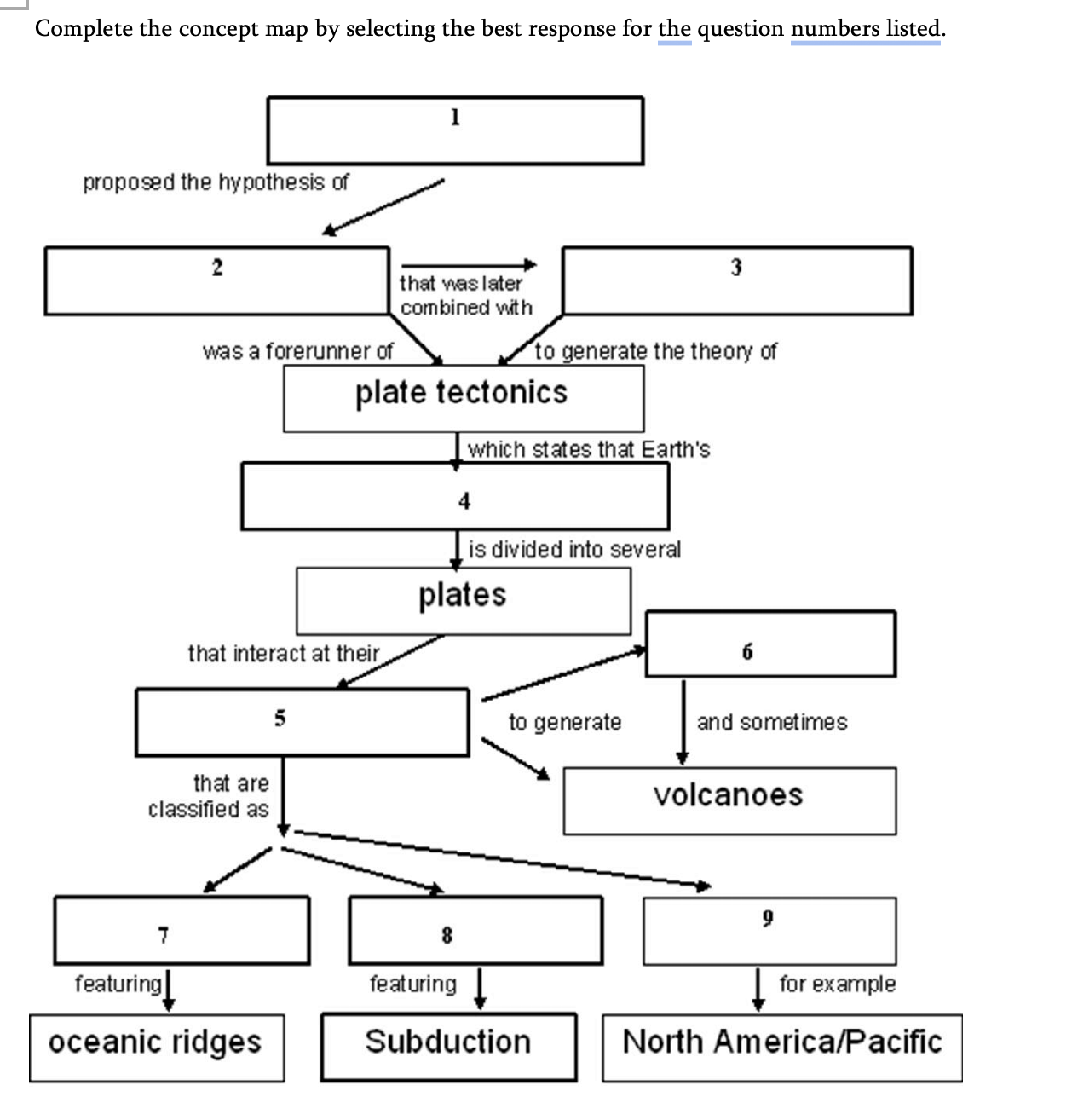
26. Complete the concept map by selecting the best response for question number 4.
A. Lithosphere
B. Crust
C. Mantle
A. Lithosphere
27. Complete the concept map by selecting the best response for question number 5.
A. Hot spots
B. Centers
C. Boundaries
C. Boundaries
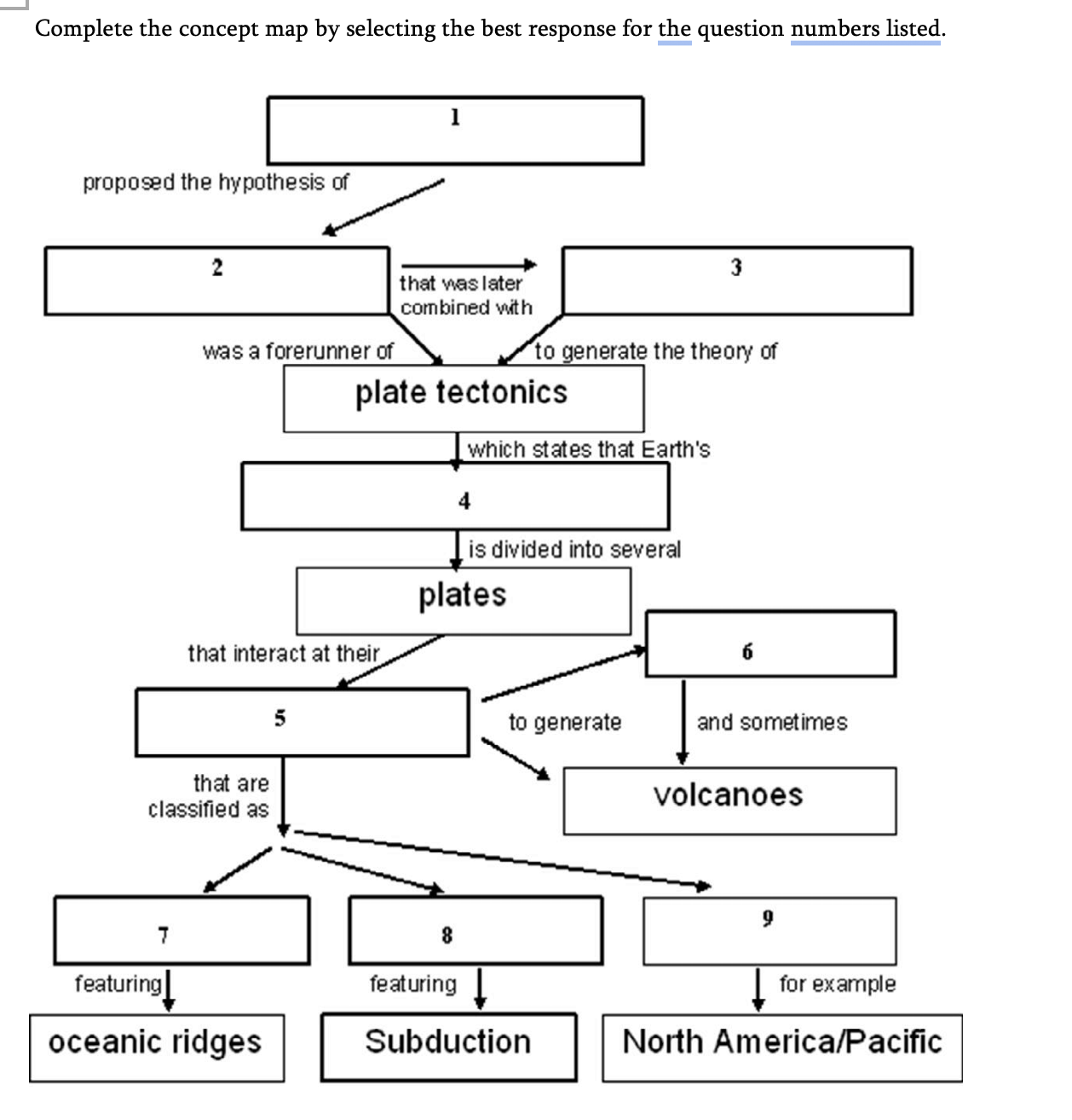
28. Complete the concept map by selecting the best response for question number 6.
A. Earthquakes
B. Hot spots
C. Basins
A. Earthquakes
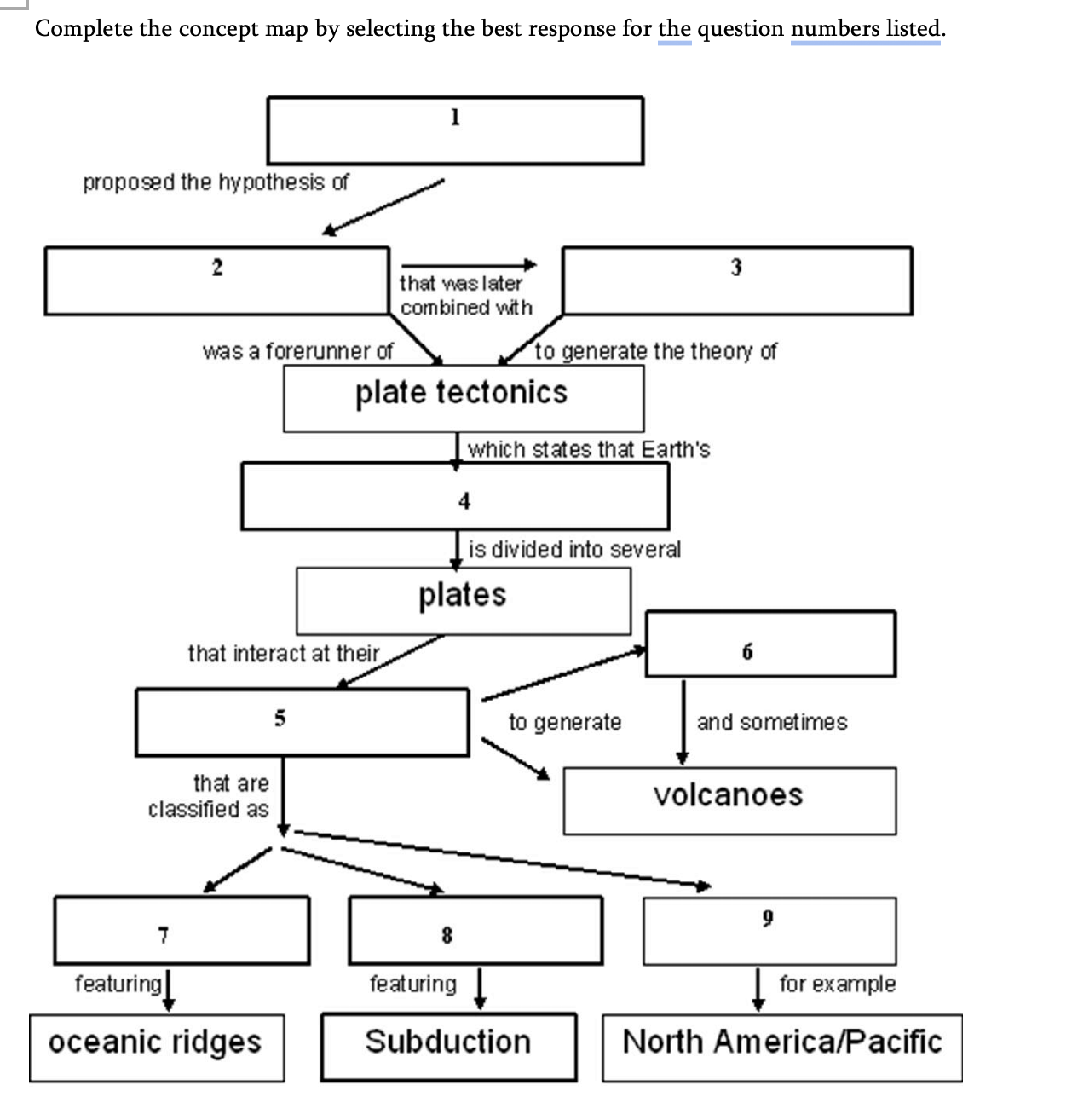
29. Complete the concept map by selecting the best response for question number 7.
A. Convergent
B. Divergent
C. Transform
B. Divergent
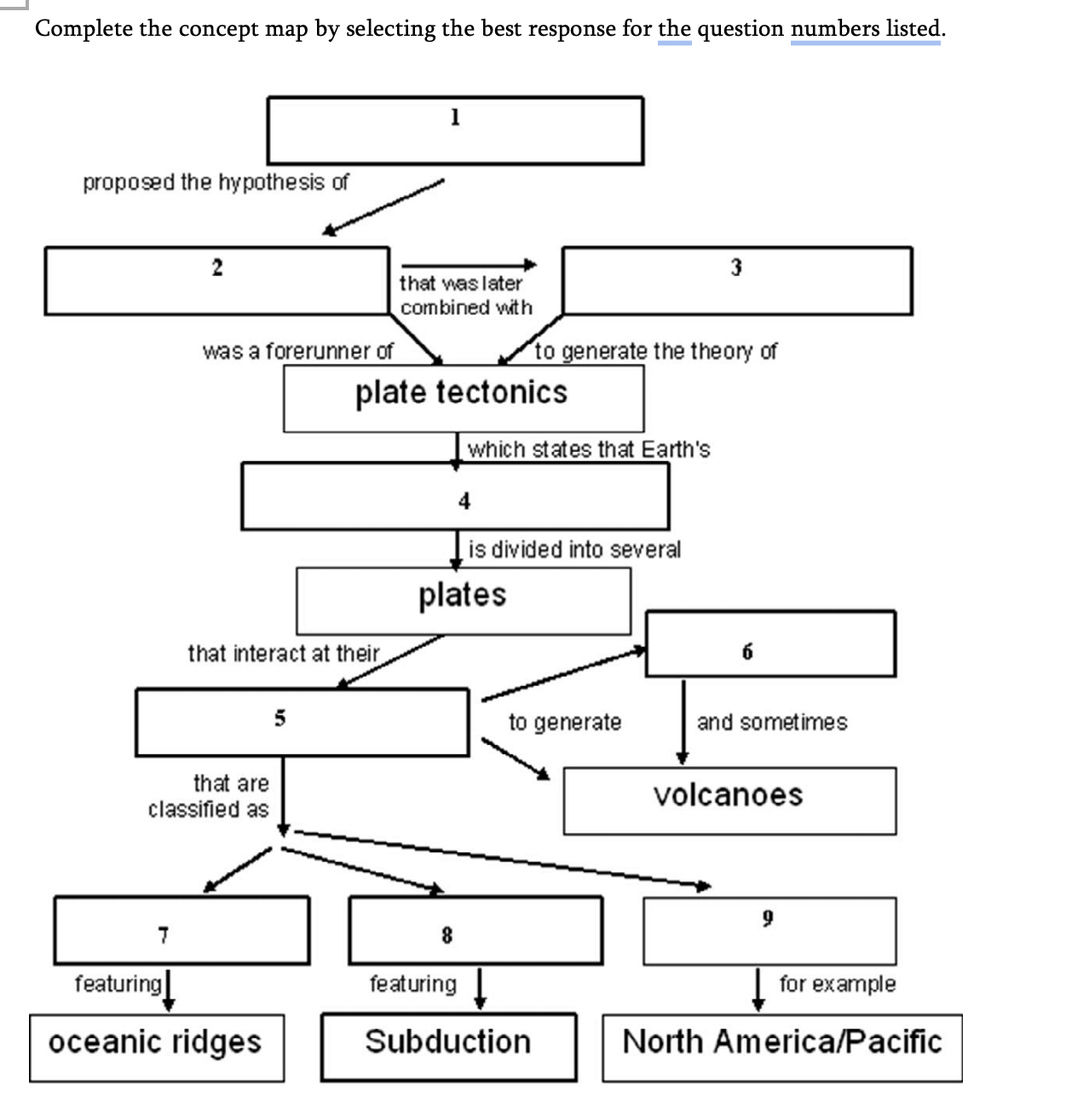
30. Complete the concept map by selecting the best response for question number 8.
A. Convergent
B. Divergent
C. Transform
A. Convergent
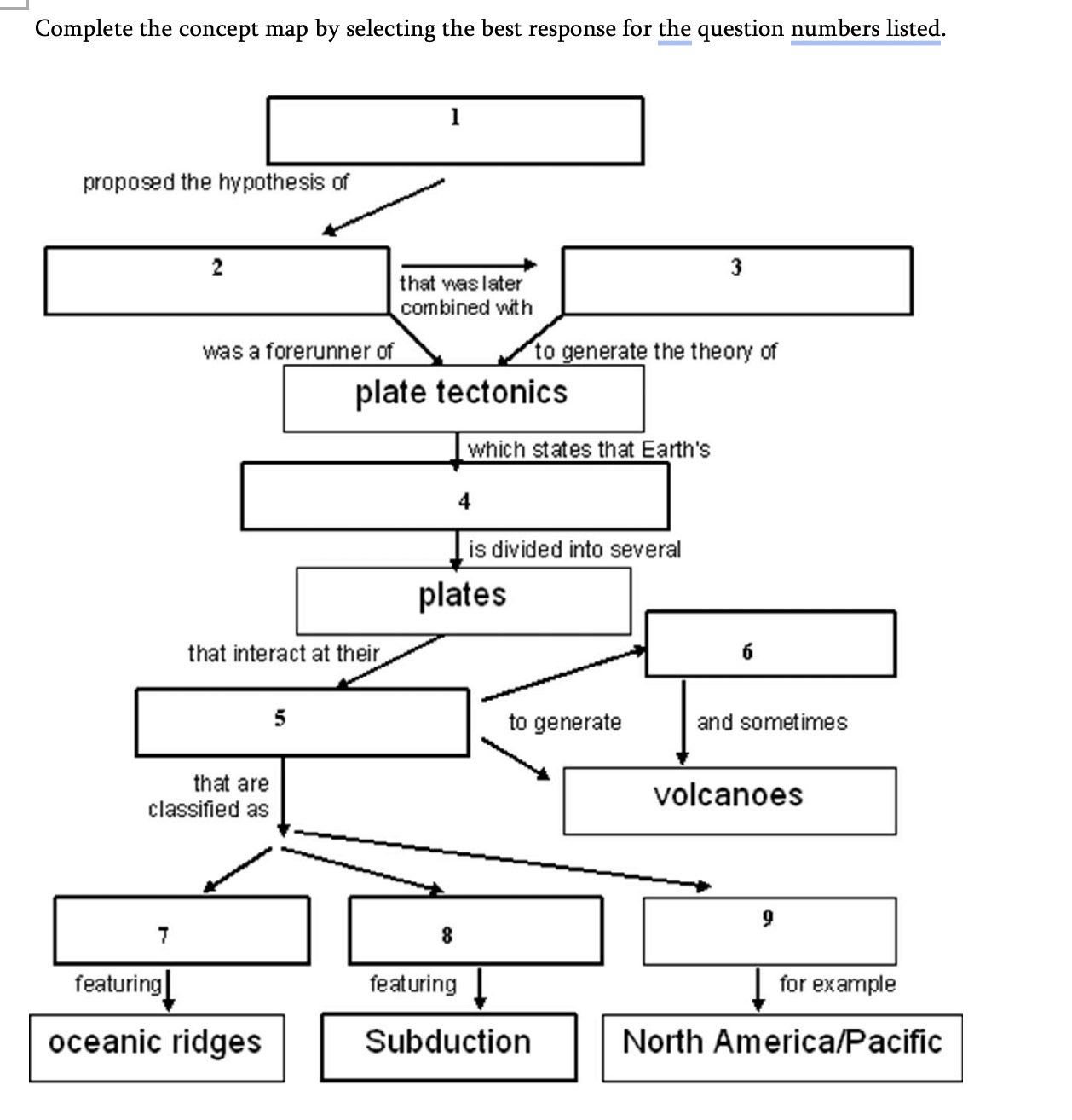
31. Complete the concept map by selecting the best response for question number 9.
A. Convergent
B. Divergent
C. Transform
C. Transform
32. What was the super-continent landmass proposed by the person whom formulated the idea of continental drift?
A. Pangaea
B. Rodinia
C. Eurasia
A. Pangaea
33. Where are the youngest rocks found on the seafloor?
A. Trenches
B. Mid-ocean ridges
C. Along coastlines
B. Mid-ocean ridges
34. What happens to the age of seafloor rocks moving away from a mid-ocean ridge?
A. The rocks get younger.
B. The rocks get older.
C. The rock ages do not change.
B. The rocks get older.
35. What happens to the depth of the seafloor moving away from a mid-ocean ridge?
A. The seafloor deepens adjacent to the ridge.
B. The seafloor shallows adjacent to the ridge.
C. The seafloor depth does not change adjacent to the ridge.
A. The seafloor deepens adjacent to the ridge.
36. Which two ideas were combined to form the theory of plate tectonics?
A. Continental drift and the Big Bang
B. Continental drift and the scientific process
C. Continental drift and seafloor spreading
C. Continental drift and seafloor spreading
37. Where is new seafloor generated?
A. Trenches
B. Mid-ocean ridges
C. Along coastlines
B. Mid-ocean ridges
38. Where is seafloor returned to the mantle?
A. Trenches
B. Mid-ocean ridges
C. Along coastlines
A. Trenches
39. The speed of plate motion is approximately
A. 1-10 cm/yr.
B. 1-10 m/yr.
C. 1-10 km/yr.
A. 1-10 cm/yr.
40. Approximately how old is the oldest oceanic crust?
A. 2 billion years
B. 200 million years
C. 20 million years
D. 2 million
B. 200 million years
41. What is the proper order of Earth's compositional layers from the interior to the surface?
A. Crust, mantle, core
B. Mantle, core, crust
C. Core, mantle, crust
C. Core, mantle, crust
42. What happens to the age of the Hawaiian Islands moving away from the hot spot?
A. They get older
B. They get younger
C. The age does not change
A. They get older
43. What technology allows scientists to precisely measure plate motions?
A. Global seismometers
B. Global satellite imagery
C. Global positioning system
C. Global positioning system
44. Which type of plate motion is characteristic of a convergent boundary?
A. Plates move away from one another.
B. Plates move toward one another.
C. Plates move past one another
B. Plates move toward one another.
46. Which type of plate motion is characteristic of a transform boundary?
A. Plates move away from one another.
B. Plates move toward one another.
C. Plates move past one another.
C. Plates move past one another.
47. What happens when an oceanic plate collides with a continental plate?
A. The continental plate is subducted.
B. The oceanic plate is subducted.
C. The oldest plate is subducted.
B. The oceanic plate is subducted.
48. Where is heat flow the greatest?
A. Near oceanic ridges
B. Near oceanic trenches
C. Near transform boundaries
A. Near oceanic ridges
Which statement is TRUE about the relationship between age and topography of the ocean floor?
A.Deeper regions of the ocean floor are younger
B.The Pacific Ocean is larger than the Atlantic Ocean because it contains older oceanic floor
C.Oldest oceanic crust is only present near trenches
D.Youngest seafloor rocks occur near oceanic ridges
D.Youngest seafloor rocks occur near oceanic ridges
The magnetic North Pole has migrated northward over the last century, so how did magnetic inclination readings at Chicago change between 1900 and 2000?
A.Inclination increased
B.Inclination decreased
C.Inclination remained constant
B.Inclination decreased