History of Evolution
 Call Kai
 Learn
Learn Practice Test
 Spaced Repetition
 Match
Match Flashcards
 Knowt Play
1/40

There's no tags or description
Looks like no tags are added yet.
Name | Mastery | Learn | Test | Matching | Spaced | Call with Kai |
|---|
No analytics yet
Send a link to your students to track their progress
41 Terms
Mary Anning?
became known as an expert on fossils in the early 1800s
her gender and socioeconomic status precluded her from joining scientific societies and sharing her discoveries
History of Evolutionary Biology
Ancient Thought
Fossils and pre 18th century thought
Uniformitarianism/Pre-Lamarckian Evolution
Lamarck and Lyell
Between Lamarck and Darwin
Darwin and Wallace
Late 19th Century
Mendelians vs Biometricians (1900-1915)
Theoretical Evolutionary Genetics (1915-1930)
Modern Synthesis (1930-1950)
Era of Big Ideas (1950-1980s)
Molecular Revolution (1990 – now)
What are the 3 Ancient Ideas about evolution?
Ancient Greece (600-300 BC)
Taoism (China, 300 BC)
Islam (9th Century)
Ancient Idea: Ancient Greece (600-300BC)
Anaximander: early philosopher who proposed that humans evolved from non-human species, land organisms originated in the water
later, more influential philosophers (Plato, Aristotle) proposed a more static view of the universe
Ancient Idea: Taoism (China)
World is constantly changing- contrast with more static western view
Zhuang Zhou proposed speciation 300 BC)
Ancient Idea: Islam
Islam-al Jahiz (9th century): book of animals discusses struggle for existence
Ibn Khaldun (14th century): humans developed from a “world of monkeys” by species becoming more numerous
Fossils and pre-18th century thought
who influenced western philosophy?
what did they emphasize?
static perception?
what did they think of fossils?
western philosophy was heavily influenced by Plato and Aristotle
emphasized perfection of creation and great chain of being
static perception: why change things if the world is already perfect
fossils were assumed to be remains of organisms still living elsewhere
What was the 18th century known as?
Age of Reason: an era that laid the foundation for modern science. Many ideas about evolution were developed during this time
What ideas developed during the 18th century and who developed them?
Comte de buffon: a french scholar who proposed change over time, but suggested that different species had different ancestors (limited evolution from many different ancestors, no common ancestor of all life)
Cuvier: studied fossils and age of the earth, proposed that fossils are extinct organism, catastrophism= evolution proceeded through very big changes
Erasmus Darwin (Charles Darwins grandfather): wrote poetry about the formation of new species and natural history
Who is James Hutton and William Smith?
James Hutton and William Smith were geologists in a British scholar group called the Uniformitarianists
Uniformaterianists: claimed that the geological processes taking place now operated similar in the past; the earth was very old
ex: formation of mountains and layers of rock, sedimentary rock layers have different fossils, erosion, sedimentation, volcanic activity,
suggesting that the earth was shaped by slow, continuous change
What did Hutton and Smith argue/find?
Hutton argued for the constancy of the geological process
Smith found that layers/order of rock strata were consistent in different places and had the same kind of fossils regardless of where he found the layers
Who is Lyell?
Lyell: an english geologist published the Principles of Geology (1830s), a comprehensive synthesis of uniformatarian ideas with geological phenomena (age of earth, rock layers)
Who is Lamarck?
Lamarck: a french scholar who proposed (1809) that organisms evolve new traits through a combination of environmental pressure and inheritance of acquired characteristics
Mid- 19th Century before Darwin/Wallace?
who were important people during this time?
William Charles Wells: wrote an essay on natural selection (1813)
Patrick Matthew: proposed natural selection (1831)
Matthew was upset when Darwin published the Origin of Species bc he argued he thought of it first and claimed he was the discoverer of natural selection
How were Darwin and Wallace different from the scientists before them?
Darwin and Wallace had extensive field experience outside of England (low biodiversity, lots of human modification)
explored environments with high biodiversity and unaffected by humans (ex: voyage on the Beagle, time in Amazonia and SE Asia
observing nature in the wild shaped their thinking
Joint paper presented in 1858, but neither attended the presentation, Darwin was spurred to publish the Origin of Species in 1859
Evolution After Darwin
did society accept the idea of evolution and natural selection?
Evolution was widely accepted by scientists fairly quickly
however, natural section was less accepted bc it requires variation within populations; such variation contradicted the prevailing explanation of heritability of the time: Blending
this lack of knowledge of genetics hindered advances in the late 19th century, leaving natural selection to be accepted by mainly naturalists (Wallace, Bates, Hooker)
What was rediscovered in the 1900s?
1900s: Mendelian (particulate) inheritance was rediscovered. This led to serious conflict between Mendelists and Biometricians
The disagreement between biometricians and Mendelists was about how evolution works and how traits are inherited.
Biometricians- what do they believe?
Biometricians:
natural selection causes evolution
observed quantitative traits in populations of parents and offspring, less emphasis on mechanism of heritability
studied traits using statistics
Evolution happens gradually
Traits (like height or size) show continuous variation (a range, not just categories)
Natural selection slowly shifts these traits over time
👉 Example: Human height — there’s a smooth range from short to tall, not just “short” or “tall”
Medelists- what do they believe?
Mendelists:
inheritance causes evolution
observed dominant and recessive alleles, assumed dominant alleles would “win out” and become more frequent in a population over time
Traits are inherited as discrete units (genes)
Variation is not continuous, but comes in distinct categories
Evolution can happen in sudden jumps (mutations)
👉 Example: Flower color being either purple or white
Unification Evolution and Genetics
when was this conflict resolved?
who set up a framework to allow us to predict how evolution would occur under different conditions?
this conflict was resolved by 1915-1930, as basic theoretical ideas about genetics and evolution were developed
Wright, Haldane, and Fisher set up a framework to allow us to predict how evolution would play out under different conditions
this was not immediately appreciated bc of Math
What was the Key ideas of their framework? (4)
Alleles make up genotypes (AA, Aa, aa)
Both alleles and genotypes have frequencies within a population
Both alleles and genotypes have fitness values
Allele and genotype frequencies can change in predictable ways
Allele and genotype frequencies can change in predictable ways- what ways?
Selection (differences in fitness)
Genetic drift (chance changes)
Migration (movement between populations)
Mutation
Nonrandom mating
Meiotic drive (allele affects outcome of meiosis)
Modern Synthesis (1930s-1950s)- what is it?
Modern Synthesis: successful integration of genetics with Darwin’s postulates, leading to a reformulation of the Theory of Evolution
What were the two propositions made during the Modern Synthesis era (1930-1950s)
Gradual evolution results from small genetic changes that are acted upon by selection
the origin of species and higher taxa (macroevolution) can be explained in terms of natural selection acting on individuals (microevolution)
alleles associated with higher fitness increase in frequency from one generation to the next
1950s-1980s
what happened during this period?
name?
how was research affected?
Era of Big Ideas (1950s-1980s)
having a common conceptual framework allowed for explosion of new ideas (entire field of behavioral ecology, neutral theory of molecular evolution)
Tomoko Ohta: Japanese population geneticists that developed the nearly neutral theory of molecular evolution
despite the flood of new ideas this period was hampered by technical limitations, making ideas difficult to tests
ex: it would be hard to test the effects of groups vs individual selection without models observing relatedness and group structure
1990s- Now
what is this era known as?
what has allowed researchers to test hypotheses that were impossible before?
what is there a greater emphasis on now?
“The Golden age of evolutionary biology”
“Molecular Revolution”
molecular techniques have allowed researchers to test hypotheses that were previously impossible
much greater emphasis on rigorous hypothesis testing
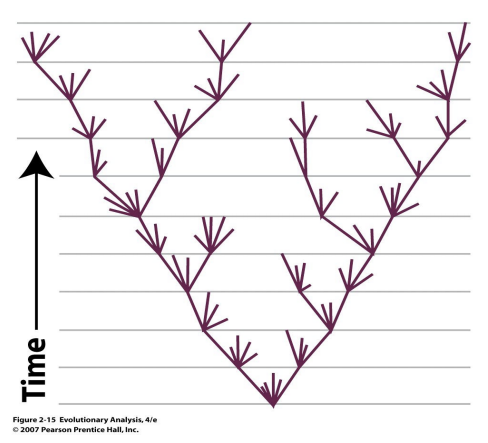
Only Illustration in Origin of Species
what does evolution consists of?
what can evolution produce?
Crucial contribution: evolution consists of change over time plus splitting/origins of diversity
this process can produce not only differences over time, but also increased diversity
Taxonomy & Phylogenetic systematics- what are they?
Traditional classification of organisms based grouping on morphological similarities
Taxonomy
Taxonomy: naming of organsims grouped into progressively more inclusive sets (a hierarchy)
Taxon: can refer to any level in the hierarchy (taxa is plural)
Easy way to remember
Taxonomy = the system/process of classifying organisms
Taxon = one specific group within that system
Think:
Taxonomy = filing system
Taxon = one folder in the system
Phylogenetic Systematics
naming is based on evolutionary relationships and classification is tree based, reflecting branching events
clade: a group of organisms that includes a single common ancestor and all of its descendants (aka a monophyletic group)
Paraphyletic Groups
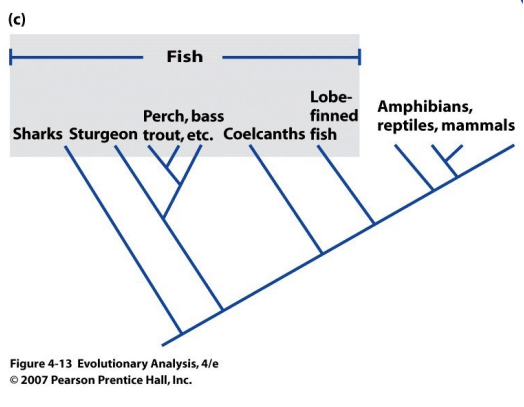
Many traditional taxa names represent paraphyletic groups
Paraphyletic: group includes some, but not all the descendants of a common ancestor
ex: Fish
a common ancestor
but NOT all descendants
Monophyletic Groups
evolutionary history should be based on monophyletic groups
groups includes all descendants of a common ancestor
A monophyletic group includes:
a common ancestor
and all of its descendants
What do nodes represent?
how do we study relatedness?
nodes represent the most recent common ancestor between 2 groups
they show us points of divergence
the order of organisms along the branch tips does not tell us their relatedness
we must investigate the nodes and branching patterns
Sister Taxa
sister taxa: share a unique common ancestor not shared with other groups
sister taxa are each others closest relatives in the tree
share the most recent common ancestor
branch off from the same point on the tree
Different ways to depict phylogenies
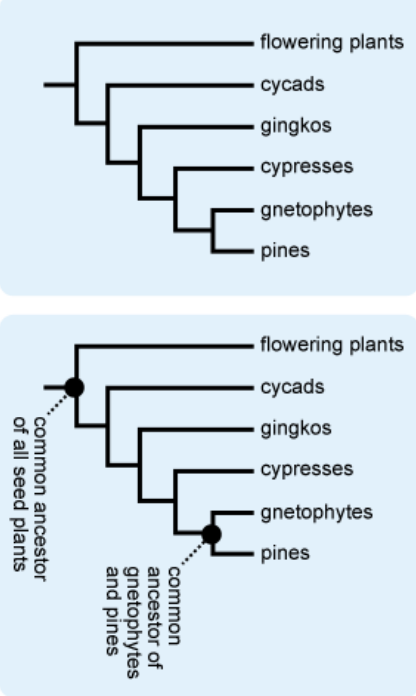
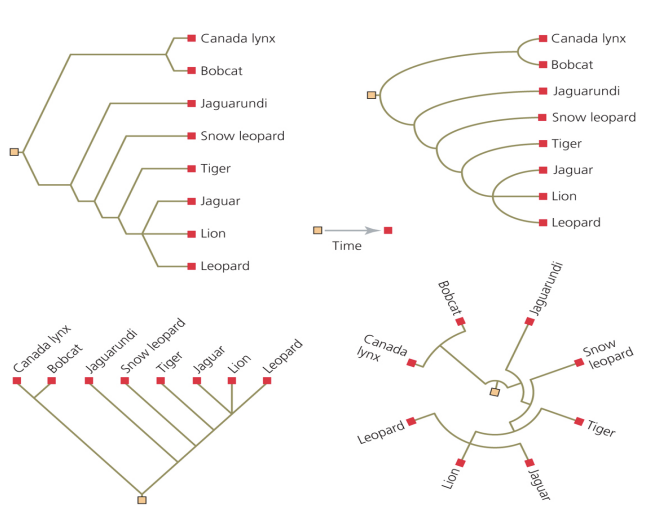
Phylogenies can be presented in different ways in publications
all show branching patterns. when interpreting these trees, use the nodes as your guide
ex: we see the lion, leopard, and jaguar grouped together in every tree
Reduced Phylogenies
trees can be reduced by depicting less species
phylogenies can depict subsets of species, and dont necessarily show every possible species in a group
What is Polytomy?
Polytomy: three-way split, rather than a bifurcattion, can indicate uncertainty in a lineage
Which traits are informative for phylogenies?
what do they need to reflect?
How do we decide with traits to use in constructing a tree?
The traits need to reflect common ancestry and evolutionary history.
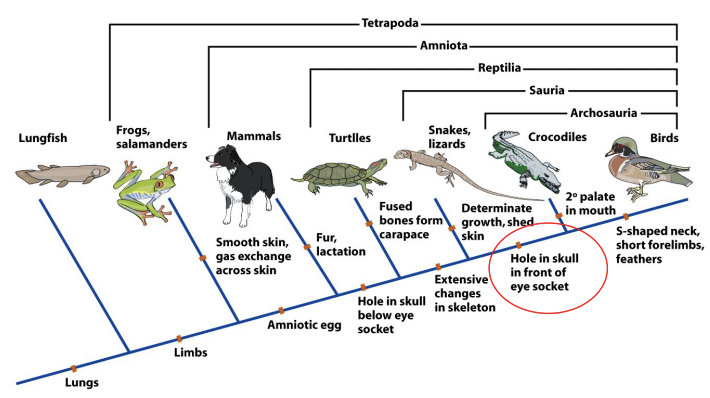
The types of homologous traits that are useful in phylogenies are synapomorphies
Synapomorphies
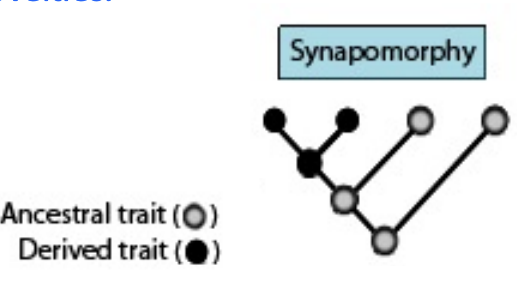
a shared, derived character used to define clades
synapomorphies identify monophyletic groups
derived traits are evolutionary novelties
A shared derived trait inherited from a common ancestor
Used to determine evolutionary relationships and identify clades
Considered an evolutionary novelty because it is a newly evolved trait
How do we decide what is derived?
an ancestral trait is present in the common ancestor of organisms
in contrast, derived traits are evolutionary novelties
new traits that did not exist in the ancestor but appeared later during evolution.
some derived traits are unique to one species, or they are shared