MCB 2010 Module 2 Assignment
 Call Kai
 Learn
Learn Practice Test
 Spaced Repetition
 Match
Match Flashcards
 Knowt Play
1/29

There's no tags or description
Looks like no tags are added yet.
Name | Mastery | Learn | Test | Matching | Spaced | Call with Kai |
|---|
No analytics yet
Send a link to your students to track their progress
30 Terms
Why must fresh cells be used for the Gram stain?
As cells age, they may not stain correctly
If you viewed the slide microscopically after the crystal violet step, Gram-positive cells would appear _________blank in color while Gram-negative cells would appear _________blank in color.
purple; purple
Why is Gram's iodine added to the slide?
It forms complexes with the crystal violet, decreasing its solubility.
If you viewed the slide microscopically after the ethanol/acetone step, Gram-positive cells would appear _________ while Gram-negative cells would appear _________
purple; colorless
Gram-positive bacteria retain the crystal violet-iodine complexes because the ethanol/acetone
dehydrates the thick peptidoglycan cell wall, making it impermeable
During the Gram stain procedure, bacteria can first be differentiated from each other after the application of _________
decolorizer
If the Gram's iodine step was skipped in this technique, what would likely be seen under the microscope, providing all other steps were performed correctly?
Most cells would appear red/pink
All bacteria can be classified as either Gram-positive or Gram-negative
False
The presence of flagella can be determined by a Gram stain.
False
Rod-shaped bacteria
can be either Gram-positive or Gram-negative.
After Gram's iodine is added to the slide, what color do cells appear?
All cells appear purple in color.
The thinner peptidoglycan layer of Gram-positive bacteria allows the crystal violet-iodine complex to leave the cell.
False
Which of the following cell arrangements is described CORRECTLY?
Diplococcus - pairs of spherical cells
Mycoplasma pneumoniae lacks a cell wall and is a pleomorphic.
True
Which of the following bacterial groups is described CORRECTLY?
Spirochetes – move by axial fibrils
Which of the following bacterial genera is NOT described correctly?
Corynebacterium – spherical
The target of penicillin in bacterial cells is ______.
the cell wall
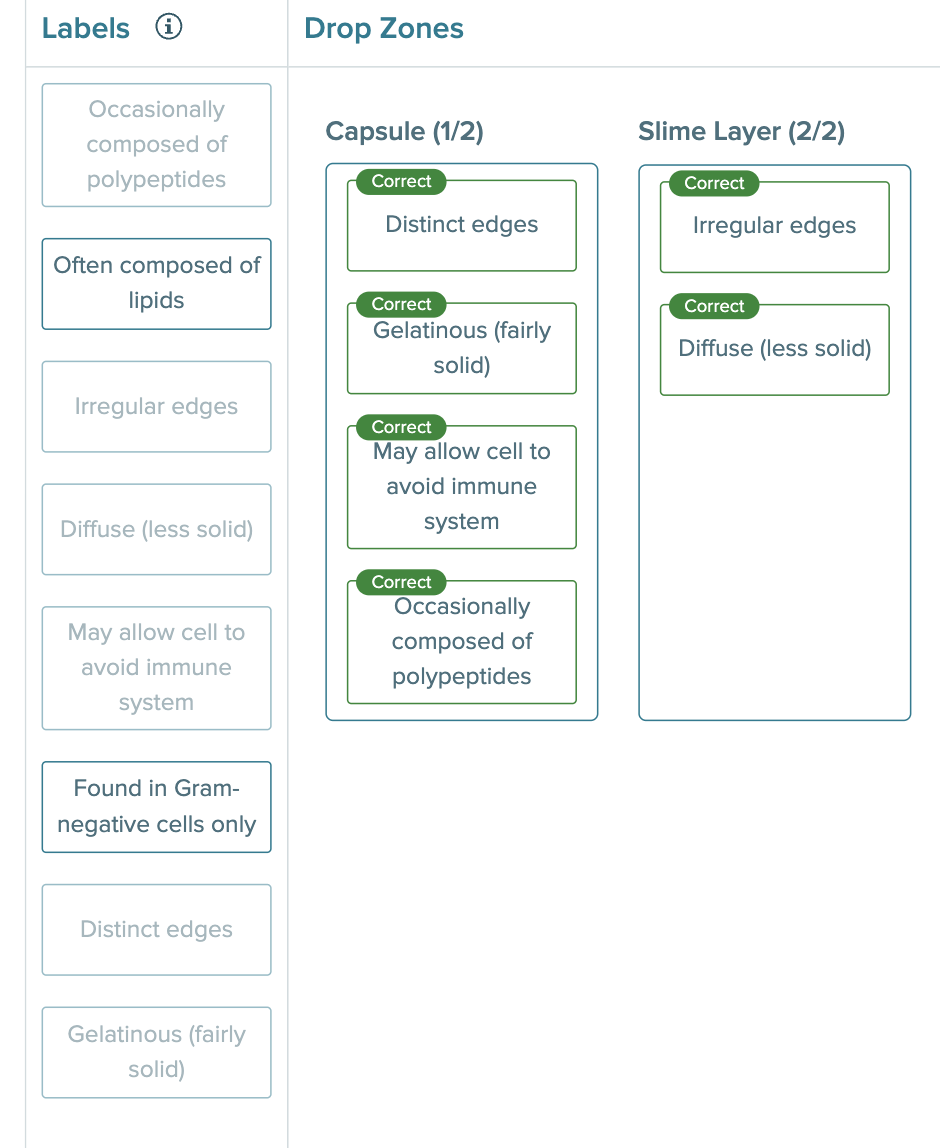
Match the descriptions given below to either the capsule or slime layer. Only six labels are used.
this one
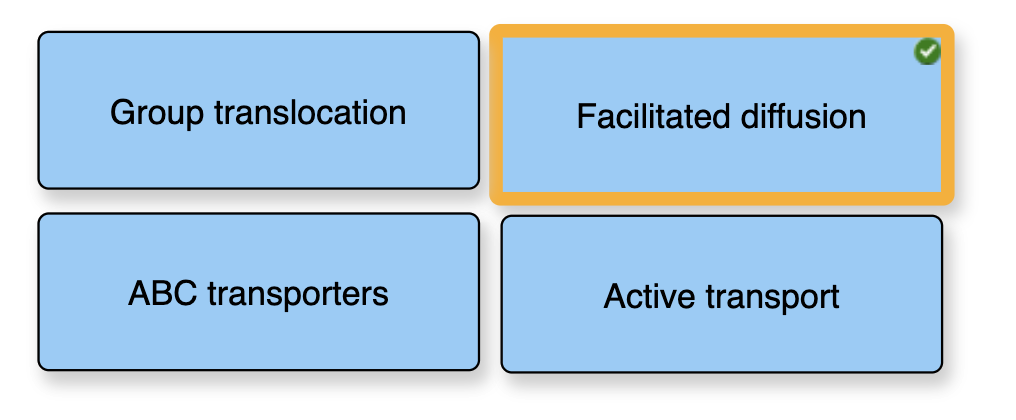
Which of the following ways in which molecules move across a membrane does not require energy?
this one
Small amounts of LPS alert the body to invasion by Gram-negative bacteria, while large amounts of LPS may cause shock and death.
True
Identify the differential staining method that is most important in the diagnosis of tuberculosis, caused by Mycobacterium tuberculosis.
Acid-fast stain
Which of the following can affect the resolution of a bright-field microscope?
wavelength of light
type of specimen
quality of lenses
type of specimen and magnification
Microbes from the domain Archaea have cell walls containing peptidoglycan.
True
Match the staining technique to the appropriate example.
this one

In a capsule stain,
this one
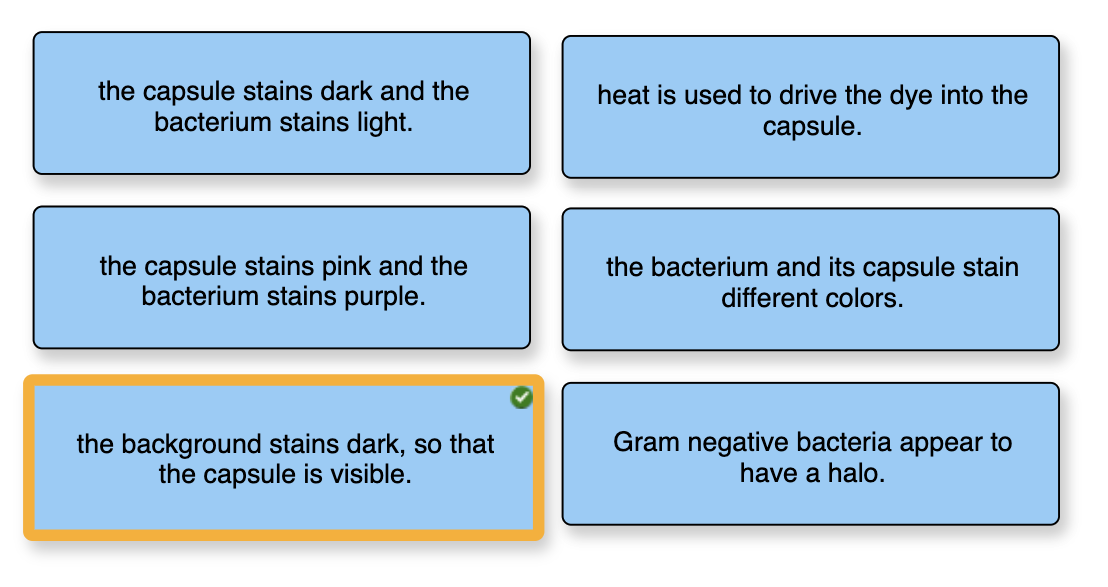
Which of the following about simple and differential staining is CORRECT?
Simple stains use a single color while a differential stain uses more than one color to highlight differences between certain groups of cells.
Which of the following bacterial structures is most directly linked to chemotaxis?
Flagella
Match the types of cytoskeletal elements with their correct function.
Mostly responsible for mechanical support and helps the cell resist physical stress.
Intermediate filament
Match the types of cytoskeletal elements with their correct function.
Typically functions to allow the cell cytoplasm to move.
Actin filament
Match the types of cytoskeletal elements with their correct function.
Involved in the movement of chromosomes during cell division
Microtubule