Week 2 - Casting Fundamentals 1
 Call Kai
 Learn
Learn Practice Test
 Spaced Repetition
 Match
Match Flashcards
 Knowt Play
1/7

Earn XP
Description and Tags
Mech4304 God Help Me
Name | Mastery | Learn | Test | Matching | Spaced | Call with Kai |
|---|
No analytics yet
Send a link to your students to track their progress
8 Terms
Types of nucleation
Homogenous - rare, needs 20% undercooling with no external help
Heterogeneous - Dominant in real life, external surface helps solidifcation
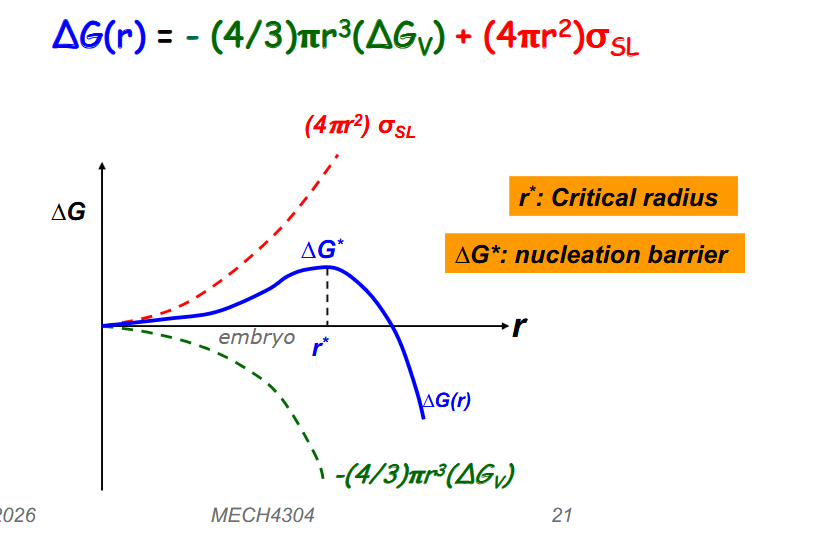
Free energy equation
Seen below, essentially, must get over maximum radius r* to nucleate, otherwise breaks back down. Surface energy grows with r but the volume energy lowers it.
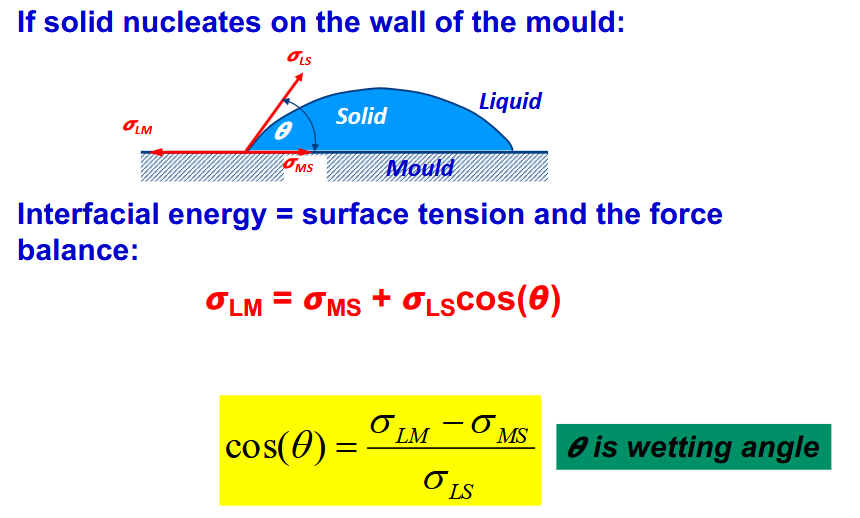
Wetting
Essentially just nucleus sticking to the wall. Doesn’t change r* but G* does.
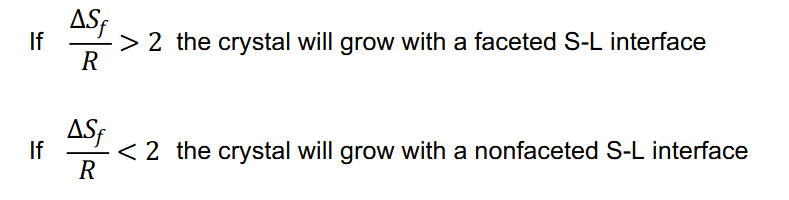
Faceted vs Non-Faceted Growth
Depending on the value, faceted or non-faceted growth occurs.
Faceted → Flat interface, much more crystaline (occurs in metals)
Non-faceted → Continuous curvy interface, present in silicons.
Constitutional Under cooling
In compositions, where it cools lower then it theoretically should. Occurs as solute is rejected into liquid, raising its composition and lowering the melting point, forming latices and interesting shapes.
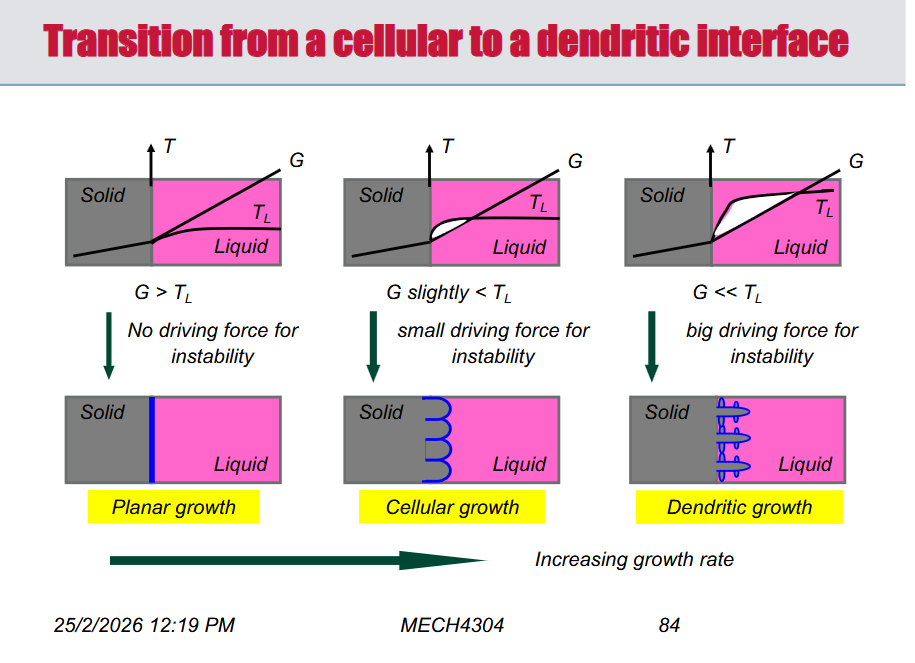
Growth rate During Solidification effects on crystal structure
Planar → Forms when temperature gradient (G) is steeper then liquid temperature gradient
Cellular → When G is slightly less then temperature gradient, forms cells
Dendritic → When G is much less → Get tree branches
Mushy zone
Liquid and solid coexist, between liquid temp (TL) and Solid temp (TS), alloys have a wide range causing more of these range. Problems is, sometimes dendrites link, with not enough liquid in between, causing hot tearing, shrinkage porosity etc.
Undercooling
Things to know:
DeltaT = Tm - Tactual
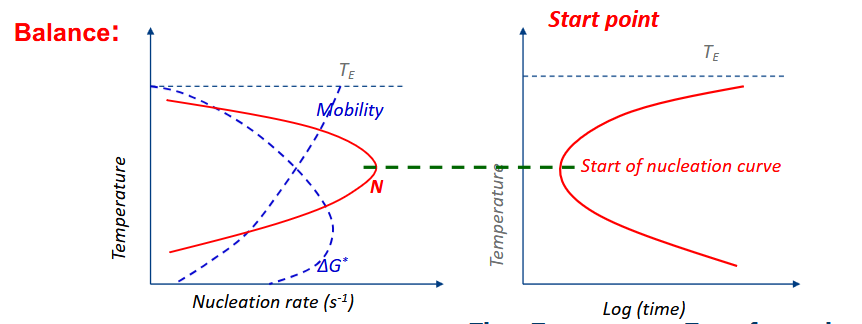
Increasing deltaT → Smaller r*, smaller G*, faster nucleation.
Increasing deltaT → Lower atomic mobility → slower nucleation
Therefore, balance gives TTT curve attached, where fastest is mix of both.