FINALS
 Call Kai
 Learn
Learn Practice Test
 Spaced Repetition
 Match
Match Flashcards
 Knowt Play
1/151

There's no tags or description
Looks like no tags are added yet.
Name | Mastery | Learn | Test | Matching | Spaced | Call with Kai |
|---|
No analytics yet
Send a link to your students to track their progress
152 Terms
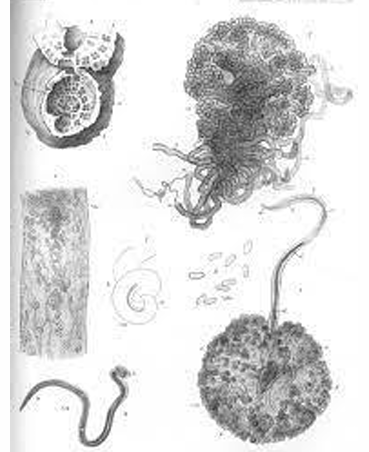
posterior part assumes a globular shape
Simondsia sp.
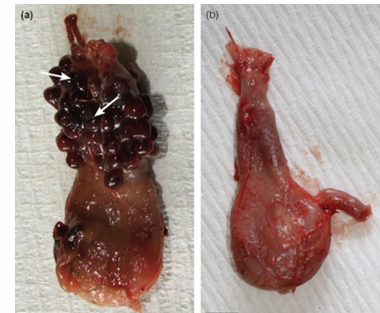
after copulation, female swells and become almost spherical
Tetrameres sp.
2 types/ forms of larvae
Rhabditiform: free-living worm
Filariform: parasitic worm
Note: Rhabditiform will eventually transform to filariform
Nematodes in general are elongated, cylindrical, and tapering exept 2
Tetrameres spp.
adults are normally elongated and cylindrical, but after copulation, gravid females become spherical and attach to the lumen of the GIT ⤷ typically either in the proventriculus or the crop!
Simondia spp.
posterior ends of gravid females become globular after copulation
There is one (1) exception to these worms being dioecious (Nematode)
Caenorhabditis elegans is considered to be androdioecious; consisting of hermaphrodites and rare males!
is considered to be androdioecious; consisting of hermaphrodites and rare males!
Caenorhabditis elegans
Nematode Body Layers and Composition
Ectoderm: body covering
Mesoderm: muscle layer
Ectoderm: digestive tract
Pseduocoelom: space between the endoderm and muscle layer
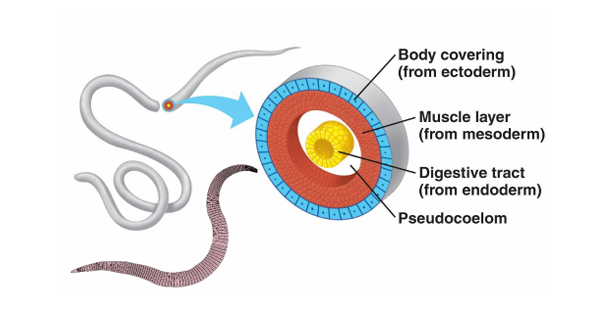
the space between the endoderm and the next layer is known as the
e pseudocoelom, which contains the perienteric fluid
Perienteric fluid is produced by the cells which line the esophagus, known as
Pseudocoelomites or Stellate Cells
Perienteric Fluid
this fluid is produced by the cells which line the esophagus, known as pseudocoelomites or stellate cells
it is composed of substances such as ions
it functions to maintain the worm’s internal pressure, which is ½ atmospheres higher compared to the external environment
lines the digestive tract, consisting of the oral cavity, the esophagus, and the intestines
Endoderm
muscular layer consisting of only a longitudinal muscle layer
no circular muscle layer is present!
Mesoderm
body covering, or the cuticle
together with the muscular layers, the cuticle prevents the explosion of the worm due to the high internal pressure
Ectoderm
The whole body of a nematode is referred to as the
Hydrostatic Skeleton
Nematodes excrete their waste in the form of
NH3 (Ammonia)
Nematodes excrete their waste in the form of NH3 (Ammonia) through
Paired Nephridia
Marine Nematodes excrete their waste through
Rennete Cells
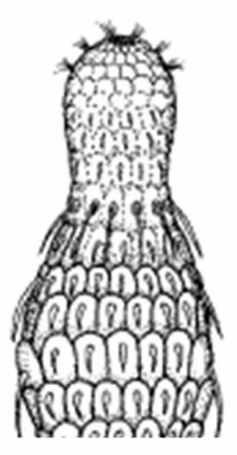
Plaques and Cordons
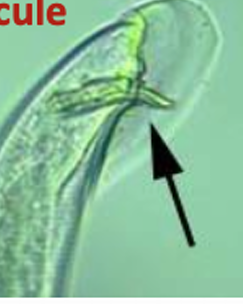
Spicule
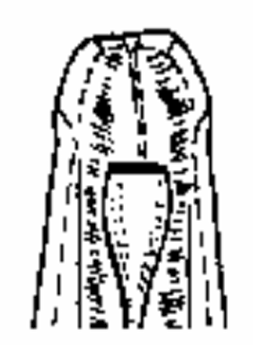
Amphid
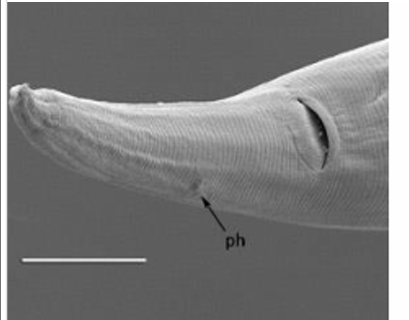
phasmid
Cuticular Modification
Phasmid
Amphids or Deirids
Leaf crown or Lips
Cervical or Caudal Papillae
Cervical or Caudal Alae
Plaques and Cordins
Spicules
Gubernaculum
Telamon
depression at the posterior extremity
has sensory function (chemoreceptive)
the presence or absence of this organ depends on the species of nematode
Phasmid
counterpart of phasmids
found at the anterior extremity
on either side of the head
Amphid or Deirids
row of papillae around the rim of the buccal capsule
★ These are predominant in horse roundworms!
Leaf crown or lips
These are predominant in horse roundworms!
Leaf crown or lips
spine-like or finger-like processes which are sensory or supportive in function
Cervical or Caudal papillae
flattened, wing-like expansions of the cuticle in the esophagus and tail regions
Cervical or Caudal Alae
plate-like and chord-like ornamentations present in the cuticle of many nematodes
Plaques and Chords
structure utilized by male nematodes that functions for attachment during copulation and expands the vagina
⤷ done by parting the vulva of their mating partners!
the number of spicules varies based on the species
⤷ e.g. Trichuris spp. have 1 spicule, while Trichinella spp. have 2 spicules!
★ Doc Vitz’s MNEMONIC:
TrichurIs has 1 ‘i’ at the end, hence only one spicule, while TrichineLLa has 2 ‘l’s at the end, hence having two spicules!
Spicules
cuticular thickening in the dorsal wall of the cloaca of males which guides the spicules for copulation
Gubernaculum
cuticular thickening in the ventral wall of the cloaca of males which guides the spicules for copulation
Telamon
How do nematode move?
mainly through the less than ½ atmosphere pressure difference compared to the external environment
The musculature of nematodes is divided into 2 major planes:
Dorsal Field: Dorsal Epidermal Chord
Ventral Field: Ventral Epidermal Chord
the demarcation line between these two layers is the lateral epidermal chord
Nematodes have 4 types of nerves:
Dorsal Nerve: motor function
Ventral Nerve: sensory function
Lateral Nerve (2): both for sensory and motor fnx
somatic division is voluntary
autonomic division is involuntary; further divided into sympathetic + parasympathetic sections
motor function
Dorsal Nerve
innervates cuticular modifications such as the phasmids, amphids, and cervical and caudal papillae
Sensory fnx
Ventral Nerve
This part of nematode is equivalent to the “BRAIN”
Circum-oesophageal commisures
Nematodes detect objects in their path through the
Amphid
Cervical papillae
these structures will then send signals for the ventral nerve, which then propagates the signals to the “brain” to move its body via the command of the dorsal and lateral nerves
Amphid &
Cervical papillae
There are 2 main types of purgatives/dewormers, namely:
Vermifugal- which result in intact worms being passed out in the feces
Vermicidal-which result in damaged or macerated worms being passed out in the feces
TYPE OF ESOPHAGUS
Bulb shapes
Double-bulb shape
Rhabditiform
Filariform
Muscular gland
Trichuroid
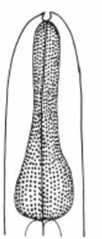
has a large posterior swelling, like in ascarids
present in the ff. families:
○ Family Ascarididae
○ Family Hetarakidae
Bulb shape
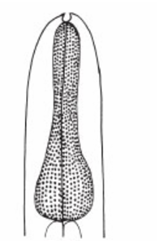
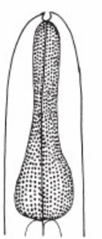
What families under Esophagus Bulb-shaped
Family Ascarididae
Family Hetarakidae
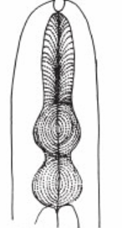
has double large posterior swellings, like in oxyurids
present in the ff. families:
○ Family Oxyuridae ONLY
pinworms
Double-bulb shape
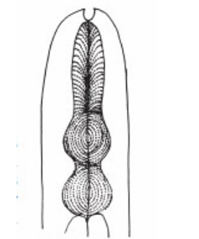
What families under Esophagus Double- Bulb shaped
Family Oxyuridae
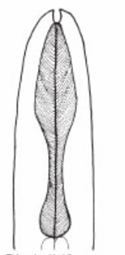
as a slight anterior and posterior swelling
present in pre-parasitic larvae of many nematodes, and in any adult free-living nematodes
present in the ff. families:
ORDER: RHABDITIDA
○ Family Strongyloididae ONLY
Rhabditiform
What families under Esophagus Rhabditiform
Family Strongyloididae
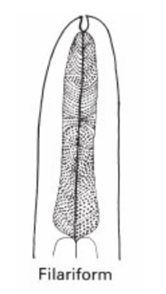
Simple and slightly thickened posteriorly,
as in bursate nematodes
present in families under the
Order Strongylida
Superfamily Strongyloidea
Family Strongyloididae
Family Stronglidae
Family Stephanuridae
Family Syngamidae
Family Ancylostematidae
Family Trichostrongylidae
Family Trichonematidae
Filariform
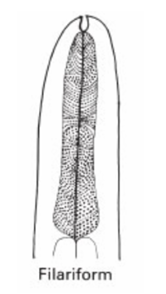
What families under Esophagus Filariform
Strongyloididae
Strongylidae
Stephanuridae
Syngamidae
Ancyslostomatidae
Trichostrongylidae
Trichonematidae
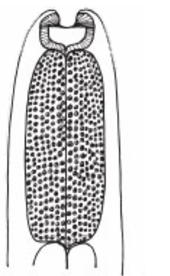
muscular anteriorly,
glandular posteriorly,
like in filariids and spirurids
present in families under
Order Spirurida
Superfamily Spiruroidea
- Family Acuriidae
Family Acuriidae
Family Dracunculidae
Family Filariidae
Family Gnathostomatidae
Family Onchoceradae
Family Physalopteriidae
Family Steriidae
Family Spiruridae
Family Thelaziidae
Family Tetrameridae
Muscular-glandular
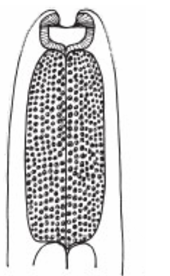
Family under Esophagus Muscular Glandular
Family Acuriidae
Family Dracunculidae
Family Filariidae
Family Gnathostomatidae
Family Onchoceradae
Family Physalopteriidae
Family Steriidae
Family Spiruridae
Family Thelaziidae
Family Tetrameridae
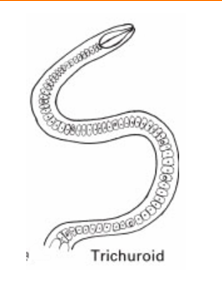
capillary form
lined with stichosomes, which are stacked in columns and function for phagocytosis
present in families under
Order Enoplidae
Superfamily Trichuroidea, Dioctophymatoidea
Family Dioctophymidae
Family Capillaiidae
Family Trichiellidae
Family Trichuridae
Trichuroid
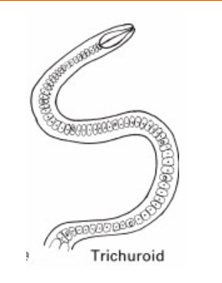
Family under Esophagus Trichuroid
Family Dioctophymidae
Family Capillaiidae
Family Trichiellidae
Family Trichuridae
Presence of phasmids
Phasmidia or Secernentea
Absence of phasmids
Aphasmidia or Adenophorea
found in the members of Order Strongylida (SSSSATT)
Bursate (only with copulatory bursa)
Found in every other nematode family
Non-bursate
only one group of nematodes lack phasmids, which belong to what family
Order Enoplida
Family Dioctophymidae
Family Capillaiidae
Family Trichiellidae
Family Trichuridae
females readily produce eggs which are passed out of the body
Oviparous
females produce eggs which are present within the body, and the larvae hatch WITHIN the body of the helminth before being released into the external environment
Ovoviviparous
females do NOT produce eggs, instead they produce larvae which are readily expelled from the body
Viviparous
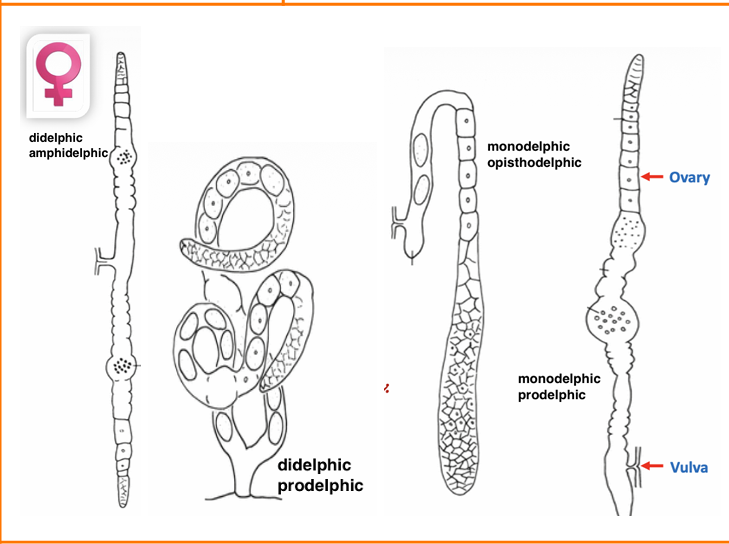
Number of Ovaries
Monodelphic- 1 ovary
Dipelphic- 2 ovary
Multidelphic- more than 2 ovaries
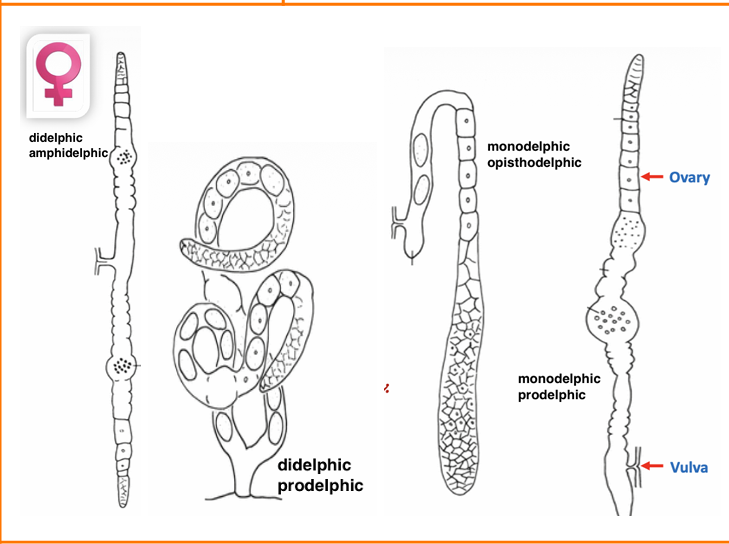
Location of Ovaries
Prodelphic- ovaries anterior to vulva
Ophistodelphic- ovaries posterior to vulva
Amphidelphic- located both anteriorly and posteriorly to the vulva
Male nematodes possess spicule/s, which are the male reproductive organs, as well as guiding apparatuses known as the
gubernaculum and telamon
Order Ascaridida Consists of three (3) superfamilies
Ascaridoidea → bulb-type esophagus
a. Family Ascarididae
i. Ascaris
ii. Toxocara
iii. Parascaris
iv. Toxascaris
v. Anisakis
Oxyuroidea → double-bulb-type esophagus
a. Family Oxyuridae
i. Oxyuris
3. Subuluroidea → bulb-type esophagus
a. Family Hetarakidae
i. Hetarakis
ii. Ascaridia
Migration routes of family Ascarididae
Species: Ascaris suum
Transplacental
Transmammary
Tracheal
Somatic
Species: Ascaris suum
Transplacental: X
Transmammary: X
Tracheal: CHECK
Somatic: X
Migration routes of family Ascarididae
Species: Parascaris equorum
Transplacental
Transmammary
Tracheal
Somatic
Species: Parascaris equorum
Transplacental: X
Transmammary: X
Tracheal: CHECK
Somatic: X
Migration routes of family Ascarididae
Species: Toxocara cati
Transplacental
Transmammary
Tracheal
Somatic
Species: Toxocara cati
Transplacental: X
Transmammary: CHECK
Tracheal: CHECK
Somatic: CHECK
Migration routes of family Ascarididae
Species: Toxocara canis
Transplacental
Transmammary
Tracheal
Somatic
Species: Toxocara canis
Transplacental: CHECK
Transmammary: CHECK
Tracheal: CHECK
Somatic: CHECK
Migration routes of family Ascarididae
Species: Toxascaris leonina
Transplacental
Transmammary
Tracheal
Somatic
Species: Toxascaris leonina
Transplacental: X
Transmammary: X
Tracheal: X
Somatic: X
Migration routes of family Ascarididae
Species: Toxocara vitulorum
Transplacental:
Transmammary:
Tracheal:
Somatic:
Species: Toxocara vitulorum
Transplacental: X
Transmammary: CHECK
Tracheal: X
Somatic: CHECK
Common Name of Parascaris equorum
Cn: Equine Roundworm
Scientific Name of Equine Roundworm
Parascaris equorum
Scientific Name of Canine Roundworm
Toxocara canis
Common Name of Toxocara canis
canine roundworm
Most common roundworm affecting both domestic and wild canids
Toxocara canis
The cervical alae of these species given the appearance of arrow-headed worms
Toxocara canis
Toxocara cati
Toxascaris leonina
When these helminths migrate to visceral organs, this phenomenon is known as
Viscera larva migrans
species of nematodes that are capable of performing viscera larva migrans, which include the ff.
Toxocara canis- dog
Toxocara cati- cat
Toxocara borina- cattle, buffalo, zebu
Capillaria hepatica- rats
Lagochilascaris minor- dog, cat, and other mammal
Common name of Toxocara cati
Feline Roundworm
Scientific name of Feline roundworm
Toxocara catis
Nematode which parasitizes both dogs and cats
Toxascaris leonina
Paratenic host of Toxascaris leonina
Rodents
Comon name of Neoascaris/ Toxocara vitulorum
Bovine roundworm
Scientific name of Bovine Roundworm
Neoascaris/ Toxocara vitulorum
Scientific name of Pig Roundworm/ Large Roundworm of pig
Ascaris suum
Roundworms parasitizing the small intestines, lungs, and liver of swine
Ascaris suum
Common name of Ascaris suum
Pig Roundworm
Large Roundworm of pig
Roundworms parasitizing cattle
Neoascaris/ Toxocara vitulorum
These Ascaris suum have a pathognomonic Lx produced by L3 larvae upon necropsy
milk spot of the liver
Ascaris suum have unique ova in that these eggs have:
(a) mammilated layer → golden brown due to the host’s bile
(b) lipid layer → coating made up of ascarosides
Common name of Ascaris Lumbricoides
Large Roundworm
Giant roundworm
Human intestinal roundworm
Scientific name of
Large Roundworm
Giant roundworm
Human intestinal roundworm
Ascaris lumbricoides
Largest roundworm parasitizing the small intestines, lungs, and liver of humans
Ascaris lumbricoides
Roundworms parasitizing raccoons
Ascaris procyonis
Roundworms that parasitize fish and marine mammals
Anisakis spp.
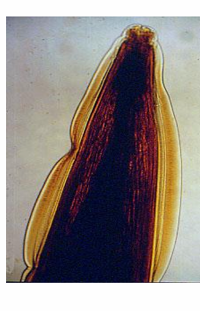
Toxocara canis
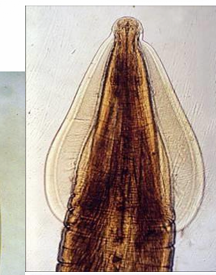
Toxocara cati
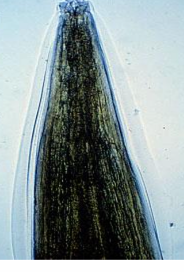
Toxascaris leonina