BIO 202 EXAM 4
 Call Kai
 Learn
Learn Practice Test
 Spaced Repetition
 Match
Match Flashcards
 Knowt Play
1/172

Earn XP
Description and Tags
Name | Mastery | Learn | Test | Matching | Spaced | Call with Kai |
|---|
No analytics yet
Send a link to your students to track their progress
173 Terms
mendels work
mendels work led to the concept of gene and the foundation in understanding of inhertianc
his work was ignored until 1900
sutton and boveri
they noticed chromosomes and genes are both present in pairs in diploid cells
homologous chromosomes separate during meiosis
fertilization restores the paired condition for both chromosomes and genes——-this led to the chromosomal theory of inheritance-
chromosomal theory of inheritance
The chromosomal theory of inheritance is that genes are located on the chromosomes, and behavior of chromosomes during meiosis and fertilization explains the interitance of traits
Thomas Hunt Morgan
First person to associate a specific gene with a specific chromosome
Morgan’s experimental model
like mendel, he was insighful in his choice of model, drosphilia melanogaster
drosphilia melanogaster
a fly that east fungus form rotten fruits hence the name fruit fly
Fruit fly
they are prolific breeders- make a 1000 of flies at once
cheap to grow
generation time span is about 2 weeks- whole life from birth to death in 2 weeks
mutations produced phenotypes that are visible by naked eyes
have only 4 pair of chromosomes
by 1910- does anyone knows the chromosomes functions?
no
what does nettie stevens discobered?
morgan and his graduate student- Nettie stevens discovered that not they have only 4 pairs of chromosomes but also that female flies have 2 identical x chromosomes
but males has very different X and Y chromosomes - which X is never present in female
morgan’s first mutant
he worked so hard by crossing over flies but didn’t find anything until 2 years
after 2 years he found a single white-eyed male as mutation in flies
Wild type W+
red eyes are wild type- very common in all will natural populations W+
Mutant phenotype W
White is the mutant phenotype- it is the mutation in wild type allele
What is the evidence that fly eye color is linked to gender ? 1-
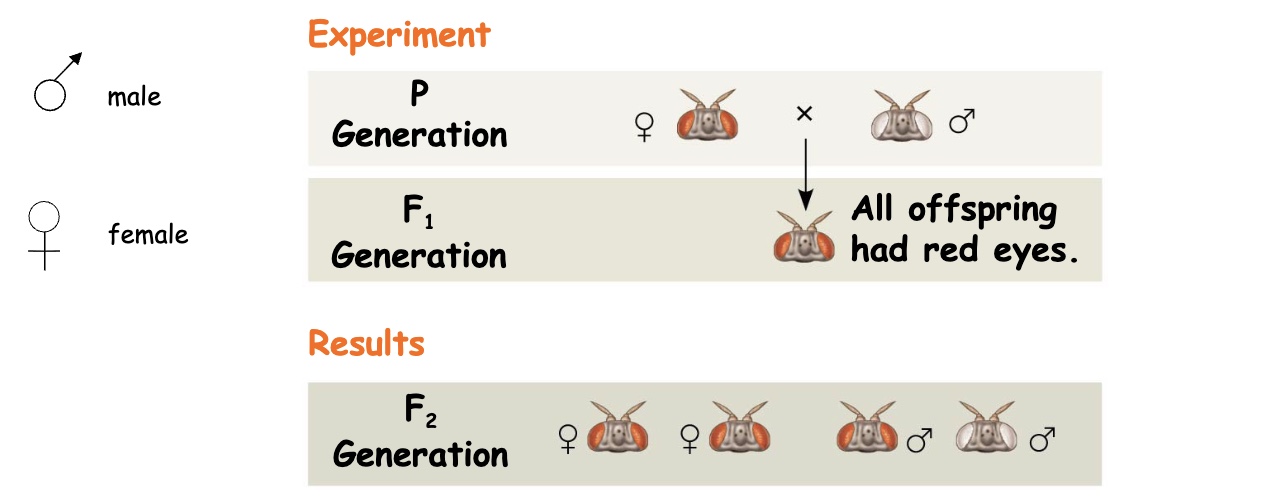
red eye female(homo) cross over with white eye male(hetero)
F1 gen- all offspring have red eye color because red eyes are dominant over white
Crosses between F1 generation. 2-
as expected it produced 3:1 phenotypic ration- red: white : red
Unexpectedly results
The white-eyed trait appeared only in males
All the females had red eyes.
But half the males has red and other half has white eyes (again and again)
Se* chromosomes segregate during meiosis meaning-
each sex chromosomes segregates into one gamete after meiosis
xx produces haploid gametes- eggs- all containing X chromosomes
XX- female
XY- male
X + Y- male
X+ X- female
to remember- male has hat- so arrow upwards
nomenclature for drosophilia genetic
Gene name comes from first mutant discovered
W+
Red
WT
dominant
W
White
mutant
recessive
Hemizygous
when Males X w+ Y have only a single x chromosome- and there is no copies of the red eye allele
explain why in the F2 generation the white-eyed trait appeared only in males?
Because Males are red eyed if they inherit red-eye allele which is w+ but white eye if they inherit a white eye allele which is w, since there is no any additonal wil-type allele present to mask the recessive allele.
location of genes
morgan discovered that genes have physical location on chromosomes
Hoe morgan discovered that genes has physical locations on chromosomes?
Panel a- homozygous red-eyed female will produce- with red eyes even the father has white eyes——mother has red- offspring will have red too
panel b- mother is homo for white eyes- all male offspring will have white eyes—even father has red eyes
THEREFORE, MALE MUST INHERIT THE X CHROMOSOME FROM HIS MOTHER AND Y FROM HIS FATHER
THEREFORE, MALE MUST INHERIT THE X CHROMOSOME FROM HIS MOTHER AND Y FROM HIS FATHER
this suggested correlation between sex-linked chromosomes and the segration of factors that determine the eye color
Morgans 3 findings
1.
Eye color is linked to the X chromosome
Morgan studied fruit flies and noticed that eye color depends on the X chromosome.
Females have two X chromosomes (XX) → they can have two copies of the eye color gene.
Males have one X and one Y (XY) → they only get one copy of that gene (on the X).
The Y chromosome doesn’t carry the eye color gene, so it doesn’t affect this trait.
Red eyes are dominant, meaning if a red version is present, the fly will have red eyes.
Simple idea: The gene for eye color is on the X chromosome, and males are more affected because they only have one X.
genes reside on chromosomes - chromosomal theory of inheritance
Before Morgan, people didn’t know exactly where genes were.
He showed that genes are physically found on chromosomes (the structures inside cells that carry DNA).
Simple idea: Genes aren’t floating around—they live on chromosomes
each gene resides on a particular chromosomes
Morgan discovered that each gene sits in a specific spot (called a locus) on a chromosome.
Simple idea: Think of a chromosome like a street, and each gene has its own exact address.
what else these findings says?
that genes located on the X chromosome exhibit unique patterns of inheritance becasue of gender and because they were linked together
what chromosomes does not carrie hundreds or thousand of chromosomes ?
chromosome Y
Linked genes
genes located on the same chromosome - they tend to inherit together because the chromosome is passed along as unit
they do not separate independently during meiosis
do linked genes assort independently?
Linked genes don’t assort independently because they’re physically attached on the same chromosome, so they usually get inherited together.
linked genes- (located closer on same chromosome)
all offspring are predicted to have parental phenotype when genese are linked in the same chromosome
We have: AaBb × aabb
And the important detail:
A and B are linked (on the same chromosome, very close together)So instead of thinking of A and B separately, think of them as traveling together as a pair:
One chromosome carries AB
The other carries ab
So the AaBb parent is really:
AB / ab
What gametes are made? If genes were NOT linked (independent assortment):
You’d get 4 types:
AB, Ab, aB, ab (all equally likely)
But since they ARE linked:
Because A and B are very close:
They stay together
No mixing (or extremely rare)
👉 So only two gametes form:
AB
ab
Final outcome
Only 2 types of offspring:
AaBb (looks like one parent)
aabb (looks like the other parent)
Ratio:
1 : 1
Why no new combinations?
Because:
A and B are physically stuck together
They don’t separate during meiosis
So you don’t see recombinant types (like Ab or aB)
takeaway
Linked genes = travel together
No independent assortment
Offspring mostly look like the parents
In this cross → only parental phenotypes (1:1 ratio)
Unlinked genes
When genes are unlinked (on different chromosomes), they follow Mendel’s law of independent assortment, meaning they separate independently during meiosis.
In the cross AaBb × aabb:
The AaBb parent makes 4 types of gametes: AB, Ab, aB, ab (all equally likely)
The aabb parent makes only ab
This produces 4 offspring types in a 1:1:1:1 ratio:
AaBb (parental)
aabb (parental)
Aabb (non-parental)
aaBb (non-parental)
Result:——
50% parental phenotypes
50% non-parental phenotypes
takeaway: Unlinked genes mix freely, so you get equal parental and new combinations.
what other experiemnt morgan did afterwards?
to test how linkage affects inheritance, morgan did other test including test crosses with fruit floes to see the inheritance of 2 characters
morgan crossed flies in traits of body color and wing size
what was expected ?
If the genes were unlinked (different chromosomes) → ratio should be 1:1:1:1
If the genes were completely linked (same chromosome, no crossing over) → ratio should be 1:1:0:0 (only parental types)
observed?
The two large groups (965, 944) = parental phenotypes
The two smaller groups (206, 185) = recombinant (non-parental) phenotypes
what does these all means?
What does this mean?
👉 The genes are linked (on the same chromosome) because parental types are more common
👉 BUT they are not completely linked because some recombinants still appear
why do recombinants show up?
Why do recombinants show up?
Because of crossing over during meiosis, which occasionally swaps parts of chromosomes and creates new combinations
takeaway
vast majority looked like one parent and other just some percent on another parent.
Final takeaway
Genes are on the same chromosome (linked)
They are close, but not extremely close
Crossing over causes some recombination, so you don’t get a perfect 1:1:0:0 ratio
In one line:
Mostly parental types + some recombinants = linked genes with crossing over.
whats goign on? crossovers and recombination. what problem he noticed?
Most offspring looked like the parents (because genes were linked)
But a small number looked different
So something must be mixing the genes occasionally
morgans idea?
Thomas Hunt Morgan proposed that:
Chromosomes can swap pieces with each other
what happens in crossing over?
During prophase I of meiosis:
Homologous chromosomes pair up (one from mom, one from dad)
Non-sister chromatids cross and exchange matching DNA segments
This is called crossing over
why this matters?
When segments are swapped:
Linked genes can get separated
New combinations of alleles are formed
This creates recombinant gametes (new trait combinations)
simple understanding
Simple analogy
Think of two matching zippers:
They line up perfectly
Then swap a section
Now each zipper has a mix from the other
takeaway
Crossing over explains why:
Linked genes are usually inherited together
But sometimes get separated, producing new combinations
One-line summary:
Crossing over swaps DNA between chromosomes, creating recombinant offspring even when genes are linked.
How do we know when genes are linked?
can be based on phenotypic ratio of offspring in test cross
complete linkage
all offspring are identical in phenotype to one or the other parent for those genes
unlinked genes
an equal number of parental vs non parent phenotype among offspring 50& recombination frquency - the physical basis for this number is the random orientation of homologous chromosomes at metaphase 1 of meiosis
Frequency of recombinant
reflects - the distance between genes on a chromosome. the greater the distance between two genes, the more likely crossing over can occur between then and vice versa
chromosomal basis of gender varies with organis,- hermaphrodites
have both male and female reproductive organs
produce both sperm and eggs
ex- worms, snails, some fish
Most animals including humans have 2 sexes
either male or female
each produce only one type of gamete
male- sperm
female- egg
chromosomal basis of sex varies
humans
xx- female
xy- male
birds- some reptiles
zz- male
zw- female
insects- sex depends on the number of chromosomes
Y chromosome
Y is the sex-determining chromosome
it carrie the key gene (SRY) triggers male development
environmental sex determination
seen in reptiles like crocodiles and some turtles
temperature during development decide sex
ex- warmer vs cooler nests- diff sexes
what happens in humans?
In female xx and males xy- special cells in the ovaries and testes go through meiosis to make gametes (eggs or sperm)
meiosis cuts the chromosome number in half—- halpoid gametes (one copy of each chromosome)
Mother- she has 2 x chromosome- during meiosis- eggs get one x—-so all eggs x
father- he has x and y
during meiosis- half sperm gets x and other half y
so sperm 50 % x and 50 % Y
what determines the baby’s sex?
xx- female
xy- male
since sperm are 50/50- theres about a 50 % chance of each sex
Aristotle 320 BC
he believed sex was based on temperature, but modern biology shows its determined by chromosome x and y
SRY
SRY is the gene found only on Y chromosome
Acts like a master switch for a male development
How sry gene determines the sex?
if sry is present
It turns on other genes
embroys gonads develop into testes
leads to male development
if its absent
no signal to become male
gonads develop into ovaries
so female development is the default pathway
What does SRY gene actually do?
it makes transcription factor- a protein that turns other gens on/off
these genes controls - testes formation, male characteristics, sperm production
Mouse vs sry gene
scientist added the sry gene to an xx female mouse embryo
the mouse developed as a male
this proves SRY alone can trigger male development, even without Y chromosome
X vs Y chromosomes
the x and y chromosomes are very different
Y chromosome
smaller
has very few genes (gene-poor)
genes are mostly related to male traits
not essential for survival
X chromosome
larger
has many genes 1000+
many are essential for life
sex linked genes
genes are located on the x or y chromosomes are called sex-linked genes
what happened during meiosis?
even though x and y are very diff, they still pair up during meiosis, and act like homologous chromosomes
how ?
they match up only in small shared region called pseusoautosomal region
crossing over
Because x and y are mostly not similar in dna sequence- they rarely exchange dna - crossing over is uncommon - crossing over is when chromosmes swap pieces, creating new combinations of genes
Y chromosome inheritance
only males have a Y chromosomes
female do not
so a father passes his Y chromosomes only to his sons
daughter get his x, not y
why y doesn’t change much?
the x and y chromosomes are mostly not similar- not homologous
becasue of that, y does not undergo crossing over( except tiny regions)
so the y chromosome passed down almost unchanged father to son, only small changes happen due to muttaions
why y chromosme matters
The above properties make the y chromosome useful for
studying evolution
tracing family lineage
paternity testing
What about female having 2 x chromosmes ? wouldn’t females have double gene activity?
No, because of X-inactivation process
in female, one x chromosome in each cell is turned off
so only one x is active , just like in males
it prevents females from having double gene dosage .
X- activation - Barr body
females have 2 x chromosmes -xx
in each cell, one x is turned off
the inactive x becomes a condensed structure called barr body
prevent having double the gene activity compared to male xy
what happens in egg cells?
the inactive x is reactivated in the ovaries
so every egg ends up with one active x
why don’t females get more x- linked disorders ?
Because - which x is turned off is random in each cell- some cells use maternal X and some use paternal x
Mosaic effect
once a cell inactives the x, all its daughter cells keeps the same cell off, which creates a mosaic affects in females
50 % of cells use one off cell and 50 use other
so females are mix of 2 cell types
mosaic effect example - cats
in tortoiseshell/ calico cats
one carries orange fur
the other carriers black fur
diff patches of cells activate different x chromosomes
Result- patchy orange + black fur
Why are these cats almost always female ?
males xy only have one x- only one color
females have two xx- can show both colors because of x- inactivation
sex-linked genes - on the x chromosome
x chromosome carries many genes not related to sex
these are called x-linked genes
they follow special inheritance patterns because - female - xx, and males xy- only one x effects show up more easily
X-linked recessive traits
A- normal- dominal
a- mutant- recessive
Males (XY)- only one x - if they get a they are affected
females (XX_- need 2 copies of aa to be affected
Aa female- carriers- usually not affected
Inheritance patterns 1- affected father (XaY) with normal mother (XAXA)
all daughters - XAXA - carriers
All sons - XAY- normal
Father passes X to daughters
Y to sons
carrier female (XAXa) with normal male (XAY)
daughters 50 percent carrier- XAXa
50 percent normal- XAXA
sons
* 50 percent affected (XaY)
50 normal (XAY)
3. Carrier female (XAXa) × affected male (XaY)
50% of all children affected
Daughters:
Some carriers, some affected
Sons:
Some affected, some normal
why females are less affected ?
to get female more-
mother must be carrier
father must be affected
so males are more often affected by x-linked recessive traits
females are often carriers
father pass x - linked traits to daughters , not sons
X- linked disorders
there are many genes app 1000 on the x chromosome
muttaions on x chromosome genes
can cause-
red/green color blindness
hemophilia
duchenne muscular dystrophy
male pattern baldness is also x- influences
THESE ARE USUALLY RECESSIVE / X- LINKED
why disorders more in males ?
Males = XY (only one X → “hemizygous”)
If they get one mutant allele → they show the disorder
Females = XX
Need two mutant copies to be affected
If only one → carrier
So:
Males are affected much more often
Why sex chromosome abnormalities are tolerated ?
Compared to other chromosomes, abnormalities (aneuploidy) are less severe because:
Y chromosome has few essential genes
Extra X chromosomes get inactivated (Barr bodies)
Only one X stays active, no matter how many X’s there are
inheritance idea
Carrier female → passes mutation to:
50% of sons (affected)
50% of daughters (carriers)
Males only need one copy → higher chance of disease
Females need two copies → much rarer
Central dogma
DNA- RNA- Proteim
dna holds the instructiond
RNA is copy of those instructions
proteins are what actually do the work in cell
Genotype vs Phenotype
genotype- DNa sequence
phenotype- your traits - what you see, appearance
Traits depends on proteins made form DNA
Gene expression
transcription- DNA- RNA - rna synthesis
translation- RNA - PROTEIN- protein synthesis
Triplet codons
DNA/ RNA is read 3 letters at a time
each group of 4= 3 codons
Each codon =. one amino acid
codons do not overalp
each codon has one meaning
How experiments helps scientists ?
these scientist figured out how genes makes protein
1- Archibald garrod -
In born errors of metabolism
studies genetic diseases
found that some people lack certain enzymes
caused by mutations in genes
Genes control metabolism- chemical reactions in the body
george Beadle and Edward Tatum
One gene- one enzyme
showed each gene makes one enzyme
later update to- one gene- one polypeptide
dna and rna - nucleic acid - and protein is polypeptide
Francis crick and sydney brenner
Properties of the genetic code
he discovered
code is read in triplets- 3 bases
it is non-overlapping
reading frame is critical
Nirenberg and matthaei; khorana
cracked the genetic code
figure out which codon= which amino acid
example- UUU- phenylalanine
What is gene ?
A gene is piece of DNA that gives instructions to make a protein .
How does genes control phenotype?
genes - makes proteins especially enzymes
proteins control chemical reactions in the body- metabolism
These reactions determines your traits - phenotype
gene- protein- traits
Idea from garrod related to gene
he studies genetic disease and said
genes control enzyme production
enzyme control chemical reactions