Comprehensive Virus and Bacteria Structure, Classification, and Replication
 Call Kai
 Learn
Learn Practice Test
 Spaced Repetition
 Match
Match Flashcards
 Knowt Play
1/57

There's no tags or description
Looks like no tags are added yet.
Name | Mastery | Learn | Test | Matching | Spaced | Call with Kai |
|---|
No analytics yet
Send a link to your students to track their progress
58 Terms
What are viruses?
Microscopic particles that infect cells, consisting of DNA or RNA, and cannot reproduce on their own.
What type of organisms can viruses infect?
Both eukaryotes and prokaryotes.
What is a bacteriophage?
A type of virus that infects and usually kills bacteria.
How are viruses classified?
Based on morphology, nucleic acid type, host organism, and the disease they cause.
What does morphology refer to in viruses?
The size, shape, and structural composition of viruses, which can be helical, icosahedral, enveloped, naked or complex.
How much smaller are viruses compared to bacteria?
Viruses can be up to 1000 times smaller than bacteria.
What is a capsid?
A protein structure that encases the genetic material of a virus.
What are icosahedral viruses?
Viruses with a 3-dimensional geometric figure, such as herpes and adenoviridae.
What are helical viruses?
Viruses with rod-shaped capsomeres that can be either naked or enveloped.
What characterizes enveloped viruses?
They have a viral envelope surrounding the nucleocapsid, obtained by budding through a host membrane.
What are naked viruses?
Basic helical and icosahedral viruses without an envelope.
What is a complex virus?
A virus with a complicated structure, such as poxviridae.
What are the main components of a bacteriophage?
A head or capsid containing nucleic acid and a tail that delivers genetic material into bacteria.
What are the five steps of bacteriophage multiplication?
1. Absorption 2. Penetration 3. Replication 4. Assembly 5. Release.
What happens during the absorption phase of bacteriophage multiplication?
The phage attaches to a susceptible bacterial host using tail fibers.
What occurs during the penetration phase?
The phage injects its nucleic acid into the bacterium while the phage remains outside.
What is the lytic phase in bacteriophage multiplication?
The phase where the bacterium lyses, releasing newly formed phages into the environment.
What is a temperate (lysogenic) phage?
A phage that integrates its DNA into the host chromosome, potentially leading to antibiotic resistance.
What are the steps of animal virus multiplication?
1. Adsorption 2. Penetration 3. Uncoating 4. Replication 5. Assembly 6. Release.
What is host range in the context of viruses?
The specific cells and species that a virus can infect, determined by the presence of specific receptors.
How do viruses penetrate host cells?
By fusion of the virus envelope with the cell membrane or other mechanisms.
What is the end result of endocytosis of the whole virus?
Only the nucleocapsid (capsid + genetic material) reaches the cell cytoplasm.
What happens during the uncoating step of viral infection?
The viral nucleic acid is released from the capsid, with variations depending on the virus's mode of entry.
How is the nucleocapsid released if the virus enters by fusion with the cell membrane?
The nucleocapsid is released directly into the cytoplasm.
What occurs if a virus enters a cell via receptor-mediated endocytosis?
The virus is enclosed in a vesicle, and enzymes dissolve the envelope and capsid to release the viral nucleic acid.
What is the first step in the replication of DNA viruses?
DNA enters the nucleus of the host cell and is transcribed into mRNA.
What role do early viral proteins play in DNA virus replication?
They aid in the replication of viral DNA.
What must RNA viruses provide for transcription?
Their own polymerase.
What is a key characteristic of retroviruses?
They follow a different route for replication compared to other RNA viruses.
Where does translation of viral mRNA occur?
In the host ribosome.
What are the two ways mature virus particles can be released from a host cell?
Budding (exocytosis) and lysis (explosion).
What happens during the assembly step of viral infection?
Mature virus particles are assembled from viral components including proteins and nucleic acid.
What is the significance of the viral proteins in relation to host cells?
The virus's proteins must match the receptors on the host cell's plasma membrane to facilitate entry.
What is an abortive viral infection?
An infection without viral production.
What characterizes a lytic or cytocidal viral infection?
It kills the host cell, either by exploding it or consuming it.
What is a persistent viral infection?
A long-term infection where the virus remains in the host for extended periods.
What is the difference between chronic and latent persistent infections?
Chronic infections are continuous and productive, while latent infections have limited or no viral synthesis and can reactivate.
How do chronic infections manifest in the host?
They infect the host in small amounts continuously.
What happens during a latent viral infection?
The virus remains dormant in the host and can reactivate under favorable conditions.
What are slow infections?
Infections with prolonged incubation that take years to manifest and are followed by disease.
What are transforming infections?
Infections where viral nucleic acid may remain indefinitely without producing virus, potentially causing oncogenic changes.
What are the morphological effects of host cell damage caused by viruses?
Altered shape, detachment from tissue surface, lysis, membrane fusion, and altered membrane.
What are the physiological effects of viral infections on host cells?
Addition of viral proteins into the plasma membrane can alter characteristics such as ion movement and cellular activities.
What is genotoxicity?
The ability of a chemical, physical, or biological agent to damage a cell's genetic material, leading to mutations, cancer, and heritable genetic defects.
What are the potential effects of genotoxic substances?
They can damage host cell DNA, cause mutations, and potentially initiate cancer.
What are prions?
Infectious protein particles that are not alive and can induce misfolding of normal proteins in animal tissue.
What diseases are caused by prions?
Transmissible spongiform encephalopathies, such as mad cow disease.
How do prions differ from viruses?
Prions lack nucleic acid and cannot be killed by standard sterilization methods.
What is the characteristic of prion diseases like CJD?
They are caused by misfolded proteins that induce other proteins to misfold, leading to brain function disruption.
What are the symptoms of CJD?
Rapid onset of dementia, neurological problems, and it can be transmitted through contaminated medical devices.
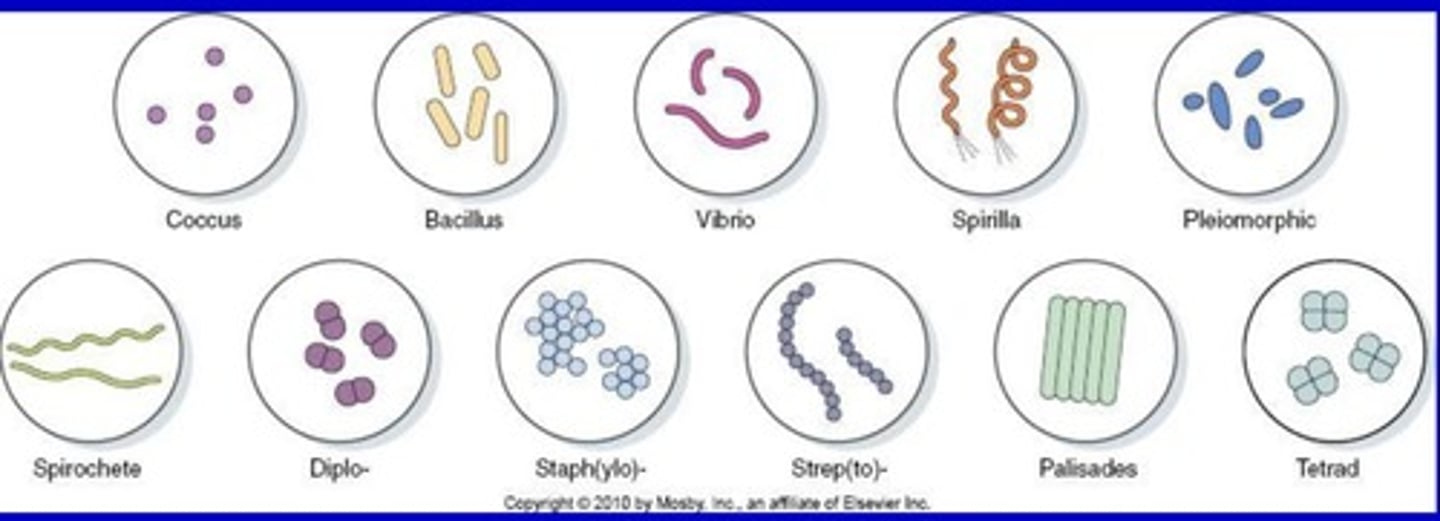
What are the shapes of bacteria?
Cocci (spherical), bacilli (rod-shaped), and spirals (curved or spiral-shaped).
What is the staining characteristic of Gram-positive bacteria?
They stain purple due to their thick cell wall.
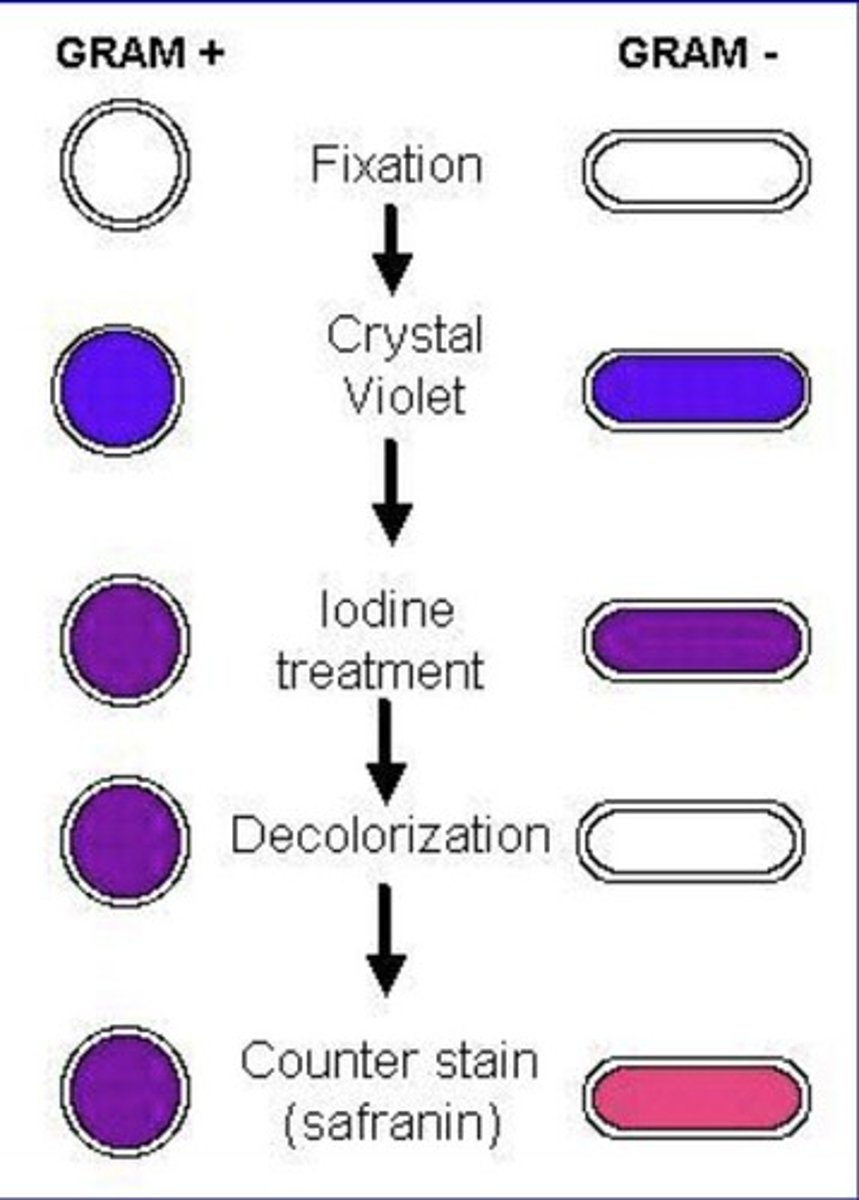
What is the staining characteristic of Gram-negative bacteria?
They stain red due to their thin cell wall.
What is binary fission in bacteria?
A method of bacterial reproduction where the mother cell duplicates DNA, divides chromosomes, and separates into two identical daughter cells.
What is the role of a decolorizing agent in bacterial staining?
It differentiates between Gram-positive and Gram-negative bacteria by removing the dye from Gram-negative bacteria.
What is the process of bacterial multiplication?
It involves DNA replication, chromosome division, cross-wall completion, and separation of daughter cells.
What is the significance of endospores in bacteria?
Endospores are protective structures that allow bacteria to survive harsh environmental conditions.
What is the difference between eukaryotic and prokaryotic cells?
Eukaryotic cells have a nucleus and membrane-bound organelles, while prokaryotic cells do not.