Bacterial respiratory pathogens (Marta Martins lecture 3)
 Call Kai
 Learn
Learn Practice Test
 Spaced Repetition
 Match
Match Flashcards
 Knowt Play
1/33

There's no tags or description
Looks like no tags are added yet.
Name | Mastery | Learn | Test | Matching | Spaced | Call with Kai |
|---|
No analytics yet
Send a link to your students to track their progress
34 Terms
the upper respiratory tract consists of which 3 body parts?
nose, nasal cavity and pharynx
the lower respiratory tract consists of which 4 body parts?
larynx, trachea, bronchi and lungs
what are upper respiratory tract infections caused by?
acute infections
6 common examples of URT infections
pharyngitis
laryngitis
rhinitis
sinusitis
tonsilitis
otitis media
during a LRT infection the … and … within the lungs become inflamed
trachea and bronchi
two types of LRT infections?
bronchitis and pneumonia
defenses against pathogens in the RT
… hair
… in the trachea
… secretions
… responses such as … and …
… cells such as …
… present in mucus
nasal hair
cilia
mucus
involuntary, coughing and sneezing
immune, macrophages
sIgA
Normal microbiota is generally limited to the … respiratory tract, where gram … bacteria such as … and … are very common. Disease causing bacteria are present in the normal microbiota and cause disease only if the host is … or if they are … to other hosts
upper, positive, staphylococci, streptococci, immunocompromised, transferred
two examples of bacteria present in the normal RT microbiota
staphylococcus aureus and streptococcus pneumoniae
Sinusitis is most commonly caused by … but can also be caused by … and … problems. It generally follows the … …
allergies, infections, structural problems, common cold
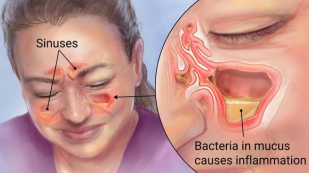
bacteria love fluids and … to keep an … balance, meaning they grow best in … filled areas and easily cause …
saline, osmotic, fluid, inflammation
Symptoms of sinusitis include … congestion, … above the nose or in the forehead and the feeling of a … or …
Aditionally facial … and … are common. Discharge appears … with a … or … colour in case of a bacterial infection, while discharge caused by allergies is … and accompanied by … eyes.
Sinusitis is diagnosed based on … … and is treated with … … …
nasal congestion, pressure, headache, toothache
swelling, tenderness, opaque, green, yellow, clear, itchy
clinical presentation, broad spectrum antibiotics
Acute otitis media is a common sequel of …
Viral infections of the URT lead to inflammation of the … tubes and buildup of … in the … ear, which can lead to bacterial … in the fluid. Bacteria can lead to … production and continued … secretion.
Chronic otitis media occurs when the fluid remains in the … ear for … periods of time and may be caused by … bacteria
Symptoms include sensation of … or … in the ear and … loss
rhinitis
eustachian, fluid, middle, multiplication, pus, fluid
middle, indefinite, biofilm
fullness, pain, hearing
Pharyngitis is inflammation of the …
It is characterised by … and …, … mucosa and swollen …
… pharyngitis is generally more severe than … pharyngitis
throat
pain, swelling, reddened mucosa and swollen tonsils
bacterial, viral
Diphtheria symptoms are initially experienced in the … RT
Symptoms include sore …, lack of … and a low grade …
… form on the … or …
upper
sore throat, lack of appetite and a low grade fever
pseudomembranes, tonsils or pharynx
the diptheria toxin is an … toxin, that consists of two main functional components; the … subunit which halts … synthesis and the … subunit which facilitates … into host cells
AB, active, protein, binding, entry
the A fragment of the diphtheria toxin contains the … domain and the B fragment contains the … and … … domains
catalytic, transmembrane and receptor binding
which diseases affect both the upper and lower RT?
whooping cough, respiratory syncytial virus and influenza
whooping cough is also known as … caused by the bacteria … …
pertussis, Bordetella pertussis
Whooping cough first has a … stage where bacteria cause … symptoms and it lasts about …
The next stage is the … stage characterised by severe and uncontrollable … … which can result in burst … … in the … and even …
Complete recovery can take … and other microbes can more easily cause … infection
catarrhal, cold, 1-2 weeks
paroxysmal, coughing spasms, blood vessels, eyes, vomiting
months, secondary
Bordetella pertussis also produces a … toxin
pertussis
Pneumonia is an … condition of the lungs in which … fills the …
It can be caused by a wide variety of different … with … pneumonia usually being milder than … pneumonia
There is a … acquired pneumonia (contracted outside hospitals) and a … pneumonia (contracted in a hospital setting) with … pneumonia usually being more severe
It begins with … RT symptoms including a … nose, …, … and …
Onset of the lung symptos follows which includes … pain, …, … and … sputum
inflammatory, fluid, alveoli
microbes, viral, bacterial
community, nosocomial, nosocomial
upper, runny nose, congestion, headaches and fever
chest pain, coughing, fever and discoloured
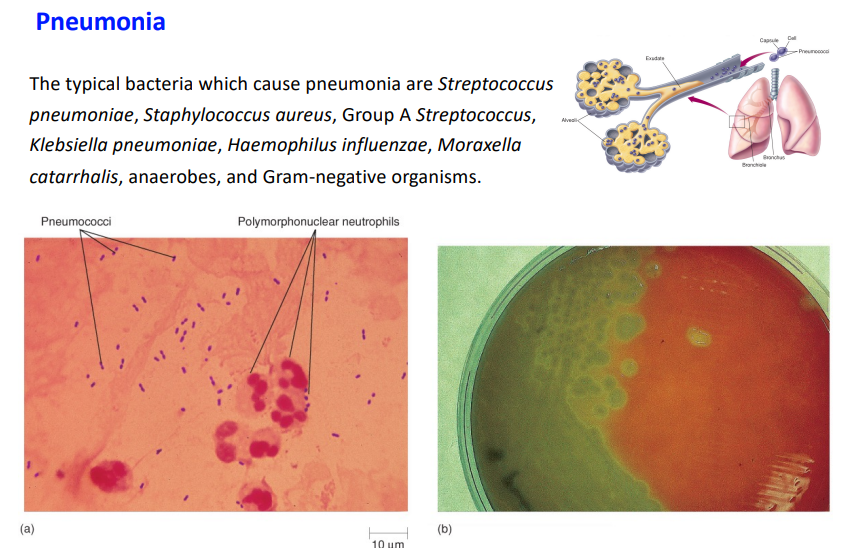
3 examples of bacteria which cause penumonia
streptococcus pneumoniae, staphylococcus aureus and klebsiella pneumoniae
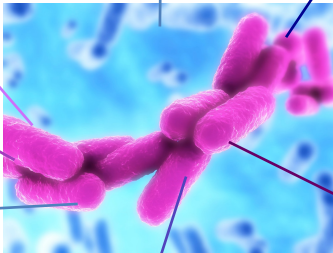
6 (or 7) klebsiella pneumoniae fax
gram negative
rod shaped
non motile
polysaccharide capsule
facultative anaerobe
lactose fermenting
nosocomial infections
Klebsiella pneumoniae is found in nature in …, … and …
It is also present in a healthy human microbiota in the …, the …, on the … and … tract but does not initially cause disease
It can spread rapidly but NOT through …
It can progress into sever bacterial infections including … (4 examples)
soil, water and plants
mouth, nasopharynx, skin and intestinal tract
air
pneumonia, bloodstream infections, UTIs and meningitis
members of the Klebsiella genus typically express which two types of antigens on the cell SURFACE?
lipopolysaccharide (O antigen) and capsular polysaccharide (K antigen)
About … K antigens and … O antigens have been described with … variability of these antigens being the basis for … into various …
… of all serotypes appears to be similar
77, 12, structural, classification, serotypes
virulence
revise slide 29!!!
ok

8 pseudomonas aeruginosa fax
gram negative
rod shaped
motile
encapsulated
nonspore forming
facultative anaerobe
can cause disease in plants and animals
found in soil and water
pseudomonas aeruginosa is an … pathogen associated with nosocomial … and … acquired pneumonia
opportunistic, hospital and ventilator
revise slide 35!!!
ok
In cystic fibrosis, impaired … … and a … … lung environment (also with low …) promotes colonisation by … …
The bacterium uses multiple … factors for … infection and then adapts through … change and … formation into a … and less … but persistent infection
mucociliary clearance, hypoxic inflammatory, pH, Pseudomonas aeruginosa
virulence, early, genetic, biofilm, chronic, motile
Pseudomonas aeruginosa causes the infected tissues to become green due to the … siderophore
pyoverdine
once Pseudomonas aeruginosa establishes a chronic infection is loses … and adapts through … changes due to …
cytotoxicity, genetic, hypermutability