(UNIT 8) CHAPTER 52, 51, 53, 54
 Call Kai
 Learn
Learn Practice Test
 Spaced Repetition
 Match
Match Flashcards
 Knowt Play
1/55

There's no tags or description
Looks like no tags are added yet.
Name | Mastery | Learn | Test | Matching | Spaced | Call with Kai |
|---|
No analytics yet
Send a link to your students to track their progress
56 Terms
Behavior
Behavior: Action carried out by muscles under control of the nervous system.
Many behaviors rely on specialized body structures or forms.
4 Questions to study animal behavior
What stimulus triggers the behavior and how do the various body systems bring it about?
How does the animal’s experience during growth and development influence the response to the stimulus?
These two questions are proximate causation: how a behavior occurs or is modified.
How does the behavior aid survival and reproduction?
What is the behavior’s evolutionary history?
These two questions are ultimate causation: why a behavior occurs in the context of natural selection.
Fixed Action Patterns
Fixed action pattern: Sequence of unlearned acts directly linked to a simple stimulus. Often unchangeable and once initiated carried to completion.
Ensures that activities essential to survival are performed correctly without practice.
Sign Stimulus: External cue that triggers this behavior.
Migration
Animals use environmental cues to guide migration: regular, long-distance change in location.
Track their positions relative to the sun (animals adjust for these changes of the sun by a circadian clock, an internal mechanism that has a 24-hour periodicity) or relative to the Earth’s magnetic field.
Circannual Rhythms
Circannual Rhythms: Behavioral rhythms linked to the yearly cycle of seasons. Influenced by periods of daylight and darkness in the environment.
Some can be linked to the lunar cycle (which affects tide movement).
Signal
Signal: Stimulus transmitted from one organism to another.
Communication: Transmission and reception of signals.
Four common modes of animal communication
Visual, chemical, tactile (touch), and auditory.
Pheromones: Chemicals emitted by members of one species that can affect other members of the species.
Stimulus-response chain
Stimulus-response chain: The response to each stimulus is itself a stimulus for the next behavior.
Innate VS Learning
Innate Behavior: Behavior that is developmentally fixed.
Learning: Modification of behavior as a result of specific experiences.
The capacity for learning depends on nervous system organization established during development following instructions encoded in the genome.
Habituation
Habituation: Loss of responsiveness to stimuli that convey little or no information.
Types of learning
The development and organization of an organism’s nervous system can restrict learning.
Imprinting: Establishment of long-lasting behavioral response to a particular individual or object.
Sensitive Period: Imprinting can only take place during this specific time period in development.
Spatial Learning: Establishment of a memory that reflects the environment’s spatial structure.
Cognitive Map: Internal representation of spatial relationship, among objects in an animal’s surroundings.
Associative Learning: The ability to associate one environmental feature with another.
Classical Conditioning: An arbitrary stimulus becomes associated with a particular outcome.
Trial-and-error learning (operant conditioning): Learns through trial and error in which a behavior becomes associated with a reward or punishment.
Cognition: Process of knowing that involves awareness, reasoning, recollection, and judgment.
Problem-solving: Cognitive activity of devising a method to proceed from one condition to another in face of real or apparent obstacles.
Social Learning: Learning by observing others and interpreting behaviors and their consequences.
Culture: A system of information transfer through social learning or teaching that influences the behavior of individuals in a population.
Direct Movements
Direct Movements
Kinesis: Simple change in activity or turning rate in response to a stimulus.
Taxis: Automatic movement, oriented movement +/- from stimulus.
Phototaxis (plants growing towards light), chemotaxis (a skunk strays a smell and you move away from it), geotaxis (location).
Foraging
Foraging: Eating and any activities an animal uses to search for, recognize, and capture food items.
Higher population densities may forage over longer distances than those in smaller population densities.
Foraging behavior is a compromise between benefits of nutrition and the costs of obtaining food (energy expenditure and risk of being eaten while foraging).
The way an organism forages must not increase its chances of being eaten.
Predation risk influences foraging behavior (higher predation risk is interlinked with more foraging behavior).
Mating systems
Mating systems: The length and number of relationships between males and females.
Promiscuous mating: No strong pair-bonds.
Monogamous: One male mating with one female.
Polygamous: An individual of one sex mating with several of the other.
Polygyny: A single male and many females.
Polyandry: A single female and multiple males.
Sexual dimorphism
Sexual dimorphism: Males and females differ in appearance.
Monogamous species; Males and females often look very similar.
Polygamous species: The sex that attracts multiple mating partners is typically showier and larger than the opposite sex.
Mating Systems and Parental Care
If the offspring (birds) requires continuous food supply that is difficult for a single parent to meet, a male stays and helps a single mate. However if the offspring can feed and care for themselves the male usually does not stay and seeks other mates. This maximes reproductive success.
In the case of mammals, the lactating female is often the only food source for the young, and males usually play no role in raising the young. However, some males protect females and young, a male or small group of males typically cares for a harem of many females.
Certainty of paternity: The degree of confidence a male has that a child is genetically his own, influencing his investment in the offspring.
This may cause a male other than the female’s usual mate to father offspring with that female if as the father
The certainty of paternity is relatively low in most species with internal fertilization because the acts of mating and birth (or mating and egg laying) are separated over time.
However, the males of many species with internal fertilization engage in behaviors that appear to increase their certainty of paternity. These behaviors include guarding females, removing any sperm from the female reproductive tract before copulation, and introducing large quantities of sperm that displace the sperm of other males.
External fertilization: Higher in certain paternity and therefore paternal care.
Sexual Selection
Sexual selection: A Form of natural selection in which differences in reproductive success among individuals are a consequence of differences in mating success.
Intrasexual Selection: Members of one sex choose debates on the basis of characteristics of the other sex.
Intrasexual selection: Involved opposition between members of one sex for mates.
Mate Choice by Females
Ornaments, bright coloration, and more in animals correlate in general with health and vitality thus females are more likely to pick them.
Mate choice can also be influenced by imprinting (how their parents look).
Mate-choice copying: Behavior in which individuals in a population copy the mate choice of others.
However mate-choice copying doesn’t occur if the change between the males are drastic (extremely bright fish vs dark fish).
The logic is that if a female mates with a male that is attractive to other females it increases the probability that her male offspring will also be attractive and therefore have high reproductive success.
This can reduce variation in males.
Male Competition for Mates
Agonistic behavior: Threats, rituals, and sometimes combat which determines which competitor gains access to a resource (food or mate).
May not directly reduce variation in males. May lead to the evolution of alternative male mating behavior and morphology.
Applying Game Theory
Game theory: Evaluates alternative strategies in situations where the outcome depends on the strategies of all the individuals involved.
The fitness of a particular behavioral phenotype is influenced by other behavioral phenotypes in the population. Phenotypes fluctuate frequently, once one phenotype becomes abundant the other follows.
How genes affect behavior
Genetic Basis of Behavior
Specific gene(s) can evoke certain behaviors in animals such as mating and how they take care of offspring.
Genetic Variation and the Evolution of Behavior
Differences in behavior can be found within a species but are often less obvious.
Case Study: Variation in Prey Selection
Snakes in coastal populations will eat banana slugs but inland populations won't. This is not caused by the environment but rather the genes. The genes were the ability to recognize and respond to odor molecules produced by banana slugs and inland snakes couldn't.
Case Study: Variation in Migratory Patterns
Birds started migrating westward when they didn’t before, due to natural selection and a change in their genetic code.
Altruism
Altruism: Behavior that reduces an animal’s individual fitness but increases the fitness of other individuals in the population.
Examples: Warning calls, worker bees (sacrificing themselves) protecting queen bees, protecting offspring in groups.
Inclusive Fitness
The reason behind altruism could be parents (close relatives) sacrificing themselves or their offspring which increases the parent’s genetic representation in the population. Altruism is maintained even if it doesn’t benefit the individual because it benefits the whole population and future generations.
Inclusive fitness: Total effect an individual has on proliferating its genes by producing its own offspring and by providing aid that enables other close relatives to produce offspring.
Hamilton’s Rule and Kin Selection
The three key variables in an act of altruism are the benefit to the recipient (average number of extra offspring the recipient of an altruistic act produces), the cost to the altruist (how many fewer offspring the altruist produces), and the coefficient of relatedness (equals the fraction of genes that,on average, are shared).
Hamilton’s rule: Natural selection favors altruism when the benefit to the recipient multiplied by the coefficient of relatedness exceeds the cost of the altruist.
Kin selection: Natural selection that favors altruism by enhancing the reproductive success of relatives.
Reciprocal Altruism
Reciprocal altruism: When non-relatives help each other, benefiting them both.
Occurs when individuals are likely to meet again and when there would be negative consequences associated with not returning favors to individuals to individuals who had been helpful in the past.
This is called cheating (benefit the person constantly receiving the aid).
Tit for tat: An individual treats another in the same way it was treated the last time they met. When their aid is not reciprocated the individual will stop.
Population
Population: Group of individuals of a single species living in the same general area.
Density and Dispersion
Density: Number of individuals per unit area or volume.
Dispersion: Pattern of spacing among individuals within the boundaries of the population at a specific time
How do scientists figure out density?
Mark-recapture method: Used to estimate the size of wildlife populations.
Scientists begin by capturing a random sample of individuals in a population. Then they tag (mark) each individual and then release them. (Sometimes they don’t need to be captured, scientists may photograph them instead.) After a few days or weeks, scientists capture or sample a second set of individuals.
Equation:
X = Marked individuals in second sample | n = total number of animals captured in second sample | s = number of individuals marked and released in the first sample| N = population size
Other methods used include counting, sampling, and indicators of population size such as nests and burrows.

Additions and subtractions to populations
Additions to population include birth (reproduction) and immigration (influx of new individuals from other areas).
Subtractions to populations are death and emigration (movement of individuals out of a population and into other locations).
Immigration and emigration can affect the establishment of new populations in regions of favorable habitat.
Patterns of dispersion
Clumped: Most common, individuals are aggregated in patches.
Due to resources, mating, protection and environment in certain areas.
Uniform: evenly spaced.
Due to direct interactions between individuals in a population, outcompeting others, antagonistic social interactions (territoriality– defense of a bounded physical space against encroachment by other individuals).
Random: Unpredictable spacing, not common in nature.
The individual in a population is independent of other individuals, absence of attractions or repulsions among individuals or where key physical or chemical factors are relatively constant across the area.
Life Table
Demography: Study of key characteristics (birth,death, migration rates) of populations and how they change over time.
Life table: Summarizes the survival and reproductive rates of individuals in specific age-groups within a population.
Cohort: A group of individuals of the same age, from birth until all individuals are dead. Research often follows this to make a life table.
Tracks the number of offspring produced by females in each age-group and the proportion of the cohort that survives from one age-group to the next.
Survivorship Curves
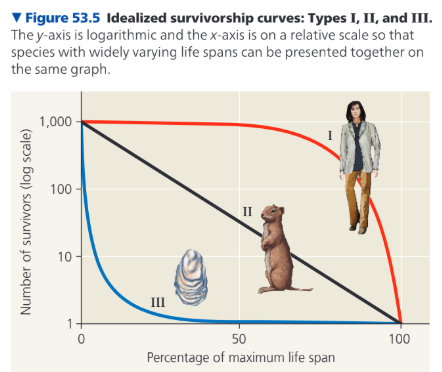
Survivorship curve: A plot of the proportion or numbers in a cohort are still alive at each age.
Type 1 curve is flat at the start, reflecting low death rates during early and middle life, and then drops steeply as death rates increase among older age-groups.
Common in large mammals that produce few offspring but provide them with good care.
Type II curves are intermediate, with a constant death rate over the organism’s life span.
Common in some rodents, many invertebrates, lizards, and annual plants.
Type 3 curve drops sharply at the start, reflecting very high death rates for the young, but flatten out as death rates decline for those few individuals that survive the early period of die-off.
Common in organisms that provide very large numbers of offspring but provide little or no care (fishes, plants, and marine invertebrates).
Not limited to these curves can show a mix or more complex patterns. Different species and different populations may have different curves.
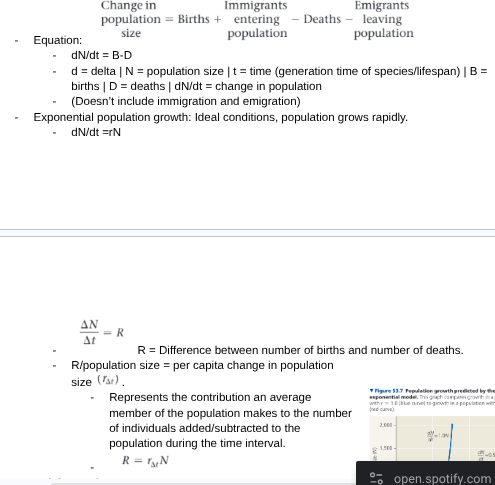
Equation for growth without carrying capacity
Called exponential growth, grows in a “J” shape.
Exponential population growth: A population that experiences ideal conditions that they increase in size by a constant proportion at each instant in time.
Intrinsic rate of increase: Per capita rate (r) at which an exponentially growing population increases in size at each instant in time.
Equation for growth with carrying capacity
Carrying capacity (K): Maximum population size that a particular environment can sustain (limited resources).
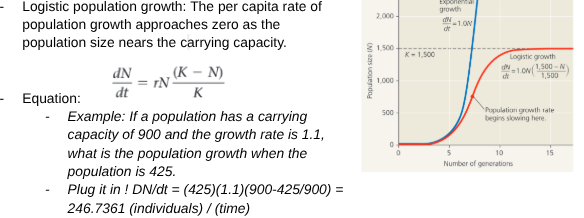
Logistic Model in Real Populations
The logistic model assumes that populations adjust instantly to growth and approach carrying capacity smoothly. In reality, there is often a delay before the negative effects of an increasing population are realized.
Populations can temporarily overshoot its carrying capacity before stabilizing.
Some populations fluctuate greatly, making it difficult to define carrying capacity.
Life History
Life history: Traits that affect an organism’s schedule of reproduction and survival (evolutionary outcomes).
When reproduction begins
How often the organism reproduces
How many offspring are produced per reproductive episode
How often an organism reproduces
Semelparity: “BIg bang reproduction”, many offspring are produced at once. Individuals often die afterwards, and occur in less stable environments.
Iteroparity: Repeated reproduction, few but large offspring, more stable environments.
Density selections
K-selection (density-dependent): Selection for life history traits that are sensitive to population density (usually associated with interoparity.)
Operates in populations living at a density near the limit imposed by their resources. Competition is strong.
R-selection (density-independent) : Selection for life history traits that maximize reproductive success (usually associated with semelparity.)
Maximizes r, intrinsic rate of increase, and occurs in environments in which population densities are well below carrying capacity or individuals face little competition.
Why do organisms reproduce the number of offspring they do?
There is a trade-off between the number of offspring and amount of resources a parent can devote to each offspring.
Caring for a large number of young may lower the survival rates of the parents.
Some organisms whose offspring are not likely to survive will produce many small offspring increasing the chance of at least a few surviving.
For example) Trees have small offspring which may help them be carried to a broader range of habitats.
Animals that suffer high predation rates also tend to produce many offspring.
In other organisms, extra investment on the part of the parent greatly increases the offspring’s chances of survival.
Density independent VS Density dependent (factors)
Density independent: Birth rate or death rate that does not change with population density. Factors that exert their influence on population size, but the birth/death rate of a population does not change.
Example: Weather, temperature, natural disasters
Can cause dramatic changes in population size. Cannot cause a population to consistently change.
Density dependent: Death rate that increases with population density or a birth rate that falls with rising density due to certain factors.
Example: Food, space, water
Is consistent, said to be regulated
Mechanisms of Density-Dependent Population Regulation
Competition for resources
Disease (increases due to being too crowded)
Territoriality
Intrinsic factors (physiological factors such as aggressive interactions and hormonal changes that delay sexual maturation and depress immune system)
Toxic wastes
Population Dynamics
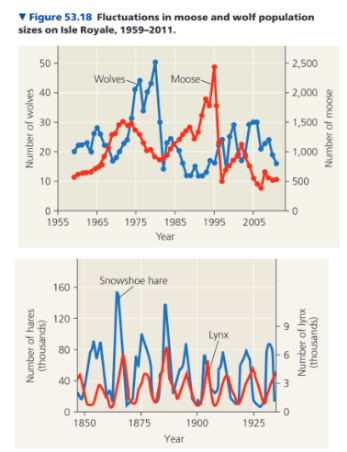
Population dynamics: Population fluctuations from year to year or place to place.
Influenced by many factors and affect other species (due to interactions).
Certain animals may have a relationship with each other. For example in moose wolf populations, when the wolves increase the moose decrease (the wolves eventually decrease due to lack of food) and vice versa.
Boom-bust cycles: Predator-prey interactions, increase and decrease together every few years.
Example: Hare decreases causing lynx to decrease as well. Hare decreases due to other predators exploiting the population.
Metapopulation & Emigration
When a population becomes crowded and resource competition increases, emigration often increases.
Metapopulation: Number of local populations are linked (immigration and emigration is important).
An individual’s ability to move between populations depends on a number of factors, including its genetic makeup.
Demographic Transition
Stable population: Birth rate equals death rate.
Demographic transition: The movement from high birth rates and death rates to low birth rates and death rates.
Associated with increase in quality of health care, improved education and sanitary conditions.
Age Structure
Age structure: Relative number of individuals in each age in the population.
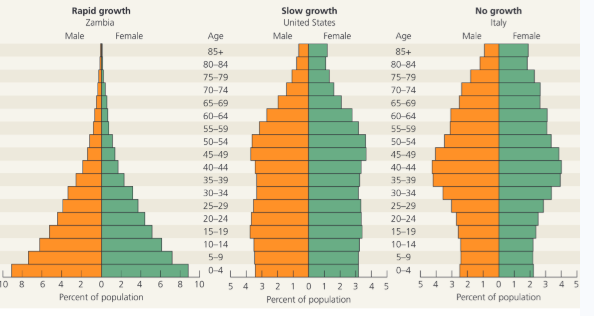
Community
Community: Group of populations of different species living close enough to interact.
Community structure: Number of species found in a community, the particular species that are present, and the relative abundance of these species.
Interspecific interactions: Interactions with individuals of other species in the community, includes competition, predation, herbivory, parasitism, mutualism, and commensalism.
Symbiosis: Species live in direct contact with one another. (Parasitism +/-, mutualism +/+ , commensalism +/0.)
Competition (-/-): Occurs when individuals of different species each use a resource that limits the survival and reproduction of both individuals.
Intraspecific competition: Competition occurring in the same species.
Exploitation (+/-): One species benefits by feeding on (harming) individuals of the other species. Includes predation, herbivory, and parasitism.
Predation (+/-): Individual of one species. The predator kills and eats an individual of the other species, the prey.
Herbivory (+/-): Interaction in which an organism, an herbivore, eats parts of plants or alga, thereby harming it but usually not killing it.
Parasitism (+/-): One organism, the parasite, derives its nourishment from another organism, the host, which is harmed in the process.
Positive interactions (+/+ or +/0): interaction between members of two species in which at least one individual benefits and neither is harmed. Includes mutualism and commensalism.
Positive interactions can affect the diversity of species found in an ecological community.
Positive interactions can have major effects on ecological communities.
Mutualism (+/+): Benefits individuals of both of the interacting species.
The species may depend on each other for survival and reproduction or be able to survive on their own.
Typically, both partners in a mutualism incur costs as well as benefits. For an interaction to be considered a mutualism, the benefits to each partner must exceed the costs. When this is not the case, mutualism may break down, at least temporarily.
Commensalism (+/0): Interaction that benefits the individuals of one of the interacting species but neither harms nor helps the individuals of the other species.
Effects of interactions between species can change over time (for example from +/0 to +/+).
Competitive exclusion
Competitive exclusion: Two species whose members compete for the same limiting resources cannot coexist permanently in the same place as one species will outcompete the other leading to the other species dying off.
Ecological Niche
Competition for limited resources can cause evolutionary change in populations.
Evolution by natural selection can result in one of the species using a different set of resources or similar resources at different times of the day or year.
Ecological niche: The specific set of biotic and abiotic resources an organism uses in its environment, how an organism fits into an ecosystem.
Ecologically similar species can coexist in a community if one or more significant differences in their niches arise through time.
Fundamental niche: Entire set of conditions under which an animal can survive and reproductive itself.
Realized niche: The portion of its fundamental niche that it actually occupies after factoring in interactions with other species.
Resource partitioning: Differentiation of niches that enables similar species to coexist in a community.
Character displacement
Character displacement: Tendency for characteristics to diverge more in sympatric than in allopatric populations of two species.
Since sympatric populations are together they must be more different to avoid competition while allopatric populations are apart so they won’t compete.
Adaptions predators, prey, herbivores and plants have
Predators have adaptations such as acute senses (help find and identify potential prey), claws, fangs, or poison (help them catch and subdue their food), fast and agile
Prey have adaptations like behavioral defenses (hiding, fleeing, forming herds or schools), active self-defense (some large mammals defend their young from predators), mechanical defenses (porcupine), chemical defenses (skunks), synthesize toxins.accumulate toxins, bright aposematic coloration (warning coloration), cryptic coloration (camouflage), batesian mimicry (harmless species mimics an harmful species), mullerian mimicry (two or more harmful species resembles each other).
Predators can also have mimicry.
Herbivores have adaptations like chemical sensors that enable them to distinguish between plants based on their toxicity or nutritional value (insects), sense of smell (some mammals), specialized teeth and digestive systems adapted for processing vegetation.
Plants have adaptations like chemical toxins, distasteful taste, chemicals that cause abnormal development in some insects that eat them or structures such as spines and thorns.
Parasites
Endoparasites: Parasites that live within the body of their host.
Ectoparasites: Parasites that feed on the external surface of a host.
Parasites may need different hosts from different species and may change the behavior of the host that increases the likelihood that the parasite will reach its next host (often making the organisms open to be eaten).
Parasites can significantly affect the survival, reproduction, and density of their host population, either directly or indirectly.
Species diveristy
Species diversity: Variety of different kinds of organisms that make up the community.
Species richness: Number of different species in the community.
Relative abundance: The proportion each species represents of all individuals.
Increased diversity increases productivity and stability of communities.
Are able to withstand and recover from environmental stresses, more stable year to year in their productivity, and more resistant to introduced/invasive species.
Introduced species (organisms humans have moved to regions outside of the species’ native range.)
Diverse communities captured more of the resources available in the system, leaving fewer resources for the introduced species and thus decreasing its survival.
Invasive Species
Invasive Species: Organisms that become established outside native range.
Characteristics: Tolerates a wide range of conditions, has a long growing season or short generation time, has few natural controls as predators, disease, or insects, disperses itself with ease.
Biomass
Biomass: Total mass of all organisms in a habitat.
Trophic Structure
Trophic structure: Feeding relationships between organisms.
Food chain: Transfer of chemical energy from its source in plants and other autotrophs (primary producers) through herbivores (primary consumers to carnivores (secondary, tertiary, and quaternary consumers) and eventually to decomposers (recycles nutrients, all living things point to this).
Trophic level: Position an organism occupies in a food chain.
Food web: Group of food chains linked together.
Single food chains are unstable but food webs (multiple food chains) are stable.
Limits on Food Chain Length
Food chains need to be short because of the energetic hypothesis which suggests that the length of a food chain is limited by the inefficiency of energy transfer along the chain.
Only about 10% of the energy stored in organic matter (90% is lost through heat and metabolism, life functions) of each trophic level is converted to organic matter at the next trophic level.
Food chains should be longer in habitat with more producers.
Species with a Large Impact
The impact of these species occurs through trophic interactions and their influence on the physical environment.
Foundation species: Species that are large or abundant, may affect communities structured by providing habitat and food for other organisms.
May also be competitively dominant.
Keystone species: Not usually abundant in a community but exert strong control on community structure through pivotal ecological roles.
Example: Feeding on and eliminating an abundance of a competitively dominant species.
Ecosystem engineers: Species that create or dramatically alter their environment.
Bottom-Up and Top-Down Controls
“Bottom-up” control: Controlled by what they eat, the abundance of organisms at each trophic level is limited by nutrient supply or the availability of food at lower trophic levels. To change the structure you would need to alter the biomass or abundance of organisms at lower trophic levels, allowing those changes to propagate up through the food web.
“Top-down” control: Controlled by what eats them, the abundance of organisms at each trophic level is controlled by the abundance of consumers at higher trophic levels. Predators limit herbivores, and herbivores limit plants. Removing/adding the top consumer should move down the trophic structure as alternating positive and negative effects.