Chapter 1 - musculoskeletal system
 Call Kai
 Learn
Learn Practice Test
 Spaced Repetition
 Match
Match Flashcards
 Knowt Play
1/71

There's no tags or description
Looks like no tags are added yet.
Name | Mastery | Learn | Test | Matching | Spaced | Call with Kai |
|---|
No analytics yet
Send a link to your students to track their progress
72 Terms
What are the 5 main functions of the skeletal system
Body movement, Framework, Protection, Mineral storage and Production of red blood cells
What are the 5 types of bone
Flat bone, Long bone, Short bone, Sesamoid bone and Irregular bone
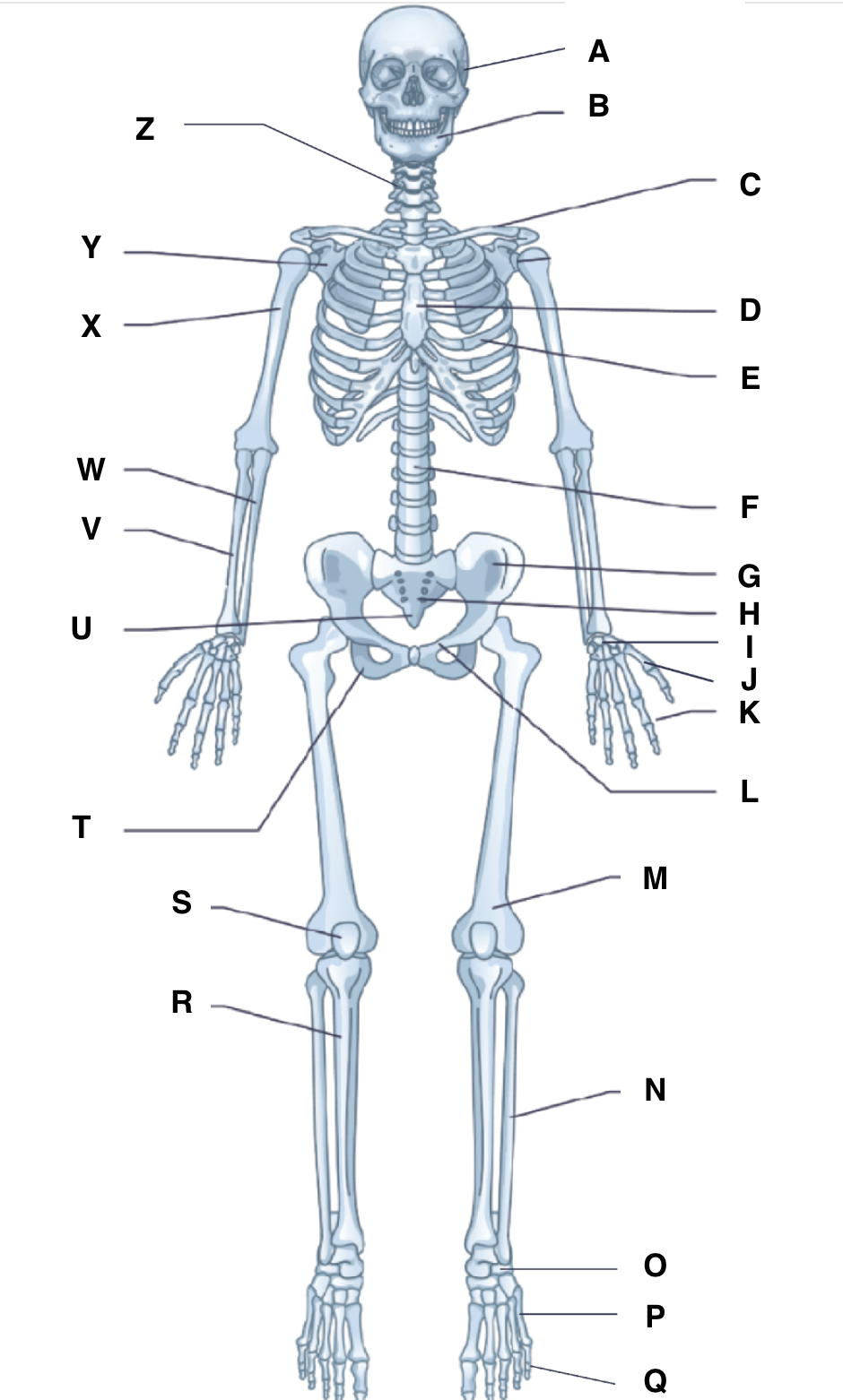
Label
A - Cranium
B - Mandible
C - Clavicle
D - Sternum
E - Ribs
F - Lumbar spine
G - Illium
H - Sacrum
I - Carpals
J - Metacarpals
K - Phalanges
L - Pubic bone
M - Fibula
N - Tarsals
O - Metatarsals
P -
What are the 3 joint classifications and what movements do they offer
Fibrous (immovable)
Cartilaginous (slightly moveable)
Synovial (freely moveable)
What are the 6 types of synovial joints
Ball and socket
Hinge
Gliding
Pivot
Condyloid
Saddle
name the 6 synovial joints when found in the arm
ball and socket - shoulder
hinge - elbow
pivot - radius and ulna in forearm
gliding - carpal of wrist
condyloid - wrist
saddle - thumb
Cartilage
Flexible connective tissue that protects and supports bones
Ligaments
connective tissue joining bone to bone. Provides stability at the joint
The names of vertebral column sections and how many vertebrae are in each and if fused together
Cervical (7), thoracic (12), lumbar (5), sacrum (5 fused together) and coccyx (4 fused together)
Anatomical positions
standing upright, facing forward with arms by the side palms facing forward
Anteroir
Towards the front of the body
Medial
Towards the middle of the body (middle)
Inferior
Towards the feet or lower part of the body
Prone
Facing down (on penis)
Distal
Further away from the trunk of the body
Superficial
Towards the surface of the body
Posterior
Towards the back of the body
Supine
Facing up (on spine)
Deep
Towards the inner part of the body
Anatomical movements
the movements that can be made at the synovial joints
Extenison
Increase in the angle of the joint
Rotation
Movement of a body part around the central axis
Adduction
Bringing a body part to back to the midline of the body
Pronation
Rotation of the hand so the thumb moves in towards the body
Dorsi flexion
Decrease the angle of the joint between the foot and the leg
Supination
Rotation of the hand so that the thumb moves away from the body
Depression
Move shoulders away from the head
Eversion
Movement of the sole away from the body's midline
Circumduction
Movement of the end of a bone in a circular motion
Plantar flexion
Increase the angle of the joint between the foot and the leg (plant a plant in the ground)
Elevation
Move shoulders towards head
Flexion
Decrease in the angle of the joint
Abduction
Movement of a body part away from the midline
Inversion
Movement of the sole towards the midline of the body
3 main functions of the muscular system
Body movement, Adequate posture and Essential bodily functions
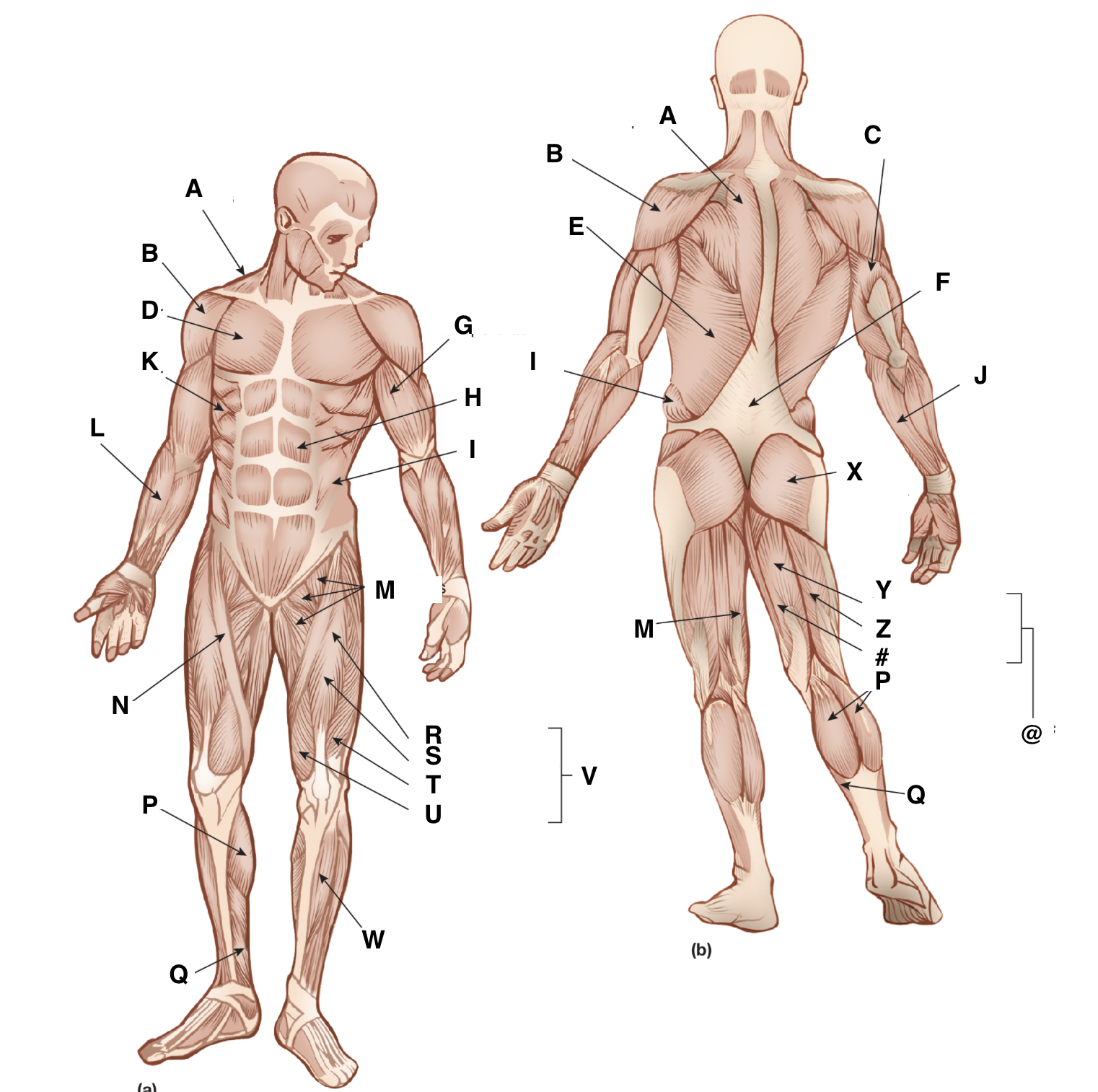
Table
A - Trapezius
B - Deltoid
C - Triceps brachii
D - Pectoralis major
E - Latissimus dorsi
F - Erector spinae
G - Bicep brachii
H - Rectus abdominis
I - Obliques
J - Wrist flexors
K - Serratus anterior
L - Wrist flexors
M - Adductors
N - Sartorius
P - Gastrocnemius
Q - Soleus
R - Rectus femoris
S - Vastus intermedius
T - Vastus lateralis
U - Vastus medialus
V - Quadriceps femoris
W - Tibialis anterior
X - Gluteus maximus
Y - Semitendinsus
Z - Bicep femoris
#- Semimembranosus
@ - Hamstring
The 3 types of muscle
Smooth, Cardiac and Skeletal
Voluntary vs involuntary muscles
Voluntary refers to having conscious control of the muscle where as involuntary refers to having no conscious control over the muscle
What types of muscles are involuntary and what types are voluntary
Involuntary - Smooth and cardiac and Voluntary - Skeletal
Smooth muscle
found in hallow organs such as bladder, blood vessels, digestive tract, etc
Cardiac muscle
Only found in the heart
Skeletal muscle
Attaches to bone and causes movement of the skeleton
The 5 types of muscle fibre arrangements
Fusiform muscle, Convergent muscle and Pennate - Unipennate muscle, Bipennate muscle and Multipennate muscle
What is the quadriceps femoris group
rectus femoris (top), vastus lateralis (outside), vastus medialis (inside), vastus intermedius (middle)
Axial skeleton
trunk, head and chest
appendicular skeleton
limbs
Tends
attach muscle to bone
Fusiform muscle
fascicles align to the long axis, allows quick and rapid shortening of the muscle (bicep brachii)
convergent mucles
fascicles converge towards single tendon (pictorials major)
Pennate muscle
fascicles are short and at an angle to the tendon (feather), garter potential to force
unipennate muscle
fascicles only one side of tendon (tibialis anterior)
bipennate muscle
fascicles both side of tendon (rectus femoris in quadriceps)
multipennate muscle
fascicle arranged into multiple rows (deltoid)
reciprocal inhibition
the process of one muscle contracting (agonist) while another muscle relaxes (antagonist) to create movement
agonist muscles
contraction
antagonist muscle
relaxes
muscles work in..
Pairs -One contracts, one relaxes e.g. Biceps relax, triceps contact
Stabilisers
aren't directly involved but keeps body fixed and steady
Myofilaments
individual proteins filaments of actin (thin) and myosin (thick) that make up a myofibril
oak like structures
cross bridges, myofilament
Sarcomeres
Actin and myosin's together
Sliding fliament theory
When a muscle contracts the myofilaments slide across each other
slow twitch fibers
red muscle fibers that are slow to contract but have the ability to continue contracting for long periods of time (aerobic)
Fast twitch
White anaerobic muscle fibres high force production with low fatigue levels
All or nothing principle
States that the nerve impulse will not stimulate the muscle fibre until it reaches a certain threshold level. Once nerve impulse reaches this threshold all fibres of the muscle unit will contract at the same time and maximally.
concentric contraction
When the muscle length shorten as the force is being produced
Eccentric contractions
When the muscle length lengthens as forces being produced
Isometric contractions
When a force is developed but there is no change in muscle length
Size principle
States that the recruitment of motor neurons within a skeletal muscle commences with small motor units and progresses to large motor units
lever
A rigid structure that rotates around a fixed point
The three parts of a lever
Axis, resistance, force
third class levels
axis, force then resistance