MAT 191 / Calculus I Key Information
 Call Kai
 Learn
Learn Practice Test
 Spaced Repetition
 Match
Match Flashcards
 Knowt Play
1/91

There's no tags or description
Looks like no tags are added yet.
Name | Mastery | Learn | Test | Matching | Spaced | Call with Kai |
|---|
No analytics yet
Send a link to your students to track their progress
92 Terms
Limit
f(x) is defined on some open interval that contains c, except possibly at c itself.
Lim x->c f(x) = L
"the limit of f(x) equals L, as x approaches c"
This means we can make values of f(x) arbitrarily close to L by restricting x to be close to c on either side of c but not equal to c.
One-Sided Limits
Lim x->c- f(x) = L
"the limit of f(x) equals L, as x approches c from the left"
meaning if we can make values of f(x) close to L by taking x to be sufficiently close to c with x less than c.
Lim x->c+ f(x) = L
"the limit of f(x) equals L, as x approaches c from the right"
meaning if we can make values of f(x) close to L by taking x to be sufficiently close to c with x more than c.
Identifying if a limit exists:
1. if the limit as x approaches c from the right = the limit as x approaches c from the left.
Definition of an Infinite Limit
Suppose f(x) is defined on some open interval that contains c, except possibly at c itself. We then write:
lim x-> c f(x) = infinity
if the values of f(x) can be made arbitrarily large by taking x to be sufficiently close to c, but not equal to c, likewise we write:
lim x-> f(x) = -infinity
if the values of f(x) can be made arbitrarily large negative by taking x to be sufficiently close to c, but not equal to c.
Definition of Vertical Asymptote
The vertical line x = c is called a vertical asymptote of the curve y = f(x) if at least one of the following statements is true:
lim x-> c f(x) = infinity
lim x-> c- f(x) = infinity
lim x-> c+ f(x) = infinity
lim x-> c f(x) = -infinity
lim x-> c- f(x) = -infinity
lim x-> c+ f(x) = -infinity
Limit Law 1
lim x -> c [f(x) + g(x)] = lim x-> c f(x) + lim x-> c g(x) = L + M
let lim x-> c f(x) = L
& lim x-> c g(x) = M
Limit Law 2
lim x -> c [f(x) - g(x)] = lim x-> c f(x) - lim x-> c g(x) = L - M
let lim x-> c f(x) = L
& lim x-> c g(x) = M
Limit Law 3
lim x->c k f(x) = k lim x->c f(x) = k*L
let k be a real number
let lim x-> c f(x) = L
Limit Law 4
lim x -> c [f(x) g(x)] = (lim x-> c f(x)) (lim x-> c g(x)) = L * M
let lim x-> c f(x) = L
& lim x-> c g(x) = M
Limit Law 5
lim x -> c f(x) / g(x) = lim x-> c f(x) / lim x-> c g(x) = L / M , provided M does not = 0
let lim x-> c f(x) = L
& lim x-> c g(x) = M
Limit Law 7
lim x->c [f(x)]^n = [lim x->c f(x) ] ^n
Limit Law 8
lim x->c k = k
let k be a real number
Limit Law 9
lim x->c x = c
Limit Law 10
lim x->c ^n sqrt f(x) = ^n sqrt lim x->c f(x) = ^n sqrt L
Direct Substitution Property
If f(x) is a polynomial, a rational function, or any of the six trigonometric functions and c is in the domain of f, then lim x->c f(x) = f(c)
Squeeze/Sandwich Theorem
suppose we have 3 functions f,g,h defined on an open interval containing x=c, except possibly at c itself. If f(x) < or = to g(x) < or = to h(x) for all x in the open interval and lim x->c f(x) = L = lim x->c h(x), then lim x->c g(x) =L
Definition of Continuity
A function f is continuous at x = c if lim x->c f(x) = f(c)
Continuity Check List
1. f(c) MUST be defined (closed circle at x=c)
2. a limit MUST exist ( lim x->c- f(x) = lim x->c+ f(x))
3. f(c) MUST EQUAL lim x->c f(x)
Important Theorem (forgot name :( )
if functions f,g are continuous at x=c , then ea. of following are also continuous at x=c:
1. f +/- g
2. f*g
3. k*f(x) {k is a constant}
4. f/g {provided g(c) does not = 0}
Another theorem
suppose f is continuous at x=b. if lim x-> g(x) = b then lim x->c f(g(x)) = f (lim x->c g(x))
Intermediate value theorem
suppose f is continuous on [a,b] Let M be any value b/w f(a) and f(b), then there exists an x-value c such that a
Correlary to IVT
Suppose f is continuous on [a,b] If f(a) and f(b) have opposite signs, then there exists an x-value c such that a
Removable Discontinuity
lim x->c f(x) exists but either f(c) is undefined or f(x) exists but isn't = limit
jump discontinuity
lim x->c+ f(x) = L (exists) & lim x->c- f(x) = M (exists) BUT L not = to M
limit from right does not equal limit from left
infinite discontinuity
vertical asymptote
3 ways a limit can fail to exist
1. jump
2. asymptote
3. oscillation
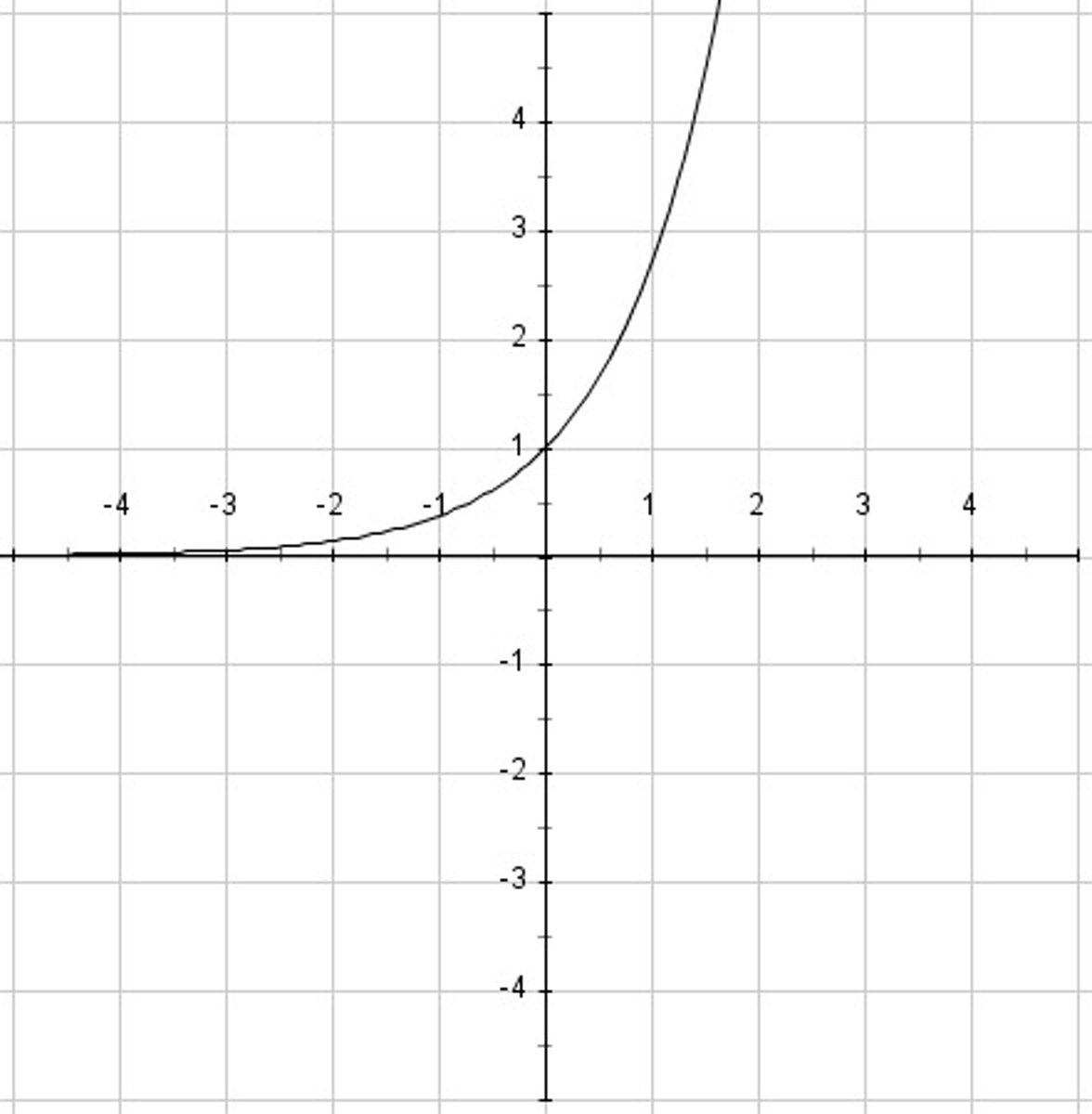
e^x
3 ways a function can fail to be differentiable
1. vertical tangent line
2. sharp corner / cusp
3. discontinuity (hole, jump, asymptote)
3 ways a function can fail to be continuous
1. asymptote
2. hole
3. jump
Surface Area of a Cone
πr(r + sqrt(h^2 + r^2))
Volume of a Cone
1/3πr^2h
Area of Circle
πr^2
Volume of a Cube
x^3
Quadratic Formula
(-b ± √(b² - 4ac))/2a
Circumference of a circle
2πr or 2d
volume of a cylinder
πr^2h
surface area of a cylinder
2πr^2 + 2πrh
d/dx cscx
-cscxcotx
d/dx cotx
-csc^2x
d/dx sinx
cosx
d/dx arcsinx
1/(sqrt(1-x^2))
d/dx secx
secxtanx
d/dx cosx
-sinx
d/dx lnx
1/x
d/dx arccscx
-1/(|x| sqrt(x^2 - 1))
d/dx logbx or b^y = x
1/ (x ln b)
d/dx tanx
sec^2x
d/dx arcsecx
1/(|x| sqrt(x^2-1))
d/dx arccosx
-1/(sqrt(1-x^2))
d/dx arccotx
-1/ (1 + x^2)
d/dx arctanx
1/(1+x^2)
surface area of sphere
4πr^2
volume of sphere
4/3 πr^3
Pythagorean Theorem
a²+b²=c²
Logarithm power rule
log b (x^y) = y * log b (x)
special trig functions
lim x->0 sinx/x = 1 or lim x->0 x/sinx = 1
lim x->0 1-cosx/x = 0 or lim x->0 cosx - 1 / x = 0
ln(e)
1
ln(1)
0
ln(0)
DNE
e^1
e
e^0
1
when should we use logarithmic differentiation ?
when taking a derivative of a variable raised to a variable
When should we replace y's when differentiating ?
during logarithmic differentiation and sometimes when taking 2nd implicit differentiation
logarithm product rule
log b (x * y) = log b (x) + log b (y)
logarithm quotient rule
log b (x/y) = log b (x) - log b (y)
when is a particle speeding up?
when the signs of the velocity and acceleration are the same
when is a particle at rest ?
when velocity is equal to zero
In related rates: what is a derivative
a derivative is a rate of change in x with respect to y so look for words like, "increasing", "decreasing", "rate", or "changing"
ch 4 . Local(relative) Max Definition
given that a function f is defined on an open interval then,
f has a local max at f(c) if f(c) >/= f(x) for all x-values on interval
there should NOT be more than one local max on an interval b/c y-value should only be one value
(highest value on an interval)
local(relative) min definition
given that a function f is defined on an open interval then,
f has a local min at f(c) if f(c)
Global(absolute) Max Definition
given a function f is defined on its DOMAIN
f has a global max at f(c) if f(c) >/= f(x) for all x in the domain of f
global(absolute) min
given a function f is defined on its DOMAIN
f has a global min at f(c) if f(c)
T/F every local max is a global max
F
T/F every global max is a local max
T
T/F given a function on closed interval , f must contain a global max
F, the function must be CONTINUOUS
extreme value theorem
every CONTINUOUS function on a CLOSED interval has a max and min value on that interval
A function has a critical point at x=c if ...
1. c is in the domain of the function
2. f'(c) = 0 or f'(c) = DNE
Random Theorem
if f has a local max or min when x=c , then c is a critical point
T/F a critical value means that there is a local max or min
F ; just b/c there is a critical value does NOT mean that it is a local max/min
Rolle's Theorem
Suppose f is continuous on [a,b] and differentiable on (a,b) then if f(a) = f(b) then there exists an x-value c where a
Mean Value Theorem
Suppose f is a function if
1. f is cont. on [a,b]
2. f is differentiable on (a,b)
then there exists an x-value c where a
(a,b)
open interval (endpoints dont matter)
[a,b]
closed interval (endpoints matter)
Definition of increasing
f is increasing on an interval, I , if f(x1) < f(x2) for all x 1, x2 in I where x1
Definition of decreasing
f is decreasing on an interval, I , if f(x1) > f(x2) for all x 1, x2 in I where x1
Theorem for inc/dec
suppose f is defined on an interval , I ,
1. if f(x) > 0 (positive) for all x in I, then f is increasing on I
2. if f(x) < 0 (negative) for all x in I, then f is decreasing on I
3. if f(x) = 0 for all x in I, then f is constant on I
Horizontal Asymptotes/ Litmits at infinty : BOBO BOTN
Bigger on bottom = 0
Bigger on top = none
Indeterminate Forms where L'Hospital's rule applies
L'Hospital's Ready: after direct substitution yields ---> 0/0 or infinity/infinity
Must Rewrite the x-variable to create a fraction: after direct substitution yields infinity - infinity or 0 infinity ... rewrite such as: x ln(x) ---> ln(x)/(1/x), then try direct substitution which should yield 0/0 or infinity/infinity
must use log properties to work towards 0/0 or infinity/infinity : after direct substitution yields 1^infinity or 0^0 or infinity^0
delta X
(b-a)/n
Rsubi
a + deltaX*i
Antiderivative
a function F is an antiderivative of f on an interval I if F'(x) = f(x) for all x in I.
Still learning (18)
You've started learning these terms. Keep it up!