Lecture 15: Memory
 Call Kai
 Learn
Learn Practice Test
 Spaced Repetition
 Match
Match Flashcards
 Knowt Play
1/31

There's no tags or description
Looks like no tags are added yet.
Name | Mastery | Learn | Test | Matching | Spaced | Call with Kai |
|---|
No analytics yet
Send a link to your students to track their progress
32 Terms
Summary of Memory systems in the Brain
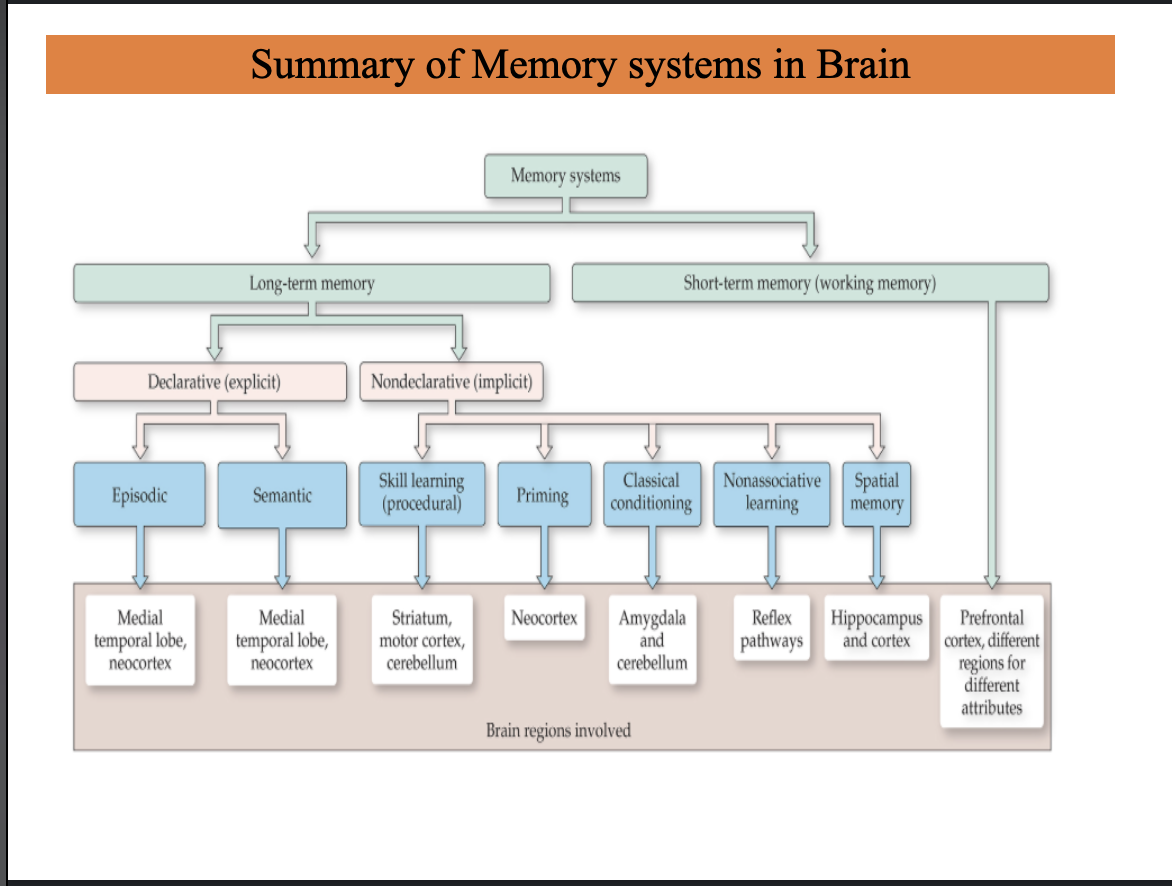
What are the three components of Memory?
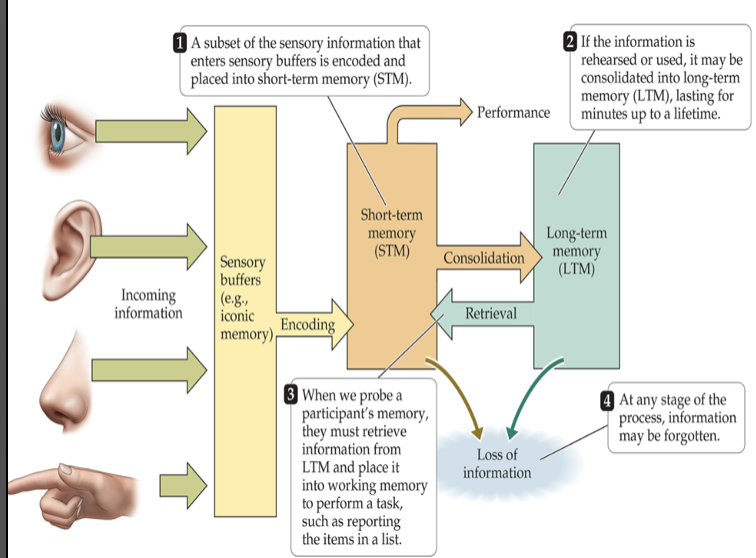
Learning - Encoding
Consolidation
Retrieval
Encodings is a stage of memory formation in which?
Information entering sensory channels is passed into short term memory
Consolidation is a stage of memory formation in which?
Information in short term or intermediate term memory is transferred to long-term memory
Retrieval is a process in memory in which?
A stored memory is used by an organism
Graph of Memory Process
Engram is the?
Physical bases of a memory in the brain which involves changes in neural circuits rather than response from a single neuron
Neuroplasticity is the ability of the nervous system to?
Change in response to experience or the environment which may be physiological or structural
Changes at the synaptic level is influenced by different factors such as?
Genetics, environment factors, and exercise
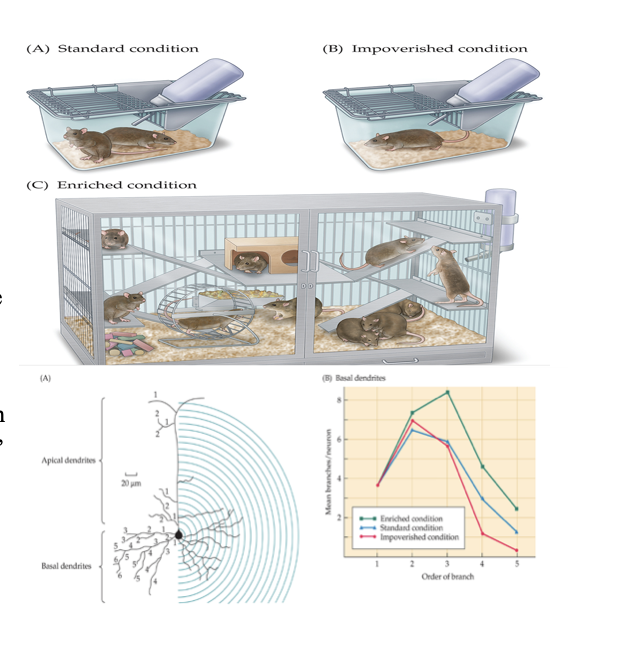
Diagram of impoverished, standard, and enriched condition
1. Impoverished condition
Least stimulation
Animal is alone, minimal toys, minimal sensory input
Leads to smaller cortex, fewer synapses, weaker learning
2. Standard condition
Normal environment
Several animals together, basic stimulation
Baseline brain development
3. Enriched condition
High stimulation
Many animals together, toys, tunnels, exercise wheels, changing environment
Leads to thicker cortex, more synapses, better learning and memory
Structural MRI scans of brain, Researches have found that human adolescents from an advantageous socioeconomic environment will have a?
Thicker cortex than someone from a low socioeconomic environment
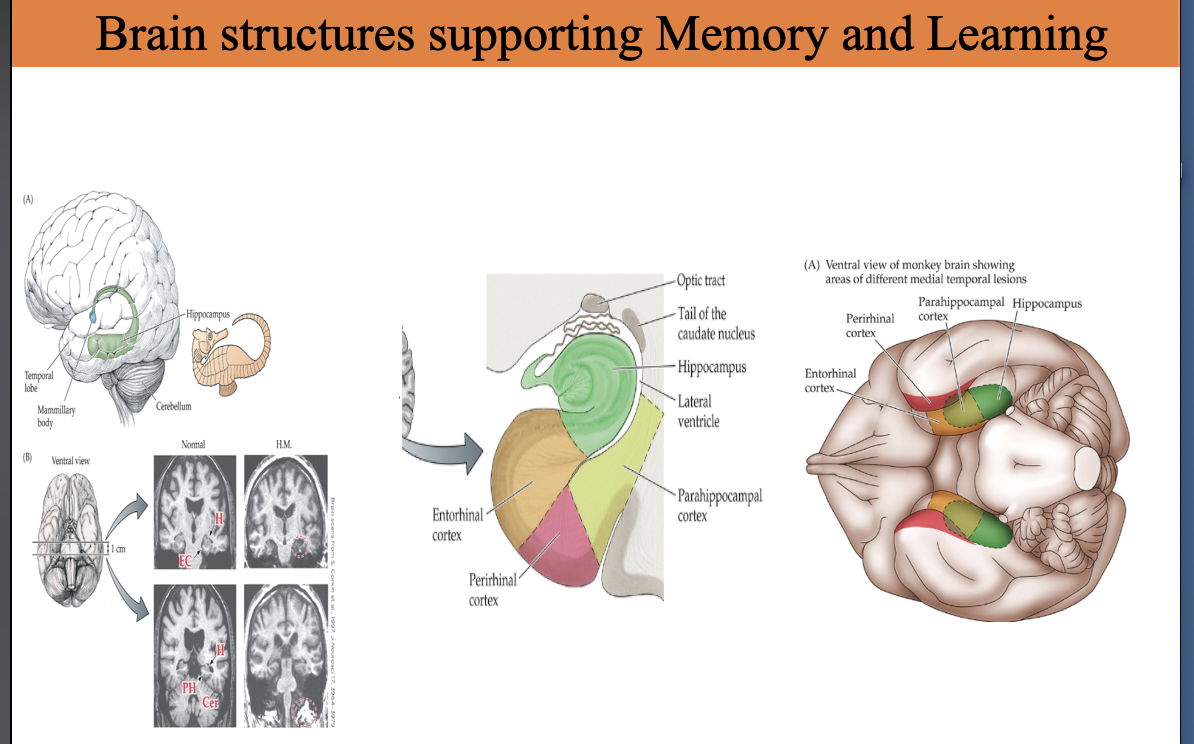
The key anatomical structures involved in forming new memories (Hint: there are 7)
Hippocampus – essential for forming new declarative memories
Entorhinal cortex (EC) – major input/output gateway to the hippocampus
Perirhinal cortex (PRC) – object recognition memory
Parahippocampal cortex (PHC) – spatial/context memory
Mammillary bodies – part of the Papez circuit
Temporal lobe – houses the medial temporal memory system
Cerebellum – procedural learning (motor memory)
Four different duration categories of memory being?
Sensory Buffer/Iconic Memories
Short Term Memory (Working)
Intermediate-Term Memory
Long-Term Memory
Sensory buffers/Iconic memores are the?
Briefest memories that vanish within seconds which are though to be residual of sensory neural activity
Short-Term Memory is a?
Component of memory that holds a small amount of information in an active, readily available state for brief period, typically a few seconds to a minute
It is mostly holds
7+/-2 information in our brains for 15-30 seconds
A type of STM is working memory which will hold?
A limited amount of information available for ready access during performance of task
Working memory is mainly controlled by?
Prefrontal cortex
Working Memory consist of? (Hint: Their are 3)
Phonological loop: Contains auditory information
Visuospatial sketch pad: Visual impression of stimuli
Episodic Buffer: Platform for integration of visual, auditory and other sensory systems
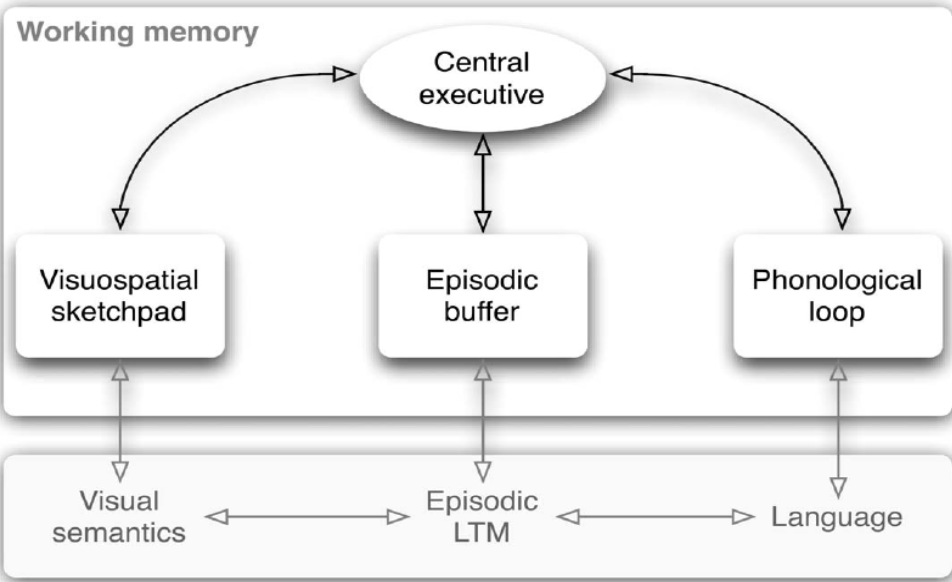
Baddeley’s Working Memory Model
Shows the four components of working memory:
Central Executive — directs attention and coordinates the system
Phonological Loop — holds and rehearses verbal/auditory info
Visuospatial Sketchpad — holds visual and spatial info
Episodic Buffer — integrates info from the subsystems + long‑term memory
Also shows connections to long‑term memory systems:
Language → phonological loop
Visual semantics → visuospatial sketchpad
Episodic LTM → episodic buffer
The Hippocampus is involved in the ________ __ __________ but doesn’t do what?
Consolidation of Memory
Doesn’t store long-term memory
What are some facts about consolidation? (Hint: Their are 3)
It takes time to occur
It is vulnerable/fragile
Changed upon recall/restorage
Most memories are stored in the?
Cortex
Sleep after learning enhances the?, this will induce?
Memory processing in hippocampus
Induce memory transfer between hippocampus and medial prefrontal cortex
This transfer __________ memories, so new memories become?
Consolidates
Stable
What is one thing about emotional events?
They are remembered better
What are the Good Old Days
Pleasent emotions are usually remembered better than unpleasant ones
What helps memory?
Emotional arousal, not importance of information
Post traumatic stress disorder (PTSD) is the?
Unwanted recall of fearful stimuli creating a feed-foward loop, with each recall producing emotional reaction than reinforces that memory
Propranolol is?
An adrenalin atagonist, which blocks adrenergic stress hormones
Early treatment with propranolol (perhaps 2 hours after event) may?
Prevent emotional reinforcement of memories in PTSD
What will help a little?
Subsequent Treatment