QUESTIONS THAT WILL BE ON EXAM (from old exams 1-3)
 Call Kai
 Learn
Learn Practice Test
 Spaced Repetition
 Match
Match Flashcards
 Knowt Play
1/10

There's no tags or description
Looks like no tags are added yet.
Name | Mastery | Learn | Test | Matching | Spaced | Call with Kai |
|---|
No analytics yet
Send a link to your students to track their progress
11 Terms
1. What discovery/advance of the list below occurred during the Second Golden
Age of Microbiology?
a. Development of the first smallpox vaccine by Edward Jenner
b. Formulation of the germ theory of disease by Louis Pasteur
c. Demonstration that DNA is the genetic material by Avery, MacLeod, and McCarty
d. Invention of the first compound microscope by Anton van Leeuwenhoek
e. Establishment of Koch's postulates for identifying disease-causing microorganisms
c. Demonstration that DNA is the genetic material by Avery, MacLeod, and McCarty
2. Which of the following is the BEST definition of cellular respiration?
a. The process of converting light energy into chemical energy stored as glucose
b. The breakdown of glucose in the absence of oxygen to produce ATP and organic
end products
c. A series of metabolic reactions that oxidize organic compounds, using an inorganic
molecule as the final electron acceptor, to produce ATP
d. The direct transfer of phosphate groups from substrate molecules to ADP to
produce ATP
e. The process of pumping hydrogen ions across a membrane to create a
concentration gradient
c. A series of metabolic reactions that oxidize organic compounds, using an inorganic
molecule as the final electron acceptor, to produce ATP
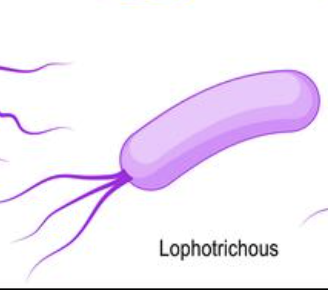
3. Draw ONE bacillus bacterium with lophotrichous flagella.
(Drawing question — the following choices describe what a correct drawing would include)
a. A spherical cell with a single flagellum at one pole
b. A rod-shaped cell with a single flagellum at one pole
c. A rod-shaped cell with a tuft of multiple flagella emerging from one or both poles
d. A rod-shaped cell with flagella distributed evenly around the entire cell surface
e. A spiral-shaped cell with a single flagellum at each pole
c. A rod-shaped cell with a tuft of multiple flagella emerging from one or both poles
1. Blue-white screening described in your text is a typical procedure when
selecting a clone. The bacteria transformed with the recombinant plasmid and
plated on media containing ampicillin and X-gal will ________.
a. form blue colonies because the lacZ gene remains intact and functional
b. not grow because the recombinant plasmid does not confer antibiotic resistance
c. form white colonies and be sensitive to ampicillin
d. form white colonies and be resistant to ampicillin
e. form blue colonies and be resistant to ampicillin
d. form white colonies and be resistant to ampicillin
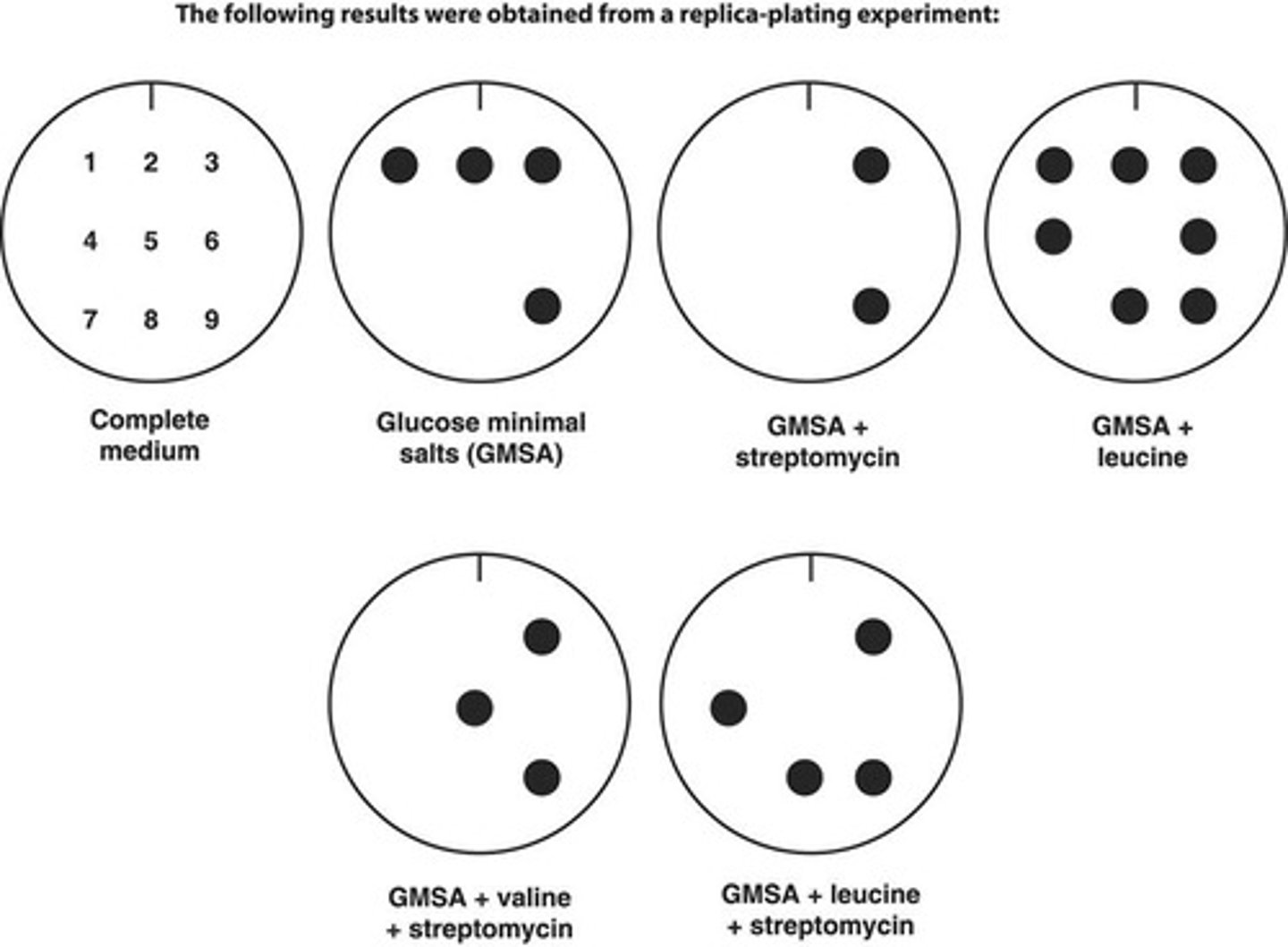
2. In the Figure, which colonies are streptomycin-resistant and leucine-requiring?
a. Colonies 1 and 4
b. Colonies 2 and 5
c. Colonies 3 and 6
d. Colonies 1 and 2
e. All colonies shown on the master plate
Colonies that appear on the streptomycin
replica plate but are absent on the leucine-free replica plate are streptomycin-resistant
and leucine-requiring.
3. Which chemical method(s) denatures proteins?
a. Halogens only (e.g., chlorine, iodine)
b. Alcohols and phenols only
c. Heavy metals only (e.g., silver, mercury)
d. Alcohols, phenols, acids, bases, and heavy metals
e. Oxidizing agents only
d. Alcohols, phenols, acids, bases, and heavy metals
4. Culture 1: Hfr, trp+ Culture 2: F−, trp− What will be the result of conjugation
between the two cultures?
a. Culture 1 will transfer the F factor and become F−; Culture 2 will become F+, trp+
b. Both cultures will become Hfr, trp+
c. Culture 1 will remain Hfr, trp+; some cells in Culture 2 may become trp+ through
chromosomal recombination
d. Culture 1 will become F+, trp+; Culture 2 will become Hfr, trp+
e. No gene transfer will occur because Hfr and F− cells are incompatible
c. Culture 1 will remain Hfr, trp+; some cells in Culture 2 may become trp+ through
chromosomal recombination
1. Which of the following pairs is mismatched? (review Ch. 12: Medically
Important Fungi)
a. Sporothrix schenckii - subcutaneous mycosis
b. Tinea pedis - cutaneous mycosis
c. Coccidioides immitis - systemic mycosis
d. Candida albicans - subcutaneous mycosis
e. Pneumocystis jirovecii - opportunistic mycosis
d. Candida albicans - subcutaneous mycosis
2. Use of culture-independent techniques like rRNA sequencing and FISH
increased our understanding of microbial diversity. Why should microbiologists
still attempt to grow new species?
a. Because rRNA sequencing is not yet accurate enough to reliably identify species
b. Because growing organisms in culture allows for detailed physiological,
biochemical, and genetic studies, and enables discovery of novel metabolic pathways
and biotechnology applications
c. Because culture-independent techniques cannot detect organisms that represent
less than 1% of a population
d. Because most microorganisms can be easily grown under standard laboratory
conditions
e. Because culture-independent techniques only work for bacteria, not for archaea or
fungi
b. Because growing organisms in culture allows for detailed physiological,
biochemical, and genetic studies, and enables discovery of novel metabolic pathways
and biotechnology applications
3. What is NOT a similarity between plasmids and prophages/proviruses?
a. Both can replicate within the host cell
b. Both can integrate into the host chromosome
c. Both can carry genes that provide a benefit to the host cell
d. Both encode proteins needed to assemble a viral capsid
e. Both can be transferred between bacterial cells
d. Both encode proteins needed to assemble a viral capsid
4. What phyla do the Methanobacteria and Halobacteria belong to? (review Table
11.1)
a. Methanobacteria - Crenarchaeota; Halobacteria - Euryarchaeota
b. Methanobacteria - Euryarchaeota; Halobacteria - Crenarchaeota
c. Both belong to Euryarchaeota
d. Both belong to Crenarchaeota
e. Methanobacteria - Korarchaeota; Halobacteria - Euryarchaeota
c. Both belong to Euryarchaeota