Nuclear Medicine Exam 2
 Call Kai
 Learn
Learn Practice Test
 Spaced Repetition
 Match
Match Flashcards
 Knowt Play
1/101

Earn XP
Description and Tags
Chapters 6-12
Name | Mastery | Learn | Test | Matching | Spaced | Call with Kai |
|---|
No analytics yet
Send a link to your students to track their progress
102 Terms
Describe the process of ionization
A charged particle collides with an orbital electron, which is then ejected
What is the effect of ionization involving an inner-shell electron?
Emission of characteristic x-rays or Auger electrons
How is excitation caused by a charged particle? How is the transferred energy emitted?
A charged particle passes an atom close, but not very close, leading to an orbital being raised to an excited state; Molecular vibrations and emission of low-energy photon radiation
What happens during the Bremsstrahlung process?
A charged particle penetrates the orbital cloud and interacts with the nucleus; the particle is deflected by the nuclear forces and rapidly decelerates, losing energy through emitting photons
What is the energy range of bremsstrahlung photons?
Nearly zero (particle is only slightly deflected) to a maximum of the full energy of the incident particle (particle is virtually stopped in the collision)
Most bremsstrahlung photons are (low/high) energy
Low
Describe collisional vs. radiative losses
Collisional: Energy lost by ionization or excitation events
Radiative: Energy lost by nuclear encounters resulting in bremsstrahlung production
(Collisional/Radiative) energy losses are by far the dominating factor in nuclear medicine
Collisional
Radiative losses increase with (increasing/decreasing) particle energy and (increasing/decreasing) atomic number of the absorbing medium
Increasing; increasing
Electrons lose their energy (faster/slower) than alpha particles
Slower
What affects the energy loss rates for charged particles? How is it related in the nuclear medicine range (<10 MeV)?
The density of the absorbing medium; energy loss increases linearly with it
Collisional energy loss rates (increase/decrease) with increasing electron energy
Decrease
What is linear energy transfer (LET)?
Energy loss deposited locally along the track; roughly equal to linear stopping power in nuclear medicine range
What is linear stopping power?
The total energy loss rate of a charged particle expressed in MeV/cm
What is specific ionization (SI)?
The number of ion pairs produced per unit length
What is the average energy expended per ionization (W)?
The ratio of LET to specific ionization
Specific ionization (increases/decreases) as a particle slows down
Increases
What is the Cerenkov Effect and when does it occur?
EM radiation appears as blue light; occurs when a charged particle moves faster than the speed of light in a medium (c/n)
What determines the range of an alpha particle?
It is only deflected slightly in collisions, so its range depends only on initial energy and average energy loss in the medium
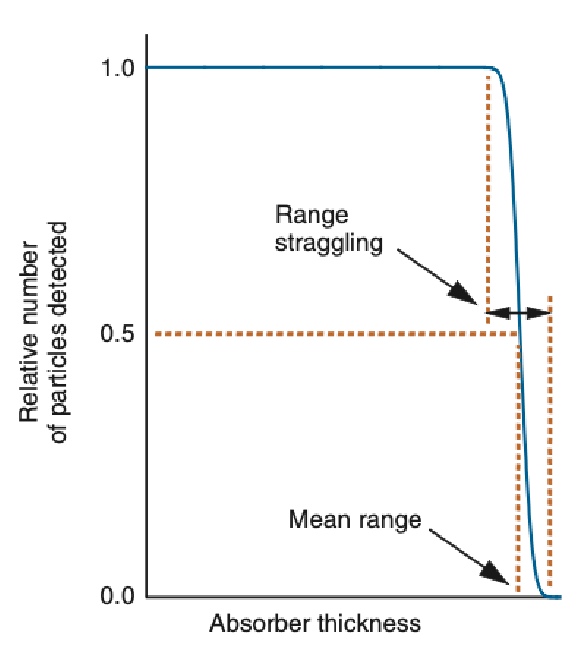
How is the range of a group of electrons determined?
Electrons do not travel in a straight line and ranges are variable, so it is defined by the extrapolated range which is slightly less than the maximum range. This is usually specified as the maximum beta particle range.
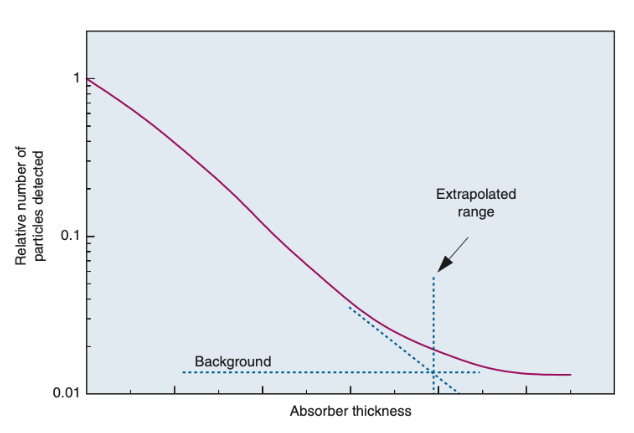
What is HVL?
The thickness required to stop 50% of the particles
What are the four possible interaction types between photons and matter that are significant in nuclear medicine?
Photoelectric effect
Compton scattering
Pair production
Rayleigh scattering
Describe the photoelectric effect
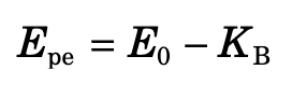
A photon transfers all of its energy to an atom, which then ejects one of its orbital electrons. The kinetic energy of the electron is the photon energy minus the binding energy.
(Trick: the photon comes first, then the electron)
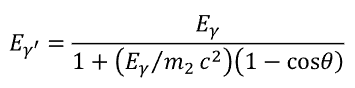
Describe Compton scattering
An incident photon collides with a loosely-bound “free” orbital electron. The energy of the scattered photon is given in the formula and the recoil energy of the electron can be found by using this with conservation of energy.
Describe pair production
A photon annihilates near a nucleus and produces a positron-electron pair. This requires 2mec2 to create the pair, so there is a threshold at 1.022 MeV.

What happens when a positron comes to a complete rest?
It gets two photons each at 0.511 MeV at 180 degree angle
What is the primary reason for deposition of energy in matter?
The produced high-energy electrons
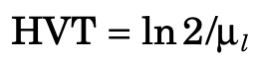
What is the half-value thickness formula?
What is the transmission factor?
The fraction of beam intensity transmitted by an absorber, or the e-mulx term in the intensity formula
What is the buildup factor B?
The factor by which transmission is increased in broad-beam conditions
What are the three types of radiation detectors?
Gas-filled
Semiconductor
Scintillation
Most gas-filled detectors are ___ detectors
ionization
What are the three types of gas-filled detectors?
Ion chambers
Proportional counters
Geiger-Muller Counters
How do semiconductor detectors work?
With ionizing radiation, the electrical charge produced can be collected by an external applied voltage. The semiconductor disc has electrodes attached to its opposite faces for charge collection
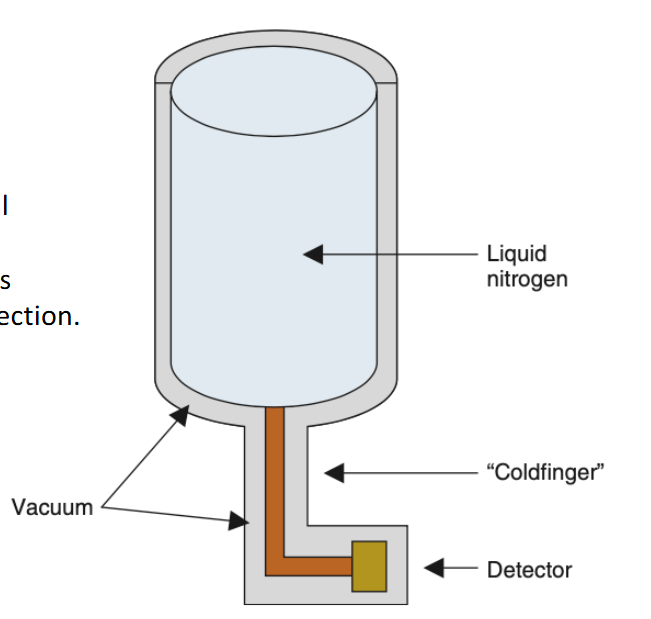
What are two problems with semiconductor detectors?
Thermally induced noise current at room temperature means detectors should typically operated at low temperatures'; Impurities capture electrons, reducing the signal
How do scintillators work?
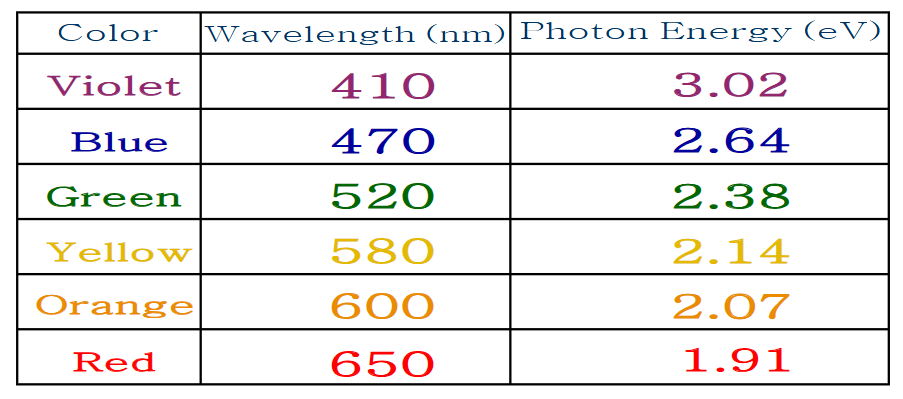
A portion of radiation energy is released as visible light in scintillator materials; the amount of light produced is proportional to the amount of energy deposited by the incident radiaiton
How do photomultiplier tubes work?
A high speed photoelectron strikes dynodes, which eject several secondary electrons along a path that will eventually hit the anode
What are inorganic scintillators? Which one is most commonly used in nuclear medicine?
Crystalline solids that scintillate due to their crystal structure— most are impurity-activated; Sodium Iodide NaI(Tl)
What are three considerations when choosing an inorganic scintillator for nuclear medicine purposes?
The ability to stop high energy gamma rays is important
High Z detector materials are generally more efficient for detecting high energy gamma rays
Faster light production mans faster decay time, which results is better timing precision and higher event rates
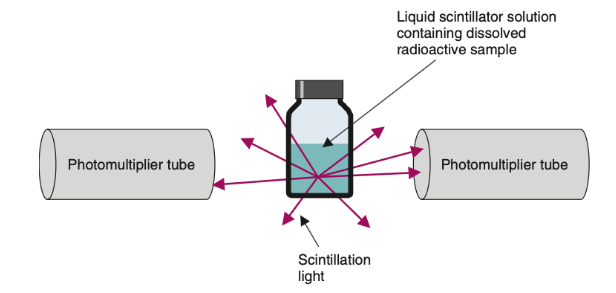
What is the most common type of organic scintillator and what is it used for?
Liquid scintillation (LS) counting; It is used to detect low-energy photons
Most radiation detectors in nuclear medicine are operated in (pulse/continuous) mode
Pulse
What are the three main purposes of a preamplifier?
Amplify the signal
Match impedance between detector and components
Shape the signal pulse
What are the two types of pre-amplifier?
Voltage-sensitive (DC) and charge-sensitive (AC)
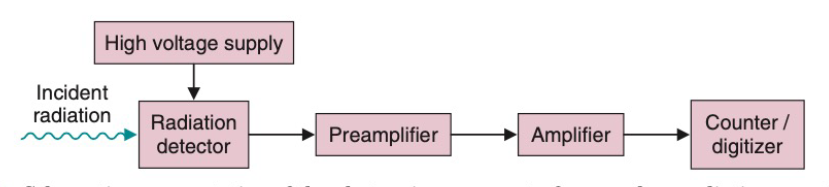
What are the electronic components for a nuclear radiation counting system?
Voltage supply, detector, pre-amp, amplifier, counter
What are the two major functions of the amplifier?
Amplify the preamp pulse
Reshape preamp pulse
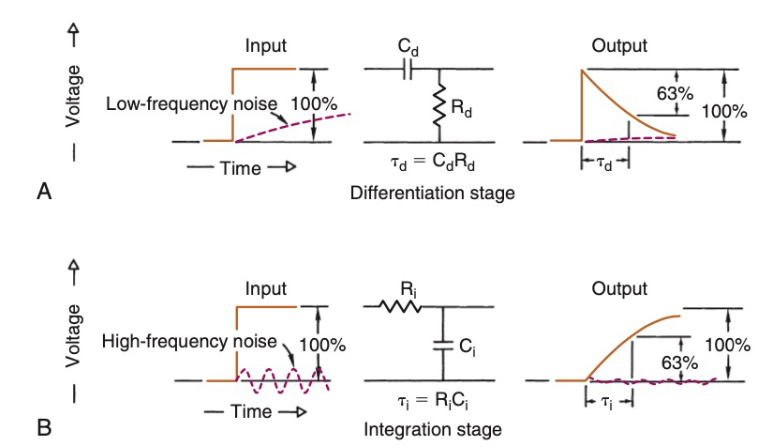
What is the most common method for amplifier pulse shaping?
Resistor-capacitor shaping, either CR (differentiation) or RC (integration)
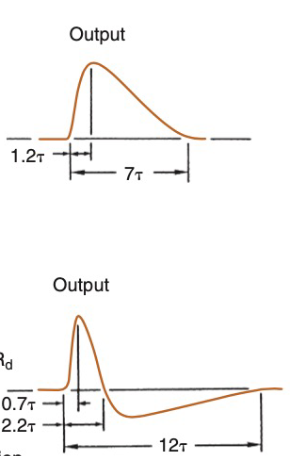
What are the two types of output for a pulse-shaping circuit combining differentiation and integration stages?
Unipolar output (almost no negative voltage)
Bipolar pulse (shorter, positive and negative voltage)
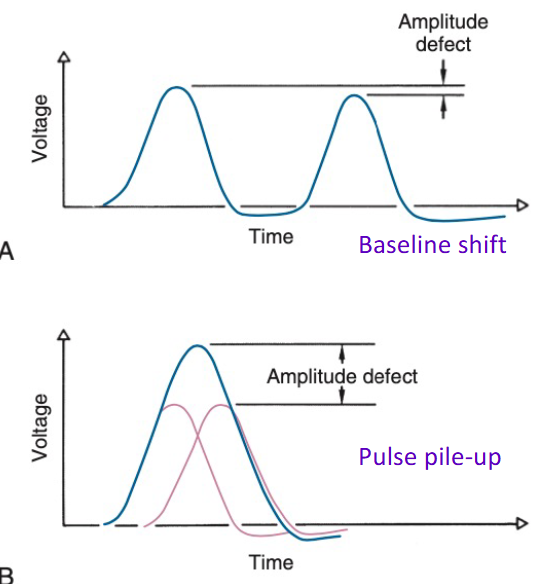
What are two practical problems for amplifiers at high counting rates?
Baseline shift: a negative voltage component causes an apparent decrease in energy in the next pulse
Pulse pile-up: two pulses occur so close together that they fall on top of each other
What is a pulse-height analyzer and what are its two types?
It determines the energy of a radiation event by examining the amplitude of the amplifier output pulse; single-channel analyzer (SCA) and multi-channel analyzer (MCA)
What are single-channel analyzers used for and what are their three components?
SCAs are used to select an energy range for counting; lower-level discriminator (LLD), upper-level discriminator (ULD), and an anticoincidence circuit
What are two types of timing methods in pulse-height analysis?
Leading-edge timing: rising portion of input pulse triggers LLD
Zero-crossover timing: output pulse occurs when input bipolar pulse crosses 0
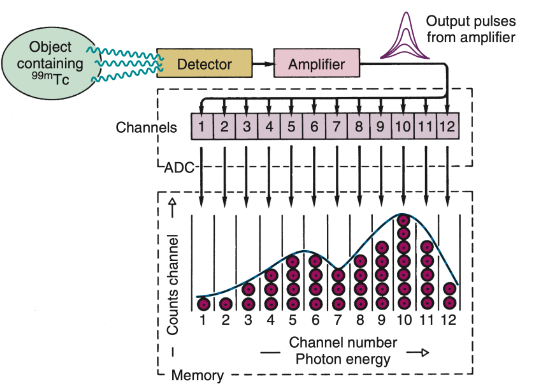
What feature does a MCA have that an SCA does not? What does it do and what is its range of channels?
Analog-to-digital converter (ADC). It measures and sorts out incoming pulses according to their amplitudes then categorizes them into a finite number of discrete intervals; 100 to 216
What are the three types of measurement errors?
Blunders: Statistical tests can be used to determine whether suspect value may be discarded
Systematic errors: e.g. measurements with a warped ruler
Statistical errors: errors present in the measurement of stochastic quantities
What is true of the average count for a large number of measurements?
It is approximately equal to the true count
What does the variance equal in a Poisson distribution?
The average number of counts
Under what condition can the Poisson distribution be approximated by the Gaussian distribution?
When the mean is large, i.e. when variance equals the true count
What approximation can be made in the Gaussian distribution?
The expectation value is equal to the true count
How is the confidence interval determined?
By ±𝜎 from 68%, 95%, to 99.7% for ±𝜎, ±2𝜎, and ±3𝜎 respectively
What is the formula for percentage uncertainty?
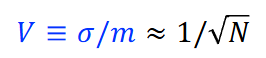
Where is probable error in N defined?
At the 50% or 0.675σ confidence interval
What is the formula for variance when there are additional sources of random error?
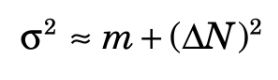
What is the percentage uncertainty for the product or ratio of a series of measurements?
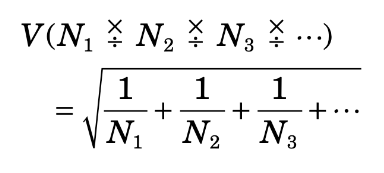
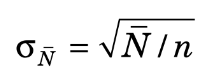
What is the uncertainty in an average number of counts?
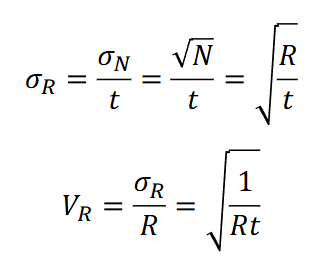
What is the uncertainty and percentage uncertainty in counting rate?
In general, a difference of ___ is considered to be of marginal statistical significance
< 2σ
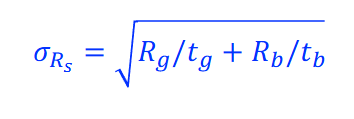
What is the uncertainty of the net sample counting rate?
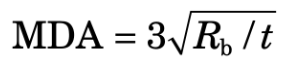
What is the minimum detectable activity?
The activity that gives a counting rate as 3σ of the background rate
For small backgrounds, (the background and counts/only the counts) matter, and for large backgrounds, (the background and counts/only the counts) matter
only the counts; the background and counts
What is the relationship between percentage uncertainty and uncertainty in terms of counting rates?
Percentage uncertainty = uncertainty/counting rate
What is the condition for distribution of gross and background counting times that gives minimum uncertainty?
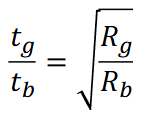
What is the chi-squared test and what is an acceptable range for values within it?
It tests whether observed results significantly differ from expected results; 0.05 < P < 0.95
What does a very low and a very high P value indicate?
Low: suggests additional sources of random error
High: likely a blunder
What does the t-test measure?
The significance of the difference between the means of two sets of data
In terms of the t-test, what does the P-value determine?
The probability that two sets of data share the same underlying distribution
What is the Thompson criterion and what does it do?
It determines whether it is reasonable to discard an outlier
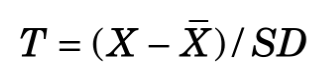
What does the amplitude of the signal from the detector reflect?
The amount of energy deposited in it by the radiation event
What is the most commonly used detector in nuclear medicine?
An NaI(Tl) scintillator
What is the typical deposition of energy in a detector from a photoelectron interaction?
Most photoelectron interactions result in full deposition of the gamma-ray energy. This leads to a photopeak at Eγ
How much energy is deposited in the detector from a single Compton scattering event?
Anywhere in the range from approximately 0 to maximum Ece. This leads to the Compton regions, including the compton edge at Ece
Where do multiple compton scattering events lie on the pulse-height spectrum?
In the valley between the Compton edge and the photopeak
What is present in the actual pulse-height spectrum that is not in the ideal spectrum? Why does this occur?
The backscatter peak; due to gamma rays that have been 180-degree Compton-scattered toward the detector
At what energies do the single and double escape peaks occur and why?
At Eγ-0.511MeV and Eγ-1.022 MeV respectively. This results from one or two (resp.) photons escaping from the detector after pair production
With increasing detector size, counts in the Compton region (increase/decrease) and the valley between compton and photoelectric becomes (shallower/deeper)
Decrease; deeper
With increasing gamma-ray energy, counts in the Compton region (increase/decrease)
Increase
How is energy resolution expressed?
FWHM divided by photopeak energy
What is a major advantage of semiconductor detectors?
Superb energy resolution
What is detection efficiency?
Efficiency with which a radiation-measuring instruments converts emissions from the source to useful signals from the detector
What are the four factors affecting detection efficiency?
Geometric efficiency
Intrinsic efficiency (detector conversion of radiation into signal)
Fraction of output signals that are counted
Absorption and scatter before reaching detector
What is the geometric efficiency for a detector with surface area A facing a small source?
gp ≈ A /(4πr2)
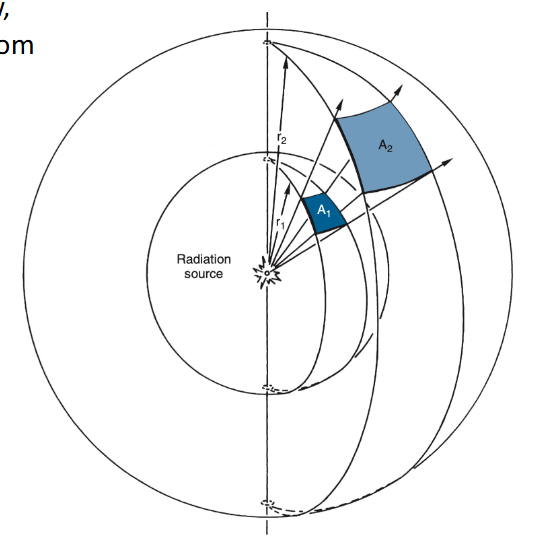
What is the geometric efficiency when the source is close to the detector?
gp ≈ (1-cos θ)/2
What is intrinsic efficiency?
The ratio of number of radiations interacting with detector to the number of radiations striking the detector
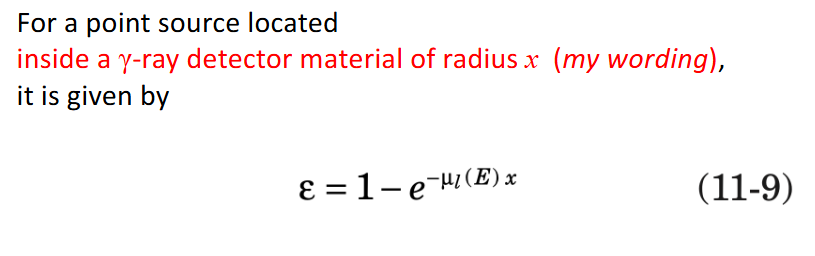
What is a calibration source?
A source with accurately known activity which should accurately simulate the shape and distribution of the measured source; used to determine detection efficiencies experimentally
What causes dead time?
Dead time occurs because time is required to process individual detected events, so the observed counting rate is less than the true counting rate
Most radiation detectors behave as paralyzable systems. What does this mean?
Every event introduces a dead time regardless of if the event is counted or not
What is the configuration of the NaI(Tl) scintillation detector?
Standard well-counter
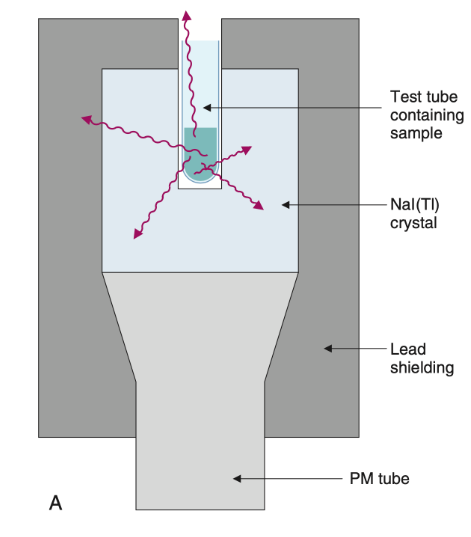
In NaI(Tl) detectors, energy resolution is (poor/good) and detection efficiency is (low/high)
Poor; high
How is the activity of a sample measured using a mock source?
The activity of the sample can be found by multiplying the known activity of the mock source by the ratio of sample to mock counting rates;
[Make sure to account for differing emission frequencies (gamma rays/disintegration)]
![<p>The activity of the sample can be found by multiplying the known activity of the mock source by the ratio of sample to mock counting rates;</p><p></p><p>[Make sure to account for differing emission frequencies (gamma rays/disintegration)]</p>](https://assets.knowt.com/user-attachments/91051323-bbb3-40ac-9875-d3dd5d368e8a.png)
How is energy selection accomplished in a well detector?
Using an SCA and checking response regularly with a long-lived standard source
How does a through-hole detector work?
Automated sample changers go into the detector; sample and blank vials are alternated to automatically record background counting rates
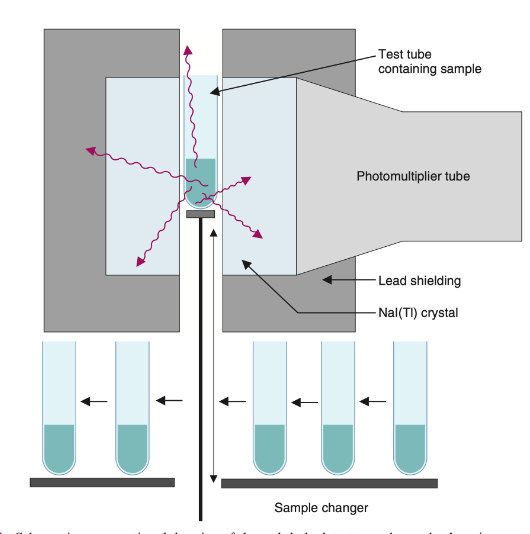
What are two main restrictions of NaI(Tl) well counters?
They are useful only for small sample volumes and small amounts of activity