Enzyme Regulation
 Call Kai
 Learn
Learn Practice Test
 Spaced Repetition
 Match
Match Flashcards
 Knowt Play
1/14

There's no tags or description
Looks like no tags are added yet.
Name | Mastery | Learn | Test | Matching | Spaced | Call with Kai |
|---|
No analytics yet
Send a link to your students to track their progress
15 Terms
Why does the body regulate enzymes?
Because cells need to control how fast metabolic pathways run
Without regulation…
Too much product can be made
Energy/resources get wasted
Cell balance is disrupted
Two ways enzyme activity is regulated
Regulation of gene expression
—→ Controls how much enzyme is made
Regulation of enzyme activity
—→ Changes activity of enzymes already present
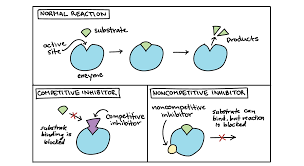
Competitive Inhibition
A molecule competes with the substrate for the active site
Inhibitor looks similar to substrate
Blocks substrate from binding
Slows reaction
Why does increasing substrate concentration reverse competitive inhibition?
Because more substrate molecules outcompete the inhibitor for the active site
More substrate = better chance the substrate binds instead
Noncompetitive Inhibition
Inhibitor binds somewhere other than active site
This changes enzyme shape —→ active site works poorly
They bind to allosteric site = non-direct change to active site
Irreversible Inhibition
Inhibitor permanently disables enzyme by forming covalent bonds
Enzyme can’t function again
Covalent bonds with key amino acids = so strong the enzyme can’t break them
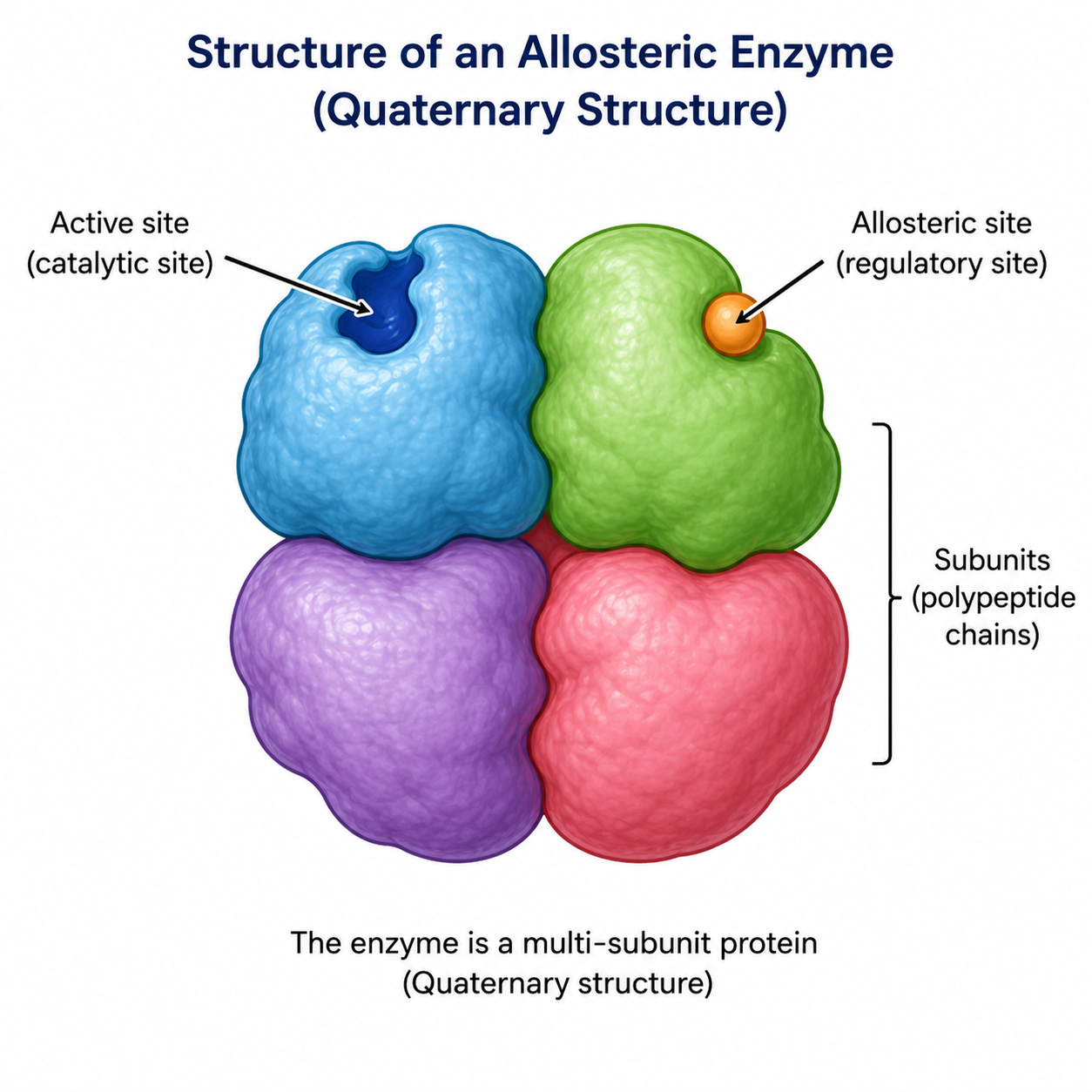
Allosteric Site
A separate spot on an enzyme
A regulator molecule binds to it = changing the enzyme’s activity
Changes enzyme shape
Turns enzyme OFF or ON
Why do many allosteric enzymes have quaternary structure?
Because they often have:
Regulatory subunits
Catalytic subunits
What is Feedback Inhibition?
When the end product of a pathway STOPS the first enzyme from working
Prevents overproduction of product
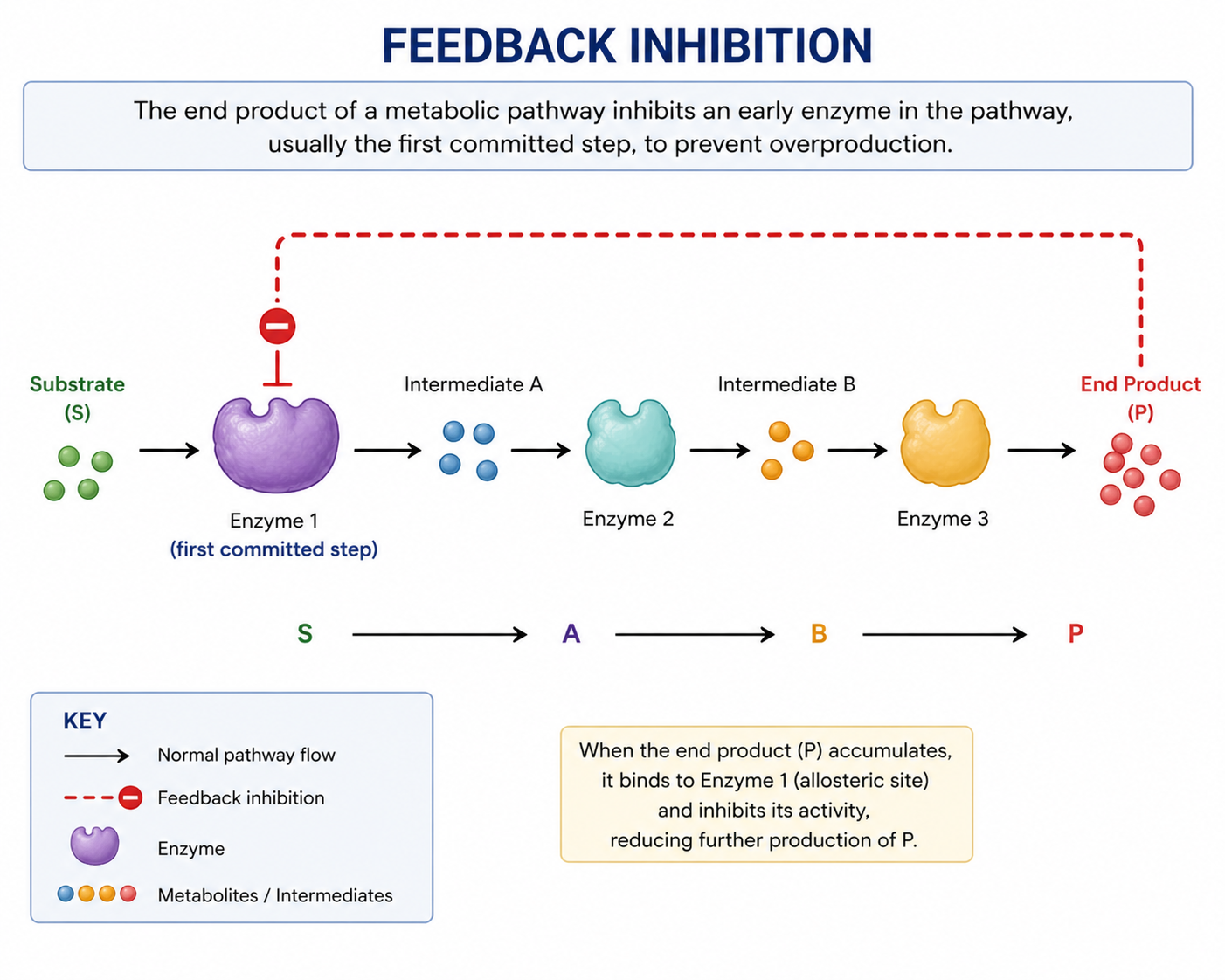
Why is feedback inhibition important?
Prevents waste
Saves energy
Prevents overproduction of product
Maintains balance
ATP Feedback
When a cell has plenty ATP…
ATP binds to enzyme (in its own production pathway) —→ enzyme changes shape —→ pathway slows down —→ less ATP made —→ ATP levels drop —→ enzyme reactivates —→ STARTS AGAIN
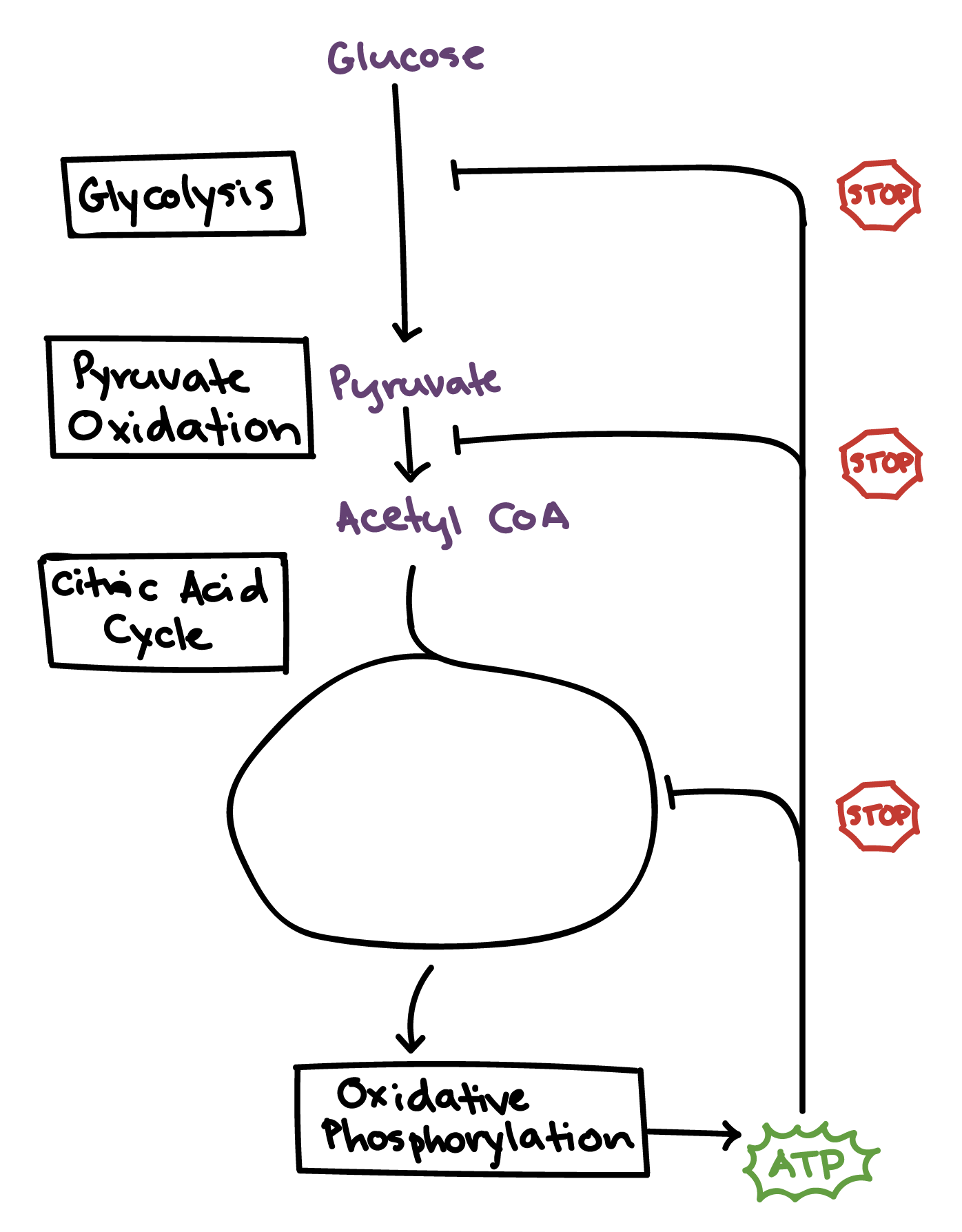
Phosphofrucktokinase (PFK)
Regulates glycolysis
Activated by Adenosine monophosphate (AMP)
Inhibited by ATP
Inhibited by Citrate
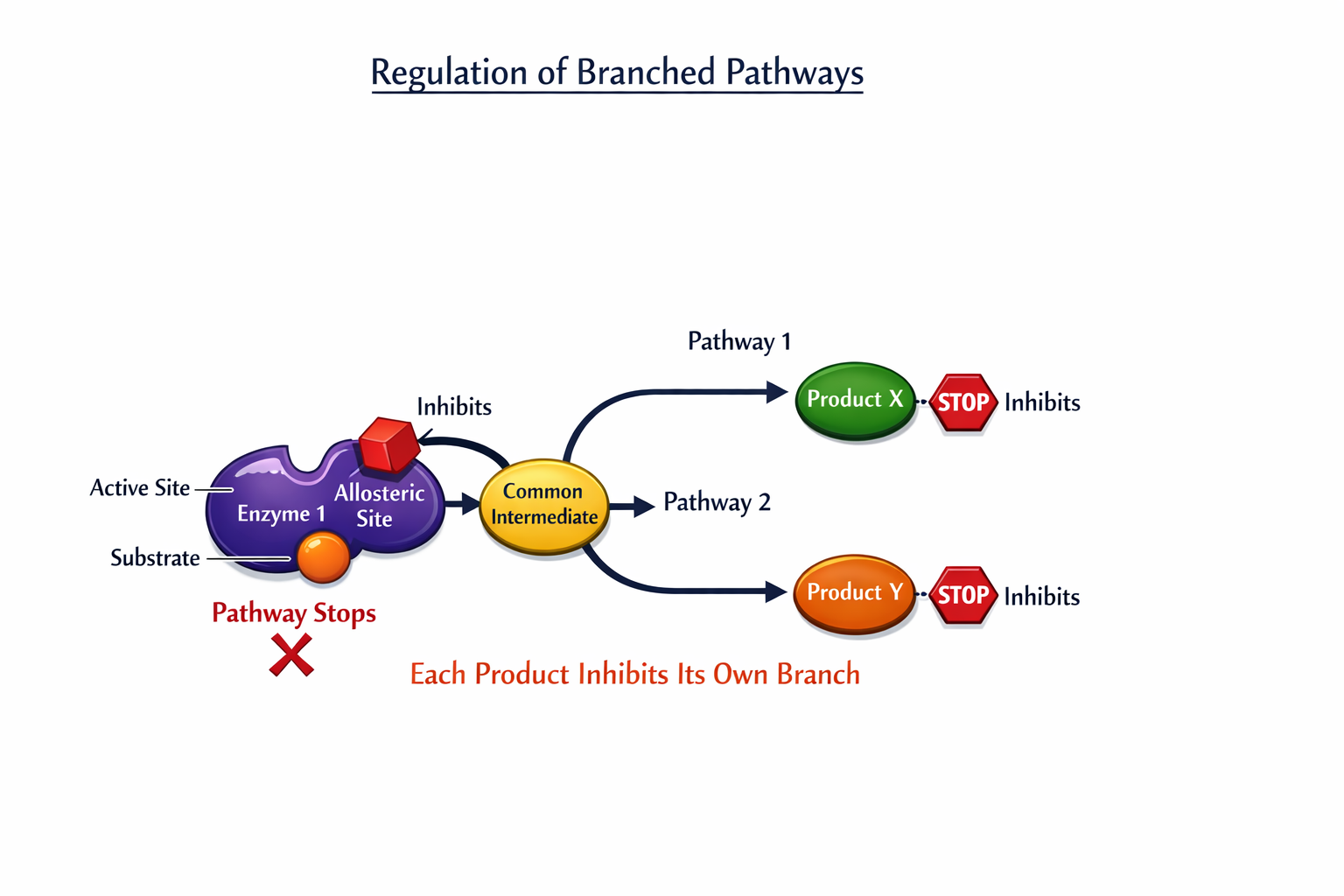
How are branched pathways regulated?
Different end products inhibit their own pathways
Positive Feedback
When a product or signal increases its own production —→ making the process go faster
Negative Feedback
When a product or signal slows down or stops its own production —→ keep things balanced