QB for 2 questions or less
 Call Kai
 Learn
Learn Practice Test
 Spaced Repetition
 Match
Match Flashcards
 Knowt Play
1/158

There's no tags or description
Looks like no tags are added yet.
Name | Mastery | Learn | Test | Matching | Spaced | Call with Kai |
|---|
No analytics yet
Send a link to your students to track their progress
159 Terms
A dialysis technician is providing care for a client with chronic renal failure. The technician would recognize which of the following characteristics of healthy kidneys? Select all that apply.
A) The kidneys are contained within the peritoneal cavity.
B) Blood vessels, nerves, and ureters all connect with the kidney at the hilus.
C) The medulla of the kidney contains the glomeruli.
D) Each kidney consists of lobes, with each lobe comprised of nephrons.
E) Each nephron contains several hundred glomeruli that perform filtration.
B, D
Feedback: The hilus is the point of nerve and blood input and urine output for each kidney, and each kidney is composed of up to 18 lobes. The kidneys are outside the peritoneal cavity, and glomeruli exist in the outer cortex. Each nephron contains just one glomerulus.
A patient in the ICU has been diagnosed with hypovolemic shock. His BP is 88/53, heart rate 122, and respiratory rate 26. Given these vital signs, the nurse should expect the urine output to be
A) maintained between 30 and 50 mL/hour with no sediment in the bag.
B) increased to 60+ mL/hour with dilute urine.
C) decreased below 30 mL/hour with decreased GFR.
D) the patient's normal amount with dark, concentrated urine.
C
Feedback: Under conditions of decreased perfusion or increased sympathetic nervous system stimulation, blood flow is redistributed away from the cortex toward the medulla. This redistribution of blood flow decreased glomerular filtration while maintaining the urineconcentrating ability of the kidneys, a factor that is important during conditions such as shock. The urine output would not increase, nor be normal.
At which of the following locations in the nephron would a health care professional first expect blood to be largely free of plasma proteins?
A) Proximal convoluted tubule
B) Bowman space
C) Loop of Henle
D) Afferent arteriole
B
Feedback: Active filtration occurs when the whole blood enters via the afferent arteriole in to the glomerular capillaries, and the blood is then filtered into the Bowman space, removing plasma proteins. The filtrate that enters the proximal convoluted tubule and the loop of Henle is already free of plasma proteins.
Which of the following statements about mesangial cells within the glomerulus is accurate? Select all that apply. Mesangial cells
A) cover the entire amount of endothelial cells contained within the capillaries.
B) have phagocytic properties that remove macromolecular materials.
C) exhibit vasodilator properties to assist with increase in blood flow in times of stress.
D) enlarge (hyperplasia) in response to glomerular diseases.
E) are coiled and drain Bowman capsule.
B, D
Feedback: Mesangial cells possess phagocytic properties and remove macromolecular materials that enter the intercapillary spaces. Mesangial cells also exhibit contractile properties in response to neurohumoral substances and are thought to contribute to the regulation of blood flow through the glomerulus. Mesangial hyperplasia and increased mesangial matrix occur in a number of glomerular diseases. The nephron tubule, called the proximal convoluted tubule, is coiled and drains the Bowman capsule
A nurse educator is orientating new nurses to a renal unit of the hospital. Which of the following teaching points should the nurse include as part of a review of normal glomerular function?
A) “Nephrons are delicate structures that cannot endure the high pressure that exists in capillary beds elsewhere in the body.”
B) “Glomerular filtrate is very similar in composition to blood plasma found elsewhere in circulation.”
C) “Dilation of the afferent arteriole allows more blood into the nephron and increases the glomerular filtration rate.”
D) “The glomerulus is located between an arteriole and a venule that work together to regulate blood flow.”
B
Feedback: Because filtration achieves the removal of nearly all blood proteins, the glomerular filtrate is nearly identical to plasma. Nephrons require high pressure to function, and dilation decreases the glomerular filtration rate. The glomerulus is located between two arterioles.
While assessing a patient with urosepsis, the ICU nurse notes the patient's BP is 80/54; HR 132; RR 24; and pulse oximetry 89% on 6 lpm O2. Over the last hour, the patient's urine output is 15 mL. When explaining to a new graduate nurse, the nurse will emphasize that the patient's status may relate to that
A) the infection is deep inside the kidney, and it will take a long time for the antibiotics to kill the bacteria.
B) the patient's sympathetic nervous system has been stimulated that has resulted in vasoconstriction of the afferent arteriole, which causes a decrease in renal blood flow.
C) the glomerular filtration system gets overwhelmed in times of stress (like infections) and can become clogged with waste material from the bacteria.
D) the ability to transport substances from the tubular fluid into the peritubular capillaries becomes impaired, which results in fluid being forced out of capillaries into the glomerulus.
B
Feedback: During periods of strong sympathetic stimulation, such as shock, constriction of the afferent arteriole causes a marked decrease in renal blood flow and thus glomerular filtration pressure. Consequently, urine output can fall almost to zero.
Which of the following substances is most likely to be reabsorbed in the tubular segments of the nephron using passive transport mechanisms?
A) Water
B) Sodium
C) Phosphate
D) Calcium
A
Feedback: Water is passively reabsorbed across tubular epithelial membranes, while ions like sodium, phosphate, and calcium necessitate active transport.
When explaining to a class of nursing students enrolled in pathophysiology, the instructor states, “the majority of energy used by the kidney is for
A) filtration of drugs out of the body.”
B) secretion of erythropoietin for production of RBCs.”
C) active sodium transport mechanisms.”
D) removal of excess glucose from the blood.”
C
Feedback: The bulk of energy used by the kidney is for active sodium transport mechanisms that facilitate sodium reabsorption and cotransport of other electrolytes and substances such as glucose and amino acids.
Damage to which of the following areas of a nephron would most likely result in impaired secretion and reabsorption?
A) Distal tubule
B) Loop of Henle
C) Proximal tubule
D) Collecting tubule
C
Feedback: Approximately two thirds of the absorption and secretion that occur in the tubular system take place in the proximal tubule.
When explaining the role of the proximal tubule in terms of medication administration, the nursing instructor will emphasize that which of the following medications are bound to plasma proteins and require the proximal tubule secretion of exogenous organic compounds to help with filtration? Select all that apply.
A) Penicillin
B) Aspirin
C) Morphine sulfate
D) Potassium chloride
E) Sodium chloride
A, B, C
Feedback: The proximal tubule secretes exogenous organic compounds such as penicillin, aspirin, and morphine. Many of these compounds can be bound to plasma proteins and are not freely filtered in the glomerulus. Therefore, excretion by filtration alone eliminates only a small portion of these potentially toxic substances from the body.
Which of the following statements most accurately captures the function of the ascending loop of Henle?
A) Urine is concentrated by the selective absorption of free water in the ascending limb.
B) Sodium and water are reabsorbed in equal amounts, reducing filtrate quantity but maintaining osmolality.
C) The majority of solute and water reabsorption occurs in the ascending loop of Henle.
D) Impermeability to water and absorption of solutes yields a highly dilute filtrate.
D
Feedback: The osmolality of the filtrate reaches a low of 100 mOsm/kg of water in the ascending limb as a result of its impermeability to water.
To treat enuresis in a young girl, her pediatrician prescribes desmopressin, an antidiuretic hormone (ADH) nasal spray, before bedtime. What is the most likely rationale for this treatment?
A) It removes water from the filtrate and returns it to the vascular compartment.
B) It lessens the amount of fluid entering the glomerulus.
C) It leads to the production of dilute urine.
D) It causes tubular cells to lose their water permeability.
A
Feedback: ADH maintains extracellular volume by returning water to the vascular compartment. This leads to the production of concentrated urine by removing water from the tubular filtrate. In exerting its effect, ADH produces a marked increase in water permeability in tubular cells.
Following an automobile accident where the patient had a traumatic amputation of his lower leg and lost greater than 40% of his blood volume, he is currently not producing any urine output. The nurse bases this phenomena on which of the following humoral substances responsible for causing severe vasoconstriction of the renal vessels?
A) Aquaproin-2 channels
B) Angiotensin II and ADH
C) Renin and potassium ions
D) Albumin and norepinephrine
B
Feedback: Increased sympathetic activity causes constriction of the afferent and efferent arterioles and thus a marked decrease in renal blood flow. Intense sympathetic stimulation can produce marked decreases in renal blood flow and GFR. Humoral substances, including angiotensin II, ADH, and endothelins, produce vasoconstriction of renal blood flow. Aquaporin-2 channels, potassium ions, and albumin do not have vasoconstriction properties.
A physician who is providing care for a 71-year-old male client with a recent diagnosis of renal failure and an acid–base imbalance is explaining some of the underlying etiology of the man's diagnoses to him and his family. Which of the following phenomena would most accurately underlie the teaching that the physician provides?
A) The kidneys are integral to the reabsorption of hydrogen ions and maintenance of a low pH.
B) Blood buffer systems and respiratory control can compensate for inadequate renal control of pH.
C) The kidneys have the primary responsibility for eliminating excess hydrogen ions from the body.
D) pH is kept at an optimal level through the renal secretion of bicarbonate ions in blood filtrate.
C
Feedback: The kidneys have the primary responsibility for maintaining body pH by eliminating excess hydrogen ions from the body, a function that blood buffer systems and respiratory control are incapable of. Hydrogen ions must be eliminated, not retained, and bicarbonate must be produced as part of buffer action, not secreted.
Which of the following clients on a medical unit of a hospital is most likely to be experiencing health problems that may be attributable to kidney disease?
A) An 81-year-old female client with osteoporosis and anemia
B) A 77-year-old client with urinary retention due to benign prostatic hyperplasia (BPH)
C) A 55-year-old woman with a recent stroke secondary to long-standing hypertension
D) A 60-year-old man with a systemic fungal infection requiring intravenous antibiotics.
A
Feedback: The kidneys play central roles in both vitamin D activation and regulation of red blood cell production, deficiencies of which may result in osteoporosis and anemia, respectively. BPH, stroke, and infection are less likely to result from kidney disease.
While living and hiking in the Rocky Mountains, a gentleman slipped and fell. He goes to an urgent care where an x-ray was done, and some blood was drawn for a CBC. The clinic informs him that he is anemic. What may contribute to this person's anemia? Select all that apply.
A) Living in a high altitude
B) Tissue hypoxia
C) Inability to manufacture erythropoietin
D) Destruction of RBCs caused by natural killer cells
E) Dehydration
A, B, C
Feedback: The synthesis of erythropoietin is stimulated by tissue hypoxia, which may be brought about by anemia, residing at high altitudes, or impaired oxygenation of tissues due to cardiac or pulmonary disease. Dehydration will cause an elevated level of RBCs.
Which of the following patients on a geriatric medical unit is most likely to require slow-release potassium supplements on a regular basis?
A) A 90-year-old female who is taking an aldosterone antagonist to treat pulmonary edema
B) An 81-year-old male who takes a thiazide diuretic to control his hypertension
C) A 79-year-old male with heart failure who is receiving a loop diuretic
D) An 83-year-old female who is taking an osmotic diuretic to address severe peripheral edema
B
Feedback: A common side effect of thiazide diuretics is increased potassium losses in the urine, which may necessitate potassium supplementation. Aldosterone antagonists, loop diuretics, and osmotic diuretics are less likely to induce hypokalemia.
A 62-year-old woman with high blood pressure is to begin long-term treatment with a thiazide diuretic that she thinks she will need to take for some time. What should the nurse expect to happen to her potassium and calcium levels?
A) Her potassium and calcium levels will not change.
B) Her potassium and calcium levels will both go down.
C) Her potassium level will drop, but her calcium level may rise.
D) Her potassium level will rise, but her calcium level may drop.
C
Feedback: Thiazide diuretics increase the loss of potassium in urine. Because calcium is actively reabsorbed in the distal convoluted tubule, it is likely that her calcium level will go up, especially if she takes it for a long time.
A patient in a hospital is frustrated at the inconvenience of having to collect his urine for an entire day and night as part of an ordered 24-hour urine collection test. He asks the nurse why the test is necessary since he provided a single urine sample 2 days ago. How could the nurse best respond to the patient's question?
A) “A single urine sample lets your care team determine if there are bacteria in your urine, but other tests of urine chemistry need a longer-term view.”
B) “Current lab tests aren't able to detect the small quantities of most substances contained in a single urine sample.
C) “Only a longer-term test is able to show whether your kidneys are letting sugar spill out into your urine.”
D) “Often why an abnormal substance shows up in urine test, a 24-hour urine collection is needed to determine exactly how much it is present in your urine.”
D
Feedback: Twenty-four–hour urine tests are often used to quantify the amount of substances, such as proteins, that an individual's kidneys are spilling. Single urine samples are able to assess more parameters than just the presence of bacteria, and they are sufficient in quantity to detect numerous substances such as glucose.
Which of the following lab results would be associated with abnormalities in kidney function? Select all that apply.
A) An absence of protein in a urine sample
B) Increased creatinine levels
C) Urine gravity of 1.038 and normal serum creatinine levels
D) Decreased blood urea nitrogen (BUN) level
E) Detectable levels of glucose in a urine sample
F) Elevated cystatin-C level.
B, E, F
Feedback: Increased creatinine and BUN are associated with abnormalities in renal function, as is the presence of glucose in a urine sample. Urine samples normally lack protein and have a specific gravity of 1.038 to 1.040. An elevated BUN coupled with normal creatinine is likely not attributable to impaired kidney function.
Which of the following statements best captures the current understanding of the etiology of mental illness?
A) The role of “nurture,” experiences, and relationships has been largely disproven.
B) Mental illness can be attributed to organic brain changes and pathophysiological processes.
C) Mental illness exists from the interplay of biologic factors and psychosocial influences.
D) Current understanding of mental illness has shown that both biologic psychiatry and psychosocial psychiatry are incorrect.
C
Feedback: Mental illness is currently thought to be the outcome of anatomical and/or physiological influences and psychosocial factors. Neither factor can attribute for 100% of the diagnoses and manifestations of mental illness. Both biologic psychiatry and psychosocial psychiatry have their merits and demerits; neither is wholly incorrect.
As part of a diagnostic workup of a 22-year-old male with recently diagnosed schizophrenia, a neurologist wants to examine the levels of metabolic activity in particular areas of the client's brain. Which of the following diagnostic procedures is the physician most likely to order?
A) Computed tomography (CT)
B) Electroencephalography (EEG)
C) Magnetic resonance imaging (MRI)
D) Positron emission tomography (PET)
D
Feedback: PET is rooted in the selective brain uptake of radiolabeled isotopes. As such, it can measure brain metabolic activity. CT and MRI offer visualization of structural components, while EEG measures electrical activity.
An adult, who was sexually abused as a child, has been displaying some stress. She seems to complain of increasing medical problems when she is under more stress. The nurse would classify this as an example of
A) vitamin deficiency.
B) the stress–diathesis theory.
C) mendelian research.
D) parental disassociation.
B
Feedback: The stress–diathesis model of psychiatric disorders evolved from a recognition that genetics (diathesis) and environment (stress) both contribute to the development of psychiatric disorders. Adults who report significant traumatic experiences such as an emotional, physical, or sexual abuse as children show a graded positive response; that is, the more trauma experienced, the more both medical and mental illness occur later in life. Vitamin deficiency has not been implicated as a cause of increasing medical complaints when experiencing stress. Mendelian research studies genetics and describes the way in which genes modulate behavior and psychological traits. Parental nurturing mediates this epigenetic response, but in the absence of nurturing (dissociation), children have difficulties with attention and following directions. As teenagers, they are more likely to engage in high-risk behaviors and, as adults, show increased aggression, impulsive behavior, weakened cognition, and an inability to discriminate between real and imagined threats.
A toddler brought up in a chaotic, nonnurturing environment may suffer neurological consequences if the parent does not achieve attachment with the child. The nurse knows that which of the following nervous systems listed below is the first to respond to the safety needs of the child?
A) Parasympathetic nervous system
B) Autonomic nervous system
C) Sympathetic nervous system
D) Limbic system
C
Feedback: If the ventral vagus is utilized and fails to provide safety, the SNS is recruited first. The other distracters are not the first to respond.
A student notices that at certain times during his studying for final exams, he is more awake and his ability to think at a higher level is happening easier. The nurse knows that this experience may be attributed to which of the following neurological functions?
A) Release of excitatory neurotransmitters such as glutamate
B) Release of GABA, an inhibitory neurotransmitter
C) Release of corticotrophin-releasing hormone
D) Heightened precortex processes
A
Feedback: Excitatory neurotransmitters such as glutamate increase the probability that the target cell will fire an action potential by mediating the depolarization of the target cell. Excitatory transmitters serve as the body's stimulants promoting wakefulness, energy, and activity through regulating many of the body's most basic functions, including thought processes, higher thinking, and sympathetic activity. Distracters B, C, and D do not play a role in this process.
Parents of a 16-year-old male who has been behaving in increasingly bizarre ways in recent months are distraught that he has been diagnosed with schizophrenia. Which of the mother's following statements about her son's diagnosis demonstrates an accurate understanding of the disease?
A) “It's disturbing to know that what I did when I was pregnant and the way we raised him contributed to this.”
B) “We are somewhat relieved that psychotherapy and a supportive environment will resolve most of the positive and negative symptoms.”
C) “This makes us even more worried about his younger brother and whether he might develop schizophrenia.”
D) “We're committed to lovingly but firmly convincing him that his delusions aren't based in reality.”
C
Feedback: The risk of developing schizophrenia is much higher in individuals with a first-degree relative who has the disease. Prenatal behavior and child-rearing techniques are not strongly linked with the development of schizophrenia, and therapy and support alone are not likely to eliminate symptoms. Delusions are not normally amenable to reason
Which of the following is a negative symptom of schizophrenia?
A) Hallucinations
B) Incoherence
C) Word salad
D) Affective flattening
D
Feedback: The negative symptoms of schizophrenia reflect the absence of normal social and interpersonal behaviors and include alogia (tendency to speak very little), avolition (lack of motivation for goal-oriented activity), apathy, affective flattening (lack of emotional expression), and anhedonia (an inability to experience pleasure in things that ordinarily are pleasurable). Positive symptoms are those that reflect the presence of abnormal behaviors and include disorganized, incomprehensible speech; delusions (e.g., that one is being controlled by an outside force); hallucinations (hearing voices is the most common); and grossly disorganized or catatonic behavior.
During an acute phase of schizophrenia when the patient is experiencing hallucinations and delusions, the nurse should anticipate that the physician will prescribe which of the following medication categories listed below?
A) An antipsychotic like risperidone
B) A benzodiazepine like lorazepam
C) A cholinesterase inhibitor like donepezil
D) An opioid receptor antagonist like naltrexone
A
Feedback: Pharmacological treatment with antipsychotics is often helpful particularly with the positive s/s of schizophrenia (delusion, hallucinations, agitation, etc.). The negative s/s of schizophrenia respond more favorably to the atypical antipsychotic drugs. Often antipsychotics are combined with benzodiazepines or antiparkinson agents during the acute phase of treatment to reduce the risk of extrapyramidal effects from large doses of antipsychotic agents. Distracters B and C are prescribed for Alzheimer disease and D is used for alcohol addiction.
Which of the following clinical manifestations would the nurse assess in the patient with bipolar disorder who is experiencing mania? Select all that apply.
A) Labile mood
B) Highly distractible
C) Inflated self-esteem
D) Despondent when asked questions
E) Excessive sleepiness
A, B, C
Feedback: Clinical manifestations of mania include decreased need for food and sleep, labile mood, irritability, racing thoughts, high distractibility, rapid and pressured speech, inflated self-esteem, and excessive involvement with pleasurable activities. Despondency is a symptom of the depressive phase.
A 44-year-old female has been diagnosed with major depression. Which of the following neuroimaging findings is most congruent with the woman's diagnosis?
A) Decreased brain activity in the pons and brain stem
B) Reduced activity and gray matter volume in the prefrontal cortex
C) Atrophy and decreased blood flow in the amygdala
D) Enlargement of the lateral and third ventricles and reduction in frontal and temporal volumes
B
Feedback: In some cases of familial major depressive disorder and bipolar disorder, PET and MRI studies have demonstrated a reduction in the volume of gray matter in the prefrontal cortex, with an associated decrease in activity in the region. Brain stem involvement is not common, and the amygdala tends to have increased blood flow and oxygen consumption during depression. Enlargement of the lateral and third ventricles and reduction in frontal and temporal volumes are associated with schizophrenia.
After surviving an ischemic stroke, a 79-year-old male has demonstrated significant changes in his emotional behavior, with his family noting that he now experiences wide mood swings with exaggerated responses of empathy, anger, and sadness to situations. His care team would most likely attribute these responses to ischemic changes in which of the following brain structures?
A) The man's occipital lobe
B) The client's temporal lobe in general and Wernicke area in particular
C) The man's parietal lobe
D) The components of the client's limbic system
D
Feedback: The neural structures that constitute the limbic system are primarily responsible for the regulation of emotion. Clinical studies have suggested that this area of the brain is important for mood states and has extensive connections with the limbic system. The occipital lobe interprets visual information, while language is the domain of the Wernicke area. The parietal lobe processes sensory input.
A 20-year-old college student has presented to his campus medical clinic because of his unshakable despondency in recent months. He has been diagnosed with depression based on his signs, symptoms, and history. The nurse knows that which of the following treatments will likely be prescribed for this student?
A) Medication that inhibits the reuptake of serotonin in his presynaptic space
B) Drugs that inhibit the accumulation of cyclic adenosine monophosphate (cAMP)
C) Benzodiazepines such as clonazepam that modulate his GABA receptors.
D) Cholinesterase inhibitors that potentiate the action of available acetylcholine
E) Antipsychotics such as olanzapine
A
Feedback: SSRIs are common pharmacologic treatment modalities for depression. Drugs that inhibit the accumulation of cyclic adenosine monophosphate (cAMP) (answer B) are usually used in the treatment of bipolar depression. Benzodiazepines address anxiety, while cholinesterase inhibitors are used in the treatment of dementia. Antipsychotics are more often used in cases of schizophrenia.
A psychiatrist is providing care for a 68-year-old female whose anxiety disorder is significantly decreasing her quality of life. The nurse knows that the client will likely benefit from which of the following pharmacologic therapies listed below?
A) A drug that influences gamma-aminobutyric acid (GABA) levels
B) An MAO inhibitor to increase the concentration of serotonin and norepinephrine
C) An antipsychotic medication that blocks dopamine receptors
D) A calcium channel–blocking agent
A
Feedback: GABA is often implicated in anxiety disorders, and benzodiazepines address this neurotransmitter. An MAO inhibitor increases the concentration of serotonin and norepinephrine. MAO inhibitors are occasionally prescribed for depression not responding to SSRIs and would not be indicated for an anxiety disorder. Calcium channel blockers are good for lowering BP and minimizing arterial spasms but are usually not prescribed for anxiety.
A woman has a long-running compulsion to repeatedly check if the doors of her home are locked and has received a diagnosis of obsessive–compulsive disorder (OCD). Her husband is at a loss to understand her irrational behavior and has sought help from a therapist himself to deal with the effect that his wife's OCD is having on their daily lives. Which of the husband's following statements would require correction?
A) “It's a relief to know that this can be changed if she continues with therapy and the medications she's been prescribed.”
B) “It's odd that someone like her and someone who's depressed might both respond positively to the same drugs.”
C) “I thought that this was something exceedingly rare, but I'm actually a bit relieved to learn that others have this disorder as well.”
D) “I'm glad that this is something that's a result of life stressors and is not associated with any dysfunction in her brain.”
D
Feedback: OCD is thought to have a neurophysiological component and is not a consequence of stress. Medications combined with behavioral therapy provide a good prognosis, and SSRI antidepressants are often used. OCD has a prevalence of 2%.
A 50-year-old woman has experienced devastating consequences in her family and work life as a result of her long-standing alcohol addiction. The levels and pathways of which of the following neurotransmitters in her body are likely to differ from an individual without addiction?
A) Dopamine
B) Acetylcholine
C) Serotonin
D) Norepinephrine
A
Feedback: Dopamine levels are thought to be altered in addiction and possibly contribute to addiction. Acetylcholine, serotonin, and norepinephrine are not noted to play a central role in the neurophysiology of addiction.
The nurse knows that the patient admitted for opioid addiction may benefit from which of the following treatment modalities? Select all that apply.
A) Prescription for dolophine (Methadone)
B) Administration of a long-term pain reliever like duragesic (Fentanyl)
C) Involvement in a self-help group like Opioid Anonymous (an offshoot of Alcoholics Anonymous)
D) Intense exercise therapy under supervision of a body builder
E) Administering beta-blocking medications to minimize agoraphobia symptoms
A, C
Feedback: Methadone, used in opiate addictions, has the narcotic properties of addiction and sedation, but lacks the euphoric effects of heroin. Naltrexone is used in treatment of alcohol and opiate addictions and works by blocking the opioid receptors and euphoric effects. Fentanyl is a pain medication, and Benadryl is an antihistamine.
Which of the following statements on the final diagnostic report regarding a computerized tomography (CT) of the head with contrast would lead health care providers to diagnose a patient with Alzheimer disease?
A) Large area of ischemia noted in the temporal lobe
B) Too numerous to count beta-amyloid (βA) deposits noted
C) Ninety percent obstruction in the posterior cerebral artery
D) Mural thrombus of vertebrobasilar arteries
B
Feedback: The major microscopic features of Alzheimer disease are the presence of neuritic (senile) plaques, neurofibrillary tangles, and amyloid angiopathy. Distracters A, C, and D are causes for a stroke.
A geriatrician and social worker are facilitating a family meeting for the children and wife of a 79-year-old man who has been diagnosed with Alzheimer disease. What goal of treatment will the clinicians most likely prioritize in their interactions with the family?
A) Modest reversal of brain plaque formation and improved symptomatology through cholinesterase inhibitors
B) Surgical treatment of the underlying ischemic changes that underlie the manifestations of the man's disease
C) The use of medications such as donepezil and rivastigmine to slow the progression of the disease
D) Cognitive and behavioral therapy to counteract the agitation, depression, and suspiciousness associated with Alzheimer disease
C
Feedback: Cholinesterase inhibitors like donepezil and rivastigmine may slow the progression of Alzheimer's but do not reverse the organic brain changes that characterize the etiology. Ischemic changes are associated with vascular dementia, and cognitive therapy is of limited use in treatment.
A 70-year-old woman has been brought to the emergency department by her daughter who noticed the woman is weak, confused, and forgetful in recent months, along with uncoordinated movements and visual disturbances at times. Which of the following questions by the physician are most likely to address her probable diagnosis? Select all that apply.
A) “What medications is your mother currently taking?”
B) “Does your mother drink alcohol?”
C) “Does your mother have a history of stroke?”
D) “Is your mother facing significant stressors right now?”
E) “Is your mother lonely?”
A, B
Feedback: The client's symptoms are characteristic of Wernicke-Korsakoff syndrome, which is associated with alcohol abuse. Medications can cause numerous cognitive and motor disturbances in elderly clients. Prior CVA and stress are less likely to contribute to her symptomatology.
Which of the following is the most likely course of Wernicke syndrome?
A) If the symptoms are correctly diagnosed, most of the effects of the disease can be reversed through better nutrition and supplemental thiamine.
B) Wernicke syndrome is uniformly fatal, with death most often occurring within a few months of onset.
C) Wernicke syndrome has no treatment, but drugs may be used to treat its associated dyskinesias and behavioral disturbances.
D) The course of the disease is relentless, and most affected persons will die of infection within 2 to 10 years.
A
Feedback: Wernicke syndrome is caused by a deficiency of thiamine (vitamin B1), and many of the symptoms are reversed when nutrition is improved with supplemental thiamine.
While batting, a baseball player is struck in the ribs by a pitch. Place the following components of the player's pain pathway in the chronological order as they contribute to the player's sensation of pain. Use all the options.
Thalamus
Dorsal root ganglion body
Dorsal root ganglion periphery
Axon
Cerebral cortex
3,2,4,1,5
Feedback: All somatosensory information from the limbs and trunk shares a common class of sensory neurons called dorsal root ganglion neurons. Somatosensory information from the face and cranial structures is transmitted by the trigeminal sensory neurons, which function in the same manner as the dorsal root ganglion neurons. The cell body of the dorsal root ganglion neuron, its peripheral branch (which innervates a small area of periphery), and its central axon (which projects to the CNS) communicate with the thalamus, which in turn communicates with the cerebral cortex using third-order neurons.
A student is feeling inside her backpack to find her mobile phone. There are a number of other items in the bag other than the phone. The nurse knows that which of the following terms best describes one's ability to sense of shape and size of an object in the absence of visualization?
Stereognosis
Astereognosis
Modalities
Somesthesia
1
Feedback: The sense of shape and size of an object in the absence of visualization is known as stereognosis. Astereognosis is a deficit whereby a person can correctly describe the object but does not recognize it. “Modalities” is a term used for qualitative, subjective distinctions between sensations such as touch, heat, and pain. Somesthesia describes most of the perceptive aspects of body sensation and requires the function of the parietal association cortex.
A woman with severe visual and auditory deficits is able to identify individuals by running her fingers lightly over their face. Which of the following sources is most likely to provide the input that allows for the woman's unique ability?
Pacinian corpuscles
Ruffini end organs
Meissner corpuscles
Free nerve endings
3
Feedback: Meissner corpuscles, which are present on the hair-free areas like palms and fingers, are responsible for fine tactile sensation. Pacinian corpuscles provide input on vibration, while Ruffini end organs exist in deeper structures that signal continuous states of deformation. Free nerve endings also detect touch and pressure, but not to the highly differentiated degree of Meissner corpuscles.
A mother is placing her child into the bathtub. The child immediately jumps out of the tub and begins to cry, stating his feet are “burning.” The nurse in the emergency department knows that the child's response is based on which of the following pathophysiological principles listed below?
Children react much quicker to contact with hot water than adults.
The tactile sensation occurs well in advance of the burning sensation. The local withdrawal reflex reacts first.
It takes a long time for thermal signals to be processed before the brain can send a signal through the spinal cord and tell the foot to withdraw.
The thermal processing center is located on the rapid conducting anterolateral system on the same side of the brain as the injury
2
Feedback: If a person places a foot in a tub of hot water, the tactile sensation occurs well in advance of the burning sensation. The foot has been removed from the hot water by the local withdrawal reflex well before the excessive heat is perceived by the forebrain. All other responses are incorrect.
If the patient's dorsal columns are not functioning, the nurse will observe which of the following responses during neurotesting, where the nurse asks the patient to close his eyes and then proceeds to touch corresponding parts of the body on each side simultaneously with two sharp points?
Grimacing when body touched with sharp points
No response to two-point discrimination
Heightened proprioceptive response
Inability to identify which way his finger was moved during the test
2
Feedback: When comparing the discriminative dorsal column–medial lemniscus pathway with anterolateral tactile pathways with testing (with eyes closed), gently brush the skin with cotton, touch an area with one or two sharp points, touch corresponding parts of the body on each side simultaneously or in random sequence, and passively bend the person's finger one way and then another. If dorsal columns are not functioning, the tactile threshold two-point discrimination and proprioception are missing, and the person has difficulty discriminating which side of the body received stimulation
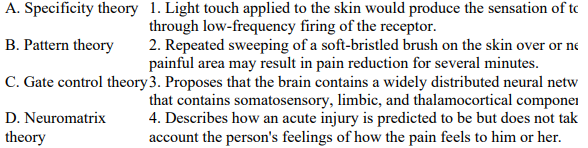
Match the pain theory to the correct physiologic basis for the pain.
A–4, B–1, C–2, D–3
Feedback: Specificity theory—describes how an acute injury is predicted to be but does not take into account the person's feelings of how the pain feels to him or her; pattern theory—light touch applied to the skin would produce the sensation of touch through low-frequency firing of the receptor; gate control theory—repeated sweeping of a soft-bristled brush on the skin over or near a painful area may result in pain reduction for several minutes; neuromatrix theory—proposes that the brain contains a widely distributed neural network that contains somatosensory, limbic, and thalamocortical components.
Following a knee injury, a football player is taking ibuprofen, a nonsteroidal anti-inflammatory drug, for the control of pain. Which of the following drug actions is most likely to result in diminished sensation of pain for the player?
The drug inhibits communication by third-order neurons between the thalamus and cerebral cortex.
The drug inhibits the enzyme needed for prostaglandin synthesis.
The drug changes the postexcitatory potential in C fibers, leading to pain sensitization.
The drug slows the conduction velocity of myelinated Aδ fibers in the pain pathway.
2
Feedback: Analgesia can be achieved by inhibition of prostaglandin synthesis, as in the case of many NSAIDs. These drugs do not affect the function of third-order neurons, the action potential of C fibers, or the conduction velocity of Aδ fibers.
A 60-year-old male client with a long history of back pain has had little success with a variety of analgesic regimens that his family physician has prescribed. He has recently been diagnosed with a chronic pain disorder. Which of the following teaching points about chronic pain would his physician most likely emphasize to the client?
“If your pain comes and goes, then we won't characterize it as chronic, and it will require different treatment.”
“You need to remind yourself that this is a purely physical phenomenon that requires physical treatment.”
“Our challenge is to bring you relief but still treat the underlying back problem that your body is telling you about.”
“These pain signals your body is sending likely serve no real, useful, or protective function.”
4
Feedback: A hallmark of chronic pain is that it usually does not serve any useful function, and that it is often remote from, or even irrelevant to, the originating cause. Like all pains, chronic pain is a complex and multifaceted phenomenon that supersedes purely physical considerations. Chronic pain need not be continuous and unchanging to be characterized as chronic.
A client in an acute medicine unit of a hospital with a diagnosis of small bowel obstruction is complaining of intense, diffuse pain in her abdomen. Which of the following physiological phenomena is most likely contributing to her complaint?
Nociceptive afferents are conducting the sensation of pain along the cranial and spinal nerve pathways of the ANS.
First-order neurons are inappropriately signaling pain to the dorsal root ganglion.
The client is experiencing neuropathic pain.
The client's C fibers are conducting pain in the absence of damaged Aδ fibers.
1
Feedback: Visceral pain, as characterized by the client's description of her pain, is conducted by way of nociceptive afferents that use the cranial and spinal nerve pathways of the ANS. The problem is not likely rooted in the inappropriate firing of first-order neurons or the substitution of conduction by C fibers. Pain that is attributable to a pathological process apart from the neural pain network is not normally considered to be neuropathic.
A nurse on a postsurgical unit is providing care for a 76-year-old female client who is 2 days posthemiarthroplasty (hip replacement) and who states that her pain has been out of control for the last several hours, though she is not exhibiting signs of pain. Which of the following guidelines should the nurse use for short-term and long-term treatment of the client's pain?
Reconciling the client's need for opioid analgesics with the risk of addiction to these drugs
Recognizing the client's pain is not likely self-limiting
Knowing that the client's self-report of pain is the most reliable indicator of pain
Realizing that chronic pain is likely to require innovative and complex treatment
3
Feedback: Clinically, the patient's self-report of pain is the most reliable indicator of pain. The risk of addiction to opioids is extremely low, and since the client's pain is acute rather than chronic, it is likely self-limiting.
A female client with bone metastases secondary to lung cancer is admitted for palliative radiation treatment and pain control. The client is presently experiencing pain that she rates at 9 out of 10. Which of the following nonpharmacological treatments is most likely to be a useful and appropriate supplement to pharmacological analgesia at this point?
Teaching the client guided imagery and meditation
Initiating neurostimulation
Heat therapy
Relaxation and distraction
4
Feedback: Given the client's high pain rating, initiating teaching around imagery and meditation is unlikely to be effective or appropriate. Neurostimulation requires implantation and/or placement of internal components, while heat is more likely to address superficial pain or pain caused by muscle tension. Relaxation and distraction would be plausible treatment options for this client.
A 30-year-old female has suffered a third-degree burn to her hand after spilling hot oil on it in a kitchen accident. Which of the following teaching points by a member of her care team is most appropriate?
“Tell us as soon as you sense the beginnings of a round of pain, and we will start with analgesics.”
“Opioids like morphine often cause constipation, but if this happens to you, we will discontinue opioids and change to another family of medications.”
“Opioids aren't without side effects, but we will take action to manage these side effects, so you can continue getting these drugs.”
“It's imperative that we prevent you from developing a tolerance for opioids while you're getting treatment for your burn.”
3
Feedback: While opioids carry side effects such as constipation, these can be managed in order to continue treatment; constipation would not preclude the continued use of opioids, but would require management. Pain medications should precede the onset of pain, and tolerance is not grounds for discontinuing treatment.
Which of the following would be an example of a child born with congenital insensitivity to pain? A child who
develops pins-and-needles sensation after jumping out of a tree.
fell off a skate board and fractured ankle but did not feel any pain and just noted swelling in foot.
skinned knee from a bike accident but only told parents when it started burning.
cries every time the wind blows because it hurts his face and ears.
2
Feedback: Analgesia is the absence of pain on noxious stimulation or the relief of pain without loss of consciousness. Congenital insensitivity is when the peripheral nerve defect apparently exists such that the transmission of painful nerve impulses does not result in perception of pain. Pens-and-needles sensation is called paresthesia. Burning sensations are usually associated with temperature (hyperthermia). Pain associated with wind (or any nonnoxious stimuli) is called allodynia.
Which of the following hospital patients is most likely to be diagnosed with complex regional pain syndrome II (CRPS II)?
A man who has been admitted for treatment of continuing hyperalgesia after sustaining a nerve injury in a motor vehicle accident
A woman who requires analgesia more than 3 months after an episode of shingles
A male client with diabetes mellitus who requires analgesia prior to each dressing change on his chronic foot wound
A female who has seemingly unprovoked attacks of pain that are accompanied by facial tics and spasms
1
Feedback: CRPS is marked by the presence of continuing pain, allodynia, or hyperalgesia after a nerve injury, not necessarily limited to the distribution of the injured nerve with evidence at some time of edema, changes in skin blood flow, or abnormal sensorimotor activity in the region of pain. Pain related to shingles is an example of postherpetic neuralgia, while a need for analgesia prior to dressing changes would not indicate CRPS. Sudden attacks of pain accompanied by facial tics and spasms may be indicative of trigeminal neuralgia.
A 58-year-old woman comes to the clinic for evaluation of a sharp, intermittent, severe, stabbing facial pain that she describes as, “like an electric shock.” The pain occurs only on one side of her face; it seems to be triggered when she chews, brushes her teeth, or sometimes when she merely touches her face. There is no numbness associated with the pain. What is most likely causing her pain?
Postherpetic neuralgia
Migraine headache
Complex regional pain syndrome
Trigeminal neuralgia
4
Feedback: Her symptoms are characteristic of trigeminal neuralgia, caused by damage to the fifth cranial nerve, which carries impulses of touch, pain, pressure, and temperature to the brain from the face and jaw.
A patient with diabetes mellitus has just undergone a right, below-the-knee amputation following gangrene infection. A few days post-op, the patient confides in the nurse that he still feels his right foot. Knowing the pathophysiologic principles behind this, the nurse can
administer a psychotropic medication to help the patient cope with the loss of his leg.
explain that many amputees have this sensation and that one theory surmises that the end of a regenerating nerve becomes trapped in the scar tissue of the amputation site.
call the physician and ask him for an order for a psychological consult.
educate the patient that this area has an usually abnormal increase in sensitivity to sensation but that it will go away with time.
2
Feedback: Multiple theories exist related to the causes of phantom limb pain. One rationale is that the end of the regenerating nerve becomes trapped in the scar tissue that forms a barrier to regenerating outgrowth of the axon. The usual treatment includes the use of sympathetic blocks; TENS of the large myelinated afferents innervating the area; hypnosis; and relaxation training.
A nurse practitioner is assessing a 7-year-old boy who has been brought to the clinic by his mother, who is concerned about her son's increasingly frequent, severe headaches. Which of the nurse's following questions is least likely to yield data that will allow for a confirmation or ruling out of migraines as the cause of his problem?
“Does your son have a family history of migraines?”
“When your son has a headache, does he ever have nausea and vomiting as well?”
“Does your son have any food allergies that have been identified?”
“Is your son generally pain free during the intervals between headaches?”
3
Feedback: While food may trigger migraines in some individuals, food allergies are not an identified contributor to migraines, and their presence or absence would be unlikely to provide a differential diagnosis of migraine. Migraines have a strong genetic component and, in children, nausea and vomiting during a headache are suggestive of migraine. Individuals who are prone to migraines are pain free in the times between episodes.
A 25-year-old woman who works as an air-traffic controller presents with facial pain and severe headache. She reports that she sometimes feels the pain in her neck or ear and that it is particularly bad during very busy times at the airport. What is the most likely diagnosis?
Migraine headache
Cluster headache
Temporomandibular joint syndrome
Sinus headache
3
Feedback: Temporomandibular joint syndrome causes pain that originates in the temporomandibular joint and is usually referred to the face, neck, or ear. Headache is also common. It is aggravated by jaw function and can be particularly severe in people under stress, especially if they grind their teeth.
A 7-year-old child had an emergency appendectomy during the night. When trying to assess his pain, the nurse should
ask him to rate his pain on a scale of 0 to 10, with 0 = no pain and 10 = worse pain ever.
show him a scale with faces of actual children and have him point to the picture that best describes how he is feeling.
consider his pulse and BP readings to be the most specific indicators of the amount of pain he is experiencing.
try to distract him by blowing bubbles to minimize the use of opioids so that he does not become addicted to the narcotic.
2
Feedback: Children do feel pain and have been shown to reliably and accurately report pain. With children 3 to 8 years of age, scales with faces of actual children or cartoon faces can be used to obtain a report of pain. Physiologic measures, such as heart rate, are convenient to measure, but they are nonspecific. They may be a sign of anxiety and not pain. Distraction methods are good, but medications should be used on an individual basis to match the analgesic agent with the level of pain.
Staff at the care facility note that a woman has started complaining of back pain in recent weeks and occasionally groans in pain. She has many comorbids that require several prescription medications. The nurse knows that which of the following factors is likely to complicate the clinician's assessment and treatment of the client's pain?
Neural pain pathways in the elderly differ from those in younger adults and are less responsive to treatment.
Assessment and treatment are possibly complicated by the large number of drugs that the client receives.
Accurate pain assessment is not possible in clients with significant cognitive deficits.
Frequent complaints of pain in older adults with dementia normally indicate hyperalgesia rather than an underlying physical problem.
2
Feedback: Polypharmacy complicates both assessment and treatment of pain in the older adult. While minor changes in pain pathways do occur as an age-related change, these do not mean that treatment is unsuccessful. Pain assessment is more difficult in clients with cognitive deficits, but it is not impossible. Reports of pain in the elderly, as with any client, may signal an underlying health problem.
As part of pre-surgical teaching for patients who are about to undergo a coronary artery bypass graft, a nurse is performing an education session with a group of surgical candidates. Which of the following teaching points best conveys an aspect of the human circulatory system?
a. "The blood pressure varies widely between arteries and veins and between pulmonary and systemic circulation."
b. "Only around one quarter of your blood is in your heart at any given time."
c. "Blood pressure and blood volume roughly mimic one another at any given location in the circulatory system."
d. "Left-sided and right-sided pumping action on each beat of the heart must equal each other to ensure adequate blood distribution."
a. "The blood pressure varies widely between arteries and veins and between pulmonary and systemic circulation."
Feedback: There is a large variation between the higher pressure in the systemic circulatory system and arteries and the lower pressure in the pulmonary system and veins. Approximately 8% of the blood supply is in the heart at any given time. Blood pressure and blood volume are inversely proportionate. The body is able to accommodate short-term differences in left-sided and right-sided output.
In which of the following situations would blood most likely rapidly relocate from central circulation to the lower extremities?
a. A client undergoes a stress test on a treadmill.
b. A client does isotonic exercises in a wheelchair.
c. A client is helped out of bed and stands up.
d. A client reclines from a sitting to supine position.
c. A client is helped out of bed and stands up.
Feedback: During a change in body position, blood is rapidly relocated from the central circulation (when the patient is recumbent) to the lower extremities (when the patient stands up). This results in a temporary drop in blood pressure known as postural hypotension and reflects the redistribution of blood in the body.
Which of the following statements most accurately captures a principle of blood flow?
a. With constant pressure, a small increase in vessel radius results in an exponential increase in blood flow.
b. Blood flow is primarily determined by blood viscosity and temperature.
c. Blood flows most quickly in the small diameter peripheral capillaries.
d. Smaller cross-sectional vessel area is associated with lower flow velocity.
a. With constant pressure, a small increase in vessel radius results in an exponential.
Feedback: Doubling the radius of a vessel is associated with a fourth-power increase in flow, provided pressure remains constant. Blood flow is primarily a function of blood pressure, resistance, and viscosity. The small size of capillaries is associated with quite slow velocity, given their large total combined cross-sectional area. Smaller cross-sectional area is associated with greater velocity.
A 72-year-old female has been told by her physician that she has a new heart murmur that requires her to go visit a cardiologist. Upon examination, the cardiologist informs the patient that she has aortic stenosis. After the cardiologist has left the room, the patient asks, "What caused this [aortic stenosis] to happen now?" The clinic nurse responds:
a. "Heart murmurs result from tumultuous flow through a diseased heart valve that is too narrow and stiff. This flow causes a vibration called a murmur."
b. "Aortic stenosis is commonly seen in elderly patients. Basically, there is a blockage in the valve that is causing blood to pool, causing decreased velocity of flow."
c. "This is caused by a tear in one of the papillary muscles attached to the valve. They can do a procedure where they thread a catheter into the heart and reattach the muscle ends."
d. "Because of the high amount of energy it takes to push blood through the aortic valve to the body, your valve is just had to work too hard and it is weakening."
a. "Heart murmurs result from tumultuous flow through a diseased heart valve that is too narrow and stiff. This flow causes a vibration called a murmur."
Feedback: Heart murmur results from turbulent flow through a diseased heart valve that may be too narrow, too stiff, or too floppy. This turbulent flow causes a vibration called a murmur.
A physician is teaching a group of medical students about the physiological basis for damage to the circulatory and neurological systems that can accompany hypotension. Which of the following responses by a student would warrant correction by the physician?
a. "As vessel wall thickness increases, tension decreases."
b. "Smaller blood vessels require more pressure to overcome wall tension."
c. "The smaller the vessel radius, the greater the pressure needed to keep it open."
d. "Tension and vessel thickness increase proportionately."
d. "Tension and vessel thickness increase proportionately."
Feedback: Tension and vessel wall thickness are inversely proportionate, in that thinner blood vessels have greater tension and vice versa. Answer choices A, B, and C all express the correct inverse relationship between tension and wall thickness.
During an automobile accident where the patient is bleeding heavily, which vascular component is the most distensible and can store large quantities of blood that can be returned to circulation at this time of need?
a. Liver and pancreas
b. Kidneys
c. Veins
d. Aorta
c. Veins
Feedback: Compliance refers to the total quantity of blood that can be stored in a given portion of the circulation for each mm Hg rise in pressure. The most distensible of all vessels are the veins, which can increase their volume with only slight changes in pressure. This allows the veins to function as a reservoir for storing large quantities of blood that can be returned to the circulation when it is needed. The liver, pancreas, and kidneys are not vascular components.
A client has suffered damage to his pericardium following a motor vehicle accident. Which consequence could be a possible complication of the damaged pericardium that his care providers should assess for?
a. Impaired physical restraint of the left ventricle
b. Increased friction during the contraction/relaxation cycle
c. Reduced protection from infectious organisms
d. Impaired regulation of myocardial contraction
d. Impaired regulation of myocardial contraction
Feedback: Regulation of myocardial contraction is not a role of the fibrous covering around the heart. The pericardium does restrain the left ventricle, reduce friction by way of fluid in the pericardial cavity, and provide a physical barrier to infection.
An 81-year-old female client of a long-term care facility has a history of congestive heart failure. The nurse practitioner caring for the client has positioned her sitting up at an angle in bed and is observing her jugular venous distention. Why is jugular venous distention a useful indicator for the assessment of the client's condition?
a. Increased cardiac demand causes engorgement of systemic blood vessels, of which the jugular vein is one of the largest.
b. Blood backs up into the jugular vein because there are no valves at the point of entry into the heart.
c. Peripheral dilation is associated with decreased stroke volume and ejection fraction.
d. Heart valves are not capable of preventing back-flow in cases of atrial congestion.
b. Blood backs up into the jugular vein because there are no valves at the point of entry into the heart.
Feedback: Because there are no valves at the entry points to the atria, congestion can result in engorgement of the jugular veins, which are proximal to the heart. Increased cardiac demand is not associated with engorgement of vessels or peripheral dilation.
As part of their orientation to a cardiac care unit, a group of recent nursing graduates is receiving a refresher in cardiac physiology from the unit educator. Which of the following teaching points best captures a component of cardiac function?
a. "Efficient heart function requires that the ventricles do not retain any blood at the end of the cardiac cycle."
b. "Recall that the heart sounds that we listen to as part of our assessments are the sounds of the myocardium contracting."
c. "The diastolic phase is characterized by relaxation of ventricles and filling with blood."
d. "Aortic pressure will exceed ventricular pressure during systole."
c. "The diastolic phase is characterized by relaxation of ventricles and filling with blood."
Feedback: Diastole is associated with ventricular filling and relaxation. Cardiac output is not 100% or near to it with each cardiac cycle, and heart sounds are associated with valve closing. Ventricular pressure exceeds that of the aorta during systole.
A patient is experiencing impaired circulation secondary to increased systemic arterial pressure. Which of the following statements is the most relevant phenomenon?
a. Increased preload due to vascular resistance
b. High after-load because of back pressure against the left ventricle
c. Impaired contractility due to aortic resistance
d. Systolic impairment because of arterial stenosis
b. High after-load because of back pressure against the left ventricle
Feedback: Increased pressure in the aorta and other arteries constitutes a greater amount of afterload work. This situation is not indicative of increased preload or impaired contractility. Systolic impairment is not a recognized characterization of inadequate cardiac performance.
In the ICU the nurse hears an emergency cardiac monitor go off. The nurse looks at the telemetry and notices the patient has gone into ventricular tachycardia. The nurse will likely assess for signs/symptoms of:
a. development of hypertension with BP 190/98.
b. oxygen deprivation with O2 saturation decreasing to approximately 90%.
c. decreasing cardiac output due to less ventricular filling time.
d. increasing cardiac index by correlating the volume of blood pumped by the heart with an individual's body surface area.
c. decreasing cardiac output due to less ventricular filling time.
Feedback: One of the dangers of ventricular tachycardia is a reduction in cardiac output because the heart does not have time to fill adequately
A nurse is using a stethoscope and blood pressure cuff to manually measure a client's blood pressure. The nurse knows that which of the following facts related to blood flow underlies the ability to hear blood pressure by auscultation (listening)?
a. The force of blood with each cardiac contraction produces friction on vessel walls that can be heard and felt.
b. The movement of smooth muscle surrounding vessels produces noise that is audible by a stethoscope.
c. Turbulent flow of blood during systole produces sound while laminar flow during diastole is silent.
d. Pressure pulsation that exceeds the velocity of blood flow is audible and coincides with systolic BP.
d. Pressure pulsation that exceeds the velocity of blood flow is audible and coincides with systolic BP.
Feedback: The pressure pulsations that accompany intermittent blood ejection from the ventricles cause sounds that are audible when measuring blood pressure and palpable at pulse sites. Friction, muscle movement, and turbulent blood flow do not account for the pressure pulsations.
Analysis has shown that a client's right atrial pressure is 30 mm Hg. What is the most likely conclusion that the client's care team will draw from this piece of data?
a. The result is likely normal and gravity-dependent given the lack of valves in thoracic and central veins.
b. The pressure is insufficient to provide stroke volume and cardiac output.
c. The pressure is excessive given that the right atrium should be at atmospheric pressure.
d. Pressure pulsations are likely to be undetectable given the low atrial pressure
c. The pressure is excessive given that the right atrium should be at atmospheric pressure.
Feedback: Normal right atrial pressure is around 0 mm Hg, or atmospheric pressure. Right atrial pressure does not have a direct influence on stroke volume or pulse pressure.
A patient arrived at the emergency department 2 days after the development of "chest pressure" and "tightness" and was treated with antacids thinking it was indigestion. His enzymes show a massive myocardial infarction (MI). Following angioplasty, the patient asks why so much muscle was damaged if only one vessel was blocked, the left circumflex. The nurse responds:
a. "With any blockage in the heart, muscle damage always occurs."
b. "If a major artery like the circumflex is occluded, the smaller vessels supplied by that vessel cannot restore the blood flow."
c. "Since the circumflex artery supplies oxygenated blood flow to the posterior surface of the left ventricle, any amount of blockage will result in vital muscle tissue being lost."
d. "When it comes to arteries in the heart, all vessels are equal, and any blockage causes a massive amount of damage that will not be restored."
b. "If a major artery like the circumflex is occluded, the smaller vessels supplied by that vessel cannot restore the blood flow."
Feedback: Hyperemia cannot occur when the arteries that supply the capillary beds are narrowed. For example, if a major coronary artery becomes occluded, the opening of channels supplied by that vessel cannot restore blood flow.
When explaining to a patient why he only had minimal muscle damage following 99% occlusion of the left anterior descending artery, the nurse will explain this is primarily due to:
a. the possibility that the person has elevated INR levels that prevent blood from backlogging in the vessel.
b. development of collateral circulation that builds channels between some of the smaller arteries usually when the flow is decreased gradually.
c. good genetic makeup that allows occluded arteries to keep vasodilating to meet metabolic needs.
d. the release of substances formed by special glands that transport the blood cell-by-cell through smaller spaces.
b. development of collateral circulation that builds channels between some of the smaller arteries usually when the flow is decreased gradually.
Feedback: Collateral circulation is a mechanism for the long-term regulation of local blood flow. Anastomotic channels exist between some of the smaller arteries. These channels permit perfusion of an area by more than one artery. When the artery becomes occluded, these anastomotic channels increase in size, allowing blood from a patent artery to perfuse the area supplied by the occluded vessel.
Which of the following individuals is most likely to be experiencing vasodilation?
a. A 51-year-old man with a history of hypertension who is taking a medication that blocks the effect of the renin-angiotensin-aldosterone system
b. A 9-year-old boy who has been given an injection of epinephrine to preclude an anaphylactic reaction to a bee sting
c. A 30-year-old woman who takes antihistamines to treat her seasonal allergies
d. A 32-year-old man who takes a selective serotonin re-uptake inhibitor for the treatment of depression
a. A 51-year-old man with a history of hypertension who is taking a medication that blocks the effect of the renin-angiotensin-aldosterone system
Feedback: Angiotensin is a potent vasoconstrictor, and medications that block this induce vasodilation. Epinephrine is also a vasoconstrictor. Histamine is a vasodilator, so antihistamine medications are likely to induce vasoconstriction. Serotonin is a vasoconstrictor, so medications that block its reuptake and increase free levels are apt to promote vasoconstriction.
When trying to explain to a new dialysis patient the movement of substances through the capillary pores, the nurse will explain that in the kidneys, the glomerular capillaries have:
a. no capillary openings since this would lead to extensive hemorrhage.
b. small openings that allow large amounts of smaller molecular substances to filter through the glomeruli.
c. large pores so that substances can pass easily through the capillary wall.
d. endothelial cells that are joined by tight junctions that form a barrier to medication filtration.
b. small openings that allow large amounts of smaller molecular substances to filter through the glomeruli.
Feedback: The glomerular capillaries in the kidneys have small openings called fenestrations that pass directly through the middle of the endothelial cells. These allow large amounts of small molecular and ionic substances to filter through the glomeruli without having to pass through the clefts between the endothelial cells.
A 51-year-old patient with a history of alcohol abuse and liver disease has low serum levels of albumin and presents with ascites (excess fluid in his peritoneal space) and jaundice. A health care professional would recognize which of the following processes is most likely underlying his health problems:
a. Low albumin is contributing to excess hydrostatic pressure and inappropriate fluid distribution.
b. Low albumin is inducing hypertension and increased filtration of fluid into interstitial spaces.
c. Insufficient albumin is causing insufficient absorption of fluid into the capillaries.
d. Low albumin contributes to an inability to counter gravitational effects.
c. Insufficient albumin is causing insufficient absorption of fluid into the capillaries.
Feedback: Deficits of plasma proteins like albumin result in insufficient amounts of fluid being absorbed into the capillary circulation by osmotic pressure. It is not a result of hydrostatic pressure, hypertension, or the effects of gravity.
While intubated for surgery, a patient has inadvertently had his vagus nerve stimulated. What effect would the surgical team expect to observe?
a. Decreased vascular perfusion due to parasympathetic stimulation
b. Decreased heart rate, contractility, and after-load
c. Decreased heart rate as a result of parasympathetic innervation of the heart
d. Decreased heart rate as a result of impaired acetylcholine re-uptake
c. Decreased heart rate as a result of parasympathetic innervation of the heart
Feedback: Vagal stimulation results in lowered heart rate as a result of parasympathetic stimulation. Vascular perfusion, contractility, and afterload would not be under direct effect. Acetylcholine reuptake would not be influenced.
A patient in the emergency department is experiencing a massive stroke with extremely low blood flow to the brain exhibited by a BP of less than 60 mm Hg. The nurse suddenly notes there is a sharp rise in the BP to 250 mm Hg. This high BP lasts about 5 minutes, and then the BP drops sharply again. The pathophysiologic principle behind this is likely due to the:
a. activation of the autonomic nervous system.
b. release of mineralocorticoids.
c. CNS ischemic response.
d. protective homeostatic mechanism.
c. CNS ischemic response.
Feedback: When blood flow to the brain has been sufficiently interrupted to cause ischemia of the vasomotor center, these vasomotor neurons become strongly excited. This causes massive vasoconstriction as a means of raising the blood pressure to levels as high as the heart can pump against. This response is called the CNS ischemic response and can raise BP to levels as high as 270 mm Hg for as long as 10 minutes.
A pathologist is examining histological (tissue) samples from a client with an autoimmune disease. Which of the following characteristics of muscle samples would signal the pathologist that the samples are cardiac rather than skeletal muscle?
a. The cell samples lack intercalated disks.
b. The muscle cells have small and a few mitochondria.
c. The cells have a poorly defined sarcoplasmic reticulum.
d. The muscles are striated and composed of sarcomeres.
c. The cells have a poorly defined sarcoplasmic reticulum.
Feedback: Cardiac cells have a less clearly defined sarcoplasmic reticulum than do skeletal muscles. They also have intercalated disks and large, numerous mitochondria. Both types of muscles are striated and composed of sarcomeres.
Which of the following blood flow patterns reduces friction, allowing the blood layers to slide smoothly over one another?
a. Crosswise
b. Axially
c. Turbulent
d. Laminar
d. Laminar
Which statements are true regarding the capillary system? Select all that apply.
a. Normal function requires that all fluid that leaves the capillary beds be reabsorbed.
b. Flow out of the system is controlled by hydrostatic pressure.
c. Fluid leaves the capillary beds via lymphatic channels.
d. Flow into the system is controlled by colloidal osmotic pressure.
e. Albumin plays a significant role in maintaining the function of this system.
b. Flow out of the system is controlled by hydrostatic pressure.
d. Flow into the system is controlled by colloidal osmotic pressure.
e. Albumin plays a significant role in maintaining the function of this system.
When a client experiences the Cushing reflex, what occurs with the body?
a. The toes fan outward in response to stimulation being applied to the bottom of the foot.
b. An increase in arterial pressure to levels above the intracranial pressure
c. The systemic blood pressure decreases to restore equal amounts of oxygen throughout the body.
d. The pupil's contract in response to light exposure.
b. An increase in arterial pressure to levels above the intracranial pressure
Considering how hydrostatic forces affect the capillaries, which of the following would increase capillary hydrostatic pressure most?
a. Increase in venous pressure
b. Increase in small-artery pressure
c. Decrease in gravity when standing
d. Decrease in arterial pressure
a. Increase in venous pressure
A nurse is caring for a client with right heart failure caused by pulmonary hypertension. Which hemodynamic parameter is most appropriate for the nurse to monitor?
a. Pulmonary arterial pressure (PAP)
b. Blood pressure
c. Central venous pressure (CVP)
d. Systemic vascular resistance (SVR)
a. Pulmonary arterial pressure (PAP)
Which blood vessels function without the benefit of having walls comprised of three muscular layers?
a. Arterioles
b. Arteries
c. Veins
d. Capillaries
d. Capillaries
The electrical activity of the heart is recorded on the ECG. What does the T wave on the ECG represent?
a. Depolarization of the ventricular conduction system
b. Depolarization of the sinoatrial node
c. Repolarization of the ventricles
d. Repolarization of the atrium
c. Repolarization of the ventricles
Which of the following is true regarding pulmonary circulation?
a. The system functions with an increased arterial pressure to circulate through the distal parts of the body.
b. It consists of the left side of the heart, the aorta, and its branches.
c. It is a low-pressure system that allows for improved gas exchange.
d. It is the larger of the two circulatory systems.
c. It is a low-pressure system that allows for improved gas exchange.
Which related circulatory complication can result from surgical treatment for metastatic breast cancer?
a. Tachycardia when at rest
b. Lymphedema in the affected arm
c. Irregular heart rate
d. Hypotension upon standing
b. Lymphedema in the affected arm
Which neurotransmitter is associated with the parasympathetic nervous system?
a. Epinephrine
b. Dopamine
c. Acetylcholine
d. Norepinephrine
d. Norepinephrine
A client's echocardiogram identified a narrowed valve that has resulted in a decreased blood flow between the left atria and left ventricle. The nurse would interpret this as the:
a. Tricuspid valve
b. Pulmonic valve
c. Aortic valve
d. Bicuspid valve
d. Bicuspid valve
Which organ has larger capillary pores to allow the exchange of gases, nutrients, and/or waste products?
a. Brain
b. Blood-brain barrier
c. Liver
d. Kidney
c. Liver
A nurse is teaching a client the correct technique for taking an arterial pulse. The nurse explains that the pulsations are:
a. Blood flow in the veins
b. Pressure pulses
c. The turbulence of the blood flow
d. Korotkoff sounds
b. Pressure pulses
A client has had an acute myocardial infarction (MI). The brother of the client has a history of angina. The client asks how he will know if his brother's pain is angina or if the brother is actually having an MI. Which statement is correct?
a. Chest pain with angina only occurs at rest; MI pain occurs during a stressful time.
b. Chest pain with angina only occurs during the day; MI pain is more likely at night.
c. Pain is more severe and lasts longer with angina than with an MI.
d. Rest and intake of nitroglycerin relieve chest pain with angina; they do not relieve chest pain with an MI.
d. Rest and intake of nitroglycerin relieve chest pain with angina; they do not relieve chest pain with an MI.
Select the correct sequence of blood return to the heart.
a. Capillaries, arterioles, arteries, right atrium
b. Capillaries, venules, veins, left atrium
c. Capillaries, arterioles, veins, left atrium
d. Capillaries, venules, veins, right atrium
d. Capillaries, venules, veins, right atrium
Which factor represents the amount of blood that the heart must pump with each beat and is determined by the stretch of the cardiac muscle fibers and the actions of the heart prior to cardiac contraction?
a. Preload
b. Cardiac contractility
c. Heart rate
d. Afterload
a. Preload
A nurse is reviewing an echocardiogram for a client with a congenital defect in the papillary muscles of the heart. Based on this result, which assessment should the nurse complete?
a. Palpate the pericardium for a heave or thrill.
b. Auscultate for a murmur caused by the backward expulsion of blood through the atrioventricular valves.
c. Monitor the blood pressure.
d. Auscultate for an extra heart sound due to incomplete semilunar valve closure.
b. Auscultate for a murmur caused by the backward expulsion of blood through the atrioventricular valves.
The nurse is caring for a client with severe aortic stenosis. What affect on cardiac afterload will the nurse note?
a. Blood pressure will be below normal due to the narrowing of the valve outlet
b. Less pressure recorded on the cardiac output due to poor leaflet contactivity
c. Greatly elevated systolic pressure when measured with hemodynamic setting
d. Pulse rate will decrease due to less blood being ejected from the heart
c. Greatly elevated systolic pressure when measured with hemodynamic setting
When explaining the role of liver Kupffer cells to a group of nursing students, which of the following statements about the function of these cells is most accurate?
A) The primary function of Kupffer cells is to secrete bile.
B) These cells are the functional unit of the liver and are responsible for all liver secretions.
C) The cells are capable of removing and phagocytizing old and defective blood cells.
D) The role of the Kupffer cells is to provide at least 50% of cardiac output each minute to each lobular of the liver.
C
Feedback: Kupffer cells are reticuloendothelial cells that are capable of removing and phagocytizing old and defective blood cells, bacteria, and other foreign material from the portal blood as it flows through the sinusoid. This phagocytic action removes enteric bacilli and other harmful substances that filter into the blood from the intestine. Small tubular channels in the liver secrete bile. The functional unit of the liver is lobule. Approximately 25% of blood per minute enters the liver through the hepatic artery.