Philosophy of Knowledge: Analysis, Conditions, and Counterexamples
 Call Kai
 Learn
Learn Practice Test
 Spaced Repetition
 Match
Match Flashcards
 Knowt Play
1/37

There's no tags or description
Looks like no tags are added yet.
Name | Mastery | Learn | Test | Matching | Spaced | Call with Kai |
|---|
No analytics yet
Send a link to your students to track their progress
38 Terms
According to Plato's Meno, what is the difference between true opinion and knowledge?
True opinions are like runaway statues, while knowledge is true opinion 'fastened' by the tie of the cause.
What is an analysis of knowledge?
A list of conditions that are individually necessary and jointly sufficient for someone knowing that something is the case.
Define a necessary condition (C) for a state (P).
If P is the case, C must be the case.
Define a sufficient condition (C) for a state (P).
If C is the case, P must be the case.
Why is the statement 'S knows that p if and only if S knows that p' not a valid analysis of knowledge?
Because being a set of individually necessary and jointly sufficient conditions is a necessary but not a sufficient condition for being an analysis.
What does the JTB account stand for?
Justified-True-Belief account of knowledge.
What are the three conditions of the JTB account?
The belief condition, the truth condition, and the justification condition.
What is the belief condition in the JTB account?
S believes that p.
What is the truth condition in the JTB account?
p is true.
What is the justification condition in the JTB account?
S is justified in believing that p.
What example is used to challenge the necessity of the truth condition?
The historical belief that stress caused ulcers before it was proven to be caused by bacterial infection.
What is the potential counter-argument to the 'stress causes ulcers' example challenging the truth condition?
The utterance might be an elliptical way of saying everyone 'thought' they knew stress caused ulcers.
What example is used to challenge the necessity of the justification condition?
The case of someone knowing the capital of Austria even if they received the information from an untrustworthy informant.
What does John Hawthorne suggest about the justification condition in different contexts?
Different 'amounts' of justification may be required to count as knowing depending on the context.
Who is responsible for the famous counterexample to the sufficiency of the JTB account?
Edmund Gettier.
What is the core problem presented by the Gettier case involving Smith and Jones?
Smith has a justified true belief, but intuitively does not possess knowledge because the truth of the belief is based on a coincidence.
What are the three conditions of the JTB (Justified True Belief) account of knowledge?
S believes p, p is true, and S is justified in believing p.
What is the primary requirement for knowledge according to the Causal Account?
S's belief must be caused by the facts that make the belief true.
What is the first problem identified with the initial Causal Account of knowledge?
It implies one cannot have knowledge of the future because causes must precede their effects.
How is the Causal Account revised to address the problem of temporal order?
S's belief must be causally connected to the facts, where connection is defined as X causing Y, Y causing X, or a common cause for both.
What is the 'whacky causal chains' problem for the Causal Account?
It suggests that even if a belief is caused by the facts, the connection might be indirect or bizarre, failing to constitute genuine knowledge.
What is the final, refined version of the Causal Account of knowledge?
S knows p if and only if S believes p, p is true, and S's belief is causally connected in an 'appropriate way' to the facts.
What is the Dharmottara example involving smoke and insects intended to illustrate?
A scenario where a belief is true and based on evidence, but the evidence is not actually connected to the truth of the belief.
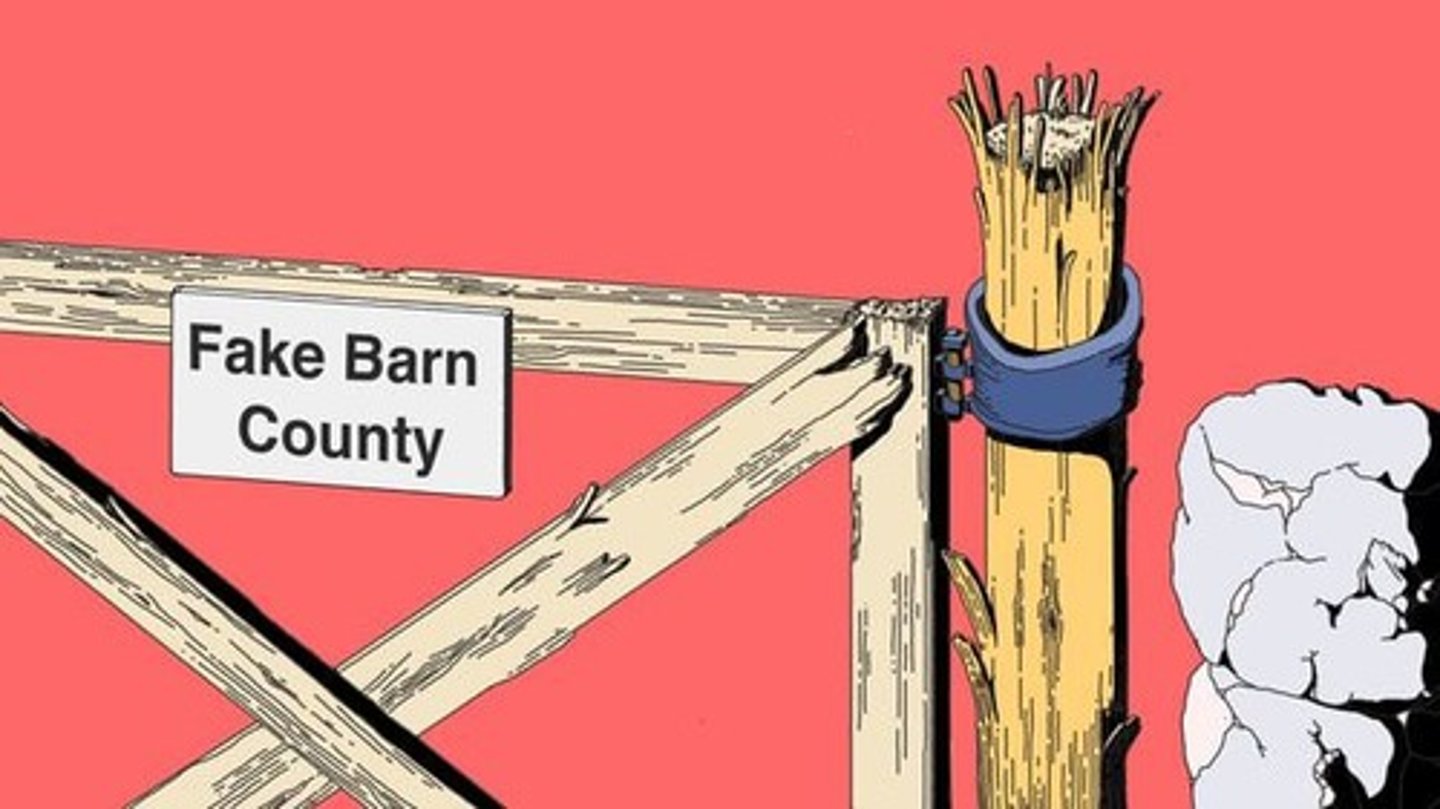
What is the central point of Goldman's 'Barn County' counterexample?
An agent can have a true, justified belief that is causally connected to the fact, yet still lack knowledge due to the presence of environmental 'luck' or facsimiles.
What is the Counterfactual Account of knowledge?
S knows p if and only if S believes p, p is true, and if p had been false, S would not have believed p.
How does the Counterfactual Account attempt to solve the Gettier problem?
It requires the belief to be sensitive to the truth, ensuring that the belief would not persist if the facts changed.
What is Kripke's objection to the Counterfactual Account regarding red barns?
The account leads to the counterintuitive result that one can know a specific detail (e.g., that there is a red barn) while failing to know the general fact (that there is a barn).
What does Kripke's objection suggest about the Counterfactual Account and logical closure?
It shows the account is incompatible with the closure of knowledge under known entailment.
What is the 'degenerating research programme' view on the analysis of knowledge?
The idea that the concept of 'knowledge' is too basic to be analyzed into simpler terms and that the search for such an analysis is futile.
Who is the philosopher associated with the view that knowledge is a primitive concept that should be used to analyze other things?
Timothy Williamson.
According to Zagzebski, why do Gettier cases arise?
They arise when a justified belief is true only by the coincidence of bad luck being cancelled out by good luck.
What is the main challenge in defining an 'appropriate' causal connection?
It is difficult to specify exactly what constitutes an appropriate connection without falling into circularity or vagueness.
What is the primary goal of the Counterfactual Account?
To ensure that a belief is not just accidentally true by making it sensitive to the truth-value of the proposition.
Why might the pursuit of an analysis of knowledge be considered a 'losing battle'?
Because concepts of high philosophical interest often lack non-trivial analyses, and attempting to find them leads to infinite regress.
In the context of the Causal Account, what does it mean for a belief to be 'causally connected'?
There is a chain of events linking the fact that makes the proposition true to the mental state of the believer.
What is the significance of the 'Barn County' example for epistemology?
It highlights that environmental factors can undermine knowledge even when the belief is true and justified.
What does it mean for a belief to be 'sensitive' in the Counterfactual Account?
The belief would change if the truth-value of the proposition changed.
What alternative approach does Mona Simion/Williamson suggest regarding the concept of knowledge?
Instead of analyzing knowledge, we should use knowledge as a fundamental tool to analyze other concepts like justification or evidence.