Bio II Ch 40
 Call Kai
 Learn
Learn Practice Test
 Spaced Repetition
 Match
Match Flashcards
 Knowt Play
1/32

Earn XP
Description and Tags
Animal form and function; not in exam 5, but in MCAT
Name | Mastery | Learn | Test | Matching | Spaced | Call with Kai |
|---|
No analytics yet
Send a link to your students to track their progress
33 Terms
anatomy
biological structure — varies widely! Many ways to solve the problem.
physiology
biological function —- can be determined from studying anatomy.
_____ and ______ also affect the way an animal interacts with its environment
size and shape
have to do with the environment it lives in
shape determines function
convergent evolution
not the product of being closely related. they are far away relatives, it is the environment that results in the same selected anatomy
describe open systems
as organisms we need exchange with the environment
rate of exchange is proportional to a cell’s surface area
same need, different response
flat animals vs more complex organisms
need to exchange gases
for us, we still have the same needs (gas exchange, filtration, etc.) but have separate structures to take care of it
exchange can happen at different levels
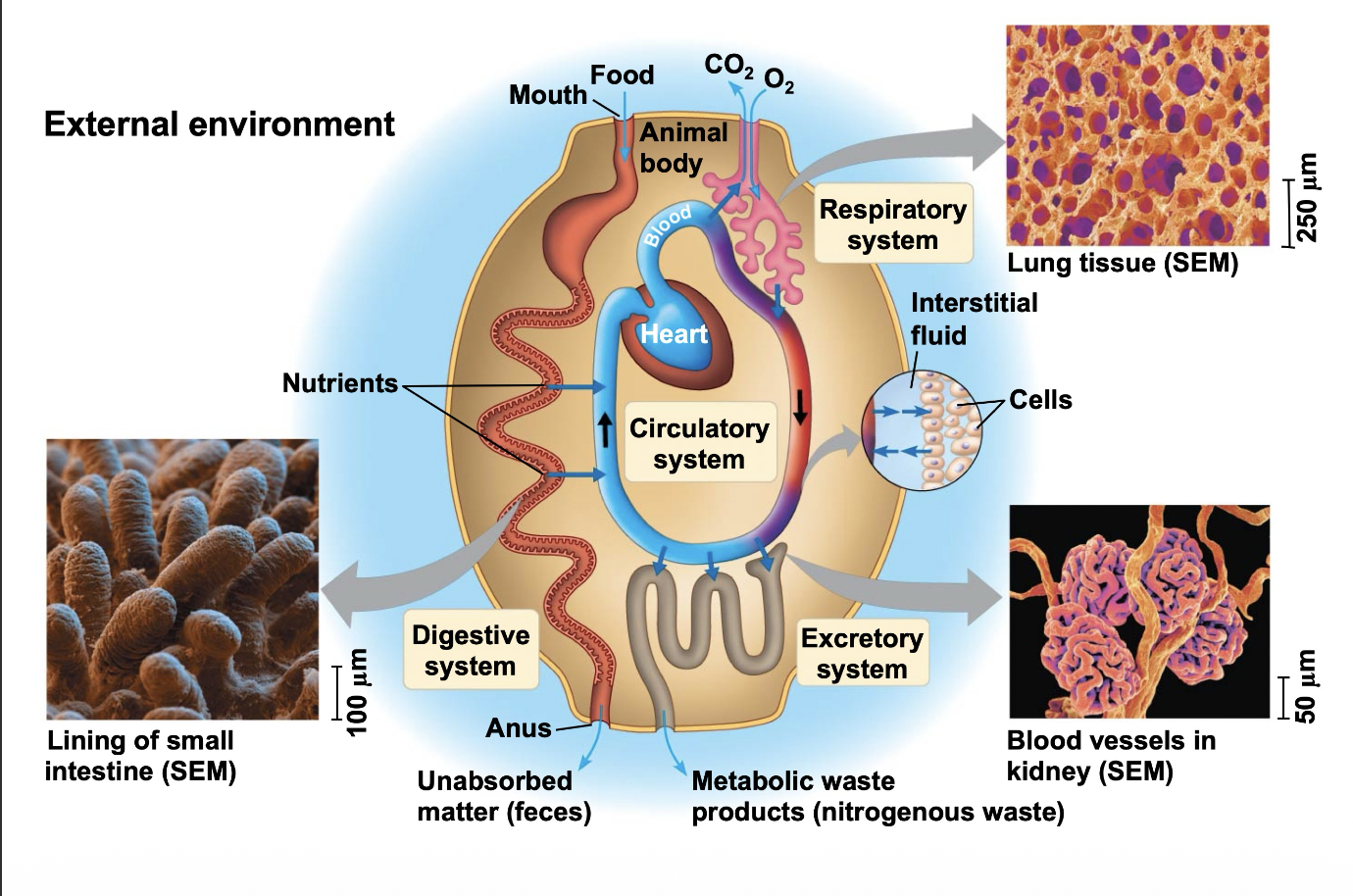
describe hierarchical organization of body plans
cells → tissues → organs → organ systems
a complex body plan helps an animal living in a variable environment to maintain a relatively stable internal environment
how respond to environment?
regardless of levels, we heavily regulate our system to stay within a specific
what kind of tissues do we have?
epithelial
connective
muscle
nervous
epithelial tissues
cover the outside of the body and lines the organs and cavities within the body
not only exposed to bacteria on our skin, but also in the digestive system through what we eat
how might epithelial tissues be arranged?
(see the image)
the less complex (pseudostratified columnar epithelium), the more efficient it can exchange
connective tissue
holds many tissues and organs together and in place
three types of connective tissue fiber
collagenous fibers (elasticity)
reticular fibers (build matrix, holding all in place)
elastic fibers (flexibility and resitance)
what kind of cells are part of this tissue?
fibroblasts
macrophages
kinds of connective tissues
loose connective tissue — keeping together external parts
fibrous — in tendons and ligaments
blood — white and red blood cells
cartilage — connecting more
adipose — produces fat, insulation
bone — mineralized structure, builds up skeleton
muscle tissue
responsible for nearly all types of body movement
types of muscle tissue
skeletal muscle (voluntary movement)
smooth muscle (involuntary movement)
cardiac muscle (heart contractions)
nervous tissue
interaction and response to environment
functions in how we receive, process, and transmit information
what kind of cells in nervous tissues?
neurons! with cell body, dendrites, axon
also glia cells that support all the nervous system
how do we coordinate the response to our environment?
two systems working together:
endrocrine and nervous
endocrine system
hormones!
molecule that travels in the blood stream
specificity
slow acting
long lasting effects
well adapted for coordinating gradual changes that affect the entire body
nervous system
transmits information
very fast
electrical signal
suited for directing rapid responses to the environment
how does feedback control work?
feedback control maintains the internal environment in many animals, maintaining homeostasis
organisms use homeostasis to maintain a “steady state” regardless of external environment
In humans:
body temperature
blood pH
glucose concentration
diabetes → when we cannot keep our glucose concentration in the right range
what is thermoregulation?
the process by which animals maintain an internal temperature w/i an normal range
endothermic
ectothermic
endothermic
mammals!
generate heat by metabolism
ectoderms
conformers
gain heat from external sources/environment
what adaptations allow endotherms to regulate temp?
insulation
circulatory adaptations
cooling by evaporative heat loss
behavioral response
adjusting metabolic heat production
insulation
skin
feathers
fur (hair) → characteristic of mammals
blubber
circulatory adaptations
not present before endotherms, mammals, ambians
vasodilation
increase diameter of vessels to lose heat if hot
vasoconstriction
reduce diameter of vessels to save some heat
countercurrent exchange - how can blood flow in two different directions?
warm blood → blood flow
cool blood → heat transfer
behavioral responses
penguins: “stick together!”
adjusting metabolic heat productions
by moving, we can adjust our temperature by moving, shivering
nonshivering thermogenesis
hormones → mitochondria → heat
does not need movement
brown fat
animals that hibernate
reptiles are ectotherms, can warm up eggs by shivering
describe negative feedback