11- Discover Psychology Impact Factor Calculation
 Call Kai
 Learn
Learn Practice Test
 Spaced Repetition
 Match
Match Flashcards
 Knowt Play
1/7

Earn XP
Description and Tags
Source: Gemini AI
Name | Mastery | Learn | Test | Matching | Spaced | Call with Kai |
|---|
No analytics yet
Send a link to your students to track their progress
8 Terms
What does a Journal Impact Factor (JIF) of 1.6 actually mean?
A) Every paper published in that journal has exactly 1.6 citations.
B) On average, papers published in that journal over the past two years were cited 1.6 times.
C) The journal only accepts papers that have a high chance of getting 2 citations.
D) The journal is ranked 1.6 out of 100 in its specific scientific field.
Answer: B) On average, papers published in that journal over the past two years were cited 1.6 times.
Explanation: The Impact Factor is a strict mathematical average. It divides the total number of citations by the total number of citable papers published in a two-year window. It does not reflect the performance of any single paper.
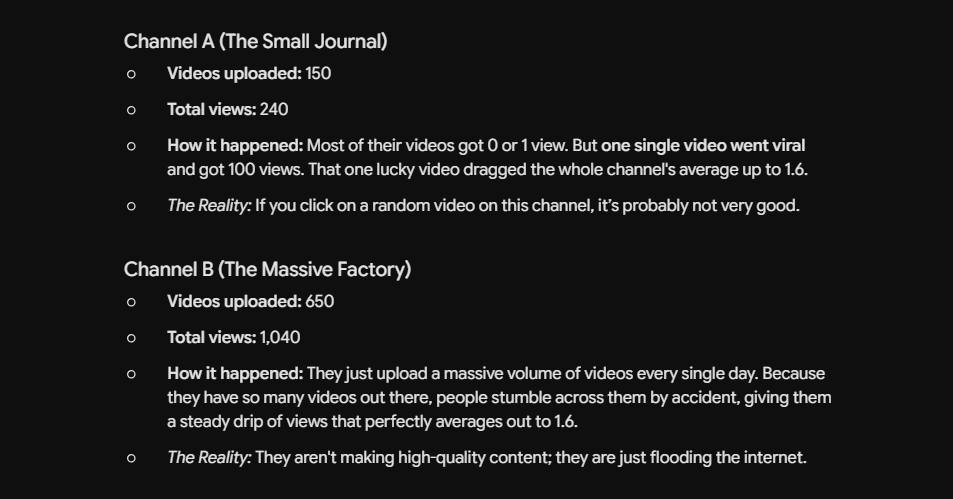
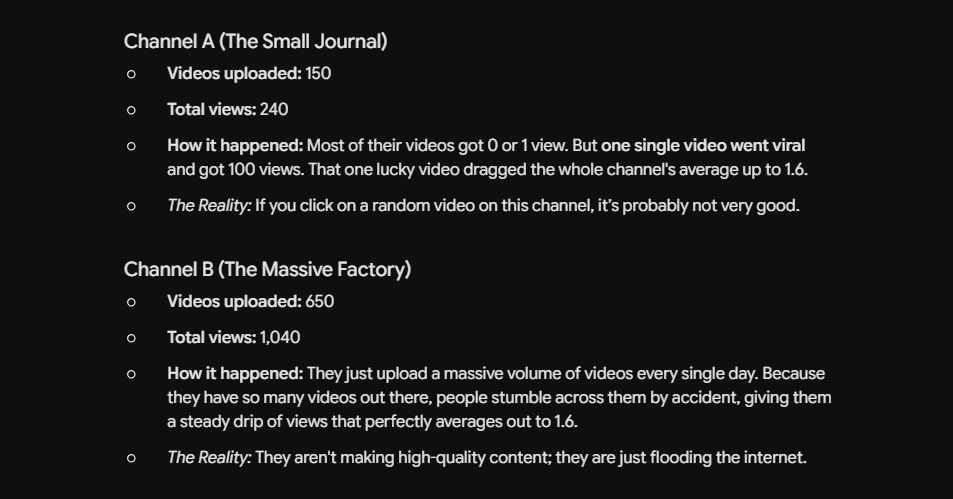
How can a small journal with mostly uncited papers artificially achieve a 1.6 Impact Factor?
A) By publishing a single "superstar" or viral paper that gets an extremely high number of citations.
B) By changing its name to sound more famous.
C) By increasing the total number of articles it publishes every year.
D) By paying other journals to mention their website.
Answer: A) By publishing a single "superstar" or viral paper that gets an extremely high number of citations.
Explanation: In a small dataset, a statistical outlier (like one paper with 100 citations) heavily distorts the average. This drags the entire journal's score up, even if the remaining papers have zero citations.
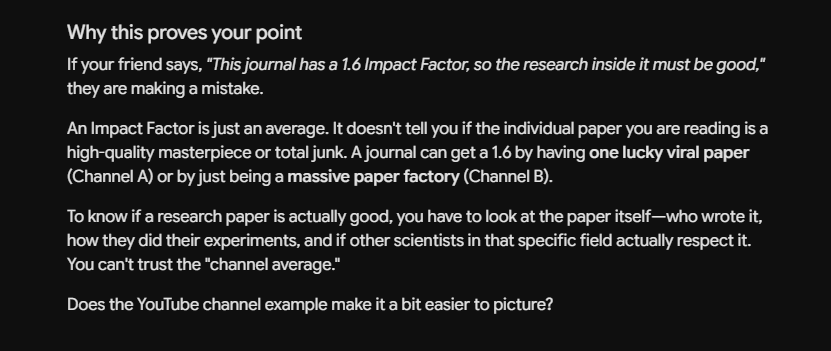
If two journals both have an Impact Factor of 1.6, what can you safely assume about the quality of their individual papers?
A) The papers in both journals are of identical scientific quality.
B) Both journals use the exact same peer-reviewers to check the science.
C) You cannot assume anything about individual paper quality based purely on the average.
D) The journal that publishes more papers is automatically better.
Answer: C) You cannot assume anything about individual paper quality based purely on the average.
Explanation: An Impact Factor is a journal-level metric, not an article-level metric. Because different journals have different sizes and citation distributions (one might be a massive paper factory while the other got lucky with an outlier), the average tells you nothing about a specific paper's rigor.
How can a massive "paper factory" journal maintain a 1.6 Impact Factor even if its articles aren't groundbreaking?
A) By forcing authors to pay higher fees to get published.
B) By relying on a huge volume of papers that frequently cite other papers within the same journal network.
C) By deleting papers that do not get viewed within the first week.
D) By only publishing papers written by famous celebrities.
Answer: B) By relying on a huge volume of papers that frequently cite other papers within the same journal network.
Explanation: Large open-access journals publish hundreds or thousands of papers a year. This creates a massive network where papers naturally cite each other, keeping the total citation count high purely due to the sheer volume of traffic, rather than the exceptional quality of any single paper.
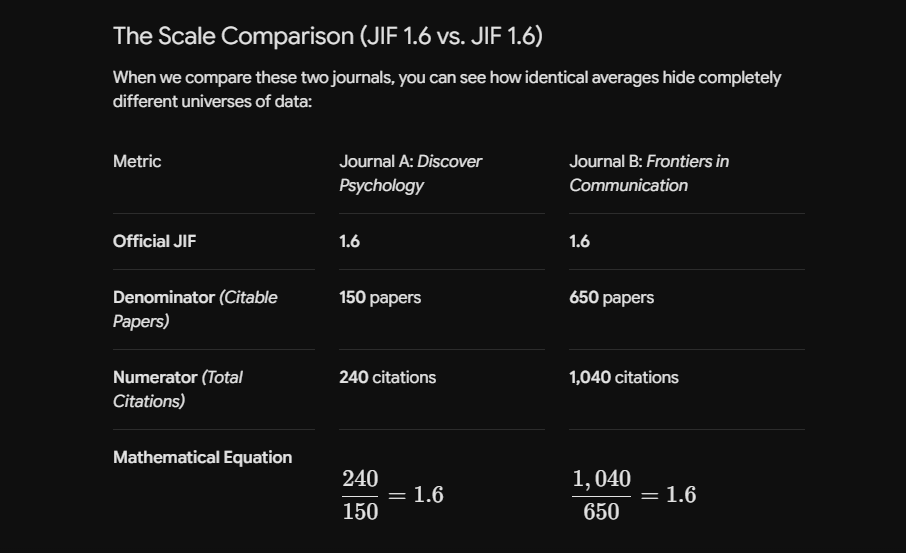
Discover Psychology and Frontiers in Communication (Year - 2024) both have an Impact Factor of 1.6, but Frontiers has four times as many papers and citations. What does this comparison prove?
A) Frontiers in Communication is four times better because it is bigger.
B) Identical Impact Factors can hide completely different scales of publishing volume.
C) Discover Psychology needs to publish more papers to stay relevant.
D) The Impact Factor is only accurate for small journals.
Answer: B) Identical Impact Factors can hide completely different scales of publishing volume.
Explanation: This comparison perfectly shows that the Impact Factor is just a ratio. A small journal with 150 papers and a massive journal with 650 papers can end up with the exact same math equation result (1.6), proving that the metric measures a crowd average rather than individual paper excellence.
Discover Psychology and Frontiers in Communication (Year - 2024) both have an Impact Factor of 1.6, but their raw numbers look like this:
Discover Psychology: 240 Citations / 150 Papers = 1.6
Frontiers in Communication: 1,040 Citations / 650 Papers = 1.6
What does this specific comparison prove to your friend?
A. Frontiers in Communication is a better journal because it has more total citations.
B. Identical Impact Factors can hide completely different scales of data and publishing volume.
C. Discover Psychology is higher quality because it is smaller and more exclusive.
D. The Impact Factor formula is broken and cannot be trusted for basic math
Answer: B. Identical Impact Factors can hide completely different scales of data and publishing volume.
Explanation: This comparison perfectly shows that the Impact Factor is just a ratio. A small-scale journal and a massive-scale journal can end up with the exact same final score of 1.6. It proves that the metric only measures a broad average, hiding whether a journal is a small pool or a massive volume factory.
Example #1
Example #1
Example #2
Example #2