Unit 5 (Political Participation)
 Call Kai
 Learn
Learn Practice Test
 Spaced Repetition
 Match
Match Flashcards
 Knowt Play
1/132

There's no tags or description
Looks like no tags are added yet.
Name | Mastery | Learn | Test | Matching | Spaced | Call with Kai |
|---|
No analytics yet
Send a link to your students to track their progress
133 Terms
Free rider problem
When individuals benefit from a public good without contributing to its cost.
ex: listening to NPR without donating
Spoiler role
A minor candidate who changes an election outcome by taking votes from a major candidate.
Stand by Your Ad provision
Rule requiring candidates to personally approve and appear in campaign ads.
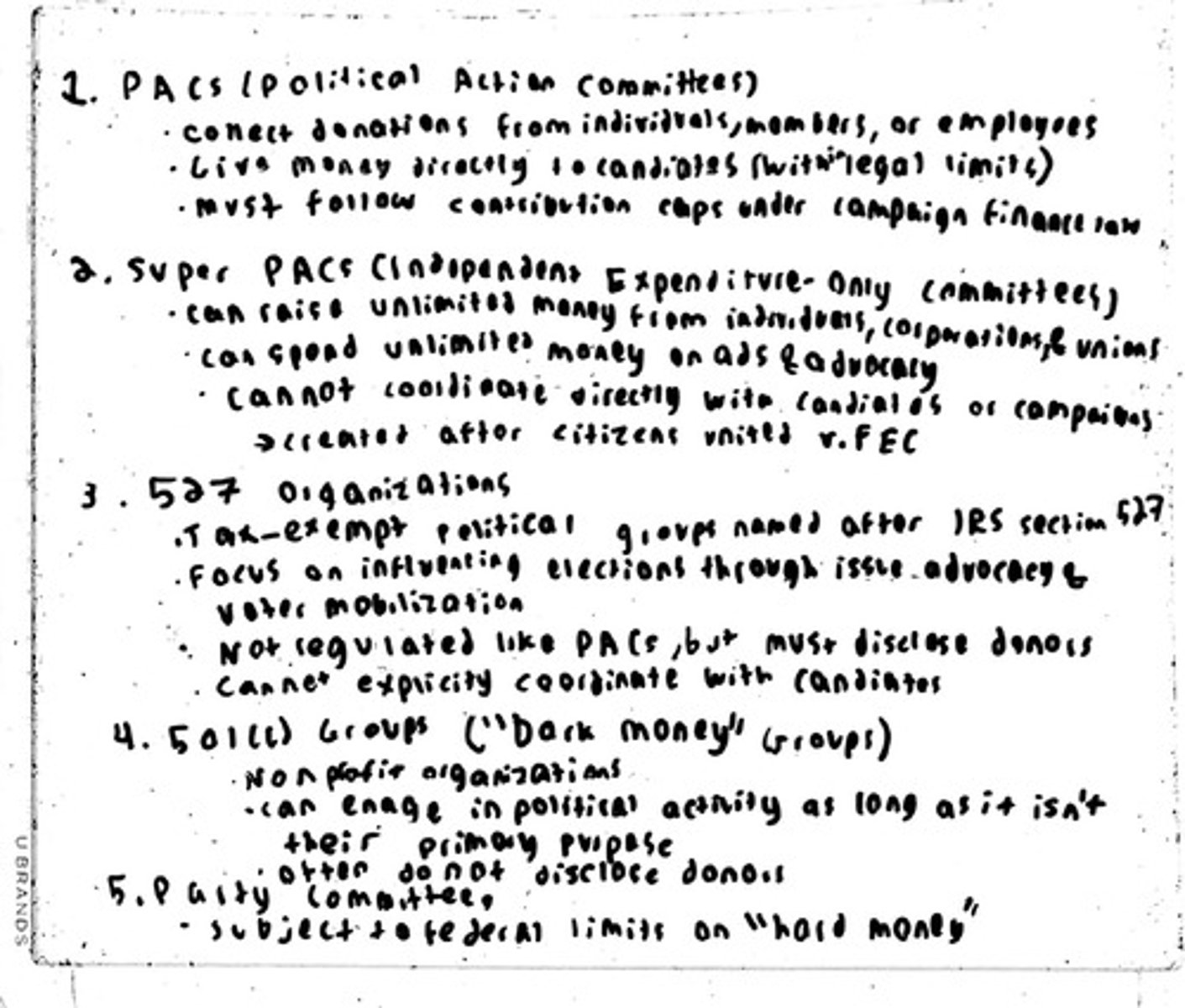
501(c)(3)s
Tax-exempt nonprofit organizations focused on education, charity, or religion; limited political activity.
ex: Make-a-Wish Foundation, Habitat for Humanity, ect.
501(c)(4)s
Social welfare nonprofits that can engage in some political activity.
ex: National Rifle Association (NRA)
527 groups
Political organizations that raise unlimited funds for issue advocacy but cannot coordinate directly with candidates.
ex: Democratic Governors Association (DGA) and Republican Governors Association (RGA)
Adversarial press
Media that actively investigates and challenges government officials and institutions.
Agenda setting
The media's ability to influence which issues the public thinks are important.
Amicus curiae briefs
"Friend of the court" documents submitted by non-parties to influence a court decision.
Attack ads
Campaign ads that criticize an opponent rather than promote a candidate.
Battleground states
States where elections are closely contested and heavily targeted by campaigns.
Beats
Specific topics or areas that journalists regularly cover.
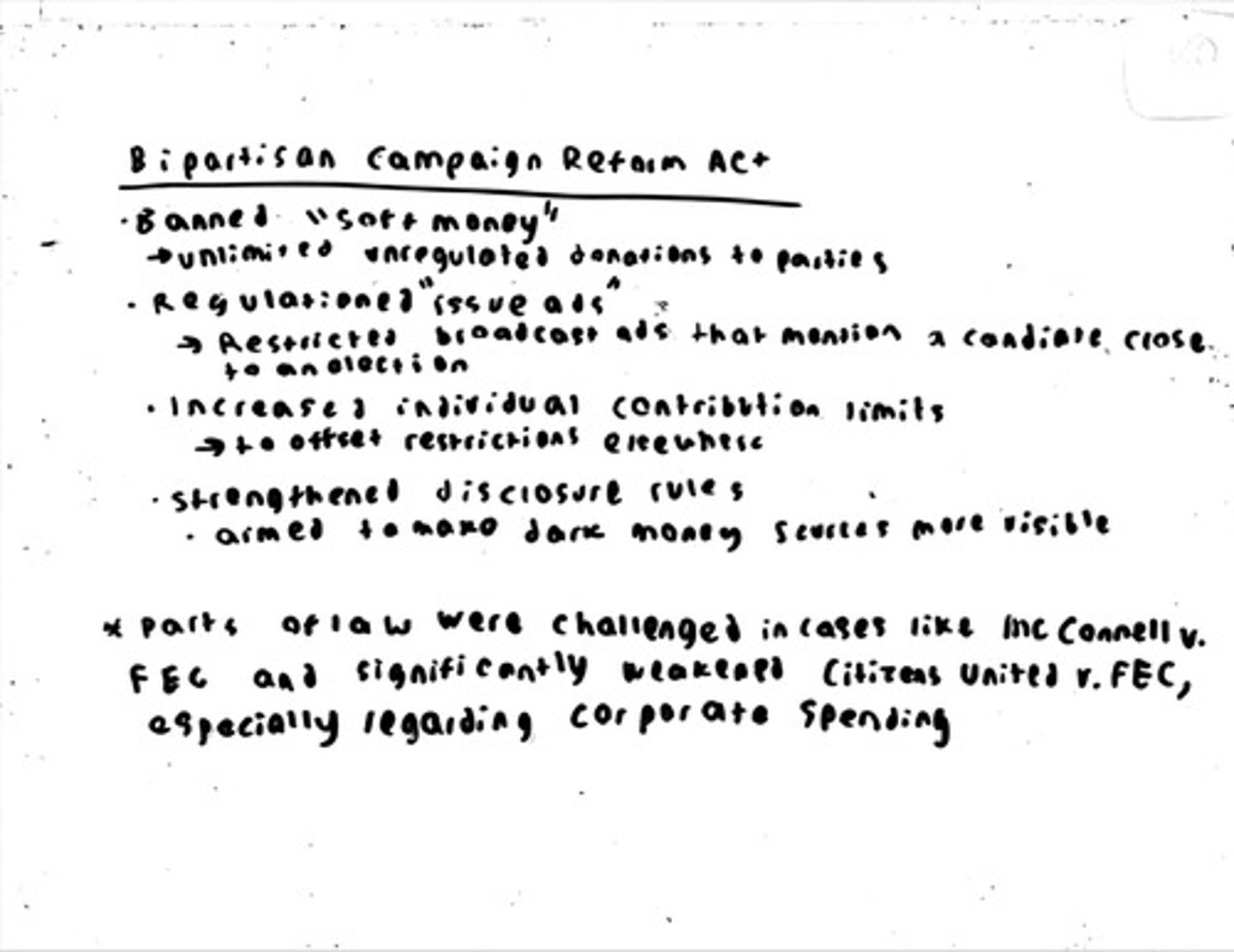
Bipartisan Campaign Reform Act (2002)
Law limiting soft money and regulating campaign advertising (McCain-Feingold).
Broadcasting
Distributing media content widely through TV or radio.
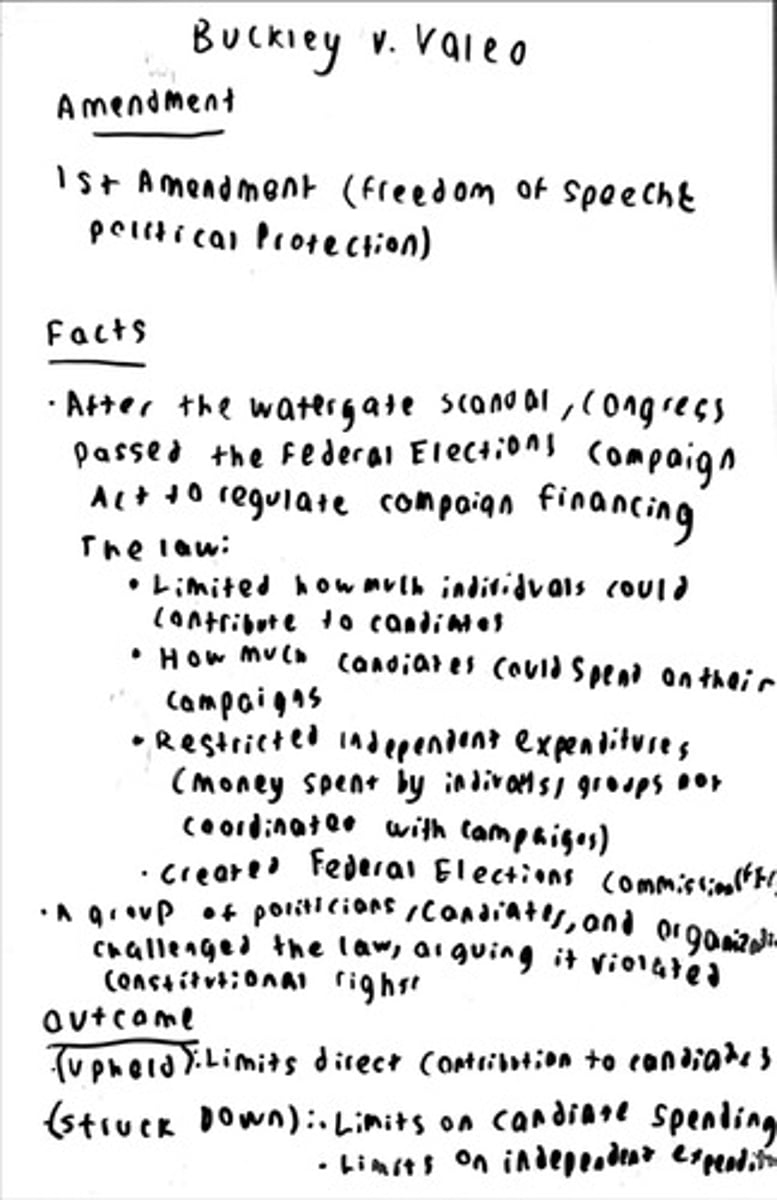
Buckley v. Valeo
Supreme Court case ruling that spending money on campaigns is a form of free speech.
Campaign management
Organizing and directing a political campaign.
Candidate recruitment
The process of encouraging people to run for political office.
Case law
Law established by court decisions rather than statutes (formal written laws).
Caucus
A meeting of party members to select candidates or decide policy.
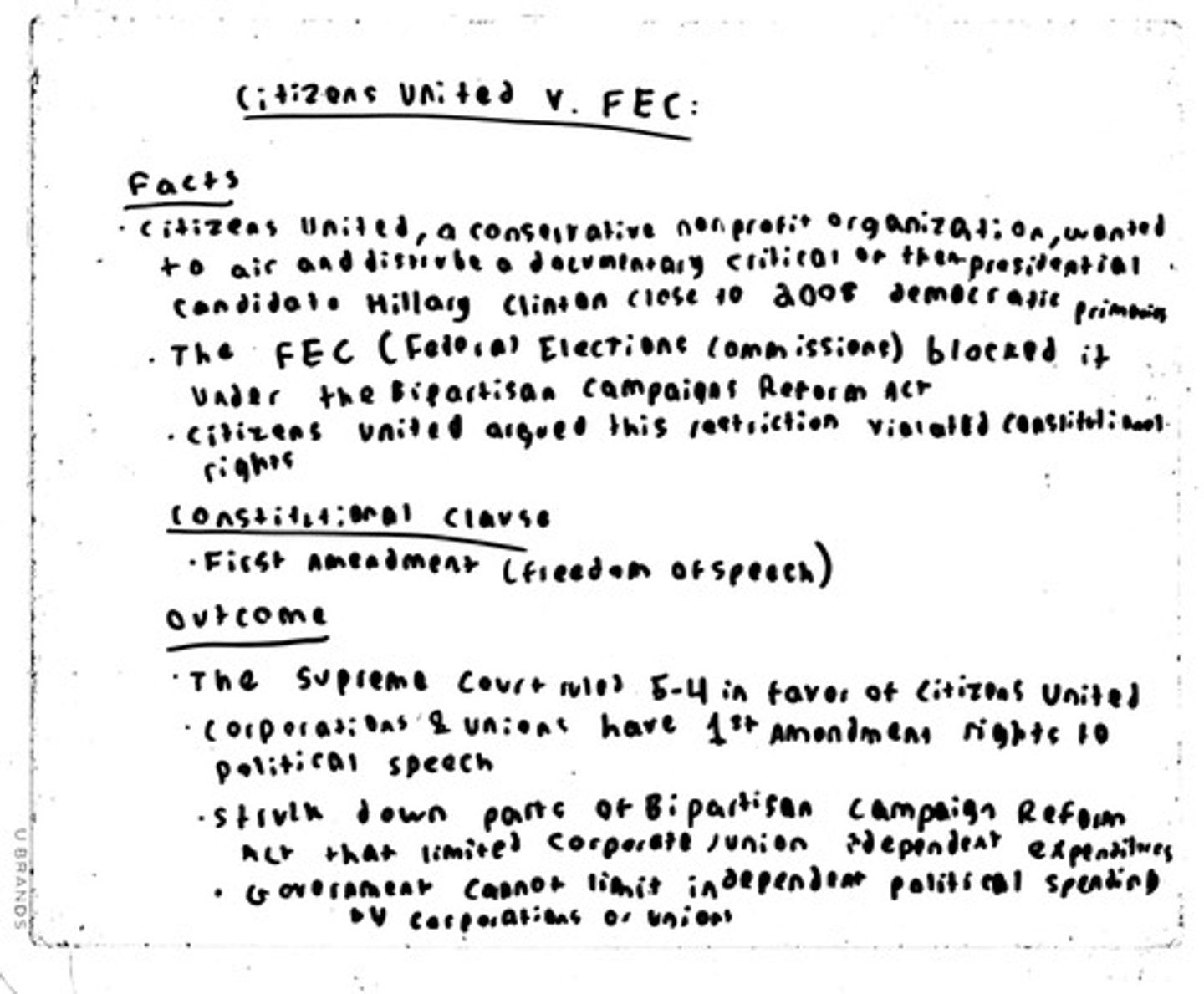
Citizens United v. FEC (2010)
Supreme Court case allowing unlimited independent political spending by corporations and unions.
Closed primary
Primary election where only registered party members can vote.
Coattail effect
When a strong candidate helps other candidates from the same party win.
Congressional primary
Election within a party to choose its nominee for Congress.
Consumer-driven media outlets
Media shaped by audience preferences and demand.
Contemporary political issues
Current topics being debated in politics.
Critical elections
Elections that cause major shifts in political party support.
Dark money
Political spending where the donor is not disclosed.
Dealignment
Weakening of voter loyalty to political parties.
Delegate
A representative chosen to vote at a party convention.
Divided government
When different parties control the presidency and Congress.
Drafting of legislation
Writing proposed laws.
Election cycle
The recurring process of elections and campaigning.
Electoral College
System used to elect the U.S. president through electors.
Electorate
All eligible voters in an election.
Electors
Individuals who formally vote for president in the Electoral College.
Faithless elector
An elector who votes against their pledged candidate.
Federal Election Campaign Act (1971)
Law regulating campaign finance and disclosure.
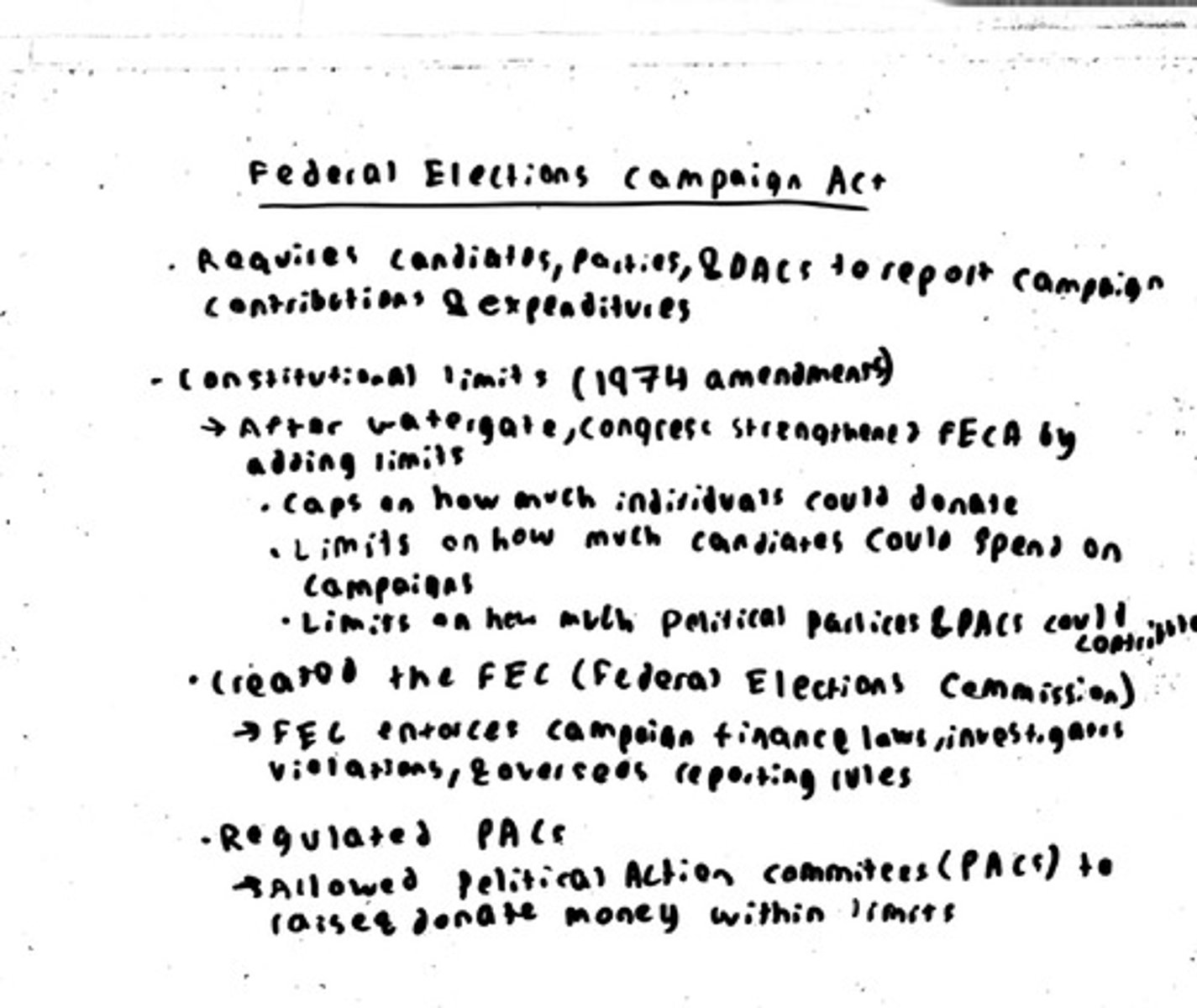
Federal Election Commission
Agency enforcing campaign finance laws.
Fifteenth Amendment
Guarantees voting rights regardless of race.
Framing
Presenting information in a way that influences perception.
Front-loading
States scheduling primaries early in the election season.
Gatekeeper
Media role in deciding which news gets coverage.
GOTV (Get Out The Vote)
Efforts to increase voter turnout.
Grandfather clause
Law allowing some people to bypass new restrictions based on past status.
Grassroots lobbying
Mobilizing the public to influence government.
Hard money
Regulated political donations given directly to candidates.
Hatch Act
Law restricting political activity by federal employees.
Horse race journalism
Media coverage focusing on who is winning rather than issues.
Hyper-pluralism
Excessive influence of many competing interest groups.
Ideologically oriented programming
Media content shaped by political ideology.
Incumbency advantage
Electoral advantage held by current officeholders.
Independent candidate
Candidate running without party affiliation.
Independent expenditures
Political spending not coordinated with a candidate.
Indirect lobbying
Efforts to influence policy by persuading the public.
Initiative
Process allowing citizens to propose laws directly.
Interest group
Organization that seeks to influence public policy.
Investigative journalism
In-depth reporting that uncovers hidden information.
Invisible primary
The period before official primaries when candidates raise money and gain support.
Iowa Caucuses
First major caucus in the presidential nomination process.
Issue ads
Ads that focus on political issues without explicitly supporting a candidate.
Issue advocacy advertising
Political messaging that promotes an issue while avoiding direct electioneering.
Linkage institution
Structures that connect citizens to government.
Literacy test
Discriminatory voting requirement used to restrict voting rights.
Lobbying
Efforts to influence government officials' decisions.
Lobbyist
A person who attempts to influence government decisions.
Majority
More than half of votes or support.
Mass media
Communication channels that reach large audiences.
Media bias
Tendency of media to favor certain viewpoints.
Media strategy
Planned use of media to shape public perception.
Media
Systems used to distribute information to the public.
Mid-term elections
Congressional elections held halfway through a presidential term.
Mobilization of membership
Efforts to activate group members to participate politically.
Muckraking
Journalism that exposes corruption or wrongdoing.
Narrowcasting
Media targeting specific audiences.
National Convention
Party meeting to nominate presidential candidates and set platforms.
National popular vote
Total votes cast nationwide in an election.
New Hampshire Primary
First official presidential primary in the U.S.
News source and information credibility
Reliability and trustworthiness of news outlets.
Nineteenth Amendment
Constitutional amendment granting women the right to vote.
Open primary
Primary where any registered voter can participate regardless of party.
Party chairperson
Leader responsible for party organization and strategy.
Party conventions
Meetings where parties nominate candidates and set platforms.
Party organization
Structure that manages party activities and elections.
Party platform
Formal set of party principles and policy goals.
Party-in-government
Elected officials representing a political party.
Party-in-the-electorate
Voters who identify with a political party.
Party-line voting
Voting according to party affiliation rather than issue positions.
Patronage
Appointing loyal party members to positions.
Plurality
Winning more votes than any other candidate, not necessarily a majority.
Political Action Committee (PAC)
Organization that raises and spends money to support candidates.
Political actors
Individuals or groups involved in politics.
Political parties
Organized groups seeking to win elections and control government.
Poll tax
Fee required to vote, used to restrict voting rights.
Precinct
Smallest voting district.
Presidential elections
Elections to choose the U.S. president.
Presidential primary
Elections where parties choose presidential nominees.
Print media
Newspapers and magazines.
Professional campaign consultants
Experts hired to manage campaigns.
Professional organizations
Groups representing people in a profession.
Proportional voting system
System where seats are allocated based on vote share.