Bio 213

0.0(0)
Studied by 0 people
call kaiCall Kai
learnLearn
examPractice Test
spaced repetitionSpaced Repetition
heart puzzleMatch
flashcardsFlashcards
GameKnowt Play
Card Sorting

1/54

flashcard set

Earn XP

Description and Tags

Sigh

Last updated 5:06 AM on 4/26/26
Name
Mastery
Learn
Test
Matching
Spaced
Call with Kai

No analytics yet

Send a link to your students to track their progress

55 Terms

1
New cards

Troposphere v stratosphere

Lowest level of atmosphere, densest. Thin layer that’s shorter at the equator. Versus, above troposphere, above clouds.
2
New cards
Latent heat
Hidden heat, the energy it takes to break molecule bonds.
3
New cards
What about Earth produces life
Liquid water, its distance from the sun, and the fact that most of its energy that comes from the sun escapes back out to space.
4
New cards
Most heat on Earth leaves through
Evaporation through the stratosphere
5
New cards
Global warming
Greenhouse gases (Carbon dioxide) keep heat from escaping into the atmosphere by being too big of molecules that can’t evaporate out. Homeostasis of the energy entering and escaping will be reached but the overall temperature will increase.
6
New cards
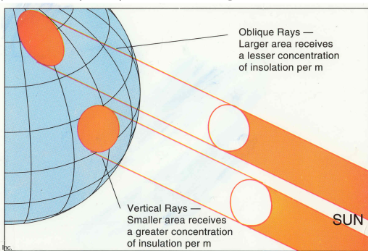
Why is the equator hotter than the North Pole?
The curvature of the Earth. The ray from the sun hits the equator more directly making the portion it hits flatter and have more surface area versus what hits the North Pole that is at an angle that makes the curvature more obvious and provides less surface area
7
New cards
Seasons explained
The angle (23.5° with respect to the equator) the Earth is at and how much surface area the sun rays have.
8
New cards
Properties of air and the relationships within them
Temperature, density, pressure, movement, and vapor. High temp = low density = high pressure = molecules close together = dry. Low temp = high density = low pressure = molecules far apart= rain. (Hot air absorbs more moisture, as moisture cools it is released as rain)
9
New cards
Climate bands
Temperate (Not so dramatic seasons); Polar regions (Big difference between seasons); Tropics (Low temperature range but dif between dry and wet)
10
New cards
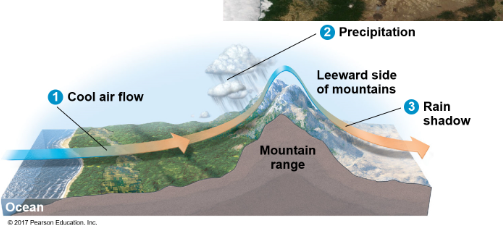
Mountain affect
Atmosphere/pressure rises with mountains inward of land (rainy) then past mountains it gets drier. The air rises, gets cold, rains (windward side), by the time it gets to the other side of the mountains the air’s dry (Leeward side). Creating a rain shadow effect.
11
New cards
Climate
Long term type of weather condition
12
New cards
Four important physical components of climate
Temperature, precipitation, sunlight, and wind
13
New cards
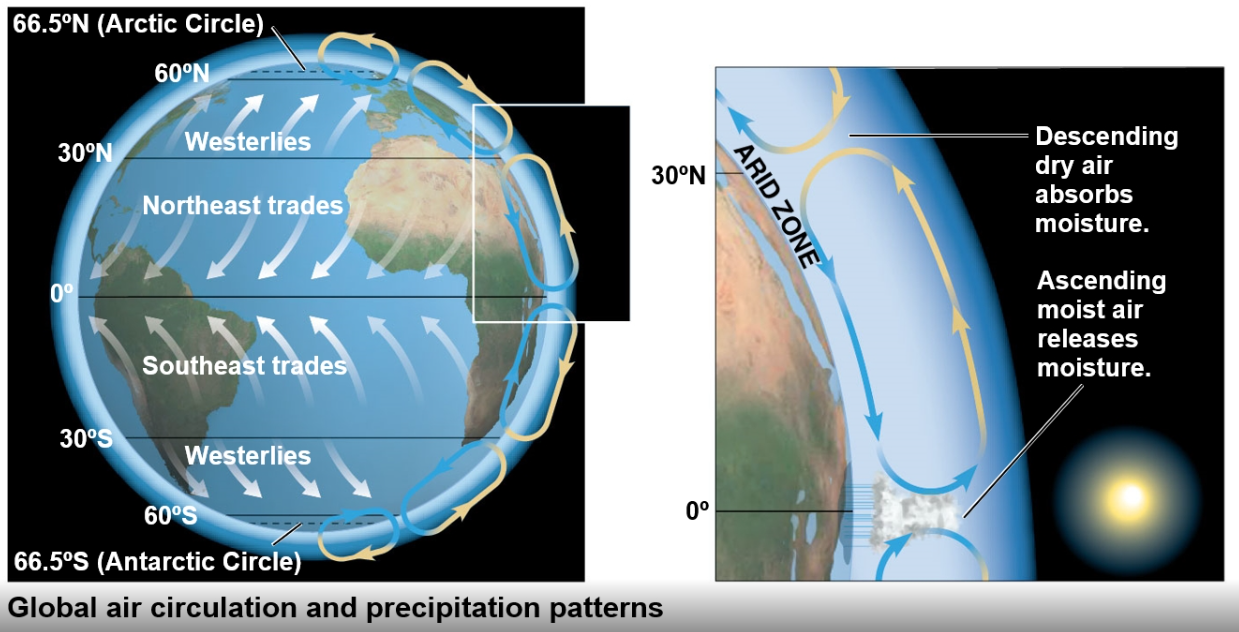
Air circulation and precipitation pattern diagram

<p></p>
14
New cards
Macroclimate v microclimate
The terrain changing how the climate interacts with the environment versus that same concept but from hills, bushes, and such.
15
New cards
Ecotone
The boundary between biomes (major life zones), horizontal gradient.
16
New cards
Canopy
Upper level of forest with the trees hogging the light.
17
New cards

What are aquatic zones based on? Photic v aphotic v abyssal v pelagic v benthic.

Based on temperature and depth. Photic zones have light for photosynthesis. Aphotic zones don’t have enough light for photosynthesis, including the abyssal zone which is deeper down. Pelagic zones are both of them together. Benthic zone is the bottom of the aquatic biome.

18
New cards
Thermocline and turnover
Prevents the mixing of different layers in water. Causes there to be significant changes at different depth levels (not gradual). Does get mixed up and down to spread nutrients when temperatures change (spring and fall), this is called turnover.
19
New cards
Abiotic vs. biotic
Vary with time, space, and temperature (not living) versus based on the interaction of living things. Together are ecological factors that impact what lives where.
20
New cards
Population ecology
How biotic and abiotic factors influence the abundance, dispersion, and age structure of a population.
21
New cards
How to estimate the amount present in population
Counting how many exist per amount of space. For a homogenous habitat: count the amount in a small random portion then multiply by the amount that exists of that portion aka then extrapolate. Count based on an indicator left by organisms. Mark recapture: catch some random amount, mark ‘em, release until they redisperse, catch another random sample, and count how many were recaught. N=(sn)/x, N=population, s=amount in first random catch, n=amount in second random catch, x=amount recaught.
22
New cards
How population densities can be organized/dif dispersion patterns
Clumped: in clusters, from fighting over a resource in a certain area. Uniform: homogenous, from being territorial. Random: from lack of motive to do anything else.
23
New cards
What biotic factors affect density?
rate of: Birth+immigration-death-emmigration=population
24
New cards
Dispersion v dispersal
How a population within an area is spaced out versus moving away from their usual environment.
25
New cards

Demography, cohort, and life table

From the individuals in a population a set of a generation are picked out (usually the females since they are needed to reproduce) and a summary of their age, survival, and reproduction is recorded up until they all die.

26
New cards

Survivorship curves

Type I: Only start to die when getting old, mainly bc of parental care and not being picked off when middle aged. Type II: Consistently dying at all ages. Type III: Most likely to die young, mainly from no parental care and a large number of offspring. Can be mixed and matched. A stair slope if die at short frequent intervals.
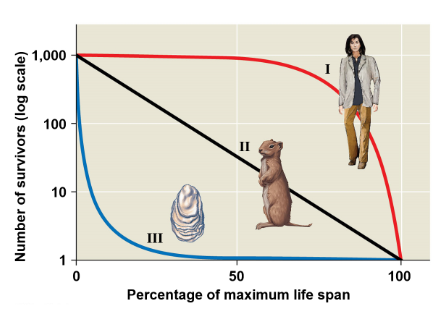
<p>Type I: Only start to die when getting old, mainly bc of parental care and not being picked off when middle aged. Type II: Consistently dying at all ages. Type III: Most likely to die young, mainly from no parental care and a large number of offspring. Can be mixed and matched. A stair slope if die at short frequent intervals.</p>
27
New cards
Change in population size equation
Births+Immigrants−Deaths-Emigrants leaving population
28
New cards
Equation for measuring changes in population size over time
∆N/∆t = R:Delta N is the change in population size, delta t is the time, and R is the difference of those lost and gained
29
New cards
Equation for rate of growth in an instant of time
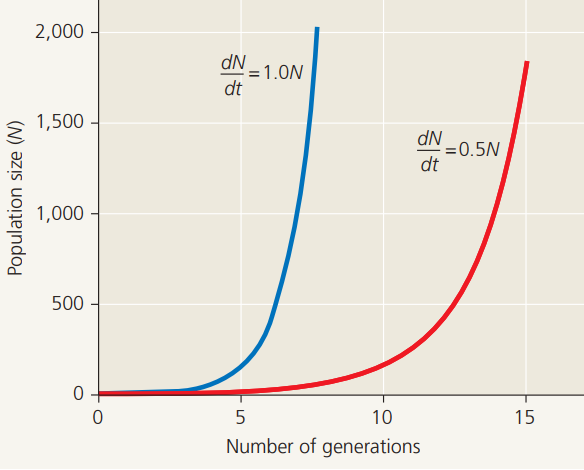
dN/dt = rN: dN/dt is the pop change over time, r is the intrinsic rate of increase, and N is the population size. A more vertical growth means growing faster.
30
New cards
Logistic population growth model
dN/dt = rN (K
31
New cards
Main components of life history
Maturity (when repro can happen), frequency of reproduction, and number of offspring per repro cycle.
32
New cards
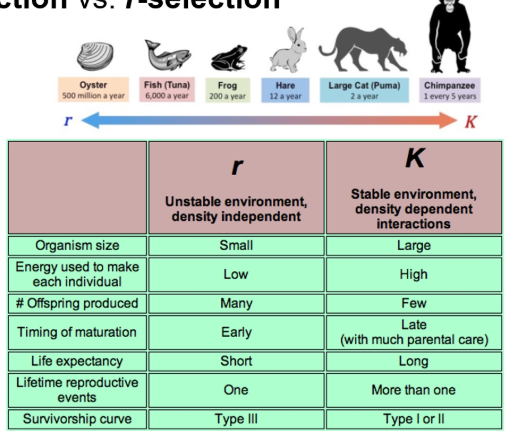
K v. r selection
Choosing survival or reproduction. Choosing K (iteroparous) means less offspring but they are more well adapted to handle competition. Choosing r (semelparous) means having more offspring since there are enough resources to go around.
33
New cards
Density-independent factors v. Density-dependent factors
Birth and death rate don’t change based on population density versus do change (from competition, intrinsic factors/behavior, disease, and/or toxic waste)
34
New cards
Population dynamics
Interaction between biotic and abiotic factors making changes in population density.
35
New cards

Meta population

Populations that are linked together from immigration and emigration.

36
New cards
Ecological footprint
The resources needed to support an individual
37
New cards
Demographic transition
Changes in birth and death rates
38
New cards
Community
Mix of different species inhabiting the same area
39
New cards
Connect competition with resource petitioning, ecological niche, fundamental and realized niche, and sympatric speciation
Competition has negative effects for all species involved. Resource petitioning comes from species/organisms subdividing resources to avoid competition, this may result in developing an ecological niche which is the sum of how they use abiotic and biotic resources. An ecological niche may be fundamental or realized depending on if the species takes the other resource when there isn’t competition or not. Sympatric speciation is the result of resource partitioning leading to character displacement.
40
New cards
Connect exploitation with predation and everything that results from it, herbivory, and parasitism
Exploitation is one organism benefitting from the negative effect it imposes on another organism. Predation, eating another heterotroph, has led to mechanical (spikes and armor) and chemical (poison and colors) adaptations and mimicry (Aposematic, MĂŒllerian, Bateson, cryptic, & behavioral). Exploitation includes those that eat autotrophs. Parasites (endo or exo) derive nourishment from a host and may not aim to kill.
41
New cards
Aposematic, MĂŒllerian, Bateson, cryptic, behavioral mimicry
Colors that truthfully state they are not worth eating; sharing the same colors of another even if not related just as dangerous to simplify the rules of what not to eat; colors that dishonestly state that they are dangerous; camouflage; and acting like different animals for best response.
42
New cards
Obligate mutualism v facultative mutualism and mutualism v commensalism
Dependent on each other to live versus the benefits happen to out way the cost but both can survive independently. Both benefit while the other is where one benefits and the other isn’t bothered
43
New cards
Symbiosis
Organisms that live closely together for a long time whether for best or for worst.
44
New cards
Species diversity = species richness v relative abundance
How many species are present versus how many of each type are present.
45
New cards
Shannon diversity index
H = –(pA ln pA + pB ln pB + pC ln pC + . . .); where H is the diversity index (represents how diverse); ABC
 are the species; and P is the relative abundance of each. More diverse are more productive (more photosynthesis), recover better, resist invasive species better, and are more stable.
46
New cards

Trophic structure and food webs

Nutrients/N -> primary producers/V (plants) -> primary consumers/H (herbivores) -> secondary consumers/P (eats primary consumers) ->->-> decomposters. Food webs are simplified by grouping those with similar trophic relation and focusing on just a portion of it. Usually less than 7 links (->).

47
New cards
Energetic hypothesis
Food links are limited by thermodynamics since 10% of energy gets to the next consumer. Predators need to eat hella to be big so they can only get so big with limits of lower trophic levels. Reason for 7 links limit.
48
New cards
Dominant species v keystone species v ecosystem engineers
Being the most measured in biomass versus having a big impact on their environment compared to their biomass due to their ecological role/niche versus organisms that physically alter their environment (beavers).
49
New cards
Biomanipulation: bottom-up v top-down/trophic cascade model of community organization
Changing those on lower versus upper parts of the food chain to see difference of abundance of animals on other levels
50
New cards
Clements v Tansley v Gleason
Ecologists: thought climate controlled environment and that abiotic and biotic changes would always reset; argued that variations in abiotic conditions could result in different possibilities of stable communities; claimed that communities formed by chance of organisms with similar abiotic requirements meeting in the same place
51
New cards
Intermediate disturbance hypothesis
Moderate levels of disturbance with either high frequency and low intensity or the opposite being the best because it leaves room for other organisms to find their preferred environment at least some of the time.
52
New cards
Ecological succession: Primary v secondary succession
A sequence of changes in community composition following a disturbance. Starts with no soil and builds from that with lichen living on the rocks, giving moisture, photosynthesis, and breaking down the rock; annual plants can grow; then plants get bigger and there’s more dirt present from smaller plants fixing nitrogen. Versus organisms moving back onto a land after the animals that were living there were exterminated by a disturbance.
53
New cards
How latitude, area, and distance from the main land affect species diversity
Tropics (angle 0) are more diverse than the poles since the tropics have more plants than the poles from the sun and precipitation. More space allows for more diversity. Closer to the mainland means more immigration.
54
New cards
Evapotranspiration
The water that evaporates from the soil and stomata of plants, used to measure how long water lasts (higher means more sun, precipitation, and diversity).
55
New cards
Zoonotic pathogens and a vector
Going from a sick animal to a not sick animal to making a human sick